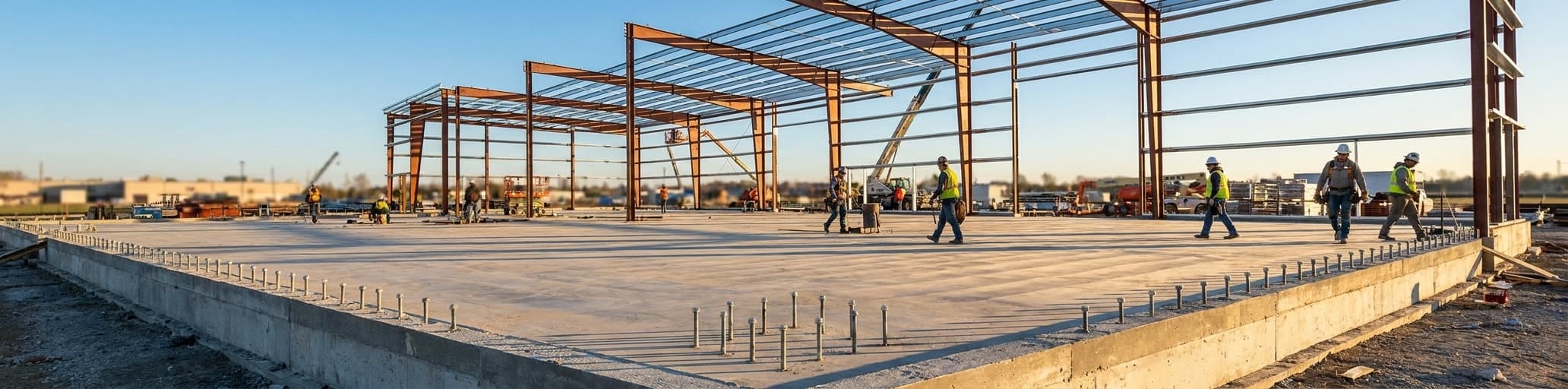

We help you understand 60×120 metal building costs, which range from $130,000 to $275,000 depending on specifications and location. Knowing how steel pricing, regional factors, and foundation requirements affect your budget ensures you get an accurate quote and avoid costly surprises.
60×120 Metal Building Cost: 2026 Pricing & Budget Breakdown
A 60×120 metal building costs $130,000-$275,000 installed in 2026, with per-square-foot pricing dropping to $16 when you leverage economy of scale.
Average cost range for a 60×120 steel building in 2026
A 60×120 metal building covers 7,200 square feet — enough floor space to serve as a warehouse, equipment shed, repair facility, or a combination of all three under one roof.[1] In 2026, the 60×120 metal building cost for a steel package lands between $130,000 and $275,000, depending on whether you are buying a basic shell or a fully engineered structure with upgraded framing, insulation, and multiple access points.[1] On a per-square-foot basis, base frame packages run $15-$20, enclosed buildings with standard doors and insulation reach $22-$30, and turnkey finished interiors — including HVAC, office space, and complete electrical — push $35-$50 or more per square foot.[2] The wide price band reflects real differences in scope.
Two buildings with identical footprints can carry vastly different price tags once local wind-load requirements, eave height, door configurations, and engineering complexity enter the picture.[1] "Starting prices" advertised online typically represent only the base frame package, not the full delivered-and-installed figure your budget actually needs to account for.[1]
Cost per square foot: how 60×120 buildings compare to smaller footprints
Larger steel buildings consistently cost less per square foot than smaller ones because fixed engineering, freight, and erection expenses get spread across more floor area.[3] A small garage might run $25 per square foot installed, while a 5,000-square-foot warehouse shell drops to around $16 per square foot — and a 7,200-square-foot 60×120 structure pushes that per-square-foot figure lower still, especially when you stay with a clean rectangular layout and a standard roof pitch.[3] The table below shows how that economy of scale plays out across common building sizes in 2026:
| Building size | Approx. sq ft | Estimated installed cost per sq ft (shell) |
|---|---|---|
| 30×40 | 1,200 | ~$25 |
| 40×60 | 2,400 | ~$20 |
| 60×100 | 6,000 | ~$17 |
| 60×120 | 7,200 | ~$16 |
Those per-square-foot figures reflect shell packages only — basic kit pricing runs $15-$25 per square foot, turnkey installed projects land at $24-$43 per square foot, and fully finished interiors with HVAC and electrical can exceed $50-$100 per square foot regardless of building size.[3] One variable that erases the economy-of-scale advantage quickly is non-standard geometry: odd dimensions like a 58×115 footprint often trigger custom engineering fees that push per-square-foot costs back up toward smaller-building territory, which is why sticking to standard sizes such as 60×120 protects your budget from the start.[3]
What's included in the base price vs. optional add-ons
A base-price steel building package covers the primary structural frame, secondary framing members, steel roof and wall sheeting, fasteners, and sealants — essentially everything needed to stand the structure up.[5] The foundation is not included; that cost lands squarely on the owner, whether the choice is a concrete slab, asphalt, or compacted gravel.[4] Most kit pricing also excludes delivery and erection labor unless the supplier explicitly bundles those services, so confirm that detail before comparing quotes.[4] Once the base structure is priced out, the optional add-ons are where the final invoice can climb significantly:
- Walk-in doors, roll-up doors, bi-fold doors, and sectional vehicle doors
- Windows for natural light and ventilation
- Insulation (blanket, rigid, or insulated metal panels)
- Wall liner panels to improve interior durability and appearance
- HVAC systems and ventilation equipment
- Electrical rough-in and fixtures
- Gutters, downspouts, and interior partitions[4][5][6]
Each of these line items carries its own engineering implication. Adding electrical fixtures, for example, raises the collateral load on the structure, which can require frame upgrades that ripple back into base costs.[5] Insulation matters beyond comfort — it prevents condensation-driven corrosion at critical connection points, meaning skipping it to cut upfront cost often produces higher long-term repair bills.[5] The exterior and interior finishings you select, from HVAC systems to windows and specialty doors, are among the most significant variables affecting total project cost.[6]
Key Factors That Drive 60×120 Metal Building Pricing
National buying power through contracted volume pricing anchors your 60×120 quote to stable agreements rather than volatile weekly steel spot rates.
Steel market prices and how National Steel Buildings locks in savings through national buying power
Steel prices heading into 2026 are volatile by any measure. Engineering News-Record's Building Cost Index shows structural steel prices climbed 11.9% through 2025, while nonresidential construction input prices surged at a 12.6% annualized rate during the first two months of 2026 — the fastest pace since the supply chain disruptions of early 2022.[7] Tariffs are the primary driver. As of April 2026, steel, aluminum, and copper items carry a 50% tariff, with derivative metal products sitting at 25%.[7] Zoom out further and the picture is starker: construction-grade steel's average per-ton cost jumped more than 20% through 2025, with four major rebar manufacturers raising prices by $60 per ton in June 2025 alone.[8] For a buyer working with a single-project supplier, those swings land directly in the final quote.
Buying power is what separates a stable quote from an unpredictable one. NAHB research confirms that buying power scales directly with firm size — larger construction buyers negotiate from a stronger position when prices rise, and see price relief faster when markets ease, because the relative difference in market power between buyer and seller determines how quickly pricing moves in either direction.[9] A supplier contracting steel across hundreds of projects simultaneously holds leverage that no single-project buyer can match. National Steel Buildings sources materials through contracted national pricing, which anchors your 60×120 quote to volume agreements rather than weekly spot rates. As one analysis of Pittsburgh-area projects illustrates, national buying power cuts lead times and reduces material costs compared to sourcing through local mills. Early procurement paired with contracted volume pricing has become standard practice for well-run projects in 2026's market,[7] and it is the mechanism that keeps your project within budget when input costs continue escalating across the broader construction sector.[8]
Location, local codes, and regional labor availability
Where you build a 60×120 structure can shift your final budget by as much as 60% compared to a project with an identical footprint in a different state.[3] Labor rates are the most visible driver: a project in rural Tennessee typically costs far less to erect than the same steel package installed in coastal Florida or a major metro market, where skilled crew demand is high and general contractors routinely add 10-20% to total project cost.[3] Permit fees follow the same geographic spread — averaging $550-$2,000 in most jurisdictions but reaching $7,500 or more in larger cities where plan review queues are long and fees are tied to construction valuation.[3] The engineering side of the equation is where location costs become less visible but far more consequential.
Coastal regions subject to ASCE 7-22 hurricane-wind provisions require heavier bracing, reinforced anchor systems, and code-compliant opening protection that can add a 15-25% structural premium compared to inland projects engineered for lower wind speeds.[3] Snow load is equally location-specific: a project in northern Arkansas engineered for a 50-psf ground snow load requires heavier purlins, tighter bridging, and additional frame deflection controls that simply don't exist in a 20-psf zone a few counties south.[10] Seismic criteria add another layer in areas like eastern Arkansas, which sits within the New Madrid Seismic Zone, where diaphragm and bracing requirements can change from a project in Oklahoma, which carries its own elevated seismic considerations.[10] Louisiana projects surface a different cost variable altogether: soft, saturated soils and high water tables can convert a standard slab-on-grade into a pile or pier foundation before a single steel column is set, and that foundation swing can dominate the entire site budget.[10] Urban jobsite logistics add cost through a different mechanism — tighter laydown areas, restricted delivery windows, and crane setup constraints increase lift complexity and mobilization time regardless of the building's structural specs.[10] Because each of these variables shows up as "invisible" steel weight, added engineering hours, or higher-than-expected field labor, a zip-code-level engineering review is not optional for a 60×120 project — it is the only reliable way to surface the actual cost before a quote is signed.[10]
Customizations that impact final cost: roof pitch, insulation, doors, windows, and interior partitions
Once the base frame is priced, every customization you add moves the final number — some modestly, others dramatically. Roof pitch is a quiet budget driver: steeper pitches require more steel and longer purlins, which adds material cost, but they also improve drainage in high-rainfall regions and open up usable attic-level space for storage or mechanical runs. Insulation choice follows a similar pattern — blanket insulation is the lowest upfront option, rigid board sits in the middle, and insulated metal panels (IMPs) carry a higher material cost but eliminate the vapor barrier and liner panel as separate line items, often producing a lower installed total than their component-by-component alternatives.
Doors are where the quotes diverge most visibly: a single 14-foot wide by 14-foot tall hydraulic bi-fold door for an aircraft hangar or equipment bay can cost more than all the framed openings in a standard warehouse combined, while a row of walk-in personnel doors adds relatively little. Windows add both material cost and structural cost — every framed opening interrupts a wall panel, requires a header, and changes the wind-load path through that bay, which can trigger a frame-line upgrade. Interior partitions carry their own engineering implication: a clear-span 60×120 building is specifically designed to eliminate interior columns, giving you unobstructed floor space that flex-space operators — e-commerce sellers, light manufacturers, fitness businesses, auto-service operations — rely on to reconfigure layouts or accommodate multiple tenants as business needs shift.[11] Adding fixed interior partition walls after the fact requires either post-frame blocking or a separate structural track system, both of which cost more than planning those walls into the original design.
Pricing all customizations during the design phase, rather than as change orders, is the single most reliable way to hold your project within budget.
Concrete Slab Requirements & Costs for a 60×120 Footprint
A 60×120 concrete slab costs $43,200 to $86,400 installed, with proper 4-inch thickness and reinforced footings supporting your building's full operational demands.
Square footage and slab thickness needed for commercial and industrial use
A 60×120 footprint delivers 7,200 square feet of usable floor space — enough to support a full-scale warehouse operation, a multi-bay vehicle service facility, a flex-space commercial suite with office and showroom combined, or an agricultural equipment building housing multiple large machines simultaneously.[11] That floor area works precisely because the clear-span design eliminates interior columns, letting you configure or reconfigure the space as operational needs shift.[11] The slab underneath needs to match the load demands of a structure this size.
For steel buildings 32 feet wide and up, the minimum slab thickness is 4 inches, and the slab perimeter should extend one inch beyond the building footprint on all sides — so a 60×120 structure calls for a slab poured at 60'2" x 120'2".[12] That additional perimeter concrete reinforces the anchor bolt zone, where the steel columns transfer load into the foundation, and gives erectors a small tolerance margin if slab measurements land slightly off-center.[12] Footings for a building this size require a minimum 24-inch-wide by 24-inch-deep section — significantly deeper than the 12×12 footings adequate for smaller structures — because the engineered webbed trussing and overall steel weight demand greater bearing area to prevent settlement or cracking over time.[12] Where the building includes roll-up or overhead doors, the slab should incorporate a slope away from each opening: a minimum 3/4-inch drop extending at least 4 inches beyond the building exterior redirects water before it can migrate under the door threshold and into the structure.[12]
Slab cost estimation: site prep, concrete, and finishing
For a 60×120 footprint, concrete installation runs $6 to $12 per square foot installed — which puts the raw slab budget for 7,200 square feet between $43,200 and $86,400 before site prep or finishing work enters the picture.[13] That range moves based on three distinct cost layers that stack on top of each other. Site preparation comes first: grading and leveling the pad area costs $0.40 to $2.00 per square foot, and a gravel base — required on most commercial pads to prevent shifting and cracking — adds another $1 to $3 per square foot on top of grading.[14] Labor for the pour itself runs $3 to $5 per square foot and covers form creation, placement, finishing, and edging.[14] For a 60×120 project, those labor hours are substantial — a slab this size requires a coordinated crew, pump trucks, and precise timing to avoid cold joints from concrete setting unevenly across a long pour.
Rebar reinforcement, which costs $1.40 to $1.85 per linear foot and is mandatory for slabs supporting this level of structural load, adds another line item that budget-only comparisons routinely omit.[13] Regional pricing creates meaningful variation on top of those base figures: central states average closer to $5.35 per square foot for the concrete work alone, while coastal markets like California and New York push that number to $8.50 per square foot or higher.[13] Finishing choices are the final cost variable. A standard broom finish — functional, slip-resistant, adequate for most warehouse or equipment storage applications — sits at the low end.
Sealed concrete adds $1 to $3 per square foot, which is worth budgeting for any building used for vehicle storage, liquid handling, or food-adjacent operations where surface durability matters long-term.[14] Decorative finishes like stamping or staining run $3 to $15 per square foot and are common in retail or office-adjacent spaces where the floor is a visible part of the customer experience.[14] The practical takeaway: a 60×120 slab budget should account for site prep, gravel base, pour labor, rebar, and finishing as separate line items rather than folding everything into a single per-square-foot estimate — the spread between a stripped-down pad and a fully finished commercial floor can exceed $30 per square foot on a project this size.[13][14]
Why foundation quality matters for long-term building performance
The foundation beneath a 60×120 steel building does more than hold the structure up — it actively resists forces trying to pull it apart. Unlike conventional buildings, metal structures are lightweight, which means their foundations must be engineered primarily to resist wind uplift rather than simply distribute downward load.[15] During a high-wind event, a large steel building acts as a sail, generating significant uplift forces at the anchor points — and if the foundation cannot counteract those forces, column bases shift, frame alignment drifts, and the structure's engineering assumptions no longer hold.[15] Anchor bolt positioning is where that vulnerability shows up first: bolts must be placed within 1/16-inch of their approved locations and set perpendicular to the foundation at exactly 90 degrees, with a minimum of four bolts per structural column in curved J-bolt or L-bolt configurations to prevent movement during concrete curing.[15] A tolerance error that seems minor at pour time becomes a structural misalignment problem once steel tonnage loads the frame.
Soil behavior adds a second long-term threat that quality foundation design accounts for upfront. Expansive clay soils — common across Texas's Blackland Prairie, coastal regions, and humid interior markets — can expand by 12% or more when saturated, generating lateral pressure against footings and vertical heave beneath slabs.[15] A properly engineered foundation distributes the building's weight and counteracts those soil forces before they translate into cracking, settling, or column displacement.[16] Vapor barrier installation beneath the slab matters alongside soil control: without a moisture barrier, capillary action draws ground moisture upward through the concrete, accelerating corrosion at anchor bolt connections and reducing the structural integrity of the zone where column base plates transfer load into the foundation.[16] Buildings with well-documented, properly engineered foundations see an average market value appreciation of 15-20% compared to structures built on basic pads, because professional appraisers specifically evaluate foundation quality when determining commercial property value — and buyers or lessees price the difference accordingly.[16]
60×120 Metal Building Specifications & Use Cases
A clear-span 60×120 frame eliminates interior columns, letting you reconfigure workstations, storage, or production space freely as your business needs evolve.
Typical applications: warehouses, aircraft hangars, agricultural storage, and retail spaces
Clear span vs. multi-bay configurations and how they affect layout flexibility A clear-span 60×120 frame eliminates interior columns across the full 7,200-square-foot footprint, which means you can configure workstations, storage lofts, office areas, or an open production floor without working around structural obstructions.[19] That unobstructed envelope is what makes the 60×120 footprint the standard minimum for equestrian riding arenas — the clear-span width provides adequate room for equestrian activities that a column-interrupted bay configuration cannot replicate — and the same column-free floor applies equally to vehicle service lines, manufacturing cells, and multi-tenant flex space where partition walls may need to move as business requirements change.[20] Multi-bay configurations add interior column lines to handle wider spans or overhead crane loads, but at a 60-foot width, a clear-span frame handles the structural demand without column interruptions, preserving full layout flexibility at this footprint size.
The planning decision that has the largest long-term impact is endwall designation: a clear-span frame engineered with an expandable endwall allows future bay additions in length without halting operations, provided the original foundation is poured and utilities are run the full anticipated future length from day one.[18] Bay spacing in the original frame must match the planned addition's spacing so bolt-up expansion panels connect cleanly, keeping the clear-span interior intact through each successive phase of growth rather than requiring interior column retrofits that would compromise the layout freedom the original design was built to deliver.[18]
National Steel Buildings's design-build approach to custom specs and rapid problem-solving
The design-build delivery method consolidates design and construction under a single contract, placing one team accountable for both scopes from project inception through completion — a structure that saves time and money compared to traditional design-bid-build delivery, where design and construction responsibilities are split between separate parties.[21] For a custom 60×120 steel building, that consolidation matters at every spec decision: when an owner requests a non-standard eave height, a specialized door configuration, or a floor plan with mixed-use zones, the design-build team catches structural implications during the pre-construction phase rather than after steel is ordered.[21] A pre-construction process that includes a project manager and superintendent performing constructability reviews early in the design sequence surfaces conflicts between structural specs and site conditions before they become field change orders — the category of cost that most reliably breaks budgets.[21] The value extends beyond structural coordination.
Managing a 60×120 project through separate design, general contracting, and subcontracting relationships means the owner personally manages the handoff at every scope boundary: communicating schedule changes, resolving conflicting scope claims between trades, and tracking whether foundation specs align with what the steel supplier engineered into the anchor bolt pattern.[22] As the comparison between turnkey and shell pricing models shows, single-source contractors prevent the costly coordination failures that emerge when separate parties hold separate contracts.
A design-build partner absorbs those coordination costs internally and also ensures site-specific expenses — grading, utilities, and foundation work — are factored into the budget upfront rather than appearing as surprises after the steel package is committed.[22] The result is a project where scope is defined once, by one accountable team, with no gap between design assumptions and field execution, keeping your 60×120 building on schedule and within budget every step of the way.[21][22]
- 2026 pricing for 60×120 metal buildings ranges $130,000-$275,000 depending on finish level, or $15-$50+ per square foot installed.
- Larger buildings achieve economy of scale; 60×120 structures cost approximately $16/sq ft shell versus $25/sq ft for smaller 30×40 buildings.
- Steel prices surged 11.9% through 2025 due to 50% tariffs on steel and aluminum, making national volume purchasing critical for budget stability.
- Geographic location affects final costs by up to 60%; coastal hurricane zones require 15-25% structural premiums versus inland regions.
- Concrete slab costs range $6-$12 per square foot installed, totaling $43,200-$86,400 for 7,200 sq ft, requiring 4-inch minimum thickness and proper drainage.
- Anchor bolt positioning must be within 1/16-inch tolerance and perpendicular at 90 degrees to prevent wind uplift damage and structural misalignment.
- Design-build delivery consolidates design and construction accountability, preventing costly change orders by identifying conflicts before steel fabrication.
- https://www.arkansasmetalstructures.com/blog/60×120-steel-building-cost-with-concrete-slab/?srsltid=AfmBOophbgZfUS_Kh8HrLeye2Uy0waD8P2i2I6taPryrOHe1s8Gk_35r
- https://metalbuildingshop.com/red-iron-steel-buildings/
- https://ameribuilds.com/steel-building-costs-what-to-expect-2026/
- https://www.google.com/goto?url=CAESrgEB7keqTSus4Rx1JLDzo28aQTtRLyvGQ_mlgylSR_nuJ-WyU5TuvhrS9BucrzXFSmC2gR1WDxeywQCphWH-_KCa9IXXCZc4J88v7yy_lPnPZn6chyN41YL8oxCD7dW-Ah4jtvjkDrtbrNzcmeUJpg1gIvCoCZK6ds883lKru4c40czEFu2aCtGsD5hr1aDehMSpjqWJtmoQ2Dx_0FQ4NTagsg1rglYTOxRFWe4plRU=
- https://www.google.com/goto?url=CAESfQHuR6pNypbOI04mWVgECHHWSqmqyYc3oUu2kL-wcnaJyq-OPBvrN5gTgNXUwY3wh1FBpK0d3vXJMnfjMvOC6iNPoUg_xljYTSTdxGFbrg7Z_6m1S3i35x4eomwsE-gulI9EV-8YMMH5wTrrIeqKD6BrYwn4Qvga0x9QUi4v
- https://www.google.com/goto?url=CAESnAEB7keqTeBWSlFGWYTIUuZ8bP8I9woz6TN3Ytd_fLVobE7ePV7DZqOUcdis5pNcMpNsx1BN43yuN5KJBu8-y4S4QNFbwNlvwaIvmiMLSmmsd11KileE8fMv_Qq1LbPqdWD5Lx4wo1TLk1wvziCUz5N2_CZyU_jfoobaMGoS490rA9HU9bdWB5z-gEpE8J_quRtUF_y_9sgSgIfrZOU=
- https://www.taxcreditadvisor.com/articles/2026-us-construction-cost-outlook-q2-update/
- https://contractoraccelerator.com/blog/breaking-steel-wood-tariffs-trigger-40-material-cost-increase
- https://www.nahb.org/news-and-economics/housing-economics/national-statistics/framing-lumber-prices
- https://www.tylerbuilding.com/post/2026-metal-building-cost-variables
- https://trusteelbuildings.com/steel-buildings/commercial/60×120/
- https://mwsteelbuildings.com/foundation-requirements-for-steel-buildings-32-wide/
- https://www.homeadvisor.com/cost/outdoor-living/concrete-slab/
- https://homeguide.com/costs/concrete-slab-cost
- https://www.jrhengineering.net/post/metal-building-foundation-design-engineering-solutions
- https://carportsolution.com/news/why-a-strong-concrete-foundation-is-essential-for-long-lasting-metal-building-installations/
- https://trusteelbuildings.com/steel-buildings/agricultural-kits/60×120/
- https://trusteelbuildings.com/steel-buildings/warehouse/60×120/
- https://www.probuiltmetal.com/buildings/commercial-buildings/60×120-workshop-facility
- https://chinasteelbuildsales.com/metal-building-sizes/
- https://www.jbsteelconstruction.com/services/design-build
- https://builtmammoth.com/how-much-does-a-steel-building-cost/