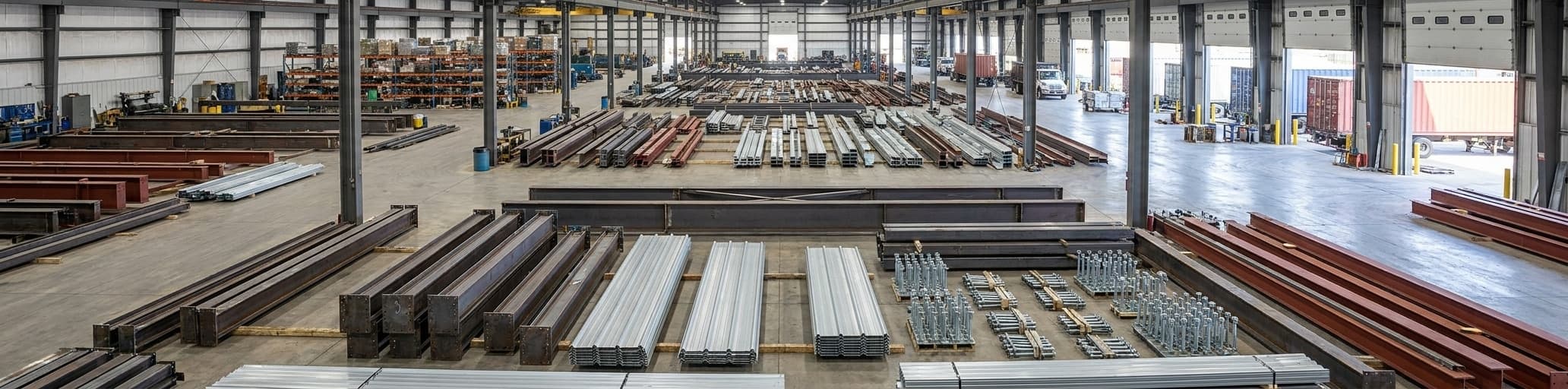

Local mills restrict your schedule and budget through single-source dependency, custom order delays, and limited engineering capacity–while we deliver Pittsburgh builders faster timelines, contracted pricing, and direct accountability through national buying power.
The Local Mill Trap: Why Proximity Doesn't Equal Value
Relying on a single regional mill locks you into spot pricing and adds 4-5 weeks of delays when custom profiles fall outside their stocked inventory.
Limited inventory forces longer lead times and higher per-unit costs
When you search for a steel building company near me, proximity feels like an advantage. It rarely is.
Local mills stock what their yard can hold–and anything outside those stocked profiles gets ordered on demand, triggering the clock the moment your specs land on their desk.[3] Lead time covers both physical delivery and production-to-shipment time at the source, meaning a custom gauge or non-stock profile adds two separate delays to your schedule simultaneously.[3] Current market data puts hot-rolled steel lead times at 3-6 weeks from point of order; cold-rolled sheet runs 5-9 weeks, and galvanized sheet 5-8 weeks.[2] Those figures assume normal mill output. Domestic capacity utilization has already slipped to 74.6%, with extended shipment delays of four to five weeks documented across the sector–and that's before a regional supplier layers on a custom order against a thin inventory buffer.[1] The cost problem compounds the timing problem: smaller order volumes from a single regional buyer carry no leverage against spot pricing.
You pay current market rates instead of contracted rates, and the per-unit material cost climbs before a single anchor bolt hits the ground. For Pittsburgh builders weighing local prefab contractors against national suppliers, that gap–measured in weeks lost and dollars overspent–shows up fast and rarely gets recovered.
Single-source dependency leaves you vulnerable to price spikes and supply disruptions
Leaning on one regional mill doesn't just restrict your options–it hands that supplier direct control over your schedule and materials budget.
Steel prices today remain roughly 50% above pandemic-era lows even without fresh disruptions, and a 2026 industry survey ranked material price volatility among the top challenges facing contractors.[4] When your single source hits an allocation limit, a mill slowdown, or a shipping bottleneck, there's no prequalified fallback in place–you wait, or you pay spot rates to whoever has inventory.[4] The exposure is well documented: 58.5% of U.S. construction businesses reported domestic supplier delays in July 2021 alone, illustrating how fast a one-vendor strategy stalls a live project.[6] The structural fix–multi-source procurement with primary suppliers, prequalified secondary sources, and geographically spread fabrication locations–demands the volume and vendor relationships only a national buyer can sustain.[5] Global forces compound the problem further: geopolitical conflicts, shipping route closures, and week-to-week tariff shifts create price spikes and extended lead times that move through single-source supply chains faster than any regional yard can respond.[4]
Custom engineering requests get delayed or rejected due to in-house capacity constraints
The capacity problem at regional mills isn't limited to stocked inventory–it runs straight through engineering bandwidth.
A standard pre-engineered metal building already runs 12-16 weeks from order to delivery; add a non-standard configuration and that climbs to 18-24 weeks, with complex engineering specs tacking on another 4-6 weeks beyond that.[7] Local shops running near their production ceiling treat custom requests as schedule liabilities rather than standard workflow, which means your non-standard gauge, custom column spacing, or crane runway addition gets pushed to the back of the queue–or declined outright.[8] Many regional suppliers simply lack the scalability and engineering depth to handle complex commercial or industrial specs without introducing quality and schedule risk on fast-track jobs.[9] For Pittsburgh builders with specific structural requirements–clear-span warehouses, aviation hangars, or heavy agricultural facilities built to Western PA snow loads–that engineering capacity ceiling is often the first wall a custom project hits.
National Buying Power: How NSB Delivers Pittsburgh Pricing Without the Local Mill Markup
ProTrades' in-house erection division eliminates the 20-50% subcontractor markup, delivering installation labor at direct cost with no middleman fees.
Nationwide supplier network reduces material costs by 15-25% compared to regional mills
ProTrades in-house erection division eliminates subcontractor markups on installation labor Every time a general contractor brings in an erection subcontractor, that labor cost gets marked up before it lands on your invoice. Industry standard puts subcontractor labor markups at 25-50% to cover the GC's supervision time, scheduling overhead, payroll burden, and risk absorption for cost overruns.[12] Separate from materials–which carry their own 15-25% markup–subcontractor labor represents the single largest markup category on a steel building installation.[12] On a $100,000 erection scope, you're absorbing $25,000 to $50,000 in coordination fees for work the GC didn't perform.[12] The 20% markup most commonly applied to subcontractor work in commercial construction compensates the GC for managing the sub, coordinating the schedule, handling client communication, carrying liability, and absorbing risk if the sub underperforms–none of which creates a single bolt in your building.[12] When that management layer is the only thing adding cost, eliminating it produces clean, direct savings with no trade-off on quality or accountability.
NSB's ProTrades in-house erection division removes that markup layer entirely. Because the erection crew works directly under NSB rather than as a contracted third party, installation labor is billed at direct cost–no coordination fee, no supervision premium, no risk buffer passed to the owner.[13] The crew building your structure answers to the same organization that engineered it, which is also why accountability doesn't fragment the way it does when a GC points at a sub and a sub points back. For Pittsburgh builders pricing a warehouse addition or steel farm building erection, that eliminated markup translates directly into budget headroom–money that stays in your project rather than covering a middleman's overhead.[13]
Real-time inventory access means 40×60 and 30×40 steel buildings ship faster than local custom orders
The 30×40 and 40×60 footprints aren't just popular sizes — they're the two most produced standard configurations in the industry, which means fabricators build them in volume rather than against individual orders.[14] That production reality translates directly into shipping speed: a professional crew can erect a 30×40 kit in as little as 2-3 days on site, and a 40×60 goes up in 4-6 days once components arrive.[15] Standard pre-engineered buildings also cut overall construction time by roughly 20% compared to custom-configured builds, because every component is manufactured off-site to preset specs and arrives ready for assembly — no field fabrication, no waiting on custom parts.[16] The contrast with a local custom order is straightforward: a non-stock profile triggers production from scratch, adding weeks before a single piece ships.
When NSB quotes a 30×40 or 40×60, the kit is pulling from stocked supply chains with real-time availability visibility rather than from a mill backlog.
For Pittsburgh owners with a hard deadline — a harvest window, a lease end date, or a contractor schedule that won't flex — that difference between available inventory and a made-to-order queue is often what keeps the project on schedule and within budget.
Single-Source Accountability: The Hidden Cost of Working with Multiple Vendors
With design-build, every schedule slip and scope question lands on one desk accountable for your price and timeline, eliminating the finger-pointing that inflates budgets.
Design-build responsibility stays with NSB from permit to completion–no finger-pointing between mills and contractors
Traditional construction splits design and build across two separate contracts–one with the designer, one with the contractor–and when something goes wrong, each party points at the other while the owner waits.[17] That dynamic is well-documented: with multiple vendors in the chain, responsibility becomes shared in theory and owned by nobody in practice, producing exactly the finger-pointing that stalls live projects and inflates final invoices.[18] Design-build consolidates accountability under a single contract and a single entity responsible for both what gets engineered and how it gets built.[17] When you use a design-build contractor, there's no opportunity for that deflection–the entity can't claim it only built to someone else's plans, because it wrote those plans.[18] For a turnkey steel project from permit submission through final erection inspection, that single-source ownership means every schedule slip, every spec question, and every site condition lands on one desk–the same desk that committed to your price and your timeline.
Constant communication through one point of contact reduces change orders and surprise costs
Change orders are the primary budget-wrecker on fragmented projects: design issues alone account for 56.5% of cost overruns and 40% of project delays, with 70% of projects experiencing rework traced directly to design inconsistencies and errors.[20] Poor communication amplifies every dollar of that exposure–PMI research links it to one-third of all construction project failures, and the average project finishes 28% over the original budget.[21] When your engineer, your supplier, and your erection crew each answer to a separate organization, a scope clarification that should take one call becomes a multi-party negotiation that generates documentation, delay, and a change order someone has to absorb.
A single point of contact closes that loop.
Penn State research analyzing hundreds of construction projects found design-build delivery reduces change orders by 6% compared to fragmented methods, because the entity that engineered the building is the same entity installing it–no ambiguity about design intent, no dispute over who approved the field change.[19] That structure kept change orders at zero on the Wisconsin Heights School District project after years of budget surprises under traditional delivery, a result that's repeatable precisely because accountability can't be deflected when one organization owns both the drawings and the schedule.[19] For Pittsburgh owners who want to understand what communication accountability actually looks like before a contract is signed, vetting steel building contractors near you on these standards is the right place to start.
Local code expertise for Western PA snow loads, soil conditions, and zoning–backed by 1,480+ completed projects
Western PA structural requirements are specific enough that a supplier without local project history will miss them on the first attempt.
Pittsburgh's local amendments to the UCC set the ground snow load at 30 psf, producing a flat roof design load of 21 psf under ASCE 7-10 formulas–before accounting for drift loading, unbalanced snow, or roof geometry adjustments that increase demand on specific configurations.[22] That figure is a Pittsburgh-specific code amendment, meaning suppliers quoting from national snow maps alone may underdesign the roof structure and trigger a permit rejection before a single anchor bolt is ordered.[23] Pennsylvania's structural design requirements add further site-specific variables: separate calculations are required for soil lateral loads, wind exposure categories, and seismic parameters under Chapter 16 of the state building code–all of which interact with foundation sizing and anchor bolt schedules in ways that shift by site location, not just building type.[24] Effective January 1, 2026, Pennsylvania moved to the 2021 ICC base codes, updating load combination requirements that affect how pre-engineered metal building packages get reviewed during permit submission.[23] Builders who have navigated that framework across 1,480+ completed projects in Allegheny, Butler, and Westmoreland counties already know what Pittsburgh's Plan Review office expects in a structural package–including the documentation requirements covered in the Pennsylvania steel frame commercial building permit checklist–and build it into your drawings before the first submission, not after the first rejection.
Real Pittsburgh Project Comparison: Local Mill vs. National Steel Buildings Cost & Timeline
Cost breakdown: 50×100 warehouse addition with concrete slab and erection labor
Timeline reality: NSB 8-12 weeks vs. local mill 12-16 weeks with contingency delays The 4-8 week gap between these two timelines isn't a scheduling footnote–it's a budget line item. A lower-priced quote paired with a longer lead time is often more expensive in practice once labor standby costs are factored in, meaning every week your slab sits empty waiting on steel carries a real dollar cost.[28] Local mill timelines compound from three directions simultaneously: steel lead times shift with markets, freight schedules, and mill output, so a quote that looks firm at signing can slip by weeks before a single piece ships.[27] Permits add a second variable–plan-review cycles run from weeks to months depending on scope and municipal backlog, and a supplier who hasn't navigated Pittsburgh's Plan Review office before won't have those timelines pre-mapped into your schedule.[27] Seasonal weather introduces a third: heavy rain, high winds, and temperature extremes halt pours and erection days, and without contractual weather-delay rules in writing before you sign, those lost days disappear from your schedule without credit.[27] NSB's stocked inventory and pre-negotiated fabrication pipelines compress the production-to-shipment phase that consumes most of the local mill's window–shorter supply chains mean fewer transportation delays and better-optimized delivery routes from the moment your order is placed.[10] Tying payments to actual milestones–delivery on site, permit approval, passed inspections–rather than promises is the contractual move that protects your schedule regardless of which supplier you use.[27] The table below shows where each timeline phase lands for both paths, and the prefab building kits delivery timeline breaks down how each phase maps to the calendar on a live Pittsburgh project.
| Phase | NSB | Local mill | Key risk |
|---|---|---|---|
| Engineering & shop drawings | 1-2 weeks | 2-4 weeks | Custom specs add queue time at regional shops |
| Fabrication & production | 3-5 weeks | 5-8 weeks | Non-stock profiles trigger made-to-order delays |
| Shipping & delivery | 1-2 weeks | 2-3 weeks | Single-source freight vs. optimized multi-hub routing |
| Permit review buffer | Mapped in advance | Often unplanned | Local code familiarity eliminates resubmission cycles |
| **Total window** | **8-12 weeks** | **12-16 weeks+** | **Plus contingency delays for weather, market shifts** |
Decision Essentials: 5 questions to ask any local mill before signing a contract
The cheapest quote rarely survives first contact with the real costs. Foundations, site prep, permits, and freight are frequently absent from the headline number a local mill puts in front of you–and by the time those line items surface, you're already committed.[27] Before signing anything, five questions separate a supplier worth trusting from one that will cost you twice.
- What's explicitly excluded from your quote? Foundations, unloading fees, engineering drawings, and building permits are profit centers for suppliers who omit them from initial pricing.[27] If a cost isn't spelled out in the contract, treat it as excluded–then budget accordingly before you sign, not after.
- Are delivery and permit milestones written into the contract? Steel lead times shift with markets, freight schedules, and mill output, so a date that looks firm at signing can slip by weeks without any contractual consequence.[27] Tie payments to actual milestones–delivery on site, permit approval, and passed inspections–not to verbal assurances.[27]
- Can you provide current proof of licensure and insurance? A licensed contractor meets local and state testing requirements; a properly insured erector carries both liability coverage and workers' compensation.[29] Ask for documentation before any work begins–hesitation or irritation at the request is a red flag worth acting on.[29]
- Do you have documented experience with Pittsburgh's code requirements? Local building codes, municipal zoning bylaws, and snow load amendments vary enough that a supplier without regional project history will miss Pittsburgh-specific requirements and trigger a permit rejection.[29] Ask for references from Allegheny, Butler, or Westmoreland County projects specifically–not just general steel building experience.[29]
- Will you provide a fully itemized cost breakdown? Bundled pricing hides markup across steel kits, erection labor, freight, and engineering drawings.[30] An itemized list is the only tool you have to identify where the margin lives and which line items carry room to negotiate–anything less gives the supplier full control over where the overages land.[30]
Any local mill that can't answer all five without hesitation has already answered your most important question. For a broader look at what to watch for when evaluating contractors in Western PA, the steel building contractor red flags guide covers the patterns that ag and commercial owners catch too late.
- Local mills restrict options to stocked inventory, forcing custom orders into 12-16+ week timelines with no schedule leverage.
- Regional suppliers lack engineering capacity for complex specs, pushing non-standard requests to queue backs or outright rejection.
- NSB's in-house erection eliminates 25-50% subcontractor markups, directing labor costs straight to your project budget.
- Single-source design-build accountability reduces change orders by 6% and eliminates finger-pointing when issues arise.
- Pittsburgh's 30 psf snow load and 2021 ICC code updates require local expertise–suppliers unfamiliar with Western PA codes trigger permit rejections.
- Standard 30×40 and 40×60 kits ship in 8-12 weeks vs. 12-16+ weeks locally, compressing timelines across engineering, fabrication, and delivery phases.
- https://www.stout.com/en/insights/article/current-state-us-steel-market
- https://www.cscpails.com/2023/07/12/stay-ahead-of-the-game-steel-industry-analysis-from-csc-%F0%9F%8E%AF/
- https://www.steel.org/steel-technology/steel-production/glossary/
- https://metalcon.com/blog/metal-supply-chain-disruptions-how-contractors-and-fabricators-can-manage-market-volatility/
- https://cmicglobal.com/resources/article/Global-Supply-Chain-Management-in-Construction-Challenges-and-Solutions
- https://www.dub-l-ee.com/supply-chain-disruptions-their-management-strategies-for-construction-companies/
- https://industrialcontractorstexas.com/insights/steel-dock-equipment-lead-times
- https://www.noblesteel.us/steel-fabricators-near-me-how-to-choose-the-right-local-partner/
- https://struxhub.com/blog/modular-construction-delays-how-trumps-tariffs-are-disrupting-your-prefab-build-schedule/
- https://www.servicesteel.org/resources/local-steel-suppliers-vs-national-or-foreign
- https://www.tylerbuilding.com/post/steel-market-trends-why-now-is-the-time-to-buy-a-metal-building
- https://www.housecallpro.com/general-contractor/templates-calculators/markup-calculator/
- https://www.markupandprofit.com/articles/markup-on-subs/?srsltid=AfmBOoo8u97KFAOGQcobkDWq8ddXcBXiv9ZuNqKzgmu4UJXrmsZsM8_S
- https://futurebuildings.com/30×40-metal-building.html
- https://steelbuildingsguide.org/metal-building-kits/all-standard-sizes/
- https://alansfactoryoutlet.com/blog/metal-building-sizes/?srsltid=AfmBOoqZNL3DNogLhCbMZaYE7DlLKDVBXAnpijK5a_HoRE_JndUHQUEw
- https://commercialdisputeresolutiongroup.com/design-build-disputes/
- https://buildingadvisor.com/project-management/estimating-overview-2/estimating-errors/
- https://cicconstruction.com/blog/single-point-of-accountability-how-design-build-delivery-eliminates-project-risk-across-multiple-markets/
- https://www.rhumbix.com/blog/change-orders-construction-definitive-guide
- https://fullclarity.com/construction-cost-overruns-causes-and-fixes/
- https://www.pittdes.com/post/snow-loads-on-roofs
- https://www.pittsburghpa.gov/Business-Development/Permits-Licenses-and-Inspections/Building-Codes
- https://up.codes/viewer/pennsylvania/ibc-2018/chapter/16/structural-design
- https://www.metalbuildingoutlet.com/how-much-does-a-50×100-steel-building-cost/
- https://www.buildingsguide.com/metal-building-prices/?srsltid=AfmBOoqRnpRm-S3oKZmwLAArANrONmZq6KJ4Bwd-fjrVxFJ9lejNWSyr
- https://metalprobuildings.com/steel-metal-buildings-what-you-need-to-know-before-signing-a-contract/
- http://www.247pro.com/blog/analyzing-factors-influencing-steel-price-fluctuations-and-their-impact-on-final-structure-cost
- https://pbsbuildings.com/choosing-the-right-contractor/
- https://armstrongsteel.com/blog/build-a-steel-building-with-supplier-vs-contractor