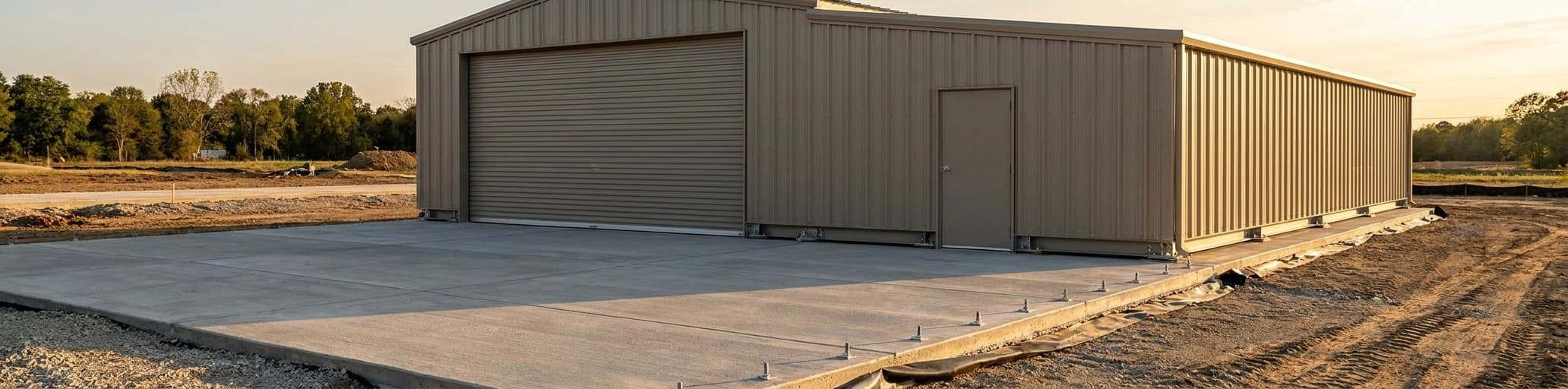

We help you understand the true all-in cost of a 20×30 metal building, from kit pricing through foundation and erection. Single-source accountability keeps your project on budget and schedule without surprise change orders.
20×30 Metal Building Cost: What You'll Actually Pay in 2026
Your 20×30 metal building kit costs $8,000-$15,000, but delivery and foundation work typically push the real price to $13,000-$30,000 before installation begins.
Base building cost: $8,000-$15,000 for the structure alone
A 20×30 metal building covers 600 square feet, and the structural kit alone typically lands between $8,000 and $15,000. Rigid-frame steel structures–the clear-span type with no interior columns–run $13 to $18 per square foot for the shell itself.[1] At 600 square feet, that math puts your base structure squarely in that cost window.
What those dollars buy is the structural envelope: steel framing, roof panels, and exterior wall cladding.
Concrete, erection labor, permits, and interior finishing are all separate line items.[1] Kits advertised below $8,000 often include only a partial outer shell with no engineered framing system–essentially a shed-grade enclosure, not a true pre-engineered steel building.[1] Delivery of the kit adds another $5,000 to $15,000 depending on distance and freight conditions, so the delivered-but-not-erected cost of your 20×30 structure will typically run $13,000 to $30,000 before a single anchor bolt hits concrete.[1]
Why National Steel Buildings pricing outperforms national averages
Volume steel contracts are the foundation of the price advantage. Contracted purchasing power locks in kit costs before spot-market fluctuations reach your quote–something most regional suppliers can't offer. But the deeper savings aren't in the kit price alone; they surface in coordination.
Foundation costs vary significantly based on building size, site conditions, and local labor rates,[2] which means any gap between your building supplier and your foundation contractor creates real budget exposure. When the same company engineers your 20×30 structure, produces the anchor bolt layout drawings, specifies concentrated column loads, and oversees erection, the handoff between design and field work is clean. A poorly designed or installed foundation can lead to cracking, shifting, warping, or moisture damage that jeopardizes the entire structure,[2] and that kind of failure almost always traces back to a coordination breakdown between separate trades–not a materials defect.
Single-source accountability eliminates that risk entirely, keeping your project within budget and on schedule without surprise change orders appearing midway through the pour.
Cost per square foot: How a 20×30 compares to larger footprints
Size is the single biggest driver of per-square-foot cost in metal construction, and not in the direction most buyers expect. Smaller buildings–including a 20×30–carry a higher per-square-foot price than larger structures because fixed costs like engineering, delivery, and erection setup get divided across fewer square feet.[1] A basic metal building kit runs $10 to $25 per square foot, while total installed costs land between $25 and $70 per square foot depending on customization and labor.[3] At 600 square feet, a 20×30 sits firmly at the upper end of that per-square-foot range. Larger buildings cost more overall but less per square foot, thanks to economies of scale in both materials and labor.[3] That spread matters when you're deciding whether to build exactly what you need today or size up slightly to capture a lower per-square-foot cost before the next project.
The table below shows how per-square-foot economics shift as footprint grows, based on installed cost ranges across the metal building market.
| Building size | Total sq ft | Kit cost range (per sq ft) | Installed cost range (per sq ft) |
|---|---|---|---|
| 20×30 | 600 | $18-$25 | $40-$70 |
| 30×30 | 900 | $15-$22 | $35-$60 |
| 30×40 | 1,200 | $13-$20 | $30-$55 |
| 40×60 | 2,400 | $10-$18 | $25-$50 |
For buyers weighing a 20×30 against a slightly larger footprint, the math often favors going to a 30×30 or 30×40 structure if the use case can accommodate the extra space. The per-square-foot cost drops meaningfully, while the site prep, permitting, and erection overhead stays nearly the same.[3] That said, a 20×30 metal building remains a cost-effective choice when the footprint genuinely matches the workload–over-building to chase a lower per-square-foot rate only saves money if you actually use the space.[1]
Concrete Slab Costs for a 20×30 Building: Site Prep to Finished Pour
A 20×30 concrete slab runs $2,400 to $4,800 in most markets, but soil prep and location can shift costs significantly, so site conditions deserve your closest attention.
Concrete slab pricing for a 20×30 footprint
A 20×30 metal building covers 600 square feet, and concrete installation for that footprint runs $4 to $8 per square foot on the lower end of the national market, putting the baseline range at $2,400 to $4,800 for a standard 4-inch slab.[4] That range holds in competitive markets across the Southeast, Midwest, and inland Southwest–where labor rates and batch-plant proximity keep costs moderate.[5] In higher-cost coastal states like California and New York, the same slab can push to $6 to $12 per square foot, meaning a 600 sq ft pour could run $3,600 to $7,200 depending on location.[6] Soil conditions are the single biggest unpredictable variable within any local market: a site requiring excavation, leveling, or gravel subbase preparation adds $0.40 to $2.00 per square foot before a drop of concrete hits the ground.[4] Labor accounts for 40% to 50% of total slab cost, running $3 to $5 per square foot for standard pour-and-finish work in most markets–which means two contractors bidding the same 600 sq ft slab can legitimately arrive at numbers $1,000 apart simply based on crew efficiency and local wage rates.[6] Reinforcement choices also shift your final number: rebar placed in a grid pattern costs more upfront than wire mesh but provides meaningfully greater tensile strength for slabs that will support vehicle loads or heavy equipment.[5] Slab thickness matters too–upgrading from 4 inches to 6 inches uses 50% more concrete but barely changes labor cost, so the incremental spend is primarily material.[6] For a 20×30 metal building used as a workshop or light commercial space, a 5- to 6-inch reinforced slab is the spec that protects your investment; opting for a thinner slab to reduce pour cost is one of the few decisions that reliably produces expensive problems later.[4]
What's included in a complete slab: excavation, grading, reinforcement, and finishing
The work that happens before concrete touches the ground determines whether your slab lasts 40 years or starts failing in five. Excavation removes all topsoil, vegetation, and organic material from the 20×30 building footprint–organic matter decomposes over time, creating voids beneath the foundation that lead to settlement and cracking.[9] Once cleared, the site is graded and a compacted gravel subbase of 4 to 6 inches is installed.[8] Each lift of gravel should be no more than 4 to 6 inches thick and compacted to at least 95% of maximum density before adding the next layer–a plate compactor or vibratory roller is required here; hand tamping cannot achieve adequate density.[9] The gravel layer does three things at once: it provides a uniform, level surface for the pour, helps distribute loads from the slab to the subgrade, and acts as a capillary break that prevents moisture from wicking up through the concrete.[8] A vapor barrier–minimum 6-mil polyethylene–goes directly over the compacted gravel before any concrete is placed, with seams overlapped by 12 inches to block ground moisture from migrating into your building.[9]
Reinforcement is where specification decisions carry the biggest structural consequences. Wire mesh handles light-duty slabs, but a 20×30 metal building used as a workshop, vehicle storage, or light commercial space needs rebar in a grid pattern–the tensile strength difference is significant when rolling loads and point loads are involved.[8] The rebar must sit on chairs to keep it centered in the slab depth during the pour; rebar that sinks to the bottom during placement provides almost no structural benefit.[7] Anchor bolts are set at this same stage, positioned precisely according to the manufacturer's anchor bolt plan–a positioning error of even an inch can prevent proper building alignment during erection or create stress concentrations that compromise structural performance.[9] Concrete strength of 4,000 PSI is the practical minimum for any metal building that will see vehicle traffic; 3,000 PSI is acceptable only for true light-duty storage with no vehicles or equipment.[7] For a side-by-side look at how slab thickness and concrete grade affect total installed cost, the cost breakdown by square foot is worth reviewing before you finalize your spec.
Finishing and curing close out the slab process, and both stages affect long-term performance in ways most buyers underestimate. For interior workshop or commercial use, power trowels create a smooth, dense surface that resists abrasion and is easy to clean.[8] Control joints are cut within 6 to 18 hours after the pour, spaced at intervals equal to 24 to 36 times the slab thickness–on a 4-inch slab, joints every 8 to 12 feet.[7] These planned weak points direct the concrete where to crack as it shrinks during curing, preventing random fractures across the floor surface. Concrete reaches approximately 70% of its rated PSI strength at seven days and 90% at 28 days; most steel building erection can proceed safely after 7 to 10 days of curing under normal weather conditions.[9] Rushing that window traps moisture vapor inside the structure and increases the risk of corrosion in the steel frame–the few days saved during construction can cost far more in remediation than the delay was ever worth.[7]
How National Steel Buildings coordinates slab work with erection for faster timelines
The biggest schedule killer in a 20×30 metal building project is the gap between slab completion and steel delivery–or the reverse, a kit sitting on-site while concrete cures. The solution is parallel scheduling: site clearing, grading, anchor bolt installation, and the concrete pour should all run concurrently with steel fabrication.[11] A 20×30 kit typically takes 3 to 6 weeks to fabricate in the factory;[11] a 600 sq ft slab under normal soil conditions takes 1 to 2 weeks from ground break to finishing. Run both tracks simultaneously and your building package arrives to a cured, ready foundation instead of a muddy lot waiting on a contractor who hasn't started yet.
That overlap only works cleanly when one team controls both tracks. The anchor bolt plan comes directly from the building's engineering drawings, and even a half-inch deviation from the specified bolt pattern can prevent proper column alignment during erection–forcing field modifications that eat days and inflate cost.[10] When engineering, fabrication, and erection originate from a single source, the anchor bolt layout survey is built into the handoff process rather than treated as a separate trade's afterthought. Industry data confirms that communication is the defining factor in steel building construction and erection timelines,[11] and fragmented project delivery–different suppliers handling the kit, the foundation, and the erection crew–creates exactly the coordination breakdown that generates mid-project change orders and idle crane time.
Single-source accountability keeps each phase locked in sequence so crews mobilize on schedule, not after a round of phone calls to track down who's responsible for a misplaced bolt.
20×30 Metal Building Specifications: Height, Roof Style & Customization Options
Choose your eave height between 10 and 14 feet based on your specific use–10 feet works for storage, while 12 to 14 feet accommodates vehicle lifts and mezzanine installations.
Standard specs: 10-14 foot eave height, 16-gauge to 14-gauge steel, gable or lean-to roof
A standard 20×30 metal building ships with eave heights between 10 and 14 feet, 16-gauge to 14-gauge steel framing members, and a choice between gable and lean-to roof profiles. Eave height drives practical usability more than any other single dimension: 10 feet handles most storage and single-bay workshop applications, while 12 to 14 feet accommodates tall overhead doors, vehicle lifts, or mezzanine storage above a work area.
Steel gauge dictates how much load the wall and roof panels resist without deflection–14-gauge panels carry meaningfully higher wind and snow loads than 16-gauge at the same span, which is why high-wind coastal zones and heavy-snow northern climates typically specify the heavier material even on a 600-square-foot footprint. Roof profile at the 20×30 size splits into two functional options: gable roofs shed precipitation symmetrically in both directions and allow a centered ridge vent for passive ventilation, while lean-to designs slope in a single direction and are particularly effective when the building attaches to or wraps an existing structure.
The framing system that ties all of those specs together is engineered computationally–bay spacing, span, and site-specific load conditions feed into design software that specifies every structural member for your exact location and use case.[12] A 20×30 built in a 150-mph coastal wind zone will carry heavier framing than the same footprint in a moderate-load inland market, even though both structures share identical exterior dimensions.
Door and opening configurations: How layout choices affect cost and functionality
Door count, opening size, and placement carry more budget impact on a 20×30 metal building than most buyers anticipate going in.[13] On a 600-square-foot footprint, a base package typically includes one roll-up door and one walk door–sufficient for single-vehicle storage or a simple workshop entry.[13] Step up to a plus package with two roll-ups and a walk door, and you gain the ability to drive through the structure or work from two access points simultaneously, which eliminates the awkward repositioning that plagues single-entry shops.[13] Multi-door or oversized configurations–three or more roll-up openings, or openings sized for tall equipment–push into the highest cost tier because each additional opening requires a structural header, added trim work, and framing modifications that ripple back through the engineering drawings.[13] The functional stakes are just as real as the budget ones: door placement controls vehicle movement patterns, natural light distribution, and prevailing-wind exposure, and getting it wrong the first time means living with the limitation for the life of the building.[13] On a 20×30 footprint specifically, the front-wall depth of 30 feet leaves room for two standard roll-up openings side by side–a layout that works well for two-bay light commercial or dual-vehicle access–while the 20-foot sidewalls typically support one walk door per side without compromising structural integrity.[13] The practical guidance from steel building project budgeting is direct: treat door and opening decisions as core design choices, not finish details, and price them honestly before the kit is ordered so the access configuration you actually need doesn't become a costly field modification after the frame is up.[13]
Customization options that add value without breaking budget: insulation, ventilation, and color
Insulation, ventilation, and color are the three customization categories most buyers treat as afterthoughts–then regret once the building is in use. On a 20×30 metal building, insulation options run from vinyl-backed batts to reflective insulation to spray foam, each step up delivering meaningfully more thermal control at a higher upfront cost.[13] The right tier depends directly on use frequency and climate: a structure holding equipment seasonally requires far less thermal management than a daily workshop where temperature swings affect both comfort and condensation on the steel frame.[13] Over-specifying insulation on a simple storage application inflates cost without improving performance–matching the insulation type to the actual use profile is where buyers keep the upgrade within budget.[13] Ventilation works in tandem with insulation choice rather than independently: an airtight insulated building without adequate air exchange traps moisture and accelerates condensation, while an uninsulated building with open vents loses passive thermal benefit.
Getting both right at the design stage costs far less than retrofitting either after erection. Color, by contrast, is the lowest-cost customization with the broadest visual impact–roof and wall sheeting ships in selected colors as part of standard fabrication, so a heat-reflecting light finish for a southern-climate site or an earth tone for a rural setting costs no more than the default option.[13] Treating insulation, ventilation, and color as coordinated design decisions–rather than individual line items added at the end–is where 20×30 metal building buyers consistently extract the most value per dollar without pushing the total project budget past their target.[13]
Total Project Budget Breakdown: Building + Slab + Erection + Permits
A 20×30 metal building installed costs $18,900 to $48,000 depending on your location's labor rates and foundation requirements.
Complete 20×30 project cost Estimates: All-in pricing from foundation to completion
Putting every line item together gives you the number that actually matters: total cash out the door. A 20×30 metal building kit runs $8,000 to $15,000 for the structure, with delivery adding $5,000 to $15,000 depending on distance and freight conditions. Foundation work lands at $4 to $10 per square foot,[3] putting a 600-square-foot concrete slab at $2,400 to $6,000 before reinforcement upgrades. Erection labor adds $5 to $15 per square foot,[3] or $3,000 to $9,000 for the 20×30 footprint. Permits range from $500 to $3,000 or more based on local requirements.[3] Stack those components and the all-in installed range for a 20×30 metal building runs roughly $18,900 to $48,000–a wide band that narrows sharply once site conditions, labor market, and specification choices are known for your specific location. The table below breaks each component into low and high estimates so you can see where your project is likely to land before committing to a final spec.
| Cost component | Low estimate | High estimate | Notes |
|---|---|---|---|
| Building kit | $8,000 | $15,000 | Frame, panels, hardware |
| Delivery | $5,000 | $15,000 | Distance and freight dependent |
| Concrete slab (600 sq ft) | $2,400 | $6,000 | $4-$10 per sq ft[3] |
| Erection labor | $3,000 | $9,000 | $5-$15 per sq ft[3] |
| Permits | $500 | $3,000 | Location dependent[3] |
| **Total all-in** | **$18,900** | **$48,000** | Site and spec dependent |
Two variables compress or stretch that range more than any others: labor market and foundation complexity. In rural markets with lower wage rates, erection labor tracks toward the $5 per square foot floor; urban projects with union wage requirements or difficult site access push toward $15 per square foot.[3] Foundation cost follows the same logic–straightforward soil with minimal excavation hits the low end, while sites requiring engineered footings, clay soil remediation, or a mandated 28-day curing process before erection can begin[14] add both cost and schedule days. Customization choices–insulation packages, additional doors, color selections–sit outside the table above and stack on top of the base all-in figure, which is why finalizing the spec before ordering the kit matters: changes made after fabrication begins carry change-order pricing, not catalog pricing.[3]
Why single-source erection through National Steel Buildings reduces hidden costs and delays
Real-world scenarios: Basic agricultural storage vs. climate-controlled commercial workspace A basic agricultural storage application–hay, equipment, or seasonal supplies–sits at the low end of the all-in cost range and requires a fundamentally different spec than a climate-controlled commercial workspace. For agricultural use, a pier foundation rather than a full slab-on-grade is a legitimate option: pier foundations are common for agricultural, storage, and rural buildings where simplicity, cost savings, and minimal site disturbance are priorities.[17] A basic 20×30 agricultural structure needs minimal insulation and can rely on passive ventilation through ridge and sidewall vents rather than a mechanical system. Where agricultural storage often goes wrong is underestimating moisture management: poor ventilation leads to condensation, rot, and metal corrosion, and proper ventilation costs only a few hundred dollars during construction but saves thousands in maintenance and replacement costs over the life of the structure.[17] Steel gauge choice also matters for longevity even in a basic storage application–26-gauge steel lasts longer than 29-gauge, and the difference in upfront cost is small relative to the gap in service life.[17]
A climate-controlled commercial workspace on the same 20×30 footprint demands a full slab-on-grade foundation rather than a pier system, because high-traffic floors and rolling loads require continuous concrete support that piers cannot provide.[17] The foundation connects the steel building to the earth and plays a vital role in stability, alignment, and long-term durability–and a poorly designed or installed foundation can lead to cracking, shifting, warping, or moisture damage that jeopardizes the entire structure.[17] Beyond the foundation, a commercial workspace spec adds a meaningful insulation package, a vapor barrier system, and HVAC rough-ins designed during the planning stage rather than retrofitted after erection. Water intrusion is the biggest long-term issue in any metal structure; proper flashing, trim work, and gutter systems prevent water damage, and buildings detailed for longevity cost slightly more upfront but avoid expensive repairs years later.[17] The cost delta between the two scenarios on a 20×30 footprint is real but bounded: the agricultural storage build typically lands in the $18,900-$28,000 installed range using simpler foundation and finish specs, while a fully climate-controlled commercial workspace with insulation, power-trowel slab, and mechanical rough-ins pushes toward the $35,000-$48,000 ceiling. Knowing which scenario matches your actual use case before ordering the kit is the single most effective way to stay within budget–over-specifying a storage building wastes capital, and under-specifying a workspace creates remediation costs that dwarf the upfront savings.[17]
- A 20×30 metal building kit costs $8,000-$15,000, with delivery adding $5,000-$15,000, but total installed cost ranges $18,900-$48,000 including foundation, labor, and permits.
- Concrete slab costs $4-$8 per square foot in competitive markets ($2,400-$4,800 for 600 sq ft), but coastal states can reach $6-$12 per square foot due to higher labor rates.
- Smaller buildings like 20×30 have higher per-square-foot costs than larger structures because fixed engineering, delivery, and erection costs spread across fewer square feet.
- Proper slab preparation requires compacted gravel subbase, 6-mil vapor barrier, reinforced rebar in grid pattern, and 4,000 PSI concrete minimum for buildings with vehicle traffic.
- Door count and placement significantly impact budget and functionality; a 20×30 footprint supports two roll-up doors on the 30-foot front wall and one walk door per 20-foot sidewall.
- https://www.homeadvisor.com/cost/architects-and-engineers/metal-home-kit-prices/
- https://norsteelbuildings.com/steel-building-foundations/an-introduction-to-building-foundations/
- https://hartvilleoutdoorproducts.com/how-much-does-a-metal-building-cost/
- https://homeguide.com/costs/concrete-slab-cost
- https://www.angi.com/articles/concrete-slab-cost.htm
- https://costflowai.com/blog/concrete-slab-cost-2026/
- https://lococoncrete.com/metal-building-concrete-slabs/
- https://wrightconstructioninc.com/post/slab-on-grade-construction-guide-design-build/
- https://mbmisteelbuildings.com/blog/steel-building-foundation/
- https://projul.com/blog/construction-steel-joist-metal-building-erection-guide/
- https://metalprobuildings.com/pre-engineered-steel-building-timeline/
- https://www.hansenpolebuildings.com/2011/06/pole-barn-truss-spacing/?srsltid=AfmBOopFGb4ccAVwVSbMUQEZG0ZrL7PgGgxiMVvqsn7AaL9g3vHjuGHs
- https://www.northtexassheds.com/steel-building-cost-guide
- https://incosteelbuildings.com/foundation/
- https://steelestimatingsolutions.com/steel-erection-costs-guide-2025/
- https://metal-america.com/turnkey-commercial-steel-building-construction-in-texas-and-oklahoma/
- https://www.columbiastructure.com/pole-barn-buyers-guide