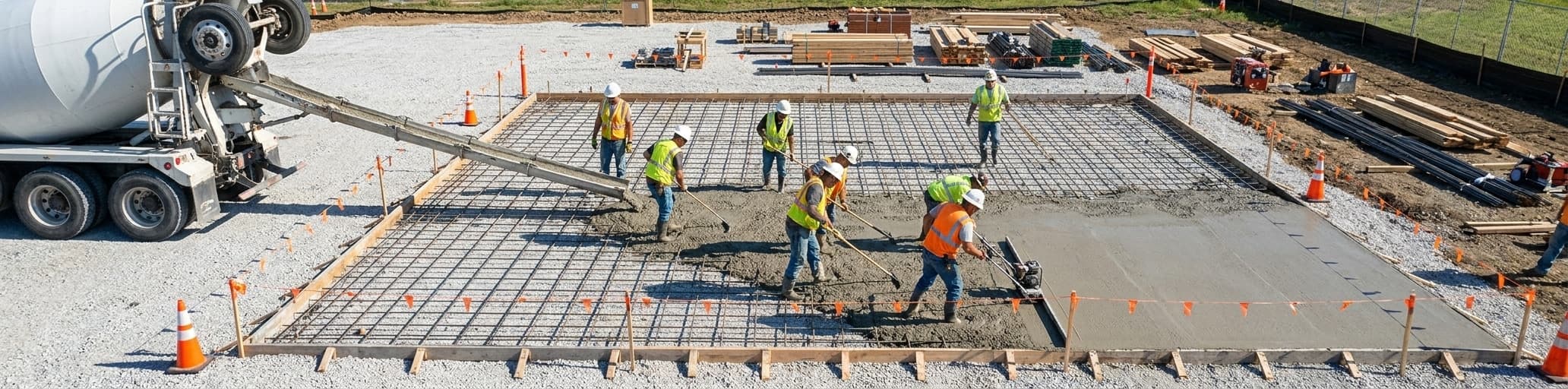

We help you understand 30×40 concrete slab costs, specifications, and procurement options so you can make informed decisions for your building project. Choosing professional installation with proper reinforcement and site prep protects your investment and eliminates costly mistakes down the road.
How to Size and Spec Your 30×40 Slab for Different Building Types
Upgrade to a 6-inch slab now for commercial use–it costs a fraction of what slab repair or replacement runs later.
Choosing slab thickness (4‑in vs 6‑in) based on load requirements and NSB building specifications
The thickness decision starts with one question: what are you actually putting on this slab? A 4-inch pour at 3,000-3,500 PSI handles passenger vehicles, light storage, and residential-grade loads without issue. [5] Once your 30×40 building shifts to warehouse, hangar, agricultural, or equipment storage use, the load profile changes entirely — forklifts, tractors, loaded trailers, and parked aircraft concentrate weight in ways that expose every weakness in an undersized slab.
A 6-inch slab isn't just thicker; it's structurally different. Increasing from 4 to 6 inches significantly improves the slab's ability to resist tension forces at the bottom under load — which is precisely where concrete fails first. [6] NSB's pre-engineered 30×40 building specs treat the 6-inch slab as the baseline for commercial and agricultural packages, not an optional upgrade, because the structure above is engineered for loads the foundation beneath must match.
If there's any chance your use will evolve — light storage today, equipment staging or a loaded flatbed tomorrow — pouring 6 inches now costs a fraction of what slab repair or replacement costs later. [5] For a building with a clearly light-duty purpose, a 4-inch slab with proper subbase compaction and 3,000 PSI concrete performs reliably; the honest part is deciding upfront whether "light-duty" still applies in three years. You can see how slab spec choices ripple through your full 30×40 metal building budget before committing to either thickness.
Reinforcement layout and NSB's pre‑engineered rebar package for optimal strength
Rebar works because steel and concrete share nearly identical thermal expansion coefficients — both materials expand and contract together, so the bond between them holds under temperature swings that would otherwise crack an unreinforced pour. [7] What that means practically is that the rebar grid doesn't just add strength at the moment of the pour; it protects the slab through every freeze-thaw cycle and load event over its lifetime. On a 30×40 slab, the grid runs in two perpendicular directions — rows and columns tied at intersections — with grid length and width calculated by subtracting the edge-rebar inset from each slab dimension, so bar placement is precise rather than approximate. [7] Two details separate a properly specced commercial slab from a residential one: the double-band perimeter and correct lap splicing.
Along the outer edges — where forklifts turn, loaded trailers back in, and aircraft wheels concentrate point loads — a doubled course of rebar along the perimeter is standard practice for garage slabs, driveways, warehouse floors, and slabs under exterior walls, because edge sections carry disproportionate stress. [8] Where your 40-foot or 30-foot slab runs exceed standard rebar lengths, bars must overlap and be tied with steel wire — never welded, since rebar's high carbon content makes it brittle under welding heat, reducing tensile strength below design spec — with a lap length of at least 40 times the bar diameter to maintain full load transfer across the splice. [7] NSB's pre-engineered rebar package for 30×40 commercial, agricultural, and aviation slab applications resolves all of this before the first bar is cut: bar size, grid spacing, edge-inset dimensions, lap zones, and perimeter doubling are specified in the layout so your contractor executes a defined reinforcement plan rather than making field calls that affect how the slab performs under load for the next 30 years. For a deeper look at how the steel structure above coordinates with the slab below, the 30×40 metal building budget breakdown shows how foundation and frame specs interact across the full project cost.
Site‑preparation checklist recommended by NSB (grading, compaction, drainage) to protect the slab
Site prep failure is the most common reason concrete slabs crack, settle, and fail prematurely — and every problem it causes is permanent once the pour is done.
The sequence NSB recommends for a 30×40 commercial or agricultural slab starts with full site clearance: all vegetation, roots, and organic debris must come out, because decomposing plant matter creates voids beneath the slab that cause uneven settling and cracking over time. [9] After clearing, excavate to a minimum depth of 4-6 inches to accommodate the base layers and slab thickness, then verify the excavated surface is level — inconsistent depth produces weak points at every low spot. [10] Compact the subgrade with a plate compactor, making multiple passes across the full 1,200-square-foot footprint; soil that feels firm underfoot is not the same as mechanically compacted soil, and the difference shows up in how the slab performs under forklift loads, parked equipment, or loaded trailers over years of use. [9] On top of the compacted subgrade, lay a 4-inch crushed rock or gravel base and compact it thoroughly — the stone layer adds structural stability and allows water to drain away from the bottom surface of the slab, which is concrete's most direct route to long-term damage from erosion and freeze-thaw cycling. [11] Grading and drainage planning deserve equal weight: the site must slope away from your building so water never pools under or around the slab, and if your lot's natural drainage runs toward the structure, a French drain or perimeter drainage solution goes in before the pour, not after. [10] For sites with fill dirt — common on lots that required grading before construction — expect more aggressive compaction requirements, since loosened fill settles over time and concrete poured on inadequately compacted fill will follow it down regardless of slab thickness or reinforcement spec. [11] This ordered sequence — clear, excavate to depth, compact subgrade, lay and compact gravel base, grade for drainage, install vapor barrier — is what protects every dollar of your 30×40 concrete slab cost once the concrete sets.
NSB Turnkey Slab Solution vs DIY or Contractor‑Only Options – A Side‑by‑Side Cost Table
NSB turnkey packages cost 10-15% more than bare contractor quotes but eliminate the scheduling gaps and hidden change orders that typically inflate commercial slab projects.
Itemized cost comparison table: NSB turnkey package vs typical contractor quote vs DIY estimate
Three procurement paths exist for a 30×40 concrete slab, and the price gap between them is real — but so is the risk gap. A DIY estimate on a 1,200-square-foot reinforced slab starts with materials: concrete at $125-$150 per cubic yard for 15 yards, rebar or mesh, vapor barrier, and form lumber totaling roughly $4,500-$7,000 [12]. That number excludes tool rental, disposal fees, and the single biggest DIY exposure — a failed or unworkable pour. Once a ready-mix truck arrives, you have 30-90 minutes to place, level, and finish before the concrete becomes unworkable; miss that window and you're paying a contractor full price to demolish your pour and start over [13]. A typical contractor-only quote — where concrete work is sourced independently from your building package — runs $8,000-$12,000 installed for a standard 4-inch reinforced slab [12], but line items like short-load surcharges, site-access fees, and permit coordination are routinely excluded from the initial quote and added as change orders once work begins [12]. An NSB turnkey package folds site prep, excavation, formwork, the pour itself, reinforcement, vapor barrier, finishing, and permit coordination under one contract — typically 10-15% above a bare contractor quote [12], but that premium eliminates the scheduling gaps, scope overlaps, and change-order exposure that inflate bare-contractor projects on commercial, agricultural, and aviation builds. The table below shows where each path actually lands across every line item:
| Line item | DIY estimate | Contractor quote | NSB turnkey |
|---|---|---|---|
| Site prep & excavation | Not included | $1,200-$3,000 | Included |
| Concrete (15 CY, 4-inch) | $1,875-$2,250 | $1,875-$2,250 | Included |
| Reinforcement (rebar/mesh) | $900-$1,800 | $900-$1,800 | Included |
| Vapor barrier | $600-$1,200 | $600-$1,200 | Included |
| Labor & finishing | $0 (your time) | $4,800-$9,600 | Included |
| Short-load/access fees | Unknown | Often excluded | Included |
| Permit coordination | Your responsibility | Often excluded | Included |
| Warranty & liability | None | Workmanship only | Full coverage |
| **Total estimate** | **$4,500-$7,000** | **$8,000-$12,000+** | **$9,000-$14,000** |
The DIY column shows the lowest number, but not the lowest risk — and for a warehouse floor, hangar pad, or equipment storage slab that has to perform under load for decades, the 10-15% turnkey premium is cost-effective insurance against every line item that bare-contractor bids quietly exclude [12]. For owners who want to reduce costs without carrying pour-day risk, the hybrid path works: handle your own excavation, form-setting, and gravel base, then hire out the pour and finish — a split that can reduce total installed cost by 20-30% while keeping the high-skill, time-critical work in professional hands [13].
Long‑term value analysis: warranty, code compliance, insurance savings, and maintenance reduction
The long-term math on a properly installed 30×40 concrete slab tilts sharply toward professional, code-compliant work once you account for four costs that never appear on an initial quote. Warranty coverage is the first. Professional contractors provide workmanship warranties that cover structural defects — material protection that has no equivalent on a DIY pour.
Studies show professionally installed concrete maintains a 90% success rate over five years, compared to roughly 30% for DIY repairs, meaning the warranty isn't just paperwork; it's priced-in risk insurance on a slab that has to perform under forklift loads or aircraft weight for decades. [15] Code compliance is where the financial exposure gets less obvious but more serious. Licensed contractors are trained in local building codes covering foundation thickness, drainage requirements, and reinforcement standards — and failing to meet those codes doesn't just delay inspections. It creates complications with insurance claims and exposes owners to fines and required rework that routinely cost more than the original professional fee would have. [14] For a warehouse, agricultural facility, or aviation hangar where the structure above the slab carries its own permit requirements, a non-compliant foundation creates a chain of code problems that runs upward through every approved component above it.
Insurance savings follow directly from code compliance: insurers treat properly permitted, inspected concrete work as a lower-risk asset, while non-compliant foundations can trigger claim denials on damage events that would otherwise be covered — a detail that matters most when a forklift incident or weather event puts the slab's structural performance on record. [15] Maintenance reduction is the fourth lever, and it compounds over time. Professional-grade materials and techniques — correct curing times, proper subgrade compaction, code-specified reinforcement — produce concrete that resists cracking, settling, and surface spalling far longer than slabs built to a budget rather than a spec. DIY concrete mistakes increase total project cost by up to 50% when professionals are brought in to correct them, and that figure doesn't include the operational cost of a slab that fails mid-lifecycle in a working facility. [16] For commercial, agricultural, and aviation builds where the 30×40 concrete slab cost is a foundation investment rather than a discretionary one, the warranty coverage, code-compliant documentation, and maintenance-free performance of a properly installed slab are the line items that determine total cost of ownership — not the per-square-foot number on day one.
How NSB's single‑source, turnkey approach minimizes risk and often lowers total project cost
The real cost advantage of a single-source approach doesn't appear on a per-square-foot estimate — it shows up in what never happens. Split procurement, where concrete work is sourced independently from your building package, creates scheduling gaps where one trade's delay cascades into every other trade's problem.
When a pour goes wrong under that model, you're calling a second contractor to demolish and redo the work — effectively doubling your concrete cost before the structure above it is even ordered. [17] Professional contractors who carry liability insurance and coordinate work across the full project scope eliminate that exposure; when something goes sideways, accountability is clear and covered rather than disputed across separate contracts. [17] Code compliance compounds this advantage: contractors experienced in local building standards know the foundation thickness, drainage requirements, and reinforcement specs your jurisdiction actually enforces, and meeting those requirements from day one keeps your permit path clean through every trade above the slab. [18] NSB's single-source model extends that protection across the entire 30×40 project — site prep, slab, and steel structure under one contract, one spec sheet, and one point of contact — so the 10-15% premium over bare-contractor pricing is offset by the change orders, scope gaps, and mid-project surprises that multi-vendor projects absorb over time. For a warehouse, hangar, or agricultural facility where the foundation and the frame have to perform together under real loads for decades, single-source accountability from dirt to door is the line item that keeps your total project cost predictable — and keeps you out of the position of paying twice for work that should have been done right the first time.
Calculate Your Project Cost in Minutes – Printable NSB 30×40 Slab Cost Calculator
Enter your slab dimensions and concrete type to get an itemized cost breakdown in minutes, complete with labor, materials, and per-square-foot pricing.
Step‑by‑step guide to using the downloadable NSB slab cost calculator spreadsheet
The NSB slab cost calculator spreadsheet turns a 30×40 concrete slab cost estimate into a five-input exercise that takes less time than a contractor callback.
You start by entering your slab dimensions — length, width, and thickness — and the calculator handles the unit conversion automatically: thickness in inches divides by 12 to produce a usable feet figure, which then multiplies against your length and width to yield total cubic footage. [https://alansfactoryoutlet.com/concrete-slab-calculator/] Dividing that cubic footage figure by 27 converts it to cubic yards, the unit every ready-mix supplier quotes and delivers. [https://alansfactoryoutlet.com/concrete-slab-calculator/] For a standard 4-inch 30×40 pour, that sequence produces roughly 15 cubic yards; a 6-inch pour lands at approximately 22 cubic yards — a 50% jump in material that the calculator flags against your per-yard price input. [19] The spreadsheet applies a 10% overage buffer automatically, because a ready-mix truck leaves once the pour starts, and the cold joint created when the next truck arrives is a structural defect, not a recoverable situation. [19] From there, you select your concrete type — standard 3,000 PSI for light storage, 4,000-4,500 PSI for garage or warehouse floors — and your reinforcement spec (mesh or rebar), and enter a regional ready-mix price per cubic yard. [20] The calculator outputs a complete line-item breakdown: concrete material, reinforcement, site prep, and labor expressed as both a total and a cost per square foot, so you can place that number directly against contractor quotes and see exactly where the gap is and why.
Sample calculation for a 30×40 warehouse with a 6‑in reinforced slab
A 30×40 warehouse slab at 6 inches runs to 22.22 cubic yards of concrete — that's the anchor number every other line item builds from. [21] At $125-$165 per cubic yard delivered, concrete material alone lands at roughly $2,778-$3,666 before a single form is set.
Rebar on 18-inch centers — the baseline spec for a warehouse floor, not an optional upgrade — adds $0.75-$1.50 per square foot, bringing reinforcement to $900-$1,800 across the full 1,200-square-foot pour. [21] Labor and finishing for a commercial slab runs $7-$8 per square foot, or $8,400-$9,600 for the full footprint, and site prep — grading, compaction, and base layers — tacks on another $1-$1.25 per square foot, meaning $1,200-$1,500 more before a yard of concrete is ordered. [21] Add the vapor barrier and your total installed cost for a spec-grade 6-inch reinforced warehouse slab lands at $12,000-$14,400, which works out to $10-$12 per square foot all-in across most inland markets — coastal and high-labor sites push that figure to $14-$18. [21] That's the number to set against any contractor quote: if a bid comes in materially below $10 per square foot for a 6-inch reinforced commercial pour, ask specifically what's excluded, because the line items that disappear from low bids — short-load buffers, vapor barriers, proper subgrade compaction — are precisely the ones that fail first under daily forklift traffic.
For a deeper look at how the 30×40 metal building budget stacks up across every trade beyond the slab, that full breakdown shows where foundation and frame costs interact across the complete project.
Next steps: request a personalized NSB quote, financing options, and project timeline
Getting your personalized NSB quote starts with one task: document your project scope before you make contact.
Define the slab dimensions, intended use, site conditions, and any known drainage or access constraints — this information determines whether a quote reflects your actual installed cost or a stripped-down number that compounds through change orders. [22] NSB prices the complete package — concrete, steel structure, and erection — under one contract, which is more cost-effective than sourcing each trade separately and absorbing a markup on each component; turnkey providers are the recommended starting point precisely because you pay one upcharge rather than one for every construction service involved. [23] Financing runs on a parallel track.
Options include traditional bank construction loans with fixed rates and repayment terms, personal loans for smaller-scale projects, and vendor financing structured specifically for pre-engineered steel — with metal building financing terms commonly running 84 months at fixed monthly payments, 120-month fixed APR plans, or no-interest arrangements for balances cleared within six months. [24] Before approaching any lender, prepare a comprehensive project plan covering scope, budget, timeline, and potential risks; lenders evaluate the project's viability alongside your credit profile, and a complete plan moves the approval process faster than an incomplete application. [24] Build a 10-15% contingency buffer into your financing amount before you finalize it — permit cycles, site access complications, and mid-project material shifts are the variables most likely to affect your final 30×40 concrete slab cost after the contract is signed, and emergency funds allocated upfront prevent the financial strain that derails project timelines. [22] For a full breakdown of loan structures and lender requirements specific to a 30×40 build, financing options that close the gap on a 30×40 build covers everything you need before your first lender conversation.
- A 6-inch slab is the structural baseline for commercial and agricultural buildings, while 4-inch slabs suffice only for light-duty residential loads and storage.
- Proper site preparation including vegetation removal, subgrade compaction, and 4-inch gravel base is critical; site prep failure is the most common cause of premature slab cracking.
- Rebar must overlap at least 40 times the bar diameter and be tied with steel wire, never welded, to maintain full load transfer across splices.
- A 30×40 warehouse slab at 6 inches costs $12,000-$14,400 installed ($10-$12 per square foot), with bids below $10 per square foot likely excluding critical components.
- Professional installation provides 90% five-year success rates versus 30% for DIY repairs, plus code compliance and warranty coverage that protect insurance claims.
- Turnkey single-source contracts cost 10-15% more than bare contractor quotes but eliminate scheduling gaps, change orders, and accountability disputes across multiple vendors.
- A 10-15% contingency buffer should be built into project financing to account for permit cycles, site complications, and material shifts that commonly affect final costs.
- https://www.myconcretecalc.com/learn/concrete-slab-cost
- https://costflowai.com/blog/concrete-slab-cost-2026/
- https://www.angi.com/articles/concrete-slab-cost.htm
- https://bucketcityconcretecontractors.com/how-much-does-a-30×40-concrete-slab-driveway-cost/
- https://essexmetalbuildings.com/4-vs-6-inch-concrete-slab-everything-you-need-to-know-to-make-an-informed-decision/
- https://kaliconcrete.com/how-thick-should-a-concrete-driveway-be/
- https://www.omnicalculator.com/construction/rebar
- https://www.vcalc.com/wiki/rebar-and-concrete-in-a-slab
- https://concretercaboolture.com.au/site-preparation-checklist-before-pouring-a-concrete-slab/
- https://groundzeronwa.com/site-preparation-steps-before-pouring-a-concrete-slab/
- https://www.a1concrete.com/concrete-repair-learning-center/prep-for-concrete-slab
- https://nationalsteelbuildingscorp.com/blog/30×40-metal-building-with-slab-cost-the-complete-pricing-guide
- https://www.slabcalc.co/guides/diy-vs-contractor
- https://www.eliteconcretetn.net/why-its-important-to-hire-a-licensed-and-insured-concrete-contractor-instead-of-diy/
- https://www.contractorsasphalt.com/diy-vs-professional-concrete-repair-which-saves-you-more-in-the-long-run/
- https://www.softprowatersystems.com/pages/professional-installation-vs-diy-cost-differences-and-value?srsltid=AfmBOop1qhfoa0j5UevK9Qk31DjFZkSuxBLx3xvoeVljbg_qpEs12hei
- https://www.gra-rock.com/post/concrete-pouring-diy-or-hire-pro
- https://jbsconstruction.net/concrete-slab-company-vs-diy-pouring-the-difference-in-quality-and-durability/
- https://costflowai.com/calculators/concrete/
- https://concretecalculator.me/slab-calculator
- https://nationalsteelbuildingscorp.com/blog/how-much-does-a-30×40-metal-building-with-slab-cost
- https://www.metalbuildingoutfitters.com/budgeting-tips-for-metal-building-costs/
- https://questarconstructionlp.com/5-steps-steel-building-project/
- https://www.steelcobuildings.com/steel-building-financing/