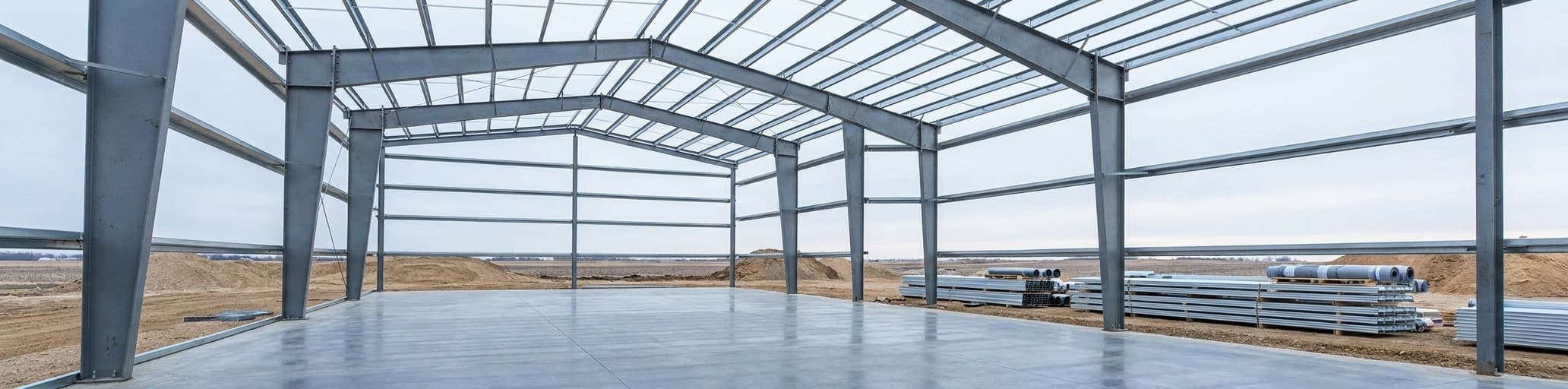

We help you understand 25×40 metal building costs, from kit pricing to foundation work, so you can budget accurately for your project. Locking in your finish tier and site conditions upfront keeps your total within range instead of facing surprises later.
25×40 Metal Building Cost: 2026 Pricing Breakdown
A 25×40 metal building kit runs $10,000 to $25,000, but plan for $15,000 to $35,000 once assembly labor is included.
Base steel structure pricing and what affects your quote
A 25×40 metal building covers 1,000 square feet, which makes national per-square-foot benchmarks straightforward to apply. Metal building kit prices run $10 to $25 per square foot for materials and plans alone, putting a base 25×40 steel kit between $10,000 and $25,000 before any site work.[1] On-site shell assembly adds another $5 to $10 per square foot, so the erected structure — framing, wall panels, and roof — lands in the $15,000-$35,000 range depending on crew rates and local market conditions.[1] A pre-engineered metal building (PEMB) keeps that number lower: components are fabricated to your exact dimensions at a factory and shipped ready to bolt together, which cuts labor hours compared to a fully custom field-fabricated build.[1]
Four variables push your quote toward the high end or hold it near the low end:
- Frame type. A rigid I-beam frame costs more per square foot than a cold-formed steel system but carries heavier snow and wind loads without additional reinforcement.
- Local code requirements. Snow load, wind speed, and seismic zone all determine how much steel goes into the structure — and your price.
- Wall height. Standard 10-foot eave heights are priced into base kits; taller walls for equipment clearance add material and engineering costs.
- Design path. Stock plans cost $1,300 to $2,000; a custom architect-drawn design runs $15,000 to $80,000 — a difference that matters even on a 1,000-square-foot project.[1]
Keep one cost-structure fact in mind as you budget: the steel shell and its assembly represent roughly 30% of a fully finished project.[1] The other 70% covers foundation, insulation, interior finishing, and mechanical systems — which is why a low kit price alone rarely tells you what you'll actually spend. If you want a useful comparison point, see how 30×40 prefab building costs break down in 2026 for a similarly sized structure with line-item detail.
How much does a 25×40 metal building cost without a foundation
At 25 feet wide, a 25×40 sits at the upper edge of the small-building category — structures with widths up to 39 feet — where standard kit configurations keep engineering straightforward and pricing predictable.[2] Medium-category buildings (widths around 40 to 41 feet) introduce more variability because added openings, higher snow loads, and specialized insulation begin to shift the final cost more noticeably at that scale; a 25-foot-wide frame avoids most of that complexity.[2] What a foundation-excluded package actually covers matters here: the steel kit includes the frame, wall panels, roof panels, trim, and fasteners — but site grading, footings, and concrete work are separate line items that no kit price absorbs, because those costs depend entirely on your soil conditions, local labor rates, and frost depth.[2] One more factor affects even the structure-only number: regional engineering requirements such as northern snow load calculations or seismic zone design specifications directly increase how much steel the frame requires, which means your foundation-free quote can still vary based on where you build, not just what you order.[2]
Why National Steel Buildings quotes are lower than competitors
Metal building vs. pole barn: initial cost and long-term savings For a 25×40 footprint, a pole barn runs $15,000-$40,000 fully installed at $15-$40 per square foot — a range that directly overlaps with a pre-engineered steel building's $15,000-$35,000 erected cost.[7] The initial spread narrows further once you account for what each quote actually covers: pole barn materials make up 65-75% of total project cost, with labor adding another $5-$10 per square foot, and concrete, insulation, windows, and doors all priced separately on top.[7] That structure means a low headline pole barn number can climb quickly once real-world finishing costs are added. An unfinished pole barn typically won't increase property value, while a well-finished steel structure delivers a 50-80% return on investment.[7] The long-term numbers shift the equation further in steel's favor: wood post-frame buildings are vulnerable to moisture damage, pest infiltration, and fire, while metal frame structures are essentially maintenance-free.[7] Both building types can reach 40-60 year lifespans, with newer builds potentially reaching 100 years — but steel gets there without the periodic structural repairs that wood frames require over time.[6] For a detailed look at how those maintenance costs compound, the steel farm buildings vs. pole barns 20-year maintenance cost breakdown shows exactly where the gap grows.
| Cost factor | Pole barn (25×40) | Steel building (25×40) |
|---|---|---|
| Installed shell cost | $15,000-$40,000 | $15,000-$35,000 |
| Cost per sq ft installed | $15-$40 | $15-$35 |
| Materials as % of total | 65-75% | ~30% of finished project |
| Labor per sq ft | $5-$10 | $5-$10 |
| Concrete slab | Priced separately | Priced separately |
| Structural maintenance | Periodic wood repairs needed | Essentially maintenance-free |
| Expected lifespan | 40-60 years (100 with upgrades) | 40-60+ years with minimal upkeep |
| Property value impact | Minimal if unfinished | 50-80% ROI when finished |
The table makes the comparison concrete: upfront costs are similar enough that neither option wins on sticker price alone.[7] What separates the two is the cost trajectory after move-in. Wood posts anchored in the ground are the primary failure point for pole barns over time — moisture and pests attack them steadily, and remediation is expensive.[7] Steel framing carries no equivalent vulnerability, which is why the 20-year ownership cost of a metal building consistently runs below a wood pole barn of the same size, even when the pole barn's initial quote looks competitive.[6]
Total installed cost for a 25×40 structure with labor included
The fully installed number for a 25×40 metal building — steel kit, erection labor, concrete slab, permits, and basic insulation — runs between $28,500 and $56,500 depending on your region, site conditions, and finish level. Breaking that range into discrete line items makes it actionable. Labor to erect the shell runs $5 to $10 per square foot, so expect $5,000-$10,000 on top of the kit price for the crew alone.[7] The concrete slab adds another $5,000-$10,000 at $5-$10 per square foot installed, with slab thickness and reinforcement driving the spread.[7] Permits land between $500 and $2,000 depending on your county.[6] Spray foam insulation for walls and roof panels costs $1 to $4.50 per square foot of surface area, which on a 1,000-square-foot footprint translates to roughly $1,000-$4,500 once wall and roof surfaces are counted.[6] The table below consolidates every installed cost component so you can stress-test your own budget before committing.
| Cost component | Low estimate | High estimate | Notes |
|---|---|---|---|
| Steel building kit (materials) | $10,000 | $25,000 | Frame, panels, trim, fasteners[2] |
| Erection labor | $5,000 | $10,000 | $5-$10/sq ft for shell assembly[7] |
| Concrete slab (1,000 sq ft) | $5,000 | $10,000 | $5-$10/sq ft installed[7] |
| Building permits | $500 | $2,000 | Varies by jurisdiction[6] |
| Spray foam insulation | $1,000 | $4,500 | $1-$4.50/sq ft of surface area[6] |
| Walk doors (2 standard) | $600 | $3,800 | $300-$1,900 per exterior door[7] |
| Site prep and grading | $1,400 | $10,000 | Land leveling, excavation[6] |
| **Installed total** | **$23,500** | **$65,300** | Region and specs determine final number |
Two line items shift the final number more than any others: site prep and insulation specification. A flat, already-graded lot can bring site prep to under $2,000, while a sloped or heavily wooded lot pushes that line toward $10,000 before a single panel goes up.[6] Insulation choice is equally decisive — a lightly used storage structure may not need full spray foam, while a climate-controlled workshop or commercial space will. Scoping both accurately early keeps the installed total within budget instead of surfacing as surprises at the end of the project.[7]
Cost Estimates: estimate your exact project budget
The shell-only number answers one question, but your actual budget depends entirely on how you plan to use the space. The erected steel shell and slab account for roughly 30% of a fully finished project, which means finishing a 25×40 to commercial or residential standards typically triples the structure cost.[1] A dry storage building needs nothing beyond that shell and slab, making it the lowest-cost outcome. A climate-controlled workshop or light commercial space adds HVAC ($7,000-$16,000), new electrical wiring ($6,000-$22,500), and interior spray foam insulation on top of the shell price.[1] Where plumbing is required, rough-in pipes add another $2,280-$5,120.[1] Permits run $500-$2,000 at every finish tier with no exceptions.[7] The table below organizes those costs into three build tiers so you can anchor your budget to your actual end use before committing to a scope.
| Finish tier | What's included | Estimated total (25×40) |
|---|---|---|
| Dry storage | Shell, slab, basic insulation, permits | $28,500-$58,500 |
| Working shop / light commercial | Shell + HVAC, full electrical, spray foam insulation | $48,000-$97,000 |
| Fully finished commercial | Shell + all mechanical systems, interior framing, drywall, flooring | $85,000-$145,000+ |
The single most reliable way to hold a project within budget is to lock in the finish tier before requesting a quote. Vague scope requests produce low opening numbers that climb steadily as mechanical, insulation, and interior finish requirements get added back after contract — the opposite of the cost-effective outcome you're looking for.[1]
25×40 Concrete Slab Cost and Foundation Specifications
A 25×40 concrete slab typically costs $6,000 to $12,000 installed, with regional pricing and your choice of reinforcement directly affecting the final price.
How much does a concrete slab cost for a 25×40 building
A 25×40 slab covers exactly 1,000 square feet, which makes the math direct.
Installed concrete costs $6 to $12 per square foot on average, putting a 25×40 slab between $6,000 and $12,000 depending on your region, thickness, and finish.[8] The national midpoint lands near $6,000 — roughly $6 per square foot all-in — but coastal states like California and New York push that number toward $8.50 per square foot, while central states average closer to $5.35 per square foot.[9] Materials account for 50 to 60 percent of the total, running $3 to $7 per square foot, with labor making up the remaining 40 to 50 percent at $3 to $5 per square foot.[8] A 24×40 slab — just 40 square feet smaller — benchmarks at $3,840 to $7,680 at the same $4 to $8 per square foot range, confirming that a 25×40 slab sits firmly in the $6,000 to $12,000 window once regional and specification differences are applied.[10]
Slab thickness, reinforcement, and drainage requirements
Concrete resists compression well but fails under tension — that's exactly why reinforcement matters on any slab that will carry real loads.[12] For a 25×40 metal building floor, the practical choice is between wire mesh for light storage and rebar for anything involving vehicles, forklifts, or heavy equipment.
A 6-inch pour is the standard target for equipment-bearing shops: each additional inch of thickness on a 1,000-square-foot slab adds roughly 3 cubic yards of concrete, so the step from 4 to 6 inches represents a concrete volume increase worth pricing before finalizing your spec.[11] When rebar is the right call, #5 bar (5/8-inch diameter) is the appropriate size for foundation-grade applications, laid in a grid pattern spaced 18 to 24 inches apart center to center — a configuration that distributes load and prevents crack propagation across the full slab surface.[12] Soil conditions inform that decision directly: well-drained coarse sand or gravel base requires less aggressive reinforcement than expansive clay or compressible fill, because stable soil limits the differential settlement that puts tensile stress on a slab in the first place.[11] Drainage is addressed at the foundation layer, not after the pour: building codes require adequate drainage systems and vapor retarders beneath slabs to manage moisture migration from below.[13] Concrete reinforced to the correct specification and poured over a properly drained base can reach a 100-year service life — skipping either element shortens that trajectory considerably.[12]
Site preparation costs that affect your final foundation price
The concrete pour is only one line item on your foundation invoice — site conditions decide how large the others get.
Land clearing runs $1,200 to $8,000 depending on how heavily wooded or obstructed the lot is, while excavation adds $2.50 to $15.00 per cubic yard when cut-and-fill work is required to establish a level building pad.[1] Grading and leveling costs $0.40 to $2.00 per square foot, which on a 1,000-square-foot footprint translates to a $400-$2,000 swing based entirely on how much slope your lot carries into the project.[1] A land survey — often required before permits are issued — adds $200 to $1,200 depending on property size and terrain complexity.[1] Permit fees deserve a separate line in the budget: the slab itself may not trigger a standalone permit, but the overall building project always does, and skipping that step creates compliance exposure that costs far more to resolve after the fact.[9] Difficult site access compounds every one of these costs — when concrete trucks and equipment can't stage efficiently, labor rates rise to compensate, and that increase flows directly into your installed total.[9] Scoping all site prep variables before finalizing a foundation quote is the only way to prevent these line items from surfacing as surprises once work has already started.[1]
25×40 Metal Building Specifications and Customization Options
A standard 14-foot eave height and rigid I-beam frame give you 1,000 square feet of unobstructed interior space without expensive custom engineering.
Standard roof pitch, wall height, and framing configurations
Wall height is the specification that most directly affects how useful a 25×40 building is day to day. A 14-foot eave height — the standard on commercial-grade rigid I-beam kits — gives you clearance for overhead doors, mezzanine storage, and light mechanical equipment without triggering the additional engineering costs that come with taller custom builds.[14] The rigid frame I-beam is the correct framing choice for commercial, agricultural, and industrial applications: welded I-beams at the primary frame carry roof and wall loads directly to the foundation, eliminating the interior columns that would otherwise eat into usable floor space on a 25-foot-wide span.[14] That clear-span interior is the functional payoff of the I-beam configuration — the full 1,000 square feet remains open and rearrangeable, which matters whether the building is being used as a workshop, a storage facility, or a light commercial space.[14] Engineered kits at this spec are built to meet demanding wind, snow, and structural integrity requirements, meaning the framing configuration you order is already calculated for load compliance rather than requiring field modifications after delivery.[14]
| Specification | Standard value | Notes |
|---|---|---|
| Eave (wall) height | 14 ft | Standard commercial-grade kit spec[14] |
| Frame type | Rigid I-beam | Clear-span, no interior columns[14] |
| Application range | Commercial, agricultural, residential | Single kit configuration covers multiple uses[14] |
| Load compliance | Wind, snow, structural integrity | Engineered to demanding requirements[14] |
Door and window options that impact structure cost
Openings are where customization costs accumulate fastest on a 25×40 steel building. Most buyers spend an additional 15 to 20 percent of their kit price on accessories — a range that covers doors, windows, and trim packages — so on a $15,000 to $25,000 kit, that translates to $2,250 to $5,000 in add-on costs before a single panel goes up.[15] The structural implication matters as much as the price tag: every opening cut into a wall or roof plane requires a framed header, additional secondary framing members, and sometimes a reinforced primary frame bay to redistribute the loads that the removed panel section was carrying.
A standard walk door with a pre-engineered framed opening is the lowest-cost option; an oversized overhead door — the kind needed for vehicle access or equipment clearance on a working shop — requires a wider header, heavier girts on the adjacent wall bays, and precise placement relative to the primary frame to avoid compromising the clear-span interior. Windows follow the same logic: punching a single standard-size window into a wall panel is straightforward, but adding multiple windows across a single wall bay shifts load paths and can require engineering review that doesn't apply to a windowless configuration.
Keeping openings to the minimum count your use case actually requires — two walk doors and one to two windows for a basic shop, rather than a fully glazed commercial storefront — is the single most reliable way to hold door and window line items within budget without sacrificing functionality.[15]
Custom engineering for agricultural, commercial, and industrial uses
A 25×40 steel building serves three distinct use categories — agricultural, commercial, and industrial — but each demands different engineering decisions before a single panel ships. Agricultural applications like equipment storage benefit from front-to-back drive-through door configurations that accommodate tractors, seeders, and hay machinery without requiring repositioning between bays, while fabrication shops and light commercial spaces rely on the clear-span interior to keep the full 1,000 square feet unobstructed for equipment placement and workflow.[16] The structural calculations behind any of these uses depend heavily on where you build, not just what you build: coastal areas, mountain valleys, and open plains each impose distinct snow load, wind speed, seismic zone, and exposure category requirements that directly determine how much steel goes into the primary frame.[16] Every jurisdiction-compliant kit requires stamped engineering drawings sealed by a licensed professional engineer — documents prepared specifically for permit submittal under the International Building Code and applicable state amendments, with your ZIP code and building department contact used to pull the correct jurisdiction-specific load tables before fabrication begins.[16] If a building department requests additional calculations or load charts after submittal, the engineering response goes back through the supplier rather than landing on your desk as an open coordination problem, which keeps the project on schedule instead of losing weeks to permit paperwork.[16]
- A 25×40 metal building kit costs $10,000-$25,000 for materials, with erected shell totaling $15,000-$35,000 depending on local labor rates and market conditions.
- The steel shell represents only 30% of a fully finished project; the remaining 70% covers foundation, insulation, interior finishing, and mechanical systems.
- A 25×40 concrete slab costs $6,000-$12,000 installed, with regional variations and reinforcement type significantly affecting the final price.
- Metal buildings offer 50-80% return on investment and require essentially no maintenance, while pole barns need periodic wood repairs over their lifespan.
- Openings like doors and windows add 15-20% to kit costs and require structural reinforcement, making minimalist design the most cost-effective approach.
- Site preparation costs range $1,400-$10,000 and depend heavily on lot conditions; sloped or wooded terrain significantly increases grading expenses.
- Finish tier selection before requesting quotes prevents cost creep; vague scopes produce low opening bids that climb as mechanical and interior requirements are added.
- https://homeguide.com/costs/metal-building-homes-cost
- https://norsteelbuildings.com/steel-building-news-industry-trends/how-much-do-steel-buildings-cost-in-canada/
- https://builtmammoth.com/how-much-does-a-steel-building-cost/
- https://metal-america.com/steel-buildings-cost-guide-for-2026/
- https://summertownmetals.com/pole-barn/pole-barn-cost-guide/
- https://www.homeadvisor.com/cost/additions-and-remodels/build-a-pole-barn/
- https://homeguide.com/costs/pole-barn-prices
- https://homeguide.com/costs/concrete-slab-cost
- https://www.homeadvisor.com/cost/outdoor-living/concrete-slab/
- https://www.barndominiumlife.com/24×40-concrete-slab-cost/
- https://www.practicalmachinist.com/forum/threads/concrete-floor-rebar-spacing.299394/
- https://www.rakenapp.com/rebar-calculator
- https://up.codes/viewer/iowa/irc-2015/chapter/4/foundations
- https://www.ebay.com/itm/257344911652
- https://www.cascadingfallsinc.com/what-do-prefab-metal-building-cost-to-construct
- https://agribilt.com/30×40-quonset-hut/