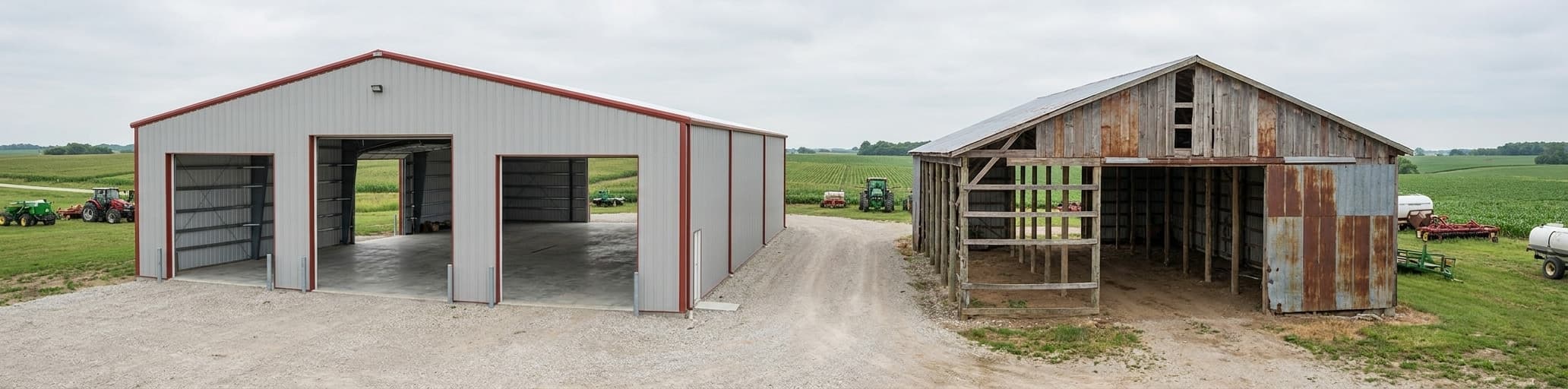

We break down the real 20-year maintenance costs between steel farm buildings and pole barns, showing where the pole barn's day-one savings disappear and steel's premium pays itself back. Steel structures eliminate costly post replacement, roof resheetings, and wall re-skinning while protecting your equipment and resale value far better than wood-frame alternatives.
Up-Front Construction & Long-Term Value
Steel farm buildings cost roughly 15% more upfront but require no chemical treatment, resist pests and fire, and eliminate the need for periodic post adjustments.
Material & labor costs on day one
Pole barns start cheaper because the structure itself is simpler: large wooden posts embedded 8 to 12 feet apart in the ground, assembled with screws and nails, then skinned with metal siding and roofing panels.[1] Steel farm buildings use pre-engineered red iron I-beam columns bolted to a concrete foundation, with column spacing of 20 to 30 feet–so you're buying more steel upfront but far fewer interior supports.[3] That foundation difference is where the day-one gap widens most: pole barns can go straight into the earth or onto basic concrete footings, while a steel frame requires a reinforced concrete slab, adding to initial site costs.[3] Across both structure types, expect to pay $30 to $150 per square foot installed, with basic pole barn kits at the low end and engineered steel builds toward the middle and upper range depending on size, location, and features.[2] Labor runs 30% to 60% of your total project cost regardless of which path you choose, and site prep–grading, foundation work, utility rough-ins–adds another $2,000 to $10,000 before a single wall panel goes up.[2] The critical number to hold onto: steel farm buildings cost roughly 15% more on day one, but that premium funds a frame that requires no chemical treatment, resists pests and fire, and stays plumb without periodic post adjustment.[1] For a detailed side-by-side cost breakdown on a 30×40 footprint, the numbers show exactly where each structure earns or loses ground over time.
Why Steel Spans Matter for Equipment Storage
Traditional buildings with interior support columns waste more than 30% of usable floor space–a direct hit to your per-square-foot investment.[4] Steel farm buildings solve this with rigid frames that transfer all roof and snow load to the exterior walls, leaving the full interior width completely open from one sidewall to the other.[4] That isn't a minor convenience: it means you're not designing your parking layout around posts; the space adapts to your equipment, not the other way around.[4]
Door clearance is the single specification most farm builders underestimate. A full-size combine with a corn head attached routinely stands 14 to 16 feet tall under its own power, so a building with 12-foot overhead doors simply can't take that machine.[5] The practical minimum for combine storage is 14-foot doors, and experienced builders routinely spec 16 feet or taller to accommodate the next equipment upgrade without a rebuild.[5] Width matters just as much–planters, sprayers, and combines with folded headers need openings 16 to 20 feet wide to enter without mirror-folding or awkward multi-point turns.[5] Getting those two numbers wrong costs you time on every single workday.
A drive-through layout–doors on opposite ends of the building–multiplies these gains further. Instead of backing a 50-foot machine out of a tight bay, you drive straight through, cutting operator fatigue and reducing the slow-speed handling that dings equipment.[5] For a detailed look at how interior dimensions translate directly into saved maneuvering time across a full harvest season, the farm equipment storage building dimensions guide breaks down exactly what footprint each common machine actually needs.
Resale Value After Two Decades of Use
Twenty years in, the structural condition of your outbuilding shows up directly in appraisal reports–and the gap between steel farm buildings and pole barns widens considerably by that point.
Properties with functional outbuildings command a $15,000 to $45,000 premium over comparable properties without them, and in agricultural zones, covered storage is treated as baseline infrastructure rather than an optional upgrade.[6] Appraisers typically value these structures at 50-70% of original construction cost–so a pole barn that cost $30,000 to build may add only $15,000-$21,000 at resale.[6] Steel's slower depreciation curve changes that math: a rigid-frame building that has never needed post replacement, re-skinning, or chemical treatment gives appraisers and buyers fewer reasons to discount, and metal structures consistently deliver better resale value than wood-frame alternatives because lower maintenance records and non-combustible frames carry less perceived risk for buyers.[7] On agricultural properties specifically, value increases of 10-15% are common where quality outbuildings are already in place, and listings with structurally sound covered storage sell 20-40% faster than comparable properties where the building condition is uncertain.[6] That faster sale timeline reduces carrying costs and tightens your control over next-purchase timing–two advantages that don't appear in a construction cost comparison but show up clearly at closing.
For a full picture of how the steel barn cost vs wood barn math plays out across two decades, the numbers reveal exactly where the pole barn's day-one savings disappear and where steel's premium pays itself back.
20-Year Maintenance Checklist & Price Tags
Galvanized steel frames need only occasional rinsing and last 40 to 70 years, while painted trim requires touch-ups annually and full repainting every 10 to 15 years.
Steel: Galvanized Frames vs. Painted Trim
Not all steel on a farm building ages at the same rate, and knowing the difference keeps you from budgeting for the wrong repairs.
The structural frame–columns, rafters, base plates–is typically hot-dip galvanized, a process that bonds a zinc layer directly into the steel surface.[8] That zinc provides what engineers call cathodic protection: even where the surface gets scratched or nicked, the surrounding zinc continues shielding the base steel from corrosion rather than letting rust spread from the damage point outward.[8] In practical terms, a galvanized frame requires nothing beyond an occasional rinse–no paint, no chemical treatment, no structural inspection for soft spots–and the coating holds for 40 to 70 years in most agricultural environments.[8] The trim, doors, and wall panels are a different story.
These components carry a painted finish, and UV exposure gradually causes that paint to fade, chalk, and eventually lose adhesion.[8] Plan for touch-up work on chips and abrasion points annually, and budget a full repaint of trim and panel surfaces every 10 to 15 years depending on sun exposure and regional humidity.[8] Steel farm buildings still run well under the industry benchmark of 1% to 3% of total building cost in annual maintenance–far below what wood-frame alternatives demand–but that figure holds only if you stay ahead of the painted surfaces while leaving the galvanized frame alone.[9] For a deeper look at which agricultural steel building maintenance tasks you can skip entirely versus which ones actually matter, the distinction between frame steel and finish steel is the single most important concept to understand before you build.
Pole Barns: Post Rot, Roof Re-Sheet & Re-Skin
The embedded wood posts in a pole barn are the first point of failure–and the clock on that failure starts the day they go in the ground. Wood materials in direct soil contact require ongoing chemical treatment to resist rot and insect damage, and that protection degrades over time regardless of the treatment grade applied at installation.[12] By years 8 to 12, posts at the soil line begin showing decay, and a single compromised post shifts wall plumb enough to rack panel alignment across adjacent bays–turning a structural repair into a cosmetic one at the same time.
The roof compounds those costs faster than most owners budget for. When wood purlins warp or absorb moisture beneath the metal skin, fastener holes elongate, panels loosen, and leaks follow.
Re-sheeting means tearing off existing panels, replacing rotted or delaminated decking–a non-negotiable step, since installing new panels over a compromised substrate voids most material warranties and accelerates the next failure cycle–then relaying new metal from scratch.[11] Tear-off alone runs $60 to $120 per roofing square before new material goes down, and damaged sheathing adds $70 to $150 per sheet on top of that.[11] Factor in labor, which typically accounts for 60% of any roofing bill, and total re-sheet cost on a 40×60 barn lands between $4 and $11 per square foot installed–a $10,000 to $26,000 project most pole barn owners face at least once inside a 20-year window.[11] Wall re-skinning follows the same timeline: elongated fastener holes, panel wave, and rust bleeding from compromised screw points eventually require either spot replacement or a full re-skin at costs that mirror the roof job. Metal roofing on a structurally stable frame, by contrast, reaches 30 to 60 years with minimal intervention–the difference being that the supporting structure beneath it never rots, shifts, or pulls fasteners loose.[10] That's the core reason a 40×80 steel-truss alternative eliminates all three cost events–post replacement, roof re-sheet, and wall re-skin–by removing wood from the load path entirely.
Energy Upgrades–Insulation, Vapor Barriers, Cool Coatings
Insulation isn't an optional upgrade on steel farm buildings–it's condensation control first and energy savings second. Steel conducts heat and cold more efficiently than almost any other building material, which means an uninsulated wall panel sweats on the first cold morning, dripping moisture onto stored grain, equipment, and hay bales below.[14] That condensation accelerates corrosion from the inside out, far faster than any exterior weather exposure. Proper insulation keeps the steel surface temperature above the dew point and eliminates that moisture cycle entirely.[14] Pole barns carry their own version of this problem: insulating around embedded posts, irregular girt spacing, and wood framing is significantly harder to execute correctly, and any gaps in coverage create air infiltration paths that erase real-world R-value performance regardless of what the spec sheet claims.[13]
For steel farm buildings, four insulation types cover nearly every budget and climate scenario. Faced fiberglass blanket insulation–installed between roof purlins and wall girts–is the most popular choice, running $1 to $3 per square foot installed and delivering a 2- to 4-year payback through reduced energy bills on a typical 40×60 building.[14] Rigid foam board eliminates thermal bridging by creating a continuous insulation layer over the steel frame itself, making it the stronger choice in cold-climate zones where frame steel acts as a direct heat-loss path.[14] Closed-cell spray foam costs more upfront but delivers the highest R-value per inch while functioning as a complete air and vapor barrier in a single application–particularly valuable in high-humidity agricultural environments where open-cell foam can trap moisture against the steel surface and accelerate corrosion.[14] Whichever type you choose, the math favors installing during initial construction: retrofitting insulation into an existing uninsulated building costs significantly more, and the cost difference between installing now versus later typically pays for the original insulation within 12 to 18 months.[14]
Vapor barriers and cool roof coatings address two separate but related problems on steel farm buildings. A vapor barrier–typically a reinforced polyethylene sheet installed on the warm side of the insulation assembly–blocks humid interior air from reaching the cold steel surface and condensing inside the wall cavity, a failure mode that degrades fiberglass R-value and triggers hidden corrosion before you see any exterior sign of a problem.[14] Cool roof coatings work on the opposite end of the energy equation: reflective pigments in painted steel panels reduce surface temperatures in summer, keeping interiors cooler and cutting the load on any ventilation or HVAC system running inside the building.[13] For livestock facilities, grain storage, and hay barns where interior temperature and humidity directly affect what you're storing, a moisture barrier system combined with proper ventilation design is the most cost-effective protection available–far cheaper than replacing spoiled inventory or repairing hidden steel corrosion.
Common Farm Hazards & Real-World Repair Bills
Steel barn panels swap directly without structural teardown, while wood barn repairs require reframing and constant upkeep even from surface-level damage.
Tractor Bumps, Hay Hooks & Wall Panel Damage
Day-to-day farm operations create a category of building damage that no weather forecast covers: the slow accumulation of tractor bumpers grazing sidewalls, hay hooks dragging across panel faces, and skid-steer operators misjudging a doorway by a few inches during a rushed harvest push.
On a steel farm building, a panel dent from a low-speed tractor contact is a cosmetic event–the rigid steel frame absorbs lateral force without racking, so column alignment and door plumb stay true even after repeated impacts near the base of a sidewall.[17] That same impact on a pole barn transfers force directly into the wood girts and posts behind the panel skin, and repeated contact at wall base level can loosen the wood framing that anchors the panel in place–turning what looks like surface damage into a repair that requires reframing, not just panel swapping.[15] Hay hook contact follows the same pattern: steel panels carry a factory-applied protective coating that resists surface penetration and stops rust from migrating outward from a scratch point, while wood siding absorbs hook gouges and opens direct pathways for moisture to reach the framing behind the wall.[15] Because pre-engineered steel buildings use modular panel systems, a damaged steel panel is a direct swap with no structural teardown involved–old wooden barns, by contrast, cost more to fix and require constant upkeep even for damage that originates at the surface level.[16] For operations that run heavy equipment in and out daily, the steel barn vs wood barn agricultural durability comparison shows exactly how impact resistance translates into fewer repair calls across a full equipment season.
Snow, Wind and Livestock Impact on Posts vs. Rigid Frames
Snow accumulation exposes the core structural difference between these two building types faster than any other weather event. In a pole barn, the load path under a heavy snow pack runs through wood framing members and directly into the soil around each embedded post–a path that's only as strong as the wood-to-ground interface, which weakens as moisture cycles and post decay progress over time.[18] Steel farm buildings transfer that same snow load through rigid I-beam rafters to exterior columns anchored in a reinforced concrete slab, keeping the load path mechanical and permanent regardless of seasonal freeze-thaw.[18] Pre-engineered steel buildings are designed from the ground up to meet specific regional snow load and wind load requirements–this isn't an optional spec upgrade, it's built into the engineering drawings before a single component ships.[19] That means your building is certified to handle the worst storm your county's code anticipates, not just the average season.[19]
Wind works the same way. A pole barn resists lateral wind force primarily through post embedment depth and the friction between each buried post and the surrounding soil.[18] As posts decay at the soil line–the failure mode detailed in the previous section–that lateral resistance degrades silently, often before any visible wall movement alerts you to the problem. A rigid steel frame anchored to concrete transfers wind load directly into the foundation, so the structure's lateral strength doesn't diminish with age or soil moisture.[18] For operations in tornado-prone corridors or coastal regions with sustained wind events, that permanence matters more than any single maintenance line item. A properly engineered steel system must meet regional building codes, and for rural properties facing heavy weather, a concrete-anchored steel frame delivers consistent strength across the full 20-year window.[18]
Livestock pressure is the hazard most structural comparisons ignore entirely, but on a working cattle or hog operation, it's constant. Animals lean, push, and rub against interior walls daily–a slow, repetitive lateral force applied at exactly the height where pole barn girts connect to embedded posts.[18] That repeated contact loosens the wood framing behind the wall skin, and a girt that shifts even slightly pulls fasteners, creates panel gaps, and opens moisture pathways into the post itself. Steel rigid frames absorb lateral livestock contact without racking because the load transfers to the concrete-anchored column base rather than into a wood-soil joint.[18] For pre-engineered steel agricultural buildings used as hog confinements, cattle barns, or horse facilities, that structural stability means your building geometry stays true–doors stay plumb, panels stay sealed, and the moisture barrier stays intact–across years of continuous animal pressure that would progressively loosen a post-frame wall.
Insurance Claims: Which Structure Costs Less to Rebuild
The insurance cost gap between these two building types doesn't appear in your annual premium–it appears when you file a claim and discover how your policy actually values the structure.
Most farm policies value barns one of two ways: Replacement Cost Value (RCV), which pays what rebuilding costs today regardless of age, or Actual Cash Value (ACV), which subtracts depreciation from that figure.[20] Pole barns depreciate roughly 1% per year, meaning an ACV policy on a 25-year-old pole barn pays only 75% of current rebuilding costs–a shortfall that can reach $7,500 or more on a structure that originally cost $30,000 to build.[20] That gap is almost always larger than the premium savings that led the owner to choose ACV in the first place.[20] Steel farm buildings depreciate more slowly because non-combustible frames carry lower perceived risk for insurers, and metal roofing and fire-resistant construction can qualify you for better rates than equivalent wood-frame alternatives–meaning the annual premium on a steel building is often lower while the payout at claim time is higher.[20] There's a second trap that catches both structure types: custom metal and post-frame buildings regularly cost significantly more to rebuild than their original construction cost or current market value, so policies written against those numbers leave you short when labor and material costs have risen since you built.[21] The practical fix is straightforward–schedule each outbuilding individually on your farm policy with its current replacement cost assigned, not its appraised or tax value, and review that figure annually since construction costs in most U.S. markets have moved materially over the past three years.[20] One detail worth noting: pole barn insurance won't cover natural wear and tear–rot, fastener pull-out, and post decay are maintenance failures, not insured events–which means every deferred repair on a pole barn also shrinks your recoverable loss if a covered peril hits the same structure.[22] For a detailed look at how a steel building's non-combustible frame directly affects what you pay for coverage, the steel farm building fire resistance guide breaks down exactly where the premium savings come from and how to document your building's specs to support a lower rate.
Financing, Warranties & Total Cost of Ownership
A 50-year structural warranty and 40-year paint warranty on steel farm buildings transfer to new owners, directly supporting your resale value at closing.
National Steel's 40-Year Paint & 50-Year Structural Warranty
The warranty on your steel farm building isn't a sales tool–it's the manufacturer's engineering commitment written into a legal document.
Pre-engineered steel buildings carry a 50-year structural warranty and a 40-year paint warranty, coverage terms that wood-frame construction simply can't match.[23] That distinction between warranty types matters more than most buyers realize: a structural warranty covers actual building failure under the snow and wind loads the frame was engineered to handle, while a workmanship warranty–the only coverage some pole barn builders offer–protects only against installation errors, leaving you exposed if the structure itself underperforms under design-load conditions.[24] Some pole barn builders offer no structural warranty at all, meaning your only recourse after a storm event is the builder's workmanship coverage, which was never designed to address structural load failures in the first place.[24] The 40-year paint term carries equal weight for your budget: it signals that the factory-applied finish is engineered to hold adhesion, resist UV chalking, and maintain color continuity across four decades of agricultural exposure–not just the first few seasons before you're back on a ladder with a spray gun.[23] Warranty transferability is the detail buyers consistently overlook, but it shows up directly at closing: when you can transfer a live structural and paint warranty to a new owner, your building arrives at the sale with documented coverage still in force, which reduces perceived buyer risk and supports your asking price without negotiation.[24] The length of a warranty is essentially the manufacturer's public statement that your building should not compound your initial investment with mounting maintenance costs–and on a steel frame farm building system engineered to specific regional load requirements, that promise is backed by the same structural math that designed the frame to outlast the warranty period itself.[23]
Rent-to-Own & Same-as-Cash Plans Compared to Pole-Barn Bank Loans
How you pay for a steel farm building determines your total cost almost as much as the building itself.
Traditional bank loans for pole barns run through agricultural and rural property lenders or construction loan programs–short-term, high-interest instruments with APRs between 5% and 30%, terms of 2 to 5 years, and minimum credit scores typically starting at 560.[27] Many conventional lenders still decline metal building projects outright, since most underwriting experience sits with stick-built construction, and institutions that do approve farm structure loans often require detailed budgets and plans before application–adding weeks to your timeline before a single panel ships.[27] Agricultural credit institutions are more familiar with steel buildings, and USDA Farm Service Agency programs exist specifically to bridge the gap for farmers who don't yet qualify for commercial farm credit, but those programs carry their own paperwork and qualification timelines.[27] Steel building financing sidesteps most of that friction.
A same-as-cash program–structured as 0% interest for 18 months–lets you use the full loan amount immediately while paying zero interest during the promotional window, making it functionally equivalent to paying cash if you clear the balance before the term ends.[25] For buyers whose credit or budget doesn't fit a standard loan, rent-to-own programs approve up to $8,000 with no credit check required, a small upfront payment, and flexible monthly payments over up to 36 months–every payment building toward full ownership.[25] The trade-off is real and worth stating plainly: rent-to-own goods can cost two to four times the cash price once all payments, fees, and term lengths are factored in, and RTO agreements are typically structured as leases rather than loans, which means they fall outside standard Truth in Lending protections.[26] That gap matters most when you're comparing a 36-month RTO arrangement against a same-as-cash plan you can pay off early–the latter wins on total cost every time for buyers who qualify.[26] For a direct breakdown of how these options play out against each other on an actual farm building budget, the financing options that close the gap on a 30×40 build shows exactly where each plan gains or loses ground depending on your credit profile and payoff timeline.
ROI Calculator: Cost per Year of Safe, Clear-Span Storage
The clearest way to compare these two structures isn't upfront price–it's total cost divided by years of reliable service, which is what cost-per-year analysis actually measures. Start with equipment protection: outdoor storage reduces equipment lifespan by 30-40% and increases annual maintenance costs by 25-35%.[29] On a $400,000 combine, that depreciation gap works out to roughly $16,000 per year in accelerated value loss compared to covered storage–meaning a $65,000 equipment building pays for itself in about four years through depreciation savings alone, before you count a single maintenance dollar.[29] Over a 30-year window, the ownership math is unambiguous: metal buildings cost $71,000 less than pole barns in total cost of ownership, and $152,000 less than stick-built wood-frame construction–a 30-48% reduction in lifetime costs.[29] Run that forward and you're looking at a 30-year ROI of 530-980% on a well-specified steel farm building, with a payback period of 2.8 to 4.8 years depending on insulation, equipment value, and labor savings.[29]
On the maintenance side, the annual cost gap is equally direct. Steel farm buildings run $500-$2,000 in maintenance over a 10-year period; traditional wood-frame alternatives cost $3,000-$8,000 over the same window–three to eight times more for the same decade of use.[28] Properly insulated steel buildings also save $1,200-$2,400 annually on heating and cooling, and the operational efficiency of covered, clear-span storage translates to 100-200 fewer labor hours per year on maintenance and logistics, worth $2,500-$7,000 annually at current farm labor rates.[29] Add those savings together across a 20-year ownership period and the annual cost of safe, clear-span storage in a steel farm building consistently undercuts a pole barn on every line–not because the upfront number is lower, but because none of the pole barn's compounding failure costs appear in your ledger. For a full picture of how agricultural steel buildings are sized and priced to hit specific cost-per-year targets, the specs translate directly into the payback calculations above.
- Steel farm buildings cost 15% more upfront but eliminate wood post replacement, re-skinning, and chemical treatment over 20 years.
- Pole barn posts fail at soil line by years 8-12, triggering $10,000-$26,000 roof re-sheet and wall re-skin projects.
- Clear-span steel frames waste zero floor space; pole barns lose 30% of usable area to interior support columns.
- Steel buildings depreciate slower and command $15,000-$45,000 resale premiums; properties sell 20-40% faster with sound covered storage.
- Total cost of ownership favors steel by $71,000 over 30 years; equipment depreciation savings alone pay for the building in 4 years.
- Steel farm buildings carry 50-year structural and 40-year paint warranties; most pole barns offer only workmanship coverage.
- Annual maintenance runs $500-$2,000 for steel versus $3,000-$8,000 for wood–three to eight times higher over a decade.
- https://prestigesteelstructures.com/metal-building-vs-pole-barn-a-detailed-comparison/?srsltid=AfmBOoo7xESd1A_ncKZXPPa9DDs_RCg3IkzNg82J3_GEfVqr3GjR-MhD
- https://www.angi.com/articles/how-much-does-building-barn-or-playhouse-cost.htm
- https://www.manseametal.com/resources/blog/a-comparison-between-post-frame–steel-frame-for-a-pole-barn_ae52.html
- https://www.vikingbarns.com/blog/clear-span-metal-buildings-guide
- https://www.steelstructuresamerica.com/farm-equipment-storage-buildings/
- https://matadorstructures.com/blog/pole-barns-increase-property-value/
- https://peb.steelprogroup.com/steel-structure/building/are-metal-cheaper-than-wood/
- https://easttexascarports.com/manufacturing/galvanized-vs-red-steel/
- https://metalprobuildings.com/case-study-how-farmers-save-30-with-a-steel-agricultural-building/
- https://allweatherroof.com/how-long-does-a-commercial-roof-last-understanding-lifespan-and-maintenance-factors/
- https://smithrock-roofing.com/roof-replacement-cost/
- https://www.totalroof.com/budget-breakdown-roofing-material-cost-considerations
- https://themetalshopllc.com/what-is-better-a-pole-barn-or-metal-building/
- https://www.akoetech.com/insulated-steel-buildings-cost/
- https://www.steelcobuildings.com/pole-barn-vs-metal-building/
- https://www.vikingbarns.com/blog/why-metal-buildings-are-the-best-investment-for-farm
- https://renegadesteelbuildings.com/why-steel-is-the-best-material-for-your-agricultural-building/
- https://alansfactoryoutlet.com/blog/pole-barn-vs-steel-building/?srsltid=AfmBOoo4ozcQz2ZyjVTufLRx_OUVuwL60jUT1fAxd2Tp3Syc9qHOoVXU
- https://metalcarportsandbuildings.com/2026/04/03/7-reasons-steel-buildings-are-perfect-for-rural-properties/
- https://nyfarminsurance.com/post/barn-insurance-coverage/
- https://www.stroudga.com/barndominium-insurance/
- https://info.fbibuildings.com/en/ultimate-guide-pole-barn-repairs-renovations
- https://gensteel.com/resources/infographics/cost-and-construction-of-steel-frame-buildings/
- https://www.lesterbuildings.com/blogs/pole-barn-warranty-what-should-your-builder-s-warranty-cover/
- https://bulldogsteelstructures.com/blog/financing-rent-to-own/
- https://alansfactoryoutlet.com/blog/rent-to-own-carports/?srsltid=AfmBOooM8NyNnl5TcLw–aTt47mMyMJAY1f38_Y-ZbTopWukCLFTs9V5
- https://www.buildingsguide.com/build/metal-building-financing/?srsltid=AfmBOopKvx0qht7mlvMTLp4kWqJKaS6Ow0Vmw6E6-tN1KTgK1K6dqQ9K
- https://www.vikingsteelstructures.com/blog/steel-garage-vs-traditional-garage?srsltid=AfmBOoo9NDS1kTctIuviRUHaPnMdTSZULN7-bxD3SEmBdYoBXPfsb3Oo
- https://www.metal-buildings.org/agricultural-building-cost-calculator/