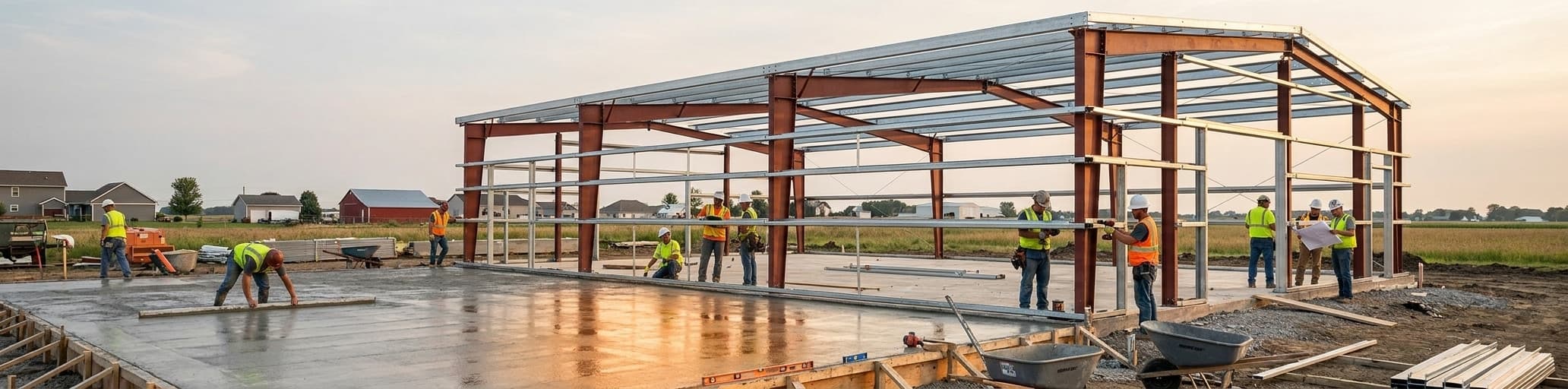

We help you understand the four major cost drivers–steel gauge, roof style, doors, and regional engineering requirements–that shape your 30×40 building quote. Knowing these variables upfront lets you compare quotes accurately and avoid budget surprises when foundation work and erection labor are factored in.
The 4 Biggest Cost Drivers That Change Your 30×40 Quote
Steel gauge, roof style, and door count drive your final 30×40 quote more than any other variables, so locking in these choices upfront saves money and prevents costly redesigns.
Steel gauge, roof style, and door configuration: which upgrades move the needle
Of all the variables inside a 30×40 kit quote, three move the final number more than any other: steel gauge, roof style, and door count.
On gauge, the standard choice is 14-gauge framing, which runs approximately 0.0747 inches thick and handles average wind and snow loads across most of the country.[15] Stepping up to 12-gauge — at roughly 0.1046 inches — adds 10 to 15 percent to framing cost, but delivers a stiffer frame under heavier loads and typically extends the rust-through warranty from 20 years to 25.[15] That premium often pays for itself in reduced repair frequency and better performance in high-wind or heavy-snow regions, where thicker galvanizing takes longer to degrade.[15] Roof style is the second lever: vertical roof panels, where the steel runs perpendicular to the ridgeline, shed rain, snow, and debris more effectively than horizontal configurations, and they carry a modest price premium over a standard boxed-eave or regular-style roof.[14] For buyers in climates with meaningful snowfall or sustained rain, the vertical option is the more defensible long-term choice because it reduces the standing-water exposure that accelerates panel wear.[14] Door configuration is the third driver, and it surprises more buyers than it should — roll-up doors, walk-in doors, and framed openings are all priced separately from the base kit, and a 30×40 building configured for multiple vehicle access points (two 10-foot roll-ups, for example) can add $1,500 to $3,000 or more depending on door type and hardware grade.[16] The practical takeaway is to finalize your door layout before requesting a quote, because adding openings after the initial design is locked in typically costs more than specifying them upfront.
For a deeper look at how galvanized framing affects your 30×40 steel barn cost per square foot, the long-term math on the gauge upgrade becomes even clearer.
Local wind, snow, and seismic requirements: engineering costs by region
Where your 30×40 sits on a map directly changes what the building must be engineered to survive — and what that engineering costs. The driving standard in 2026 is ASCE 7-22, which replaced older generalized load maps with site-specific targeting for wind, snow, and seismic hazards.[18] That shift has real dollar consequences: a standard 30×40 steel building in a moderate wind zone such as Oklahoma or Tennessee installs in the $16,000-$23,000 range, while the same footprint in coastal Florida or North Carolina carries a 15-25% premium because stricter wind and load requirements mandate heavier framing, denser secondary structure near roof edges and corners, and enhanced fastening schedules.[4] Snow load variation is equally sharp — mountain counties in Colorado can exceed 100 PSF, while ASCE 7-22 now also mandates a rain-on-snow surcharge that accounts for the sudden weight spike when rain falls on accumulated snow, a provision added after widespread roof failures in 2025.[18] Seismic exposure layers on a third cost driver: California, western Oregon, and western Washington sit near active fault systems, pushing county-level requirements for engineer-stamped lateral-load drawings that aren't standard in non-seismic markets.[17] Buildings in tornado-prone regions face an additional obligation under ASCE 7-22 Chapter 32, which introduces mandatory tornado load provisions for Risk Category III and IV structures — loads that conventional straight-line wind design does not address and that require meaningfully different framing connections.[18] The practical implication for your 30×40 budget is that a quote based on a ZIP code average rather than a full-address ASCE Hazard Tool report will miss the load values that actually govern your permit, making the quote unreliable before site conditions are even considered.[17] The table below maps regional cost impact against the primary load driver in each zone.
| Region | Primary load driver | Typical installed cost premium vs. national baseline | Engineering requirement |
|---|---|---|---|
| Inland South / Midwest (OK, TN, KS) | Wind 90-115 mph | Baseline ($16,000-$23,000 installed) | Standard engineering package |
| Coastal Southeast (FL, NC, SC) | Hurricane wind uplift | +15-25% | Reinforced C&C zones, enhanced fastening |
| Mountain West (CO, WY, MT) | Snow load 60-100+ PSF | +10-20% | Heavy-gauge frame, steeper roof pitch |
| Pacific Coast (CA, OR, WA) | Seismic lateral loads | +15-30% | PE-stamped lateral drawings required |
| Tornado corridor (TX, OK, KS, NE) | Tornado uplift (RC III/IV) | +10-20% | ASCE 7-22 Ch. 32 provisions where applicable |
For buyers comparing quotes across these regions, the 30×40 metal buildings complete guide outlines how engineering variables interact with footprint and use case to set a realistic installed price before regional load requirements are applied.
Site conditions and foundation prep: why your slab cost varies from your neighbor's
Two adjacent 30×40 builds on the same street can carry slab quotes that differ by $4,000 or more — and the gap rarely traces back to concrete commodity prices. Soil type is the primary driver.
Expansive clay, high water tables, or previously filled ground may require soil remediation, deeper compaction, or supplemental footings, each adding $3 to $10 per square foot on top of the base slab rate.[20] Frost depth compounds the variation in northern climates: footings must reach below the local frost line, which runs 36 to 48 inches in colder regions, driving up both excavation volume and concrete quantity independent of building footprint.[20] Site accessibility is a third variable that rarely surfaces in early quotes — concrete trucks have limited maneuverability, and long driveways, soft approaches, or restricted turnarounds can add mobilization cost without changing a single spec on the foundation plan.[19] Drainage is the factor most buyers discover last: a vapor barrier under the slab runs $0.50 to $1.00 per square foot, and sites with inadequate perimeter drainage typically require grading corrections that land as change orders after excavation has already begun.[20] Site conditions are, in fact, one of the least predictable cost variables and one of the most important to evaluate before committing to a budget — because poor soil does not fix itself once the forms are set.[20] A geotechnical soil report before finalizing your foundation spec is the most direct way to surface those variables before they become budget surprises; the cost of the report pays for itself the moment a soil test reveals conditions your initial quote never priced. For a full accounting of what site-specific variables add to an installed 30×40 price, the 30×40 metal agricultural building installed price guide walks through soil testing and foundation costs that standard kit quotes routinely omit.
Get an Accurate 30×40 Quote: Cost Breakdown & Next Steps
A fully installed 30×40 shell ranges from $24,000 to $60,000, with most buyers in average climates landing between $28,000 and $46,000 depending on soil, labor, and load requirements.
Cost Estimates for kit, slab, and installed totals
The most practical way to anchor your budget is to compare current market ranges across all three cost buckets rather than shopping a single headline number. A 30×40 metal building kit — frame, panels, trim, and hardware only — runs $15,000 to $25,000 at 2026 pricing.[22] Add a concrete slab at $6 to $12 per square foot for the 1,200 sq ft footprint, and the foundation line contributes $7,200 to $14,400 before a single bolt is set.[23] Stack erection, delivery, and permits on top, and a fully installed shell lands between $24,000 and $60,000 depending on region, load requirements, and finish level.[23] Buyers in average wind-snow markets typically land in the $28,000 to $46,000 range for a functional enclosed shell without interior finishing.[22] The table below maps each cost bucket to its current range so you can see which line item carries the most variability for your project.
| Cost bucket | Low estimate | High estimate | Key variable |
|---|---|---|---|
| Steel building kit | $15,000 | $25,000 | Gauge, roof style, door count |
| Concrete slab (1,200 sq ft) | $7,200 | $14,400 | Soil prep, thickness, regional labor |
| Erection, delivery, permits | $3,500 | $9,000+ | Crew scope, local code requirements |
| **Total installed (shell only)** | **$24,000** | **$60,000+** | All factors combined, no interior finish |
The per-square-foot view tells a similar story: kit-only pricing runs $10 to $25 per square foot, while a fully installed shell with slab and erection runs $20 to $50 per square foot across most of the country.[23] That spread is not noise — it reflects real differences in soil conditions, regional labor rates, engineering requirements, and door configuration. A quote at the low end of that range almost always reflects minimal load requirements, a simple door package, and favorable site conditions; a quote at the high end reflects coastal or mountain engineering, a thicker slab, and a full-scope erection contract. For a 30×40 prefab building cost estimate matched to your specific ZIP code and load requirements, National Steel Buildings provides itemized pricing that accounts for each of these variables rather than defaulting to a national average that may not reflect what your county actually requires.[21]
Real-world 30×40 project examples with actual pricing scenarios
Actual completed project data tells a more honest story than any spec sheet. Based on 178 completed 30×40 builds, the median all-in cost lands at $70,000 — a figure that sits well above the $14,000-$25,000 kit prices advertised online and reflects a finished, usable structure rather than a pile of steel panels on a truck.[24] That median, however, conceals a wide spread driven entirely by what the building includes. A 30×40 with a gravel base, one basic overhead door, and no insulation is a structurally different product from a 30×40 with a 4-inch concrete slab, two insulated overhead doors, 200-amp electrical service, LED shop lighting, and spray foam on the walls and roof deck — even though both share the same footprint.[24] Buyers who receive quotes in the $25,000-$40,000 range for an all-in 30×40 should verify scope carefully, because those numbers almost always exclude the concrete slab, electrical rough-in, and sometimes erection labor.[24] The three scenarios below map the cost spread across realistic build levels so you can identify where your project actually lands.
| Scenario | Spec level | What's included | Estimated total |
|---|---|---|---|
| Basic storage or utility building | Minimal | Gravel base, one basic overhead door, no insulation, standard erection | $29,000-$45,000 |
| Standard workshop or garage | Mid | 4-inch concrete slab, two insulated overhead doors, standard erection, basic lighting | $50,000-$70,000 |
| Full-featured enclosed shell | High | 4-inch slab, two insulated overhead doors, 200-amp service, LED lighting, spray foam insulation | $70,000-$95,000+ |
The installed cost per square foot runs $24 to $43 across the typical range, but that number is only meaningful when you know what it includes.[24] A quote at $24 per square foot on a 1,200 sq ft footprint produces a $28,800 number that looks like a deal — until the slab, electrical, and insulation invoices arrive separately. Buyers planning a year-round work environment should budget for insulation at $1.50 to $3.00 per square foot for fiberglass batt or $3.00 to $7.00 per square foot for spray foam, adding $8,000 to $28,000 on a building this size depending on the system chosen.[24] The practical takeaway from real project data is that the $70,000 median isn't inflated — it's what a functional, properly finished 30×40 steel building costs when all line items are counted and no scope is quietly excluded.[24]
How to compare quotes and avoid hidden costs when you talk to builders
The most common mistake buyers make when evaluating quotes is comparing headline numbers without verifying scope. Asking "what's your price per square foot?" is the least useful question you can put to a builder, because price per foot treats a metal building as a commodity — two buildings with the same footprint can carry different steel tonnage, engineering requirements, and included scope depending on span, eave height, loads, and door configuration.[27] A quote that omits concrete, site-specific engineering, and erection labor will always look better than one that includes them, and that gap has nothing to do with which supplier is actually offering better value.[26] Before evaluating any number, ask each builder to itemize the following line items in writing:
- Kit materials: primary frame, secondary framing, panels, trim, and hardware
- Foundation work: grading, base prep, forms, and concrete pour
- Erection labor: crew scope, lifting equipment, and anchor-bolt verification
- Engineering and permits: whether drawings are generic or site-specific and PE-stamped
- Delivery: freight charges from fabricator to your specific site address
Site-specific engineered drawings run $1.40 to $1.80 per square foot — a line item that frequently surfaces as a permit requirement after a kit-only contract is already signed.[26] Insulation and concrete together commonly double the initial kit quote, so a $15,000 advertised kit regularly lands above $30,000 once those items are counted.[26] On the contract side, metal building quotes are typically valid for only 30 days because steel, freight, and plant capacity can shift quickly — so a 30-day window protects both parties from market movement between quote and commitment.[27] The practical hedge is a deposit-and-lock approach: once scope is finalized — span, height, loads, openings, insulation — a deposit triggers a materials commitment that removes the steel portion of your package from weekly index exposure.[27] Any quote that lacks a defined scope lock, an explicit exclusions list, and separate line items for foundation, erection, and permits is quoting a structurally different product than one that includes all of those items — comparing the two on a headline number alone will produce a budget that does not survive contact with your building department or your foundation contractor.[26]
- Steel gauge, roof style, and door count are the three biggest cost drivers affecting 30×40 metal building quotes.
- Regional load requirements under ASCE 7-22 add 15-30% premiums in coastal, mountain, and seismic zones compared to baseline pricing.
- Soil type, frost depth, and site accessibility create $4,000+ slab cost variations between adjacent properties due to foundation requirements.
- A fully installed 30×40 shell with slab and erection costs $24,000-$60,000, with median real-world projects landing around $70,000.
- Quotes omitting concrete slab, electrical work, and site-specific engineering drawings will underestimate true installed costs by $15,000-$30,000.
- Insulation and concrete together typically double the initial kit-only quote, transforming a $15,000 kit into a $30,000+ project cost.
- Requesting itemized line items for kit materials, foundation, erection, engineering, and delivery is essential to compare quotes accurately.
- https://www.probuiltsteel.com/blog/30×40-metal-building-cost/?srsltid=AfmBOopAv78k24CX8CGapK-EZV9JEWuLBEUTRr550x8eX02R6djSsInh
- https://americanmetalgarages.com/30×40-metal-garage-cost-breakdown-what-you-get-and-how-it-works/
- https://www.steelstructuresamerica.com/metal-building-cost/
- https://ameribuilds.com/steel-building-costs-what-to-expect-2026/
- https://finfrock.com/how-design-build-construction-reduces-risk/
- https://cicconstruction.com/blog/single-point-of-accountability-how-design-build-delivery-eliminates-project-risk-across-multiple-markets/
- https://www.engineeredmetalbuildings.com/blog/30×40-metal-building-prices/?srsltid=AfmBOopN1jVTE2OvIBQbb3QlugE1gCnhnwgjVKBzWtn5Xxz73UCLby8W
- https://www.probuiltsteel.com/blog/30×40-metal-building-cost/?srsltid=AfmBOoocFQUZ3cO8UGXPjHFgEli5CTjvg2fV0q72_iLBaHVvw53rn0K0
- https://www.engineeredmetalbuildings.com/blog/30×40-metal-building-prices/?srsltid=AfmBOopekqSbZI1OfdbCkj95vbFtxYERBjJyDZTOJhJ6LhqW1H3no7zi
- https://www.probuiltsteel.com/blog/30×40-metal-building-cost/?srsltid=AfmBOooQmbDsIYArb6lY6aMTnw2gIxTgl_FAIFd53KMpjoNt3QXcISqS
- https://homeguide.com/costs/concrete-slab-cost
- https://www.steelcobuildings.com/how-much-does-a-30×40-steel-building-cost-in-2026/
- https://garagebuildings.com/blog/how-much-does-a-metal-garage-cost-in-2026
- https://www.engineeredmetalbuildings.com/blog/30×40-metal-building-prices/?srsltid=AfmBOoqfcoFdxOZhIp220c5ZD9RN3PLpSEU9OYINyyeWGTM2hF4V5Pkp
- https://www.coast-to-coastcarports.com/how-much-does-a-30×40-metal-building-cost?srsltid=AfmBOop7LWaNLq6era7Mu6gmFiaR5fEu-05qJhgCtSEFS_dzvtqwcBns
- https://torosteelbuildings.com/steel-building-sizes/30×40/
- https://www.engineeredmetalbuildings.com/blog/how-building-codes-and-snow-loads-impact-metal-building-price/?srsltid=AfmBOooxuAnYEjdIZCFP-NoeUntL5YtCCBQf5gGDn-c2s7ARKoScNWCV
- https://titansteelstructures.com/steel-building-engineering/designing-for-disaster-2026-wind-and-snow-load-requirements-for-metal-buildings/
- https://www.engineeredmetalbuildings.com/blog/40×60-metal-building-site-prep-concrete-slab-cost/?srsltid=AfmBOooJoggY8bqGDhgDbbWGDNEXBG1eIexazXi4OsQGDTY0oGwT2rlY
- https://www.steelcobuildings.com/40×60-steel-building-cost-what-goes-into-it/
- https://www.engineeredmetalbuildings.com/blog/30×40-metal-building-prices/?srsltid=AfmBOorkSTPUuiBJ5wfBCvunxAX1Y5M6racObURrF0jo38eadbPDe9wq
- https://www.probuiltsteel.com/blog/30×40-metal-building-cost/?srsltid=AfmBOorTSoVKWBdIYaLXS5m3UuBvaQyM0WlIeniA8vQ3yxSDORmUJb0x
- https://homeguide.com/costs/metal-building-cost
- https://www.engineeredmetalbuildings.com/blog/30×40-metal-building-prices/?srsltid=AfmBOoriQ5UQrPFcidtEyFmctvvDGAyLXnzSHZyWzfLx5PZ1Fv5mbAJC
- https://www.buildingsguide.com/metal-building-prices/?srsltid=AfmBOop6C2D4I7P362RjgtSjdRYjsy342nJBS78iRVt0lzkY11oAPQto
- https://metal-america.com/the-hard-truth-about-steel-building-cost/
- https://www.tylerbuilding.com/post/2026-metal-building-cost-variables