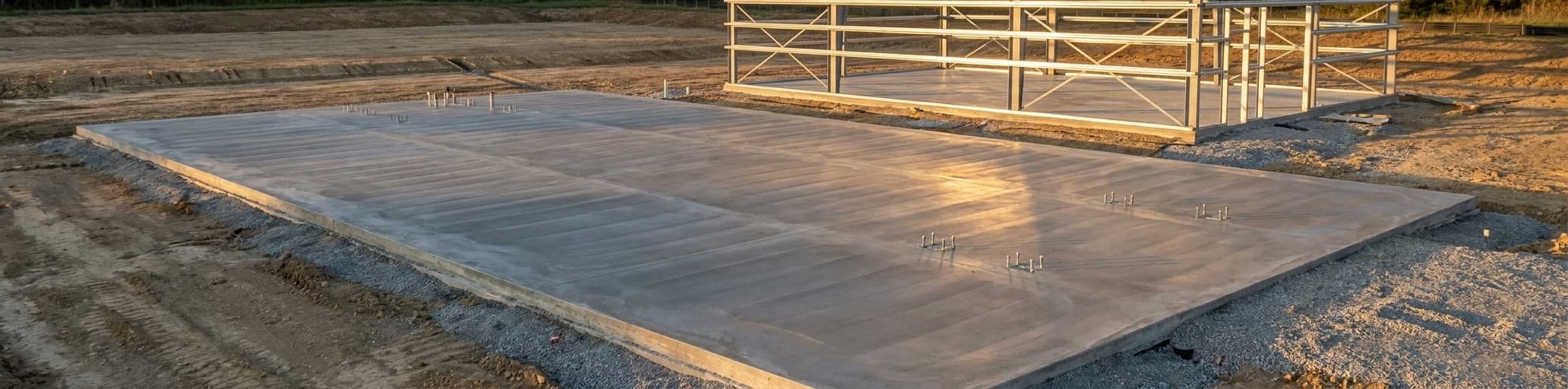

A 30×40 metal building kit costs $15-$25 per square foot, but fully installed pricing ranges $25-$50+ when you factor in foundation, labor, and site work–variables we help you understand before requesting quotes.
Complete Cost Breakdown: Building Shell, Slab, and Installation
A standard 30×40 kit runs $18,000 to $30,000, but concrete, permits, electrical, and doors cost extra–so understand what's excluded before comparing quotes.
30×40 steel building package cost: base structure and framing
A standard 30×40 steel building kit covers the primary steel frame, 26-gauge roof and wall sheeting in your chosen color, trim, fasteners, and a J-bolt anchor kit — plus engineered, stamped drawings calibrated to your local wind and snow load requirements.[6] What it does not cover is equally important to understand before comparing quotes: concrete foundation, permits, site grading, electrical and plumbing rough-in, insulation upgrades, and any doors or windows beyond the base package are all separate line items.[6] Frame gauge is the single biggest structural variable inside the package price.
A 12-gauge frame is heavier, spans longer distances without interior columns, and suits permanent commercial or barndominium-ready applications, while a 14-gauge frame works for shorter spans and basic storage uses — and the cost difference between the two can shift the kit price noticeably for a 1,200-square-foot footprint.[6] Sticking to a standard 30×40 footprint works in your favor here: non-standard dimensions such as 28×34 trigger custom engineering fees that standard sizes avoid entirely, so the 30×40 is one of the most cost-efficient footprints to specify.[5] In 2026, hot rolled coil steel is trading near $1,002 per short ton, and active Section 232 tariffs — running 25 to 30% on imports from key trading partners — are keeping domestic kit pricing elevated compared to prior years, which makes locking in a quote with a deposit worth doing before mid-year price adjustments hit.[5] Basic kit prices range from $15 to $25 per square foot in 2026, putting the 30×40 metal building kit package between roughly $18,000 and $30,000 before any site or foundation work begins.[5]
Concrete slab cost for a 30×40 footprint: site prep, materials, and labor
Installation and erection costs: why National Steel Buildings's in-house ProTrades division changes the equation Erection labor is not a minor add-on. At $6 to $12 per square foot for standard structures in 2026, it represents 25 to 40% of your total project cost — and complex builds can push that range to $15 to $18 per square foot.[4] For a 30×40 footprint, that translates to $7,200 to $14,400 before a single panel goes up. The real exposure, though, isn't the line item itself; it's what happens when the manufacturer and the erection crew are two separate companies.
You absorb the coordination risk between them. Scope disputes, scheduling gaps, and differing interpretations of stamped drawings are the most common reasons metal building projects run over budget and over schedule — not material costs.[9] National Steel Buildings' in-house ProTrades division eliminates that gap. Kit design, fabrication, and erection stay under one roof and one contract, so there is no handoff to manage and no finger-pointing between trades when a problem surfaces.
Factory-fabricated components arrive pre-cut, pre-drilled, and pre-welded, allowing field crews to bolt rather than weld — cutting field labor hours by 25 to 40% compared to conventional structural steel erection.[4] That efficiency flows directly to your budget, and single-source accountability means one call resolves any issue, from anchor bolt placement to final panel alignment, without waiting for two contractors to agree on whose scope it falls under.[9]
Cost Factors That Move Your Quote Up or Down
Finalizing every door, window, and opening before manufacturing begins protects your budget and timeline from costly engineering revisions down the line.
Roof style, doors, and openings: where most price surprises happen
Roof style is the first variable separating a base quote from your actual build cost. Standard low-pitched gable roofs are the most cost-effective option — faster to manufacture and simpler to engineer — while custom shapes, multiple rooflines, or steeper pitches add fabrication and engineering costs that compound quickly even on a 1,200-square-foot footprint.[10] Eave height works the same way: taller walls require more steel and raise erection labor, yet most base quotes don't price the upgrade unless you specify the height explicitly.[10] Both decisions lock in early in the design process and are difficult to reverse later without triggering engineering revision fees.
Doors and openings are where budget surprises hit hardest, because advertised kit prices almost never include them. Most owners spend an additional 15 to 20% of their kit price on accessories and openings once they configure the building for actual use.[10] Every roll-up door, walk door, or window cuts into the structural panel layout, requiring header framing and opening-specific engineering not captured in the base package.[11] Windows follow the same pattern — each one means removing a panel and adding a framed rough opening, plus trim and flashing to seal it against weather.[11] The practical rule: finalize every door size, location, and opening count before placing your order, because changes after manufacturing begins are costly and push your project timeline out — two outcomes that hurt both your budget and your schedule.[10]
Local wind, snow, and seismic requirements: engineering and permit costs by region
Wind, snow, and seismic loads are the three code variables that push engineering and permit costs beyond what any base quote captures — and all three are site-specific, governed by the IBC edition your local jurisdiction has adopted.[13] Design wind speed under ASCE 7 sets the pressure your frame, wall panels, connections, and anchor bolts must resist, while your exposure category — B for suburban or wooded terrain, C for open fields or airfields, D for coastal sites with unobstructed water — multiplies that pressure before any structural calculation begins.[13] Moving from Exposure Category B to D requires heavier steel frames, tighter purlin spacing, higher fastener counts, and larger anchor bolt patterns across the entire structure.[13] Coastal markets — Florida, the Carolinas, Gulf Coast states — absorb this most directly: stricter wind and load requirements add 15 to 25% to total installed pricing compared to inland wind-zone markets like Oklahoma or Tennessee.[5] Snow load follows the same compounding logic: ground snow (Pg) drives a derived roof snow value (Pf) that sets frame weight and purlin count, and in heavier load zones can force a structure from cold-formed framing into a rigid frame solution — a meaningful cost jump even on a 1,200-square-foot footprint.[13] Seismic Design Category (SDC) hits hardest on the West Coast and in pockets of the central U.S.; jurisdictions like Portland, Oregon, classify every site within city limits as SDC D under state structural code, requiring specific bracing layouts, base plate detailing, and hold-down engineering that standard non-seismic regions skip entirely — adding engineering scope regardless of building size.[12][13] These load requirements feed directly into permit fees: standard jurisdictions charge $550 to $2,000 for commercial permits, but major metros or seismically active markets reach $7,500 before structural plan review or geotechnical report requirements are layered on.[5] The 2024 IBC's new ASCE 7-22 tornado provisions add another regional variable — jurisdictions that have adopted the 2024 code now mandate heavier connections and structural components for certain Risk Category buildings in tornado-prone zones, a requirement that never appears on a base quote and can shift structural steel weight noticeably on a 30×40 red iron frame.[5]
| Region | Primary load driver | Cost impact on a 30×40 build |
|---|---|---|
| Coastal FL, NC, Gulf Coast | Wind (Exposure C/D) | +15-25% over inland baseline [5] |
| Pacific Northwest (Portland, OR) | Seismic SDC D | Engineering review mandatory; bracing and hold-down added [12] |
| Upper Midwest, New England | High ground snow (Pg) | Heavier frame; rigid frame may replace cold-formed [13] |
| Central U.S. tornado zone | 2024 IBC ASCE 7-22 provisions | Heavier connections; structural steel weight increase [5] |
| Inland South (TN, OK) | Standard wind zone | Base installed pricing range applies [5] |
The practical takeaway: confirm which IBC edition your authority having jurisdiction (AHJ) has adopted, then ask specifically for the design wind speed (Vult or Vasd), exposure category, ground snow load (Pg), seismic design category, and frost depth before accepting any quote.[13] Packaging those criteria onto a single page and sending identical specs to every supplier is the only way to generate apples-to-apples proposals — and it shortens permit review by eliminating resubmittals caused by mismatched code assumptions.[13]
Site conditions and foundation prep: soil testing, drainage, and grading impact
Of all the variables that inflate a 30×40 metal building with concrete slab cost, site conditions are the most unpredictable — and the most punishing when ignored. Professional soil testing costs $500 to $2,000 but regularly prevents foundation failures that run into the tens of thousands to correct after the fact.[15] A geotechnical engineer pulls samples at multiple depths and measures three things that directly control your foundation design: bearing capacity, moisture content, and expansion potential.[15] Sandy and gravelly soils typically support 2,000 to 3,000 pounds per square foot, making them straightforward to build on; expansive clay soils swell when wet and shrink when dry, cracking slabs and stressing column connections in ways that standard pour schedules never anticipate.[15] High water tables reduce bearing capacity and may force the foundation deeper or require perimeter drainage systems before a single form board is set.[15] Skipping the soil test to save a few hundred dollars is one of the most documented and costly mistakes in metal building construction — one owner's 60×80 project absorbed an $18,000 redesign and a six-week delay after expansive clay showed up in a soil report ordered only after the original foundation plan was already drawn.[15]
Site preparation bills separately from the concrete pour and adds up to $1.25 per square foot to your 30×40 project depending on how much clearing, grading, and leveling the ground requires — up to $1,500 before any concrete work begins.[14] Properties with significant slope or rocky soil can double those preparation costs as excavation equipment replaces hand grading.[14] Once the site is cleared of vegetation, topsoil, and organic debris, rough grading establishes drainage patterns: the finished pad must slope away from the building in every direction so water doesn't accumulate at the perimeter and undermine the slab edge over time.[15] The compacted gravel base beneath the slab — typically 4 to 6 inches deep — must be placed in lifts and compacted to at least 95% of maximum density before the next lift is added; insufficient compaction is the direct cause of settlement and cracking that hand tamping alone cannot prevent.[15] Frost depth is the final site variable: in northern climates, the foundation must extend below maximum frost penetration — as deep as 48 inches in some regions — or soil expansion during freeze cycles will heave and crack even a well-reinforced slab.[15] Each of these conditions, when discovered late, adds cost that no base quote reflects.[16]
30×40 Metal Building Cost Comparison Tool and Next Steps
Your 30×40 quote will shift significantly based on clear span width, regional labor rates, and site-specific loads–so gather your specs and zip code before requesting estimates.
Cost estimator: input your specs and see real-time pricing (unique element: NSB's custom quote engine)
The inputs that move a 30×40 quote from its low estimate to its high end fall into four categories: building dimensions and clear span requirements, gauge and frame system, site-specific load data, and erection method.[17] A pre-engineered metal building kit runs $15 to $25 per square foot for materials alone; the fully installed price — including foundation, labor, and site work — ranges from $25 to $50 per square foot or higher once all variables are priced.[17] Clear span width is the single biggest frame-weight driver: wider spans require heavier primary frames, which increases material tonnage and erection labor simultaneously.[19] Design complexity compounds this effect — high clear spans, mezzanine floors, or crane rail support require advanced engineering and more robust framing, adding cost at both the fabrication and field stages.[19] Erection labor is calculated against structure size, steel weight, crane and rigging time, and local compliance requirements — including OSHA fall protection and whether the market is union or non-union.[18] Regional labor rates alone can shift total installed pricing by 20% or more for the same footprint, making zip code one of the most consequential inputs on any quote form.[17] Before contacting a supplier for a 30×40 prefab building cost estimate, have these spec inputs ready in writing:
- Building dimensions: length, width, and eave height
- Intended use: storage, commercial, agricultural, or residential
- Required clear span and any interior column restrictions
- Door count, sizes, and locations — including overhead, walk, and overhead clearance requirements
- Insulation specification, if any
- Local design wind speed, ground snow load, and seismic design category
- Site address and jurisdiction for permit baseline
Pre-engineered metal buildings can be assembled in 4 to 12 weeks depending on size, complexity, and site preparation — a timeline that compresses when every spec input is confirmed before the order is placed, eliminating redesign loops that push delivery dates and reopen budget questions.[19] Gathering every variable on a single page before reaching out also lets you send identical spec packages to multiple suppliers, making proposals directly comparable rather than requiring line-by-line reconstruction to find what each quote includes or omits.[17]
Why single-source turnkey projects save time and hidden costs
The financial case for a single-source approach starts with one hard number: hiring a general contractor to coordinate separate trades adds 10 to 20% to your total project cost — on a $45,000 30×40 metal building with concrete slab, that markup alone runs $4,500 to $9,000 before a single coordination problem surfaces.[5] Turnkey providers absorb that overhead internally because design, procurement, fabrication, and installation are managed under one contract rather than handed off between separately invoiced parties.[20] The cost exposure that matters most, though, isn't the GC markup — it's the financial risk of scope disputes between trades.
When the steel kit manufacturer and the concrete or erection crew are separate companies, any ambiguity in the drawings, any change to anchor bolt placement, or any schedule gap between the foundation pour and the kit delivery becomes your problem to resolve, not theirs.[20] A turnkey provider, by contrast, takes full responsibility from site assessment through final inspection, absorbs overrun risk tied to unforeseen conditions, and maintains a single point of contact so that problems are resolved between internal teams rather than across separate contracts with competing interests.[20] That accountability structure also accelerates the schedule: without waiting for two or three vendors to agree on whose scope an issue falls under, field decisions get made and documented in hours rather than days — which matters when concrete cure time and kit delivery windows have to align on a tight 4-to-12-week assembly timeline.[5] The practical outcome for your budget is transparent: fixed-scope agreements prevent the cost escalations that multi-contractor projects routinely produce when one trade's delay triggers overtime charges for another.[20]
How to get an accurate, itemized quote from National Steel Buildings
Getting an accurate quote starts with what you bring to the conversation. Contractors with decades in the industry consistently flag the same root cause behind quotes that miss actual project costs: incomplete specifications submitted by the owner, which leave suppliers to fill gaps with assumptions that favor a lower number.[22] Before contacting any supplier, write down your complete project specifications — building dimensions, intended use, required clear span, door count and sizes, insulation needs, local design wind speed, ground snow load, seismic design category, and the site address for permit baseline.[17] Submitting identical spec packages to every supplier is the only way to generate proposals you can compare on equal terms; otherwise you're reconciling different assumptions across different quote formats instead of comparing prices.[21]
When a quote lands in your inbox, the right questions separate a reliable estimate from a number designed to get a signature:[21]
- Ask for a line-item breakdown separating the steel kit, concrete foundation, erection labor, delivery, permits, and optional upgrades — a lump-sum number with no itemization is a direct warning sign regardless of how competitive it looks.[17]
- Confirm what is explicitly excluded; site grading, utility connections, and door or window upgrades are the most common line items omitted from base proposals.[21]
- Ask whether the contractor handles concrete work directly or subcontracts it — when the concrete crew and the steel erection crew are separate companies, any anchor bolt discrepancy or scheduling gap becomes your problem to arbitrate, not theirs.[22]
- Request stamped, engineered drawings calibrated to your local code requirements and confirm that permit procurement is included in the contract scope.[21]
- Get warranties on materials and workmanship in writing, along with the full payment schedule, before signing anything.[21]
National Steel Buildings provides itemized, spec-specific quotes that separate every cost tier — kit, foundation, erection, and site work — under one contract, so the number you approve at the start is the number that holds through final inspection, without coordination gaps between trades that reopen the budget conversation mid-project.[22]
- A 30×40 metal building kit costs $15-$25 per square foot for materials, but fully installed with foundation and labor ranges $25-$50+ per square foot depending on variables.
- Erection labor represents 25-40% of total project cost at $6-$12 per square foot, making coordination between kit manufacturer and installation crew critical to budget control.
- Doors, windows, and openings typically add 15-20% to kit price and require header framing and opening-specific engineering not included in base quotes.
- Coastal regions face 15-25% higher costs due to wind exposure requirements, while seismic zones and high snow areas require heavier frames and additional engineering.
- Soil testing costs $500-$2,000 but prevents foundation failures costing tens of thousands; skipping it is one of the most documented costly mistakes in metal building construction.
- Site preparation costs $1.25+ per square foot and includes clearing, grading, compacted base installation, and drainage–often doubled on sloped or rocky terrain.
- Submitting identical specifications to multiple suppliers and requesting itemized breakdowns separating kit, foundation, labor, and permits prevents budget mismatches and hidden costs.
- https://www.arkansasmetalstructures.com/blog/30×40-metal-building-cost-with-concrete-slab/?srsltid=AfmBOopFMzV1ODoBq_oprOq9mmsoWvdk69Km-2OmZhsw568_1kUpKuhx
- https://gsmbuildings.com/resources/blog/how-to-find-a-metal-building-contractor-in-2026/
- https://www.ltjindustrial.com/fabrication-quote/
- https://terrapincg.com/news/pre-engineered-metal-building-cost-per-square-foot-usa
- https://ameribuilds.com/steel-building-costs-what-to-expect-2026/
- https://www.northtexassheds.com/steel-building-cost-guide
- https://www.homeadvisor.com/cost/outdoor-living/concrete-slab/
- https://www.barndominiumlife.com/how-much-does-a-30×40-concrete-slab-cost/
- https://homeguide.com/costs/morton-building-cost
- https://www.cascadingfallsinc.com/what-do-prefab-metal-building-cost-to-construct
- https://iconsteelbuildings.com/30-x-40-metal-building-kits/
- https://www.portland.gov/ppd/structural-engineering/commercial-structures
- https://metalbuildingsguide.com/loads-codes
- https://metalstructuresales.com/steel-building-installation-cost/
- https://mbmisteelbuildings.com/blog/steel-building-foundation/
- https://www.btsteel.net/blog/the-real-deal-on-agricultural-metal-building-cost-a-comprehensive-guide
- http://www.247pro.com/blog/the-ultimate-guide-to-steel-building-cost-estimation-from-initial-quote-to-grand-projects
- https://steelestimatingsolutions.com/steel-erection-cost-estimator/
- http://www.247pro.com/blog/step-by-step-guide-to-estimating-the-cost-of-pre-engineered-metal-buildings-pembs-and-steel-structures
- https://www.bricknbolt.com/blogs-and-articles/construction-guide/contractor-vs-turnkey-home-construction-guide
- https://homeguide.com/costs/metal-building-cost
- https://www.btsteel.net/blog/how-to-choose-a-commercial-metal-building-contractor