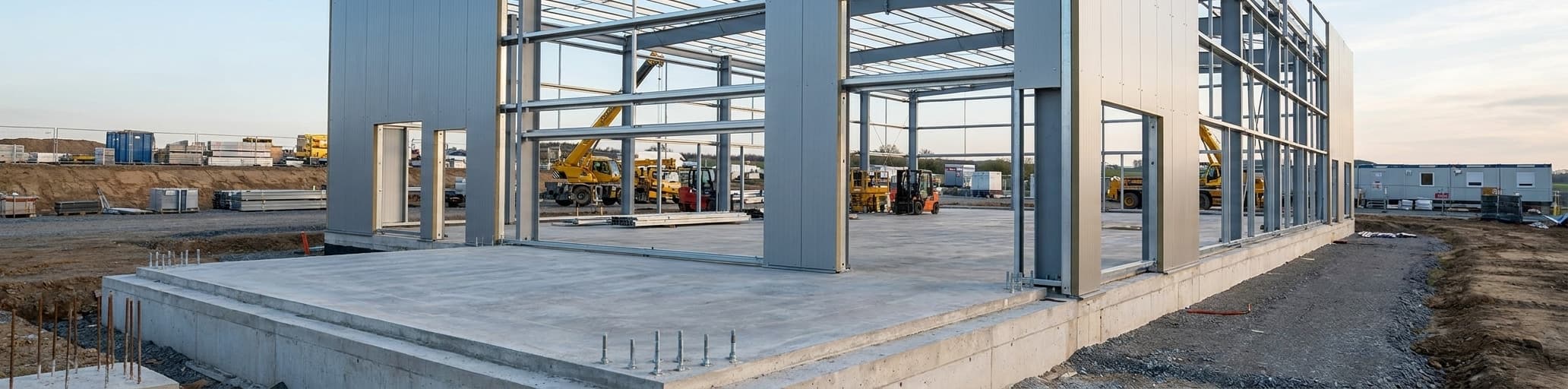

A 40×40 metal building costs $32,000 to $72,000 turnkey with slab, but hidden expenses in site prep, permits, and coordination often double initial quotes. Working with a single-source provider eliminates those surprises by consolidating engineering, fabrication, and erection under one accountable contract.
40×40 Metal Building Cost in 2026: Direct Pricing & What's Included
A 40×40 metal building with slab typically costs $32,000-$72,000 installed, but hiring separate contractors for each phase leaves you managing coordination risk yourself.
Average shell cost and installed turnkey pricing with concrete slab
A 40×40 metal building covers 1,600 square feet of clear-span interior space,[2] and pricing breaks into three distinct layers: the kit, erection labor, and the concrete slab. Metal building kits run $10 to $25 per square foot,[1] putting a 40×40 shell between $16,000 and $40,000 before assembly begins.
On-site erection adds $5 to $10 per square foot,[1] meaning another $8,000 to $16,000 on top of materials, which brings a fully erected shell to roughly $24,000-$56,000 depending on complexity. A standard concrete slab for the full footprint runs $5 to $10 per square foot installed,[1] adding $8,000 to $16,000 and pushing the total turnkey 40×40 metal building cost with slab into the $32,000-$72,000 range.
Where a project lands inside those figures depends on eave height, door and window count, local labor rates, and site conditions like grading or soil work required before the pour.
How National Steel Buildings's single-source approach affects your total investment
Most metal building manufacturers quote only the steel shell itself — framing, panels, and fasteners — while site grading, concrete, permitting, and utility rough-ins sit entirely outside that number.[5] That gap matters because those excluded line items routinely represent a significant share of a project's final cost, and when you hire separate contractors for each phase, you inherit the coordination risk yourself.[5] Every hour you spend vetting a concrete sub, chasing a grading crew, or reconciling conflicting schedules between trades is time not spent running your business.[5] A single-source provider like National Steel Buildings absorbs that coordination burden under one contract, which changes the risk math entirely: rather than a supplier whose responsibility ends at delivery, you work with a contractor accountable for the full scope — engineering coordination, fabrication, site erection, and interface management across all phases.[4] That broader accountability is why turnkey steel building contracts tend to eliminate the hidden costs that surface when multiple parties each optimize for their own scope rather than the project as a whole.
Single-source pricing typically runs higher upfront than a kit-only quote, but it delivers greater cost certainty by reducing the change orders and coordination failures that inflate budgets on split-responsibility projects.[4] Projects where one entity manages engineering, procurement, and construction consistently achieve better on-budget outcomes than those where coordination responsibility is shared or undefined.[5]
Cost breakdown: what changes price between kit-only and fully erected buildings
The clearest way to understand the cost difference between a kit-only and a fully erected 40×40 metal building is to look at where labor sits in the total bill. On the concrete side alone, labor accounts for 40% to 50% of the installed slab price, with materials covering the remaining 50% to 60%.[6] That same logic extends to the steel structure: a kit quote covers fabricated panels, framing members, and fasteners — nothing more.
The moment you add an erection crew, slab work, and site prep, you are paying for two entirely different scopes. Concrete slab installers charge $3 to $5 per square foot for labor on a standard pour,[6] and that's before any grading is done.
Site leveling adds $0.40 to $2.00 per square foot depending on how much material must move,[6] while a gravel base to prevent shifting and cracking runs $1 to $3 per square foot on top of that.[6] Stack those line items against a raw kit price and the gap between what a kit costs and what a building actually costs becomes concrete — sometimes doubling the initial number before a single steel panel goes up.
Foundation and Concrete Slab Requirements for 40×40 Buildings
A standard 4-inch concrete slab costs $8,000 to $12,800 for your 40×40 building, but soil prep and reinforcement can add $6,400 to $7,200 more.
Standard 4-inch slab specifications and soil preparation costs
For a 40×40 metal building used as a garage, workshop, or light storage facility, a standard 4-inch slab is the baseline spec — suitable for light-duty commercial loads and priced at $5 to $8 per square foot installed.[7] At 1,600 square feet, that puts your slab material and labor between $8,000 and $12,800 before soil work begins.
Concrete mix matters here: a 3,000-3,500 PSI mix covers most light-duty applications,[7] while heavier equipment or vehicle traffic pushes the requirement to 4,000 PSI or above, adding $20 to $50 per cubic yard to material costs.[7] Reinforcement adds another layer to the budget — wire mesh runs $0.50 to $1.00 per square foot, while rebar at standard spacing costs $1.00 to $2.00 per square foot more.[7] Soil preparation is where budgets often get surprised: site grading and compaction alone runs $1.00 to $2.50 per square foot, a gravel base adds $1.00 to $1.50 per square foot, and a moisture barrier beneath the slab costs another $0.50 to $1.00 per square foot if site conditions warrant it.[7] Add all three soil prep line items to the base slab cost and the ground-up total for a ready-to-build 40×40 pad can reach $14,400 to $19,200 — before a single steel panel arrives on site.
Why slab thickness and local frost depth matter to your budget
Slab thickness and frost depth are the two variables that most frequently blindside buyers once a project is underway, because both are location-specific and neither shows up in a generic kit quote.
The baseline industry spec — a 4-inch slab at 3,000 PSI — is adequate for light-use applications like personal storage and carports, but it is not designed for vehicle traffic, forklifts, or equipment loads.[8] Upgrading to a 6-inch slab adds roughly $1,500 to $3,000 to a 1,600-square-foot pour; remediating a cracked slab after the building is erected starts at $10,000.[8] Frost depth compounds the cost calculation in a different direction.
In moderate-to-warm climates, a monolithic slab — poured in a single operation with integrated thickened edge footings — passes inspection and carries a lower price point.[8] In northern states, however, frost depth can reach 48 inches or deeper, and the International Building Code requires footings to extend below that line.[8] A monolithic slab will not pass inspection where deep frost footings are required, which means buyers in colder climates must budget for a stem wall foundation instead — a more labor-intensive system where the footing and interior slab are poured as separate operations.[8] What works structurally in Texas will not meet code in Minnesota, because ground conditions and frost line requirements differ entirely between those markets.[9] Slab design is not a single national standard but a locally engineered specification, and a buyer who prices a project using generic per-square-foot figures without knowing the local frost depth is working with an incomplete budget.
National Steel Buildings's integrated site assessment process
The most persistent source of foundation problems in metal building projects is not technical — it is organizational.[8] The typical failure sequence runs like this: you order the building from a manufacturer, hire a concrete contractor separately, and the manufacturer's foundation drawings either arrive late, get filed without review, or get overridden by the concrete crew's field experience.[8] The result is a slab that is close but not correct — and anchor bolt misalignment alone can prevent a column from seating properly, leaving you with core drilling, base plate modifications, or a partial repour as your only recovery options.[8] A proper site assessment breaks that sequence before it starts.
Before any forms are set, the process requires checking natural slope, identifying soil drainage patterns, marking high and low points across the building footprint, and determining whether soil conditions warrant a geotechnical evaluation.[11] Expansive clay soils, for instance, demand that organic material be removed and replaced with granular fill — a step that only surfaces during assessment, never during the pour.[10] The Metal Building Manufacturers Association has documented that foundation-related issues account for a disproportionate share of post-construction warranty claims, and the root cause is almost always the same: the slab was designed independently of the building, without referencing the actual loads, anchor patterns, and site conditions the structure requires.[8] An integrated approach puts the manufacturer's foundation drawings in the concrete contractor's hands before forms are set, coordinates anchor bolt placement against the building's specific column layout, and verifies site grading and compaction standards — the 2% slope away from the foundation that most codes require and that most generic kit quotes never mention.[11] That sequence does not add cost; it eliminates the change orders and remediation bills that show up when coordination responsibility is split between parties who each optimize for their own scope.
40×40 Building Specifications: Height, Roof Style & Customization Options
Your choice of roof style–gable, lean-to, or gambrel–directly affects both structural engineering complexity and long-term maintenance costs on a 40×40 building.
Standard eave heights (12, 14, 16 feet) and how they affect usable space
Common roof styles: gable vs. lean-to vs. gambrel and their cost implications Roof style is one of the few decisions on a 40×40 metal building that affects both structural engineering complexity and long-term maintenance cost simultaneously.
The gable roof — two sloped sides meeting at a center ridge with overhanging awnings — is the default choice across commercial, agricultural, and industrial applications because its geometry sheds rain and snow efficiently without requiring specialized framing.[13] A lean-to, also called a mono-slope roof, uses a single continuous surface pitched in one direction; it costs less to engineer and erect than a gable because the framing is simpler, making it a practical choice for additions, agricultural storage, and buildings where one wall needs to remain open or lower.[13] The gambrel style — four roof faces in the classic barn profile — maximizes usable vertical volume inside the building envelope, which is why it appears on farming structures where loft storage or hay capacity matters more than minimizing structural cost.[13] Standard roof pitches run 2:12 and 4:12, which keep engineering straightforward and material quantities predictable; steeper pitches like 6:12 or custom angles are available when snow load requirements, aesthetics, or interior clearance demand them, but each step up in pitch adds framing complexity and panel quantity to the material bill.[13] Pitch drives cost through framing weight, and roof style drives cost through engineering complexity — a lean-to on a simple addition sits at one end of the range, and a steep-pitch gambrel with monitor venting sits at the other.
Custom engineering for loading requirements, door placement, and ventilation
Standard eave heights and roof styles get most of the attention at the quoting stage, but loading requirements, door placement, and ventilation are what actually drive the structural engineering behind a 40×40 building.
Bay spacing — the distance between primary frames — is typically set at 20 to 25 feet, but adjusting it is a routine engineering decision triggered by where doors need to land or what loads the structure must carry.[13] A wide roll-up door on a 40-foot sidewall, for instance, may require a bay reconfiguration to keep the header framing out of the opening, and that change cascades into the column schedule and anchor bolt pattern.[13] On the load side, certified engineering can accommodate wind gusts up to 180 mph and snow loads up to 90 pounds per square foot, which means the framing weight and connection details change substantially between a mild Gulf Coast climate and a northern mountain location — two buildings with identical footprints but entirely different structural specifications.[13] Ventilation follows its own logic: a monitor roof — a raised center section running the ridge line — is the most effective passive solution for a 1,600-square-foot interior, because it creates a high exit point for heat and humidity that sidewall vents alone cannot match.[13] Ridge vents and windows added to the monitor section work together to pull air through the building without mechanical systems, which matters for workshops, agricultural storage, and any application where fumes, moisture, or summer heat accumulates under the roof.[13]
40×40 Metal Building Cost Comparison Tool: Calculate Your Project Budget
A 40×40 metal building ranges from $16,000 for a shell kit to $232,000 fully customized, with your actual cost determined by which components you handle yourself.
Cost estimator: shell vs. turnkey vs. fully customized configurationsA 40×40 metal building breaks into three distinct price tiers depending on how much of the project scope you take on yourself.[1] The shell-only kit — framing, panels, and fasteners — runs $10 to $25 per square foot, putting a 1,600-square-foot package between $16,000 and $40,000 delivered.[1] That number covers nothing beyond raw materials: no erection labor, no slab, no permits, no site prep.[1] Adding on-site assembly pushes the per-square-foot cost up by another $5 to $10, bringing a fully erected shell to $24,000-$56,000 before any concrete work begins.[1] Turnkey pricing bundles the kit, erection, and a concrete slab into a single contract; at that scope level, the shell and assembly together represent roughly 30% of the total project cost, with site prep and finishing accounting for the remaining 70%.[1] A fully customized configuration — interior finishes, insulation, electrical, and HVAC included — lands between $50 and $145 per square foot for the completed structure, or $80,000 to $232,000 for a 40×40 footprint built to occupancy standards.[1]
| Configuration | Scope included | 40×40 cost range |
|---|---|---|
| Shell kit only | Panels, framing, fasteners | $16,000-$40,000 |
| Erected shell | Kit + erection labor | $24,000-$56,000 |
| Turnkey with slab | Kit + erection + concrete slab | $32,000-$72,000 |
| Fully customized | Kit + erection + slab + insulation, finishes, utilities | $80,000-$232,000 |
Real-world pricing examples for common 40×40 applications (garage, workshop, storage, agricultural)
Application type drives price more than almost any other variable on a 40×40 project, because the door count, enclosure level, and structural spec each shift based on what the building actually needs to do. On the garage end of the range, a 40x40x12 all-vertical metal building with three garage doors, a walk-in door, and eight windows starts at $55,519 — a fully enclosed, move-in-ready configuration.[14] Step down to a 40x40x14 vertical roof commercial building with a simpler framing spec and the starting price drops to $30,663, which reflects fewer standard inclusions rather than lower quality.[14] For the parking question that comes up constantly: a 40×40 floor plate fits three full-size vehicles parked side by side without issue; switch to a tandem layout with smaller cars and the same 1,600 square feet can handle up to six.[14]
For workshop and light manufacturing use, the enclosed all-vertical package justifies its higher starting price because the included window and door configuration handles natural light, airflow, and personnel access from day one — add-ons that cost extra on stripped-down configurations.[14] Agricultural storage shifts the equation in a different direction: an open-sided 40×40 vertical roof commercial building with double ladder legs is the practical spec for agribusiness machinery, hay bales, and drive-through loading, because full enclosure adds cost with no functional benefit for those applications.[14] On the pole barn side of the comparison, a 40x40x12 kit starts at $16,600 and a 40x40x14 kit at $17,650 — lower upfront kit costs than a comparable steel building, but those figures are materials-only and exclude erection, concrete, and site prep the same way steel kit quotes do.[15] The 20-year maintenance cost gap between steel farm buildings and pole barns is where the installed price difference between the two systems tends to close and then reverse.
Why working directly with National Steel Buildings eliminates hidden fees and change orders
The clearest way to understand where hidden fees originate is to read a standard kit supplier's contract.
The price on a typical building order explicitly excludes taxes, transportation, unloading at the job site, permit fees, and any costs arising from change orders — meaning the number on the first page covers none of the line items that determine what a project actually costs.[18] Change order exposure sits on top of that baseline: under standard kit supplier terms, every revision to a signed order generates a separate repriced document, and any materials fabricated before a change order is countersigned remain the buyer's financial obligation regardless of whether the change is accepted.[18] Suppliers who disclaim installation responsibility entirely compound the risk further — when erection, foundation engineering, and site prep each fall to third-party contractors sourced independently by the buyer, any dealings with those contractors are conducted solely at the buyer's own risk and expense, with no recourse to the kit supplier.[18] The practical consequence is that anchor bolt misalignment, late foundation drawings, or a slab poured to the wrong spec become the buyer's remediation problem — not the manufacturer's.
Industry data confirms the pattern: buyer disputes in the prefabricated building sector consistently trace back to ambiguous contract language around change orders and delivery terms, not defective materials.[17] The root cause is structural — when no single party owns the full scope, each trade optimizes for its own contract rather than the project outcome, and the gaps between scopes become where budgets leak.[16] Foundations, permits, site prep, and even unloading the steel from the delivery truck are routinely absent from quotes marketed as all-in, and exclusions built into supplier contracts function as a revenue mechanism rather than an oversight.[16] Working directly with National Steel Buildings under a single-source contract closes those gaps: one entity manages engineering coordination, fabrication, and erection under one agreement, which removes the handoff points where hidden costs originate and eliminates the change orders that inflate split-responsibility projects every step of the way.
- A 40×40 metal building shell kit costs $10-$25/sq ft ($16,000-$40,000), but adding erection labor and concrete slab brings total turnkey cost to $32,000-$72,000.
- Foundation and concrete slab costs often surprise buyers because soil prep, grading, and local frost depth requirements are location-specific and rarely included in initial kit quotes.
- Single-source turnkey contracts eliminate hidden costs and coordination failures that occur when multiple contractors optimize for their own scope rather than project outcomes.
- Slab design varies by climate: monolithic slabs work in warm regions, but northern states require stem wall foundations due to frost depth requirements reaching 48+ inches.
- Roof style and bay spacing decisions directly impact structural engineering complexity and cost; gable roofs are standard, while lean-to designs cost less but limit functionality.
- Standard kit supplier contracts explicitly exclude taxes, transportation, permits, and change orders, making the quoted price substantially lower than actual project costs.
- A 40×40 footprint accommodates three full-size vehicles parked side-by-side or up to six vehicles in tandem layout, with application type determining door count and enclosure needs.
- https://homeguide.com/costs/metal-building-homes-cost
- https://metalprobuildings.com/is-a-40×40-metal-building-right-for-you-uses-layouts-cost-breakdown/
- https://builtmammoth.com/how-much-does-a-steel-building-cost/
- https://xtdsteel.com/steel-structure-company/steel-contractor-vs-supplier/
- https://www.plcconstruction.com/epc-vs-design-build-whats-right-for-industrial-projects/
- https://homeguide.com/costs/concrete-slab-cost
- https://www.evensonconcrete.com/news/commercial-concrete-slabs-costs
- https://www.constructionowners.com/insights/concrete-slab-specifications-for-pre-engineered-metal-buildings-and-what-the-data-shows
- https://metal-america.com/accurate-concrete-prices-for-metal-buildings/
- https://lococoncrete.com/metal-building-concrete-slabs/
- https://metalprobuildings.com/drainage-grading-tips-for-steel-building-sites/
- https://www.carportsadvisor.com/40×40-metal-building?srsltid=AfmBOopecHDDHv2kcwRgJt9xPi0YseyuPCYVW7sCmR_wkuhxBqCJpn8h
- https://www.prospansteel.com/building-packages/
- https://www.carportsadvisor.com/40×40-metal-building?srsltid=AfmBOooGGAN9UU-3C5gNqfgwr4XWgQprD1tVqTBLdNYol4iGQPyQjBhP
- https://www.hansenpolebuildings.com/pole-barn-prices/?srsltid=AfmBOoqNdEA5mH1Hrw2yq0lgipp-can-U6Fk2p4SoPtcJWb2nKQGMOyn
- https://metalprobuildings.com/steel-metal-buildings-what-you-need-to-know-before-signing-a-contract/
- https://gsmbuildings.com/resources/blog/where-to-buy-metal-buildings/
- https://royalmbc.com/terms-and-conditions/