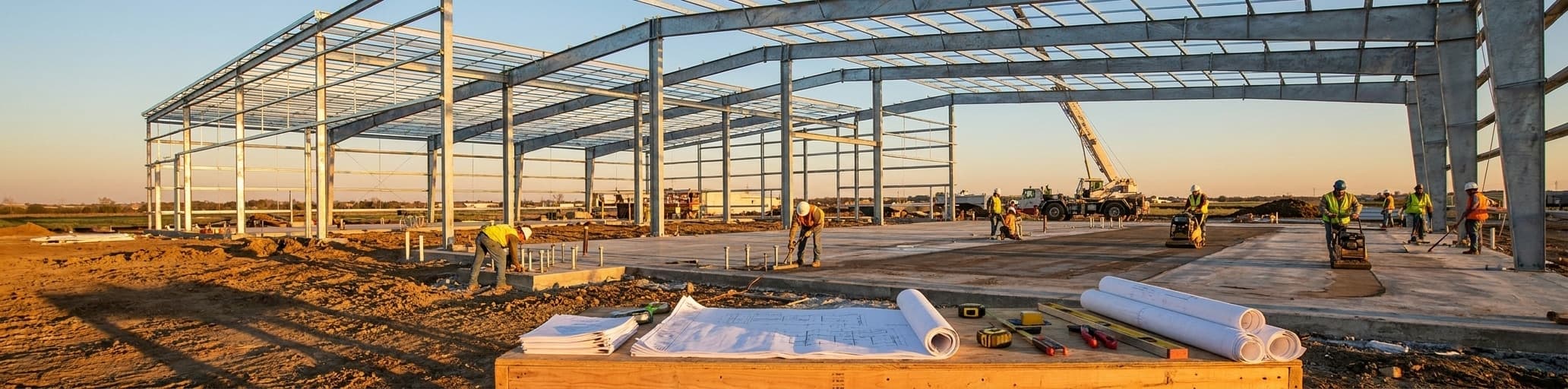

A 40×80 metal building typically costs $86,400 to $128,600 installed in 2026, with eave height and site conditions driving the biggest budget variables. We help you avoid cost surprises by pricing the complete project–foundation, materials, and erection–upfront rather than discovering hidden expenses mid-build.
How Much Does a 40×80 Steel Building Cost in 2026?
A 40×80 steel building costs $27-$40 per square foot installed in 2026, though advertised kit prices of $18-$22 per square foot exclude the slab, site work, and labor.
Typical price range and cost-per-square-foot breakdown
A 40×80 metal building delivers 3,200 square feet of clear-span space, and total installed costs typically run between $86,400 and $128,600 in 2026.[1] That works out to roughly $27-$40 per square foot all-in — a figure that bundles the steel kit, concrete slab foundation, and construction labor.[1] The kit itself prices separately at $18-$22 per square foot, so quotes you see advertised at the lower end almost always exclude site work and erection.[1]
Eave height is the single biggest variable inside the kit price. A standard 12-foot eave runs approximately $57,600 for the structure alone, while stepping up to a 20-foot eave pushes that figure to roughly $70,400 — with each additional 2-foot increment adding $3,000-$7,000 to your materials cost.[1] The table below shows how the three core cost buckets stack up across the full installed range:
| Cost component | Low estimate | High estimate |
|---|---|---|
| Steel building kit | $57,600 ($18/sq ft) | $70,400 ($22/sq ft) |
| Concrete slab | $12,800 ($4/sq ft) | $25,600 ($8/sq ft) |
| Construction / erection | $16,000 ($5/sq ft) | $32,000 ($10/sq ft) |
| **Total installed** | **$86,400** | **$128,600** |
One number worth tracking closely is the 20-30% of total budget that site preparation, foundation work, and interior finishing can add on top of the base kit quote.[1] Many initial quotes omit those line items entirely, so a $57,600 advertised price can easily become a $90,000+ project once the slab, grading, and erection crew are factored in. Planning your full budget around the $27-$40 installed range — rather than the kit-only figure — keeps your project within budget from day one.
What's included in the base building price versus add-ons
The advertised kit price for a 40×80 metal building generally covers the primary structural components: the steel frame, roof and wall panels, and standard trim pieces. Most quotes at the kit-only level include materials and basic structural installation, but site preparation and customization features are treated as separate line items.[2] That distinction is where budget surprises accumulate — a quote that looks complete often isn't.
Add-ons that fall outside the base structure price typically include:
- Insulation (wall batt and roof liner systems)
- Ventilation and louver packages
- Windows and skylights
- Doors beyond the one standard walk-door included in most base packages
- Interior partitioning or framed openings
- Interior finishing materials such as liner panels or drywall
Each of these features adds to upfront costs, but they also increase functionality and long-term property value.[2] For a 40×80 building used as a workshop or warehouse, insulation alone can meaningfully affect energy costs — it's worth budgeting as a necessity rather than treating it as optional. The practical approach is to price the full list of add-ons you need at the quote stage, not after the base structure is already contracted, so your total project number stays within budget from the start.
Why National Steel Buildings' turnkey pricing saves money over multi-vendor quotes
The kit price typically represents only 40-60% of your total project budget, which means multi-vendor quotes — each scoped to a single piece of the project — nearly guarantee cost surprises.[3] When you coordinate separately for the steel kit, the concrete slab, and the erection crew, each vendor owns their scope, not your outcome.
Unforeseen costs fall into the gaps between contracts, and nobody absorbs them but you.[4] A single-source turnkey quote bundles every line item — foundation, materials, erection, and any finishing work — into one fully itemized number, so the figure you approve at the start matches what you pay at closeout.[4] That consolidated structure also eliminates the scheduling friction of waiting on multiple vendors: one timeline, one point of contact, one team that owns the deadline from groundbreak to final inspection.[4] For a practical look at how the two pricing models play out in real projects, the breakdown in barndominium contractors: turnkey vs. shell pricing shows how coordination failures between trades routinely cost more than any savings from splitting vendors.
40×80 Building Foundation and Slab Costs Explained
Reinforced concrete slabs for 40×80 metal buildings typically cost $29,700 to $32,100 installed, with soil conditions representing your most unpredictable expense variable.
Concrete slab pricing for 3,200 square feet
A 3,200 square foot concrete slab averages $21,120 nationally at the standard $6.60 per square foot baseline — but residential slab specs rarely match what a steel building frame demands.[7] Metal buildings require anchor bolt placement, perimeter footings, and reinforcement throughout the pour to handle structural frame loads, which puts most 40×80 commercial pours in the reinforced category.[6] Reinforced slabs run $9.29 to $10.04 per square foot, placing a fully reinforced 40×80 floor between $29,700 and $32,100 for materials and labor combined.[7] Understanding what drives 40×80 metal building costs beyond the kit price starts with recognizing that the slab alone is a major budget line — not a secondary expense.
Thickness directly controls how much concrete you pour and what you pay. A 4-inch slab averages $5.35 per square foot; a 6-inch pour runs $6.19 per square foot.[7] Most metal building specifications call for 4 to 6 inches minimum, with thicker pours required wherever forklifts, heavy vehicles, or floor-mounted machinery will operate regularly.[6] Labor accounts for roughly 50% of total slab cost — approximately $3 to $7 per square foot — meaning regional labor rates can shift your final slab number by several thousand dollars even when material costs remain constant.[6] For a 40×80 commercial slab, total installed cost typically ranges from $12,000 to $25,600 for standard configurations without full reinforcement, climbing to $29,700 or beyond when high-strength concrete and complete rebar grids are specified.[5][7]
Site preparation and soil conditions that affect total foundation cost
Soil conditions are the single most unpredictable cost variable in any 40×80 metal building project, and the gap between a straightforward pour and a problem site can easily exceed $18,000.[8] Foundation work represents 15-25% of your total steel building project budget, and that number climbs fast when subsurface conditions require design changes.[8] A professional geotechnical soil test — priced at $500-$1,500 — is the most cost-effective line item on your pre-construction checklist because it identifies problems before concrete is ordered, not after.[8] Sandy and gravelly soils typically support 2,000-3,000 pounds per square foot with minimal intervention, while expansive clay soils swell when wet and shrink when dry, stressing slabs, shifting piers, and potentially requiring full foundation redesign.[8] High water tables present a separate challenge: saturated soils lose bearing capacity, forcing footings deeper or triggering drainage system additions that add time and cost before a single yard of concrete is poured.[8]
Beyond soil type, climate zone directly affects how deep your footings must go — and therefore how much concrete you pour. Frost depth requirements range from zero in frost-free southern climates to 48 inches or more in northern regions, and foundations that don't extend below maximum frost penetration will heave and crack under freeze-thaw cycles.[8] Once soil and frost variables are understood, proper grading and compaction determine whether your slab stays flat for decades or settles within years. The gravel base beneath the slab must be laid in 4-to-6-inch lifts and compacted to at least 95% of maximum density — a standard that hand tamping cannot meet.[8] Site-specific expenses including poor soil removal, drainage system installation, and rocky-condition excavation all sit outside standard slab pricing, which is why concrete slab costs for steel buildings range from $5-$10 per square foot depending on conditions at your specific address.[9] Engineering fees add $500-$2,000 for foundation plans, and permits typically run 1-3% of construction value — costs that belong in your budget from the start, not discovered mid-project.[8] Understanding what inputs move your 40×80 steel building cost estimate most starts with site conditions, because no other variable affects your foundation line item more directly. Site preparation and foundation work combined can account for 25-45% of your total project budget, making this the category where early due diligence pays the biggest return.[10]
How National Steel Buildings coordinates slab and building delivery for seamless installation
Steel delivery timing is what separates a smooth 40×80 project from a costly standstill.
Once the foundation is poured and cured, pre-engineered steel components ship to the site — typically arriving within one to two weeks — and erection begins almost immediately.[12] The problem with separate vendors is sequencing: the foundation contractor works on their own schedule, the kit ships on the manufacturer's lead time, and the erection crew books based on their calendar.
Any one of those three sequences falling out of alignment means idle crews, delayed starts, or a steel kit sitting on-site while concrete finishes curing.[11] A single-source coordinator holds all three sequences together — engineering the foundation system alongside the building system, scheduling kit delivery so it arrives after the curing phase ends, and staging the erection crew to mobilize when the slab is actually ready.[11] The full steel building timeline from initial design through foundation, erection, and close-out runs six to eight months for a structure in this size range, but prefabricated components that arrive ready to assemble compress the erection phase itself to as little as two to three weeks once the site is set.[11][13] That speed only materializes when delivery, foundation readiness, and crew scheduling are managed as a single coordinated sequence — not three independent contracts running in parallel with nobody owning the gaps between them.[13]
Key Specifications and Customization Options That Impact Your Final Price
Clear-span frames with straight columns eliminate interior obstructions and deliver the full 3,200 square feet of usable floor space that equipment staging and processing lines require.
Eave height, roof pitch, and frame type choices (clear-span versus column placement)
Frame type is the structural decision that shapes every other spec in a 40×80 building. A clear-span rigid frame uses fabricated I-beam rafters and purlins to eliminate interior columns entirely, delivering the full 3,200 square feet of unobstructed floor space for equipment staging, vehicle paths, and processing lines.[15] The fabricated I-beam rafter system also achieves higher ceiling clearance at a given eave height than wood truss alternatives can match — meaning you get more usable overhead volume without necessarily adding eave height.[14] The alternative is a multi-span frame with interior column lines: lower material cost, but columns placed at regular intervals across the floor plan permanently restrict how the space can be organized.[14] Owners who underestimate how much that column placement matters typically discover it after equipment is already staged.
Within a clear-span frame, the choice between tapered columns and straight columns carries real operational consequences. Tapered (ridged-frame) columns cost slightly less but protrude into usable floor space at the base, complicating corner workspace and interior finishing work.[14] Straight columns hold the full wall plane from floor to eave, costing a bit more upfront but returning cleaner usable square footage — experienced owners who built with tapered frames consistently report they would choose straight columns if starting over.[14]
Roof pitch and eave height are related but distinct variables. Adjusting pitch from 2:12 to 4:12 adds modest cost at the kit level — roughly a few hundred dollars — but meaningfully changes ridge height and the overhead volume available for dust collection runs, compressed air lines, lighting, and radiant heat systems.[14] Eave height compounds this effect: at 18 feet, forklift racking and overhead infrastructure gain real clearance, but the consistent experience among operators is that eave height always looks adequate on paper and proves limiting once equipment, hanging utilities, and sprinkler systems occupy the overhead zone.[14] Because rigid frame steel systems can provide clear spans across the full 40-foot width without interior supports, the combination of correct eave height and clear-span framing is what actually delivers the unobstructed operational space the footprint promises.[15]
Insulation, doors, windows, and interior finishing add-ons
The add-ons that convert a bare 40×80 shell into a functional building are where most owners encounter a second round of budget surprises. As one experienced metal building owner described it: the basic shell is fairly cheap and quick — it's everything else that adds up, including doors, lighting, interior lining, and heating.[14] Insulation pricing scales directly with performance level. Double-bubble insulation runs approximately $1.50 per square foot and handles basic temperature and humidity control.[1] R-17 insulation — the right specification for year-round climate management — runs about $3.00 per square foot, putting total insulation cost for a 40×80 at roughly $9,600.[1] Door and window costs vary by configuration: standard walk-in doors add $250-$500 each, windows run $150-$300 per unit depending on size and style, and overhead garage doors scale by opening size from 6'x6' up to 16'x16'.[1] The table below shows how add-on costs stack up against the 3,200-square-foot floor plan:
| Add-on | Unit cost | 40×80 total (where applicable) |
|---|---|---|
| Double-bubble insulation | ~$1.50/sq ft | ~$4,800 |
| R-17 insulation | ~$3.00/sq ft | ~$9,600 |
| Standard walk-in door | $250-$500 each | Per quantity needed |
| Windows | $150-$300 each | Per quantity needed |
| Overhead/garage doors | Varies by size (6'x6' to 16'x16') | Per quantity needed |
Interior finishing — liner panels, partitioned office space, lighting infrastructure, and HVAC rough-in — follows the same pattern: modest per-line-item cost that accumulates fast across a full-size footprint. Color choices for roofs, sides, and trim are typically included at no additional charge by most manufacturers, which is one customization lever that doesn't affect your bottom line.[1] The practical move is to price your full add-on list at the quote stage rather than treating each item as a future decision. Understanding what's optional at quote versus essential later in a 40×80 kit prevents those line items from becoming unexpected expenses mid-project.
40×80 specifications Essentials to estimate your project cost
An accurate cost estimate requires locking in the full component list before pricing begins.
A 40×80 structure breaks into distinct material categories — frame posts and beams, roof trusses, wall girts, roof purlins, metal panels for both roof and walls, trim pieces, and fasteners — and a change to any one of those specs ripples through the others.[17] Roof panel count depends on pitch and purlin spacing; wall panel count depends on eave height and girt layout; door framing alters panel counts and trim runs.[17] The practical approach is to settle on your full dimensional and component spec — eave height, roof pitch, column spacing, panel profile, and door and window quantities — before requesting a quote, because estimates built on incomplete specs require revision once the missing inputs surface.[17] Every calculation, regardless of how it is generated, needs confirmation against professional architectural drawings and must comply with local building codes before materials are ordered or commitments are made.[17]
40×80 Metal Building Cost Comparison: What Affects Your Bottom Line
Your 40×80 metal building cost depends heavily on zip code: labor rates, freight charges, and local codes can swing your final price by thousands of dollars.
Geographic location, local labor rates, and material delivery fees
Your zip code moves your 40×80 metal building cost in three distinct directions simultaneously: labor rates, freight charges, and local code requirements.
Regional labor rates vary by state, meaning the installation cost for an identical building spec can differ by thousands of dollars between a project in rural Texas and one in suburban New Jersey.[18] Material delivery adds a location-specific freight charge on top of the kit price — the further your site sits from a fabrication facility, the higher that line item climbs, and remote or poorly accessible sites carry delivery surcharges that standard national quotes rarely capture upfront.[19] Local building codes and permit fees compound both variables: jurisdictions with stricter wind, snow, or seismic requirements mandate engineering upgrades that raise material cost, and permit fees themselves typically run 1-3% of construction value, scaling directly with your project's total budget.[19] Concrete foundation costs follow the same regional pattern, running $6-$10 per square foot depending on local labor markets and site conditions at your specific address.[18] A quote built on national average pricing is a starting point, not a final number — locking in material pricing early, before mill adjustments, is the most reliable way to protect your budget from regional volatility, as the 40×80 steel building price volatility analysis explains in detail.
Single-source design-build versus coordinating separate contractors
The structural case for single-source design-build comes down to who owns the errors when components don't fit.
In a multi-vendor model — separate contracts for design, fabrication, foundation, and erection — each party is accountable only for their own scope, and mismatches between scopes fall on you.[20] A single-source pre-engineered approach eliminates that exposure because one company designs and manufactures all components to fit together, delivering materials that are correct the first time rather than requiring field corrections.[20] The speed advantage is measurable: the design-build method is, on average, 13% faster than a construction manager at risk (CMAR) arrangement and 36% faster than the traditional design-bid-build sequence — because construction moves seamlessly under single-source oversight rather than pausing for each sequential subcontractor to mobilize.[21][22] The MBMA estimates that PEMB single-source delivery reduces portions of the installation schedule by 30 to 50% compared to conventional construction, driven by pre-cut, prefabricated components that require little to no on-site cutting or welding.[20] Warranty coverage consolidates under the same logic: buying all building components as a single package ensures everything is covered under one manufacturer's warranty rather than separate supplier agreements that may conflict or leave gaps when something fails.[20] The practical difference for a 40×80 project owner is that change orders — the primary source of budget overruns in multi-contract builds — are minimal or nonexistent when the designer and contractor are the same team working from the same set of numbers from day one.[22]
How to lower your total project cost without compromising durability or code compliance
The most reliable cost-reduction lever on a 40×80 project is resolving every major spec decision before engineering drawings are submitted — not after.[15] A pre-construction design review that covers foundation design, door placement, eave height, insulation level, and slab thickness catches conflicts while they're still paper problems rather than field corrections that generate change orders and engineering revision fees.[15] Each of those variables is a known cost driver: eave height affects both frame steel tonnage and HVAC system sizing; slab thickness determines reinforcement requirements; door and window placement alters panel counts and trim runs throughout the structure.[15] Getting those inputs right at the design stage eliminates the downstream costs that accumulate when incomplete specs meet a real site.
On the durability side, steel's immunity to rot, mold, warping, and pest damage means the building you permit and erect today carries far lower lifetime maintenance requirements than wood-frame alternatives — the upfront investment doesn't repeat itself across decades in repainting, pest treatment, or structural repairs.[15] For a direct comparison of how that maintenance gap compounds over time, the 40×80 pole barn alternative analysis shows exactly where steel's annual upkeep savings accumulate.
Code compliance fits the same planning logic: producing sealed structural drawings that meet local load requirements at the design stage is far less expensive than engineering corrections triggered by a permit rejection after materials are already ordered.[15] Specifying expansion-friendly bay spacing and clear-span framing from the start also means adding square footage later requires minimal structural disruption — so you don't overbuild now, and you don't pay for a full redesign when operational needs change.[15]
- A 40×80 metal building costs $86,400-$128,600 installed ($27-$40/sq ft), but kit-only quotes at $18-$22/sq ft exclude foundation, site work, and labor.
- Eave height is the biggest cost variable within the kit price, with 12-foot eaves at $57,600 and 20-foot eaves at $70,400, plus $3,000-$7,000 per additional 2 feet.
- Site preparation, foundation work, and finishing can add 20-30% to total budget and are often omitted from initial quotes, causing significant cost surprises.
- Concrete slab costs range $12,800-$25,600 depending on reinforcement needs, with soil conditions and frost depth requirements creating unpredictable variations up to $18,000.
- Single-source turnkey quotes eliminate coordination gaps and change orders by bundling foundation, materials, erection, and finishing into one itemized price.
- Clear-span rigid frames deliver unobstructed 3,200 sq ft of usable space, while multi-span frames with interior columns permanently restrict equipment placement and organization.
- Locking in all major specifications before engineering drawings are submitted prevents costly field corrections and change orders during construction.
- https://chinasteelbuildsales.com/40×80-metal-building-cost/
- https://qebuildings.com/2025/10/how-much-does-a-40×80-metal-building-cost/?srsltid=AfmBOoqgvlSc8QvKzXqd87YhuZfLaPd_Js4aEpBDI0idgVCoHc0VcJn-
- https://iconsteelbuildings.com/how-much-are-metal-buildings/
- https://www.summitsteelbuildings.com/turnkey-construction-eliminates-hassles-of-building-kits
- https://paragonestimating.com/40×80-concrete-slab-cost/
- https://homeguide.com/costs/foundation-cost
- https://www.lawnstarter.com/blog/cost/concrete-slab-price/
- https://mbmisteelbuildings.com/blog/steel-building-foundation/
- https://qebuildings.com/2025/10/how-much-does-a-50100-metal-building-cost/?srsltid=AfmBOoq15EKp9WxAOZpcQEjKpM9jIjj9l0_b0HWC3_QeNU2X7JK_dI-E
- https://ameribuilds.com/steel-building-costs-what-to-expect-2026/
- https://incosteelbuildings.com/timeline-metal-building-construction/
- https://gravitycontractors.com/how-long-does-it-take-to-erect-a-steel-building/
- https://idadevelops.com/how-long-does-steel-building-construction-take/
- https://woodweb.com/knowledge_base/New_Shop_Options.html
- https://mammoth.build/metal-buildings/residential/
- https://qebuildings.com/2025/10/how-much-does-a-40×80-metal-building-cost/?srsltid=AfmBOoqFvlXoFUooXVN_Rd-xbCca9va5-wwNqvC5mTeZq3Nzfz94Dcfo
- https://www.vcalc.com/wiki/pole-barn-materials
- https://qebuildings.com/2025/10/how-much-does-a-40×80-metal-building-cost/?srsltid=AfmBOoqOAA09o0lmctOfZCGn5MbEZgOtCetS2CLLv49Fn1-QWngJhL0L
- https://www.carportsadvisor.com/metal-farm-building-prices?srsltid=AfmBOorBXixJYowvHxp3VpKAFoqWn6K0azaVL6udQRM1WWYW_VQbyWRS
- https://www.metalconstructionnews.com/articles/features/metal-building-systems-pre-engineered-metal-buildings/
- https://fse-ok.com/pemb_vs_conventional_construction/
- https://jerdonconstruction.com/everything-you-need-to-know-about-the-design-build-method/