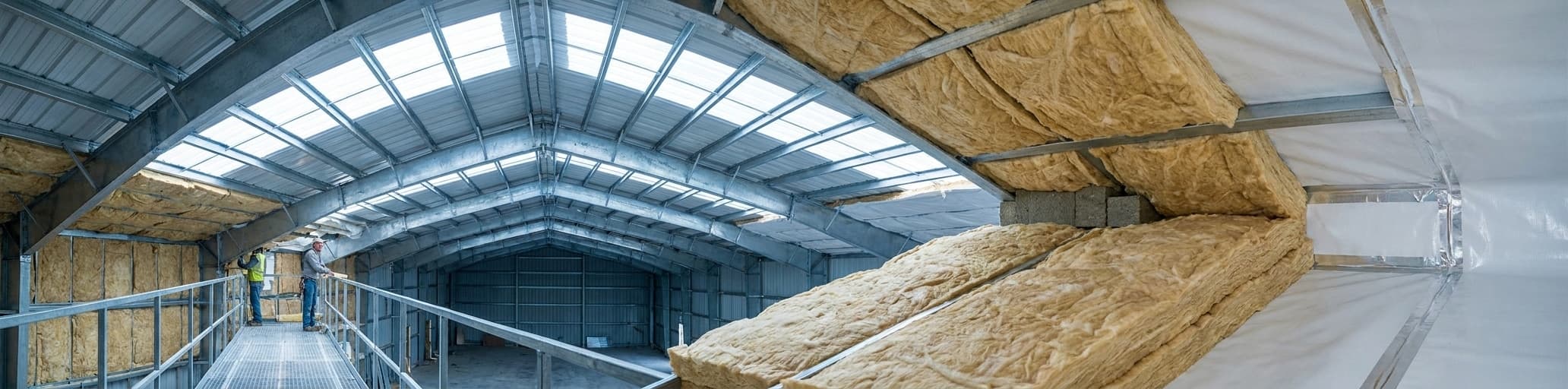

We help you understand how U-factor specifications translate real thermal performance into lower utility bills for your 40×80 warehouse. The key is matching your climate zone and building type to the right insulation assembly before comparing bids, since properly insulated structures save $1,600-$3,500 annually on HVAC costs.
Why Insulation for Metal Buildings Matters
Real-world metal building insulation often delivers 35-42% less thermal performance than labels claim, making U-factor your most reliable metric for actual energy savings.
Energy Savings & U-Factor Explained
U-factor measures heat flow through a building assembly — the lower the number, the less heat escapes in winter or enters in summer, and the less your HVAC system works to compensate.
For a 40×80 metal warehouse, that number shows up directly in your monthly utility bills.
ASHRAE 90.1-2013 confirmed that traditional compressed fiberglass blankets had been overstating thermal performance for years — roof assemblies by up to 35% and wall assemblies by up to 42% versus actual installed performance.[1] In practice, compressing a nominal R-10 to R-19 blanket between wall panels and girts delivers only R-5 to R-6 of real thermal resistance.[1] Hitting a roof U-factor target of U-0.065 using traditional topside-only methods can require a pre-installed R-35 assembly just to net an installed R-15 — more than double the material for the same result.[1] The gap between what a label says and what your building actually performs is exactly where energy savings are won or lost, which makes understanding U-factor the first step in specifying insulation for metal buildings that delivers on your investment.
Condensation & Moisture Control
Steel conducts heat rapidly, so warm interior air that contacts cold steel surfaces drops moisture at the dew point — collecting on roof panels and wall girts where it corrodes metal, promotes mold growth, and saturates insulation over time.[3] Insulation alone won't stop this process.[3] What actually prevents condensation is a two-part system: insulation slows the heat transfer that creates the temperature differential, while a vapor retarder keeps moist air on the warm side of the assembly before it ever reaches cold metal.[3] For occupied buildings, a Class I or low-perm vapor retarder — rated at 0.02 or 0.09 perm — cuts moisture transmission most effectively; any material rated above 1.0 perm doesn't qualify as a vapor retarder at all.[3] Where the system most often fails is seam sealing: independent testing found that a 6-inch tab sealed with tape outperformed every other common seaming technique, and every penetration — not just field seams — needs the same treatment to keep the air and vapor barrier continuous across the entire assembly.[3]
Code Compliance & LEED Points
The first compliance decision for any 40×80 warehouse is which code governs: IECC or ASHRAE 90.1. Both set the same general performance floor, and most U.S. jurisdictions accept either one — but ASHRAE 90.1 is the more appropriate choice for warehouses specifically because the IECC does not recognize semi-heated buildings, a condition that is common in warehouse and industrial applications, while ASHRAE 90.1 does.[5] Both codes divide the country into eight climate zones, and the required R-values and U-factors for your wall and roof assemblies differ by zone, so confirming your zone before specifying insulation for metal buildings is a mandatory first step.[5] When your assembly deviates from the prescriptive single-skin standing-seam configurations referenced in the code tables — for example, when using insulated metal panels or a non-standard layered system — you'll need to run calculations and submit results through approved compliance software such as COMcheck to verify your U-factors before a code-enforcement officer signs off.[4]
Exceeding minimum code thresholds is where LEED points enter the picture. The same envelope principles that satisfy code — tighter U-factors, reduced air infiltration, and cool roof coatings that lower solar heat gain — translate directly into credits under LEED and other voluntary programs when you push performance beyond the minimum.[5] Daylighting offers a specific path to additional LEED credits in metal warehouse applications: substituting translucent panels for standard roof panels delivers natural light across the floor area, and when paired with automatic lighting controls that dim or cut electric lights in response to available daylight, the assembly qualifies for daylighting credit under both ASHRAE 90.1 and LEED.[5] Coordinating those details early — insulation assembly, cool roof specification, and daylight zones — keeps you cost-effective on both the compliance path and any LEED target your project requires.
40×80 Wall & Roof Assembly Options
Pre-cut fiberglass batts and automated installation methods reduce labor by roughly 50% while delivering uncompressed R-values from R-30 to R-70+ without budget inflation.
High-R Fiberglass Blanket Systems
are a multi-material assembly — fiberglass blankets, a low-permeance vapor retarder, steel banding, and fasteners — engineered to fill, not compress into, the 8-12" purlin and girt cavities that metal building framing naturally provides.[6] Two configurations cover most 40×80 applications.
Banded Liner Systems (LS) attach a low-perm fabric vapor retarder across the full underside of the purlins with two unfaced fiberglass layers above, giving you a finished interior surface and optional fall protection.
Long Tab Banded Systems (FC) are the lower-cost, roof-only alternative: one laminated layer runs parallel between purlins and a second unfaced layer runs perpendicular on top, leaving purlins exposed so electrical and HVAC trades can access them after the roof goes on.[8] The double-layer geometry is where the performance comes from — the perpendicular second layer acts as a thermal spacer between the metal panels and the structural steel, breaking the conductive path that single-layer compressed systems leave intact.[7] Pre-cut fiberglass batts eliminate field splicing and reduce waste on your 40×80 metal barn or warehouse build, and automated installation methods — where a continuous vapor retarder sheet is winched across an entire bay in under 30 minutes — cut labor by roughly 50% versus traditional hand-pulling methods.[6] Uncompressed installed R-values run from R-30 with a single blanket layer up to R-70+ with multiple layers, which means you can match your climate-zone target without over-specifying material or inflating your budget.[6]
Rigid Board & Vapor-Retarder Combo
Rigid board insulation — typically polyisocyanurate or polystyrene — qualifies as continuous insulation under IECC 2015 and ASHRAE 90.1-2013 because it runs uninterrupted across all structural members without thermal bridges other than fasteners and service openings.[9] That distinction matters for your 40×80 assembly: because rigid board isn't compressed around purlins or girts the way fiberglass blankets are, its labeled R-value tracks closely with actual installed performance — something fiberglass cavity-fill systems can't claim without a secondary thermal spacer layer.[9] In practice, a wall prescription like "R-13 + R-13 CI" isn't a single product; it's a system pairing R-13 fiberglass between girts with R-13 rigid board as the continuous layer, and both components are mandatory to meet the target U-value.[9] Rigid board is particularly well-suited for warehouses with high interior humidity — cold storage, food processing, or chemical storage — where a vapor-retarder facing laminated directly to the board face keeps the dew point on the warm side without relying on a separate membrane that could be torn or left unsealed at penetrations.[10] When the thermal target can't be reached with rigid board alone, hybrid assemblies that pair foam board with fiberglass fill are permitted under both IECC and ASHRAE 90.1, provided you verify the combined U-value through COMcheck or ASTM C1363 testing before submitting for permit.[10] One detail to confirm with your building supplier before finalizing specs: local fire codes may require a separate code-approved thermal barrier over exposed rigid foam, which affects your interior finish choice and adds to your installation sequence.[10]
Insulated Metal Panels (IMPs)
IMPs differ from every other assembly in this spec sheet: the structural skin, foam insulation core, and interior facing arrive as a single factory-assembled unit, eliminating the separate vapor retarder, banding, and thermal-break layer that multi-component systems require.[11] The foam core — typically polyisocyanurate — delivers outstanding insulating quality, and because no compression occurs during installation, labeled R-values track closely with real installed performance.[11] Panels come in a wide range of colors, sizes, and finishes, making them viable across offices, warehouses, industrial facilities, and cold storage applications — and for high-humidity interiors specifically, the factory-bonded facing keeps the dew point on the warm side without relying on field-applied membranes that can fail at seams or penetrations.[11] On a prefab warehouse or high-clearance industrial build, IMPs provide a superior thermal break that drastically reduces heating costs for large-volume spaces where fiberglass or rigid board would require multiple supplemental layers to reach the same U-factor target.[12] The trade-offs are direct: IMPs cost more per square foot than the other systems covered here, and the interlocking joint system requires experienced installers — because it's the joint continuity, not the panel face alone, that keeps the air and thermal barrier intact across the full assembly.[11]
U-Factor Performance Data
Single-layer metal roof insulation fails code unless thermal blocks interrupt purlin conduction, a detail ORNL testing confirmed makes the difference between 45% and full performance.
Roof U-Factor Chart by Thickness
The roof U-factor for a metal building assembly isn't determined by insulation thickness alone — it's driven by the combination of thickness, installation method, and whether thermal blocks interrupt the steel purlin's conductive path.
ASHRAE 90.1 sets U-0.065 (installed R-15.3) as the minimum for conditioned metal building roofs, and a standard 6" R-19 single-layer draped system falls short of that threshold: ORNL hot box testing confirmed the over-the-purlin configuration performs at only 45% of a double-layer system with thermal blocks, making the single-layer approach a code failure regardless of its label rating.[14] For metal building roofs, the standard configurations break into four tiers — screw-down with no thermal blocks, single layer with thermal blocks, double layer with thermal blocks, and filled cavity with thermal blocks — with each tier allowing additional continuous insulation above the deck to push U-factors lower.[13] Thermal blocks in these assemblies are R-3 rigid insulation strips extending 1.5" beyond each purlin flange; if the roof deck fastens to purlins more frequently than 12" on center, add 0.008 to the published U-factor for any tier.[13] For insulated metal panel roofs, the math is more direct: factory-injected polyurethane or polyisocyanurate delivers R-5.9 per inch across a continuous, framing-free panel face, so U-factor scales predictably with panel thickness and no compression or bridging loss applies.[13] At the fiberglass end of the spectrum, standard 0.6 lb. density blankets at common thicknesses — 3.0" (R-10), 4.0" (R-13), and 6.0" (R-19) — illustrate exactly why single-layer assemblies miss the code floor: even 6" of fiberglass does not reach U-0.065 without the two-layer geometry and thermal-block detail that prevents purlin bridging from erasing the label value.[15]
Wall U-Factor Chart by Assembly
Wall assembly U-factors for metal buildings follow a different logic than roofs, and the 2013 ASHRAE 90.1 revision made that gap impossible to ignore.
Prior versions of ASHRAE 90.1 overstated metal building wall assembly performance by up to 42%, and the corrected default values in Table A3.2 reflect what actually happens when fiberglass blankets are compressed between wall panels and girts: a nominal R-10 to R-19 laminated blanket delivers only R-5 to R-6 of installed performance, regardless of what the label says.[1] That correction drove a structural change in how 90.1-2013 specifies metal building walls — the prescriptive tables now list only assemblies built around continuous insulation (CI), defined as insulation running uncompressed across all structural members without thermal bridges other than fasteners and service openings.[1] That definition specifically rules out foam board attached to the inside face of girts, because the girts themselves interrupt the thermal plane.[1] If you want to use a fiberglass-based wall assembly instead — which remains permitted — you must demonstrate compliance through the U-factor alternative path using approved software like COMcheck rather than pulling a prescriptive R-value from the table.[1] The practical takeaway for a 40×80 warehouse: your wall assembly U-factor is controlled by the CI layer positioned on the exterior face of the girt line, not by whatever fill sits between girts, and the two values should never be confused when you're calculating code compliance or comparing assembly bids.
Compare to Energy Code Targets
Knowing your assembly U-factor is only half the compliance picture — you also need to confirm which code version is actually enforced at your project address.
The R-value and U-value tables themselves have changed very little from IECC 2012 through IECC 2024, and from ASHRAE 90.1-2013 through the 2025 edition; the minimum thermal targets for metal building roofs and walls have remained largely stable across more than a decade of code cycles.[9] Where the bar has risen is everywhere else: tighter air leakage limits, improved mechanical efficiency requirements, reduced thermal bridging beyond just insulation layers, and updated lighting controls now carry as much compliance weight as the insulation assembly itself.[9] That means hitting U-0.065 on your roof and clearing the wall CI target is a necessary condition for a permit, but not a sufficient one — your full envelope strategy needs to address air infiltration and lighting in the same submittal.[9] State adoption timelines add another variable: some jurisdictions are still enforcing IECC 2012, others have moved to IECC 2021, and states like California (Title 24) and Washington (WSEC) operate under their own energy codes entirely, with requirements that can diverge from both IECC and ASHRAE 90.1.[9] For any 40×80 metal warehouse crossing state lines or built in a jurisdiction you haven't permitted in before, confirming the active code cycle before finalizing your assembly spec is the one step that keeps your COMcheck submission from coming back rejected.
Both IECC and ASHRAE 90.1 do provide a U-factor alternative path: any proprietary assembly with a measured U-value from ASTM C1363 hot-box testing that meets or beats the code threshold is a valid compliance route, which gives you flexibility to use IMPs, hybrid systems, or high-R banded assemblies that don't appear in the standard prescriptive tables.[9]
Spec & Purchase Guide
Match your climate zone to current ASHRAE 90.1 or IECC tables first, then confirm your building type and roof configuration before finalizing any insulation spec.
Choose the Right R-Value for Your Climate
The old default — 6" R-19 roof insulation paired with 4" R-13 wall insulation — no longer meets code requirements in most U.S. climate zones, so your first move is matching your zone to the current ASHRAE 90.1 or IECC tables before touching a spec sheet.[9] Three building-use categories drive how strict those requirements are: unheated buildings and low-energy buildings carry no mandatory insulation requirements, semi-heated buildings face relaxed thresholds, and fully conditioned buildings must meet the full prescriptive values — and each category is defined explicitly in both IECC and ASHRAE 90.1, so confirming your building type is as important as confirming your zone.[9] Roof type compounds the decision: standing seam roofs give you the full range of tested U-value configurations, while screw-down roofs have only a single tested result of U-0.044 — a number that falls short of the code floor in several climate zones — making roof type a thermal performance decision, not just a structural one.[9] For the insulation assembly itself, a standard R-30 roof liner system delivers an in-place U-value of 0.037, which corresponds to roughly R-27 of actual installed performance — a useful benchmark when cross-checking your zone's table requirement against what a supplier is quoting you.[9] If you're working with a local metal building contractor who regularly pulls permits in your jurisdiction, they can confirm both the active code cycle and whether your roof-type choice leaves you with adequate compliance headroom before you finalize the assembly.
Fastening & Air-Barrier Details
A continuous air barrier (CAB) is the assembly detail that separates a code-compliant envelope from one that bleeds energy regardless of insulation R-value — it's defined as special materials and assemblies where all joints and penetrations are sealed to keep internal and external environments separated, a requirement now embedded in newer energy efficiency codes.[19] The three fastening details that most often break that continuity are panel sidelaps, penetrations, and structural support transitions.
At panel joints, butyl tape — a polyisobutylene-isoprene polymer sealant — seals metal roof panel and flashing joints, while closure strips, formed to the exact contour of ribbed panels, close every opening where panels meet other building components; both must be installed at every joint, not just field seams.[19] On the wall side, skipping a weather-resistant barrier between wall framing and steel siding creates a direct condensation path where warm interior air contacts cold metal; the reliable fix is a vapor retarder installed on the warm side of the assembly before interior finishes go on, since mechanical dehumidification is only a mitigation, not a permanent seal.[18] Thermal blocks — strips of rigid foam insulation positioned to reduce heat flow at structural supports — are the fastening-adjacent detail that prevents purlins and girts from acting as thermal bypasses straight through the insulation layer.[19] These four elements — continuous air barrier, sealed penetrations at every panel transition, warm-side vapor retarder, and thermal blocks at every structural support — work as a system; missing any one of them means your installed U-factor drifts measurably away from your spec sheet.
Get a Sealed Quote in 24 Hours
A sealed quote means every line item is locked before you sign — insulation assembly type, installed U-factor, vapor retarder specification, thermal block detail, and labor included.
Identical 40×80 specifications routinely vary by $9,600-$24,000 between manufacturers, which means comparing three to five bids isn't optional; it's the only way to confirm you're paying market rate.[20] When you request a quote, bring three inputs: your climate zone, your building-use category (unheated, semi-heated, or fully conditioned), and your roof type (standing seam or screw-down) — because all three drive the insulation assembly specification, and a supplier who doesn't ask can't give you an accurate number.[20] Look for transparent pricing that covers engineering, stamped drawings, and every material component with no unexpected costs at contract signing, so you can compare assembly performance — installed U-factor, vapor retarder perm rating, and thermal block detail — not just total price.[21] Properly insulated 40×80 buildings save $1,600-$3,500 annually on HVAC versus uninsulated structures, with payback periods running two to four years, so confirming the insulation line item against those benchmarks is a direct test of whether a quote is complete or padded.[20] Knowing exactly what arrives with your kit — and when — is part of that picture; the prefab building kit delivery timeline walks through what NSB's engineering and fabrication sequence looks like from order to delivery, so you can plan your site prep and erection crew without surprises.
- U-factor measures heat flow; lower numbers reduce HVAC costs and monthly utility bills for metal warehouses.
- Traditional fiberglass blankets overstate performance by up to 42% in walls; installed R-value is often half the label rating.
- Two-layer insulation with thermal blocks prevents purlin bridging and is required to meet ASHRAE 90.1 U-0.065 roof standard.
- Vapor retarders with 0.02 or 0.09 perm rating prevent condensation; every seam and penetration must be sealed to maintain continuity.
- Insulated Metal Panels (IMPs) deliver consistent R-5.9 per inch with no compression loss, ideal for high-humidity cold storage applications.
- Climate zone and building-use category determine code requirements; confirming active code cycle before specifying prevents permit rejections.
- Properly insulated 40×80 buildings save $1,600-$3,500 annually on HVAC with 2-4 year payback periods.
- https://thermaldesign.com/techinfo/newsMain/insulating_metal_buildingsashrae_90.1_2013_effects_metal_buildings/
- https://cmi-insulation.com/best-vapor-barrier-setup-in-metal-buildings/
- https://insulation.org/about-insulation/metalbuildinginsulation/metal-building-design/
- https://www.mbci.com/blog/energy-codes-metal-panel-selection/?srsltid=AfmBOorcJorzfVQECiKEpQXr2bGuZiiBMTGhXY3R9bvwyi9B_6JLuZjv
- https://continuingeducation.bnpmedia.com/courses/metal-building-manufacturers-association/using-metal-building-systems-to-meet-and-exceed-the-energy-code/
- https://thermaldesign.com/techinfo/newsMain/automated_installation_yields_higher_r_values/
- https://metalbuildinginsulation.com/double-layer-insulation/
- https://therm-all.com/a-guide-to-metal-building-insulation/
- https://www.metalconstructionnews.com/articles/features/insulation-systems-metal-building-code-compliance/
- https://insulation.org/io/articles/navigating-energy-code-compliance-for-metal-buildings-2/
- https://www.buildingsguide.com/build/metal-building-insulation/?srsltid=AfmBOoqjRxf92KVjhUziSVuTAUgsJLaQtxXTTLTyYRuG2_lMd03rrfPI
- https://yourbuildingteam.ca/markets/industrial/
- https://energycodeace.com/content/table-4.2.9-u-factors-of-insulated-metal-panel-roofs-and-ceilings
- https://thermaldesign.com/techinfo/category/technical_bulletins/technical_bulletin_19/
- http://metalbuildingdepot.com/aspx/rvalues.aspx
- https://thermaldesign.com/techinfo/codeanalysis/
- https://www.ashrae.org/technical-resources/bookstore/standard-90-1
- https://www.hansenpolebuildings.com/tag/pole-building-insulation/?srsltid=AfmBOorFWcLhXrA4sebffJprS3ZUm58cP8W8nN99C0Wc-awbh-6CSBk1
- https://www.buildingsguide.com/build/comprehensive-glossary-of-steel-building-terms/?srsltid=AfmBOorZD9K–AnIgYTXL4ZIw1cPvRpDTQJLPHEY9xg1qmL252Vxgm7C
- https://www.metal-buildings.org/40-x-80-metal-building/
- https://metalbuildingshop.com/red-iron-steel-buildings/