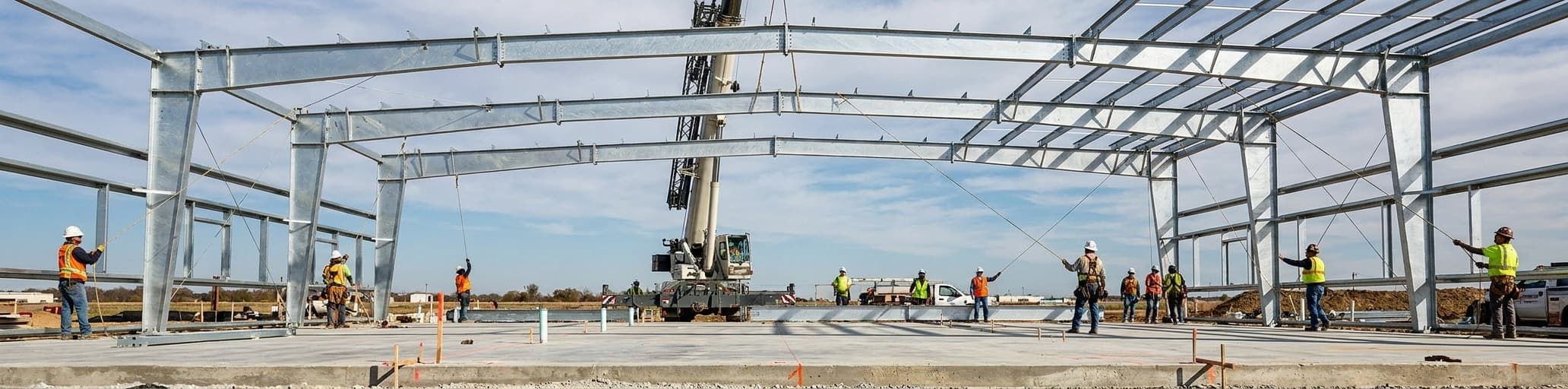

We help you understand why single-source accountability–not proximity–keeps metal building projects on budget and on schedule across all 34 service states. Integrated design, fabrication, and erection under one team eliminates costly scope gaps that plague projects split across separate contractors.
National Steel Buildings' Nationwide Service Coverage and What It Means for You
One team accountable for design, engineering, fabrication, and erection keeps your steel building project on budget and schedule, eliminating the scope gaps that plague multi-contractor projects.
Why Local Availability Matters Less Than Design-Build Partnership
When you search for metal buildings near me, the instinct is to find the closest fabricator or dealer. Proximity to a steel mill, though, tells you nothing about whether your project finishes on budget or on schedule.
What actually drives outcomes is whether one entity holds a single contract covering design, engineering, fabrication, and erection — or whether those responsibilities are scattered across separate firms with separate interests. Industry data from the Design-Build Institute of America and FMI Corporation shows that design-build projects are completed 102% faster than traditional design-bid-build projects and carry 3.8% less cost growth.[1] The mechanism is structural: when design and construction are integrated under one team, cost feedback flows into design decisions in real time rather than after drawings are complete, and long-lead steel can be ordered months before a conventional contractor would even be selected.[1] A PEMB partner that coordinates design, engineering, and erection as a single team eliminates the scope gaps that arise when separate architects, fabricators, and erectors operate from different contracts — gaps that routinely cause budget overruns on projects that looked simple at the initial quote.[2] The best PEMB providers do more than deliver steel; they deliver a solution from planning and design through to erection, with one team accountable for every phase.[2] That single point of accountability, not geographic proximity, is what keeps your project within budget and on schedule.[3]
NSB's Single-Source Advantage Across All 50 States
The core risk in any steel building project isn't the steel — it's the scope gap, the space between separate contracts where no single party is accountable.
When an architect, a fabricator, and an erector each hold their own agreement, nobody owns the interface between them, and that interface is exactly where components fail to fit, materials arrive short, and every party points to someone else's contract.[4] A single-source model closes those gaps entirely: design, fabrication, delivery, and erection are managed by one team, with every component specified and designed to function as an integrated system from the start.[5] The practical difference shows up immediately — material costs and construction timelines become predictable before ground ever breaks, because the same team that drew the building also ordered the steel.[4] With structural engineers licensed in all 50 states, a single dedicated point of contact handles local code compliance directly, whether your project sits near Augusta, GA, near Aiken, SC, or anywhere else across the country — no handoff to a third-party engineer unfamiliar with your drawings, no new gap created mid-project.[5] Before committing to any provider, reviewing how local prefab contractors handle scope accountability tells you more about real project risk than any price per square foot ever will.[5]
How Our In-House Erection Division Ensures Quality Control Wherever You Are
Most steel building providers manufacture the components and then hand off installation to a third-party erector — creating exactly the accountability gap that causes field problems. An in-house erection crew changes the equation entirely.
When the same organization that fabricated your building also puts it up, in-house crews operate under direct supervision from project managers who already know the drawings, so misalignments get caught and corrected before panels are locked in rather than discovered on a punch list.[6] The quality difference is structural: consistent workmanship standards apply across every project because the foremen, equipment operators, and laborers all follow a single, unified installation protocol — not whatever the subcontractor of the week considers acceptable.[7] That consistency extends to scheduling. Because labor, equipment, and sequencing are managed internally, there are no crew no-shows caused by a subcontractor double-booking a crew on a higher-margin job across town.[6] Self-performing firms also gain a direct line between field foremen and project management, which means real-time issue resolution instead of a three-party phone chain.[8] The cost benefit is equally concrete: subcontractors typically layer markups onto both labor and materials, and eliminating those markups lowers the total installed cost without cutting corners on execution.[8] For projects spread across geographies — whether near Augusta, GA, near Aiken, SC, or in a rural county with no local erectors at all — an in-house division means you get the same crew quality and the same accountability regardless of zip code, backed by an OSHA-compliant safety program that applies uniformly on every site.[6]
Finding the Right Metal Building for Your Location and Climate
Steel building permits require engineer-stamped drawings, site-specific load calculations, and jurisdiction-dependent documentation that typically takes 4-8 weeks for commercial projects when complete.
Regional Building Codes and Permit Requirements NSB Handles for You
Steel building permits operate in a different world than residential construction permits — inspectors who see two or three steel building applications per year apply far more scrutiny than they would to a standard wood-frame project, and that unfamiliarity routinely translates into longer review cycles and stricter documentation expectations.[10] A complete permit submission typically requires engineer-stamped structural drawings, foundation and connection details tied to actual site soil conditions, wind and seismic load calculations, and — for commercial projects — fire department access review and ADA accessibility compliance documentation.[9][10] Requirements shift dramatically by jurisdiction: California's seismic detailing adds engineering review layers absent in Texas; Florida's hurricane wind codes trigger load analyses that differ entirely from Montana's snow load requirements; and local amendments to statewide codes can mandate stricter anchor bolt schedules or additional stormwater controls that generic plans never address.[9][10] In Georgia — where property owners commonly ask whether a permit is required for a metal building at all — the answer is yes for virtually any permanent structure, with county-level requirements varying enough to catch unprepared applicants off guard.[10] Residential and agricultural applications typically clear in 2-4 weeks when documentation is complete; commercial projects average 4-8 weeks; complex industrial submissions can run 8-12 weeks or longer.[10] Incomplete applications reset that clock entirely — a single missing soil report or absent energy compliance document triggers a resubmittal cycle that adds weeks per round, exactly what happened when a Tennessee contractor faced three consecutive rejections on a straightforward 40×60 equipment storage building.[10] The most common rejection causes are foundation plans that don't match structural load requirements, insufficient wind load calculations for clear-span steel frames, and zoning conflicts that surface only during plan review.[10] Engineers licensed in all 50 states who already know your drawings — rather than a third-party reviewer unfamiliar with your project — are what separates a first-pass approval from months of revision cycles; for a deeper look at how to evaluate whether a contractor actually owns permit accountability end-to-end, the steel building contractors vetting guide for 2026 lays out the right questions to ask before you sign anything.[10]
Climate-Specific Steel Building Design: Snow Load, Wind, and Seismic Considerations
The structural engineering baseline shifted in 2026 with widespread state and county adoption of ASCE 7-22, the latest minimum design load standard from the American Society of Civil Engineers, referenced by IBC 2024.[11] A supplier still quoting from ASCE 7-16 or older load maps puts your project at genuine risk — the 2026 revisions incorporate 30 to 40 years of additional climate data, refined risk targeting, and entirely new hazard provisions that previous editions barely addressed.[11] Snow load is where the most significant changes landed: ASCE 7-22 replaces generalized ground snow maps with site-specific, risk-targeted values, and northern, mountainous, and lake-effect regions are seeing meaningful jumps in required design loads.[11] Metal buildings add complexity beyond what a standard commercial structure faces. Unheated facilities — equipment storage, warehouses, grain buildings — carry a thermal factor of Ct = 1.2 under ASCE 7, which increases the calculated roof snow load compared to a heated building.[12] Sloped metal roofs are classified as slippery surfaces, which allows a roof slope reduction factor (Cs) to lower the design load when the roof is unobstructed and there is clearance below the eave for snow to slide — but gable roofs, common on steel buildings, remain susceptible to unbalanced drift loading on one side of the ridge, a load case that must be designed for explicitly.[12]
Wind provisions under ASCE 7-22 are more site-specific and more demanding near building edges and corners, where uplift and cladding pressure are highest, with refined components and cladding pressure zones now requiring more robust framing and tighter fastening at those high-pressure areas.[11] ASCE 7-22 also introduces mandatory tornado load provisions in Chapter 32 for the first time — prior codes treated tornado design as optional or addressed it only in commentary.[11] For most agricultural, commercial, and residential steel structures, the tornado provisions won't apply directly, but institutional or essential-facility projects now face a permitting requirement rather than a design preference, because tornado vortex forces produce extreme vertical uplift and lateral pressures that conventional straight-line wind design does not account for.[11] Seismic requirements follow the same site-specific logic: loads vary by zip code, and a building engineered to a generic template no longer satisfies what local building departments require under current code.[11] The throughline across all three load types is identical — get stamped engineering drawings calculated for your actual location, not last decade's maps, or plan for permit rejections and redesign costs before your project ever breaks ground.[11]
Service Area Finder: Confirm NSB Coverage and Get a Local Timeline
Your install lead time depends on which region your site falls in, not on whether you searched "metal buildings near me" or called a national line directly. Coverage across 34 states breaks into five regional bands, each with a distinct install scheduling window.[13] Southeast states — Georgia, North Carolina, South Carolina, Tennessee, Alabama, Mississippi, Kentucky, and Florida — carry the shortest lead times at 1 to 2 weeks from order to install crew on site, reflecting both higher crew density and shorter delivery runs.[13] The Northeast and Mid-Atlantic corridor running from Maine through West Virginia (13 states total) and the Midwest cluster of Ohio, Indiana, Michigan, and Illinois both run 2 to 3 weeks.[13] The South-Central band of Kansas, Oklahoma, and Texas falls in the same 2-to-3-week window.[13] The West — Colorado, New Mexico, Idaho, Nevada, California, and Washington — carries the widest scheduling window at 3 to 5 weeks, driven by longer delivery distances and lower installation crew density in those states.[13] The table below maps every covered state to its regional install band.
| Region | States Covered | Install Lead Time |
|---|---|---|
| Southeast | GA, NC, SC, TN, AL, MS, KY, FL | 1-2 weeks |
| Northeast / Mid-Atlantic | ME, VT, NH, MA, RI, CT, NY, NJ, PA, DE, MD, VA, WV | 2-3 weeks |
| Midwest | OH, IN, MI, IL | 2-3 weeks |
| South-Central | KS, OK, TX | 2-3 weeks |
| West | CO, NM, ID, NV, CA, WA | 3-5 weeks |
Every project in the coverage footprint — regardless of regional band — ships free to your prepared site, includes factory-trained installation at no additional cost, and arrives with engineer-stamped drawings calculated for your county's actual snow, wind, and seismic loads rather than a generic national template.[13] G90 galvanized steel panels carry roughly 50% more zinc coating than the industry-standard G60, and that spec applies uniformly across all 34 states rather than being reserved for coastal or high-humidity zones alone.[13] Financing runs up to $300K through HFS at rates from 7.99% APR, with rent-to-own options available in every state the service footprint covers — so the same financing terms available near Augusta, GA are equally accessible near Aiken, SC or anywhere else on the coverage map.[13]
Metal Building Costs in Your Area: What Drives Pricing and How NSB Keeps Costs Down
National procurement volume lets us lock steel prices that local mills cannot match, protecting your budget from 2026's tariff-driven cost increases.
How National Buying Power Reduces Material Costs Compared to Local Mills
The tariff environment fundamentally changed the math on material procurement in 2026. According to analysis from Associated Builders and Contractors using Bureau of Labor Statistics data, nonresidential construction input prices rose at a 7.1% annualized rate in January 2026, driven primarily by Section 232 tariffs on imported steel and aluminum that now reach up to 50%.[14] A local mill buying steel in modest quantities absorbs every dollar of that increase and passes it straight to you in the quote.
A national procurement operation works differently — volume contracts negotiated across hundreds of projects allow price locks that individual buyers cannot access, a dynamic the federal government's own procurement analysts have documented: large-scale buyers can "make demands of suppliers beyond just cost," and suppliers accommodate those demands because the volume justifies it, the same mechanism that lets Costco command lower prices while simultaneously raising quality standards that smaller retailers could never enforce.[15] The practical consequence for your project is that ABC Carolinas member firms are reporting commercial and industrial projects cancelled, rebid, or significantly scaled back after updated steel quotes exceeded original budgets by 10-15%.[14] Early procurement and fabrication slot lock-in are the countermeasures that protect budgets — tactics that require working capital and supplier relationships local mills simply cannot sustain at the volume needed to keep pricing stable.[14]
Cost Drivers by Region and Building Type
Not every project faces the same tariff exposure, and the cost impact varies by how metal-intensive a given building type is.
Structural steel, metal deck, aluminum storefront components, and metal roofing are among the most exposed categories under 2026 tariff schedules — all of them disproportionately present in clear-span commercial, industrial, and agricultural steel buildings compared to wood-frame or hybrid construction.[14] Projects in high-freight regions see a compounding effect: tariff-driven material price increases layer on top of longer delivery runs, widening the gap between a locally procured quote and a nationally contracted one.
The 7.1% annualized input price increase documented in January 2026 is a national average — individual line items like structural steel and aluminum have seen sharper moves that affect large-footprint commercial and industrial buildings more severely than smaller residential structures.[14] Owners who are searching for metal buildings near me in areas like Augusta, GA or near Aiken, SC, where commercial and agricultural activity is high, benefit most from contracted pricing that locks material cost before those regional spot-market premiums widen further.[14]
Transparent Pricing Model: Material, Labor, Engineering, and Delivery Breakdown
The most common question owners ask — "What's your price per square foot?" — is also the least useful anchor for a real budget. Two buildings with identical footprints can carry wildly different steel tonnage, erection complexity, and total installed cost once span, local code loads, and site conditions are factored in; a single per-sqft figure hides every variable that matters.[16] A transparent, line-item model separates those variables into four distinct cost buckets, each driven by different forces and each requiring a different risk management strategy.[16]
| Cost component | Primary driver | Key 2026 risk |
|---|---|---|
| Materials | Steel commodity pricing, tariff schedules, mill lead times | Spot-market spikes after bid day — mitigated by deposit-and-lock |
| Engineering | Span, ASCE 7-22 load requirements, building geometry | "Hidden" steel weight from wind zones, clear-span depth, seismic detailing |
| Labor | Erection schedule, site access, crane conditions | Jobsite constraints and crew mobilization in rural or congested sites |
| Delivery | Freight distance, fuel surcharges, lane availability | Long-haul logistics cost shifting independent of mill pricing |
Materials carry the highest volatility exposure. The structural package — primary frames, secondary steel, roof and wall panels — dominates PEMB kit cost, and steel behaves as a globally traded commodity rather than a local supply-chain purchase.[16] The practical defense is a deposit-and-lock arrangement: once scope is approved, a materials commitment removes the steel portion of the budget from weekly market movement, so the quote in your inbox reflects a secured fabrication slot rather than a snapshot of today's spot price.[16] Engineering is where budget surprises actually originate. ASCE 7-22's refined wind pressure zones, updated components and cladding maps, and new tornado load provisions for certain Risk Category buildings add engineering hours and physical steel weight that a generic per-sqft template never captures.[16] Switching from a modular frame to a 100-foot clear span, for instance, changes the structural problem entirely — deeper rafters, larger haunches, tighter deflection control — which means two buildings of equal square footage can have entirely different frame weight and cost.[16] Labor cost is directly tied to schedule: pre-engineered components arrive pre-cut and pre-punched, reducing field layout time and rework in a way that supports the 30-50% faster erection commonly cited for PEMBs versus conventional construction.[16] Jobsite conditions then move that number in either direction — rural sites with limited crane access raise mobilization cost, while constrained urban laydown areas increase lift complexity regardless of building size.[16] Delivery rounds out the four-bucket model as its own discrete exposure: long-haul heavy steel packages are sensitive to freight lane constraints, fuel surcharges, and logistics availability that can shift delivered cost even when mill pricing is flat — a variable that disappears inside a lump-sum quote but surfaces as a change order if conditions shift after contract.[16] Keeping delivery as a named line item gives you visibility into that exposure before you commit. Viewed together through a total-cost-of-ownership lens rather than first-cost alone, a transparent line-item model also surfaces where pre-engineered steel creates durable financial advantage: faster occupancy compresses the carry period on construction financing, lower lifetime maintenance reduces unplanned capital outlays, and a high-performance insulation assembly reduces operating energy cost over decades — advantages that a lump-sum per-sqft quote renders completely invisible.[17]
Cost Comparison Tool: Estimate Your Project Budget by Region and Building Type
Building size is the fastest lever you can pull to lower cost per square foot. Fixed engineering, permitting, and mobilization expenses spread across more area as footprint grows, and repetitive panel installation improves crew productivity at scale — a dynamic that consistently produces 15-25% lower per-square-foot costs in buildings above 10,000 square feet compared to structures under 2,500 square feet.[18] The three-tier pricing model (kit only, installed shell, fully finished) creates a wide range even within a single footprint, so the table below maps those tiers across common building sizes using 2026 mid-market benchmarks for installed shell cost — meaning building package, foundation, and erection, but excluding insulation, MEP, interior finishes, and site work.[18][19]
| Building size | Square footage | Installed shell cost per sq ft | Approximate installed shell total |
|---|---|---|---|
| 30×40 | 1,200 sq ft | $34-$42 | $41K-$50K |
| 50×100 | 5,000 sq ft | $28-$36 | $140K-$180K |
| 100×100 | 10,000 sq ft | $25-$33 | $250K-$330K |
| 100×200 | 20,000 sq ft | $22-$30 | $440K-$600K |
Regional labor markets, freight distance from the fabrication plant, and local code requirements move those shell numbers in either direction once you pin down a specific site.[18] Right-to-work Southeast and South-Central markets — Georgia, Tennessee, the Carolinas, Texas — run 10-20% below the national average, making them the most favorable PEMB cost environment in the country.[18] The Midwest tracks near the national average outside of Chicago, where union labor premiums add 15-25% to erection and foundation line items.[18] Mountain West states carry 10-20% premiums driven by population growth and elevated snow load requirements at higher elevations.[18] The Northeast is the most expensive region, with dense-area permitting, union requirements, and compressed construction seasons pushing total installed shell costs 25-45% above average.[18] The table below maps those regional bands to installed shell ranges for standard warehouse applications in 2026.[18][19]
| Region | Representative markets | Installed shell range (warehouse) | Variance vs. national avg |
|---|---|---|---|
| Southeast / South-Central | Atlanta, Dallas, Charlotte, Nashville | $20-$28 per sq ft | 10-20% below |
| Midwest (secondary markets) | Columbus, Indianapolis, Kansas City | $24-$34 per sq ft | Near average |
| Mountain West | Denver, Salt Lake City, Boise | $28-$40 per sq ft | 10-20% above |
| Northeast | New York, Boston, Philadelphia | $35-$55 per sq ft | 25-45% above |
| West Coast | California, Seattle metro | $38-$58 per sq ft | 30-50% above |
Once the shell is priced by size and region, building use determines how far the fully finished cost diverges from the shell baseline — and the gap is wider than most owners expect.[18] Agricultural storage and basic equipment buildings need minimal interior work and typically close out at $25-$45 per square foot all-in, while a standard warehouse or distribution center runs $45-$75 per square foot fully finished.[18] Industrial facilities with crane loads, heavy slabs, and process utilities push to $55-$100 per square foot, and commercial retail or office builds with architectural cladding and tenant improvements reach $85-$150 or more.[18] A 20×30 storage structure — one of the most common entry-level searches — lands at the lower end of the agricultural range, while a 40×60 commercial workshop demonstrates the mid-range most clearly: add a foundation ($12,000-$24,000 for that footprint), professional erection, and basic utilities to a mid-range kit, and total project cost typically settles between $48,000 and $120,000 depending on finish level.[19][20] Fully finished turnkey costs across all building types range from $24-$43 per square foot at the basic end up to $50-$100 or more per square foot for climate-controlled commercial facilities — a spread large enough that budgeting off any single benchmark without specifying tier, region, and building use will consistently produce an unreliable number.[19] For owners in high-commercial-activity corridors like Augusta, GA or Aiken, SC, locking in material costs early with a deposit-and-fabrication-slot commitment is the most effective hedge against the 7.1% annualized nonresidential input price increases documented in early 2026, since most building quotes carry validity windows of only 30-60 days before steel market movement requires repricing.[19]
Next Steps: Getting a Custom Quote and Timeline for Your Local Project
Bring your site address, building use, occupancy date, and site constraints to your first call to transform a ballpark estimate into a real design conversation.
What to Prepare Before Contacting NSB: Site Details, Use Case, and Timeline
The fastest way to get an accurate quote is to arrive at the first conversation with four pieces of information already in hand. Without them, the initial discussion stays at the ballpark-estimate level — useful for a sanity check but not useful for locking a fabrication slot or confirming a delivery window. The four items are your site address or GPS coordinates, your intended building use, your target occupancy date, and any known site constraints. Address or coordinates let the engineering team pull the correct county wind, snow, and seismic requirements before the call ends rather than following up later. Intended use drives frame depth, clear height, door placement, and whether the project needs fire-rated construction or ADA compliance — a 40×60 equipment storage building and a 40×60 commercial workshop share a footprint but differ substantially in structural and code requirements. Target occupancy date determines which fabrication slot makes sense: projects with a hard deadline tied to a planting season, a lease start, or an aviation hangar delivery all carry different scheduling math than an owner with a flexible six-month window. Site constraints — slope grade, access road width, overhead utility lines, or a restricted laydown area — affect crane mobilization and delivery sequencing in ways that matter more on rural sites than owners typically expect. Having those four items ready compresses the first consultation from a discovery session into a working design conversation, which is the point where real cost clarity begins.
Beyond those four essentials, three additional details accelerate the process without requiring any professional reports or drawings:
- Approximate footprint dimensions — even a rough size like "I need roughly 5,000 square feet" or "something in the 40×80 range" lets the team cross-reference regional pricing benchmarks and flag any span limitations for your target market before engineering begins.
- Utility availability — whether the site has existing electrical service, water, and sewer access, or whether utilities need to be extended, changes the scope of finish work and sometimes affects foundation design for industrial or commercial applications.
- Ownership or lease status — a leased site with a landlord approval requirement can add two to four weeks to the permit timeline, and knowing that upfront keeps the schedule projection honest rather than optimistic.
NSB's Rapid Quoting Process: From Initial Consultation to Design Review
The quoting process moves through three sequential stages, each with a defined output and a fixed clock. The first conversation — phone or email — focuses on site address, building use, target occupancy date, and any known site constraints; that information lets the engineering team pull county-specific wind, snow, and seismic load requirements before the call ends rather than chasing them down afterward.[23] Quote development follows within two to five business days, depending on scope: the estimate is a line-by-line breakdown of materials, fabrication labor, finishing, and installation rather than a single lump-sum number, so you can see exactly where contracted pricing is protecting your budget and where exposure still exists.[23] Once a quote is accepted, design review begins with shop drawings — the fabrication team's full instruction set showing every piece, every connection, every weld location, and every mounting point — and this stage is the last inexpensive place to make changes: moving a column six inches on a drawing takes minutes, while moving it after steel is cut costs hours and scrap material.[23] For commercial and structural projects, a licensed engineer reviews and seals the drawings before fabrication begins, adding one to two weeks to the drawing phase on standard commercial scopes and three to four weeks on larger projects requiring multiple coordination rounds.[23] The practical consequence of running these stages in sequence — consultation, then itemized quote, then sealed shop drawings — is that actual steel erection, which takes only two to three weeks for a standard rectangular building, starts from a fully resolved set of approved documents rather than a set of assumptions that generate field changes later.[21]
The three stages map to predictable calendar windows:
- Initial consultation to itemized quote: 2-5 business days[23]
- Shop drawing production and client review: 1-2 weeks for standard commercial scopes; 3-4 weeks for projects requiring engineer-of-record sealing[23]
- Steel erection once foundation and drawings are approved: 2-3 weeks for a standard rectangular building[21]
The full pre-construction sequence — design, permitting, and foundation — typically spans the bulk of a project's calendar; the erection phase itself is fast.[21] Starting the consultation with complete site information compresses the front end of that sequence and is what keeps the overall timeline from drifting.[22]
Why 1,480+ Completed Buildings Trust NSB for Turnkey Steel Solutions
A turnkey contractor takes responsibility for the entire project — engineering and design, procurement, civil construction and installation, and commissioning — so the client simply turns the key to begin operating.[24] What earns repeat business and referrals across 1,480+ completed buildings isn't the steel itself; it's the elimination of the accountability gap that forms whenever separate architects, fabricators, and erectors operate under different contracts.[25] When one firm owns every phase, there is no interface between parties where components fail to fit, materials arrive short, or blame gets redistributed.[25] Pre-engineered metal buildings delivered under a true turnkey model trim construction schedules by roughly 30-40% compared to conventional systems like tilt-up or precast construction, which translates directly into earlier occupancy, faster revenue generation, and a shorter carry period on construction financing.[26] Beyond speed, steel systems avoid the moisture, pest, and rot issues that drive unpredictable maintenance costs on other building envelopes, producing more predictable lifecycle expenses and a simpler upkeep profile over decades of use.[26] Steel's inherent modularity — clear spans, standardized bays, bolt-up frames — also means the building you commission today can accept added bays, mezzanines, or re-skinned facades as your operation grows, protecting asset value without requiring a new project from scratch.[26] Every completed structure, whether an agricultural storage facility in the Southeast, a commercial warehouse near Augusta, GA, an aviation hangar near Aiken, SC, or an industrial facility in the Mountain West, adds to a documented track record that answers the one question no price-per-square-foot quote ever can: does this contractor own the outcome from first drawing to final punch list, or does accountability dissolve the moment scope crosses from one firm to another?[24][25]
- Design-build projects complete 102% faster and cost 3.8% less than traditional design-bid-build due to integrated accountability across all phases.
- Steel tariffs reached up to 50% in 2026, causing nonresidential construction input prices to rise 7.1% annually, requiring early material procurement to lock pricing.
- ASCE 7-22 load standard now requires site-specific wind, snow, and seismic calculations by zip code, making generic building templates non-compliant with current building codes.
- In-house erection crews eliminate subcontractor markups and accountability gaps, reducing total installed costs while maintaining consistent quality across all projects.
- Installation lead times range from 1-2 weeks in the Southeast to 3-5 weeks in the West, with regional labor costs varying 10-50% depending on market conditions.
- Installed shell costs for metal buildings range from $22-$55 per square foot depending on region and size, with Northeast markets 25-45% more expensive than Southeast.
- Providing site address, building use, occupancy date, and site constraints upfront compresses initial consultation into a working design conversation with accurate pricing.
- https://terrapincg.com/news/what-does-a-design-build-contractor-do
- https://forgebuildings.com/how-to-choose-the-right-pemb-manufacturer-and-builder/
- https://westernsteel.com/frequently-asked-questions/
- https://forgebuildings.com/pre-engineered-metal-buildings-an-investment-alternative/
- https://www.bakercompaniesus.com/steel-buildings/
- https://m2steel.com/service/erecting-steel-building/
- https://www.crossland.com/news/the-benefits-of-self-performance-capabilities-in-the-construction-industry/
- https://www.raecobuilders.com/blog/2025/1/13/3-advantages-of-self-performing-construction
- https://ibarraconstructionservices.com/essential-guide-to-permits-for-metal-building-construction/
- https://mbmisteelbuildings.com/blog/steel-building-permits/
- https://masonsteelcorp.com/steel-building-wind-and-snow-load-requirements-what-buyers-need-to-know-in-2026/
- https://www.structuremag.org/article/design-snow-loads-and-metal-buildings/
- https://tritonindustriesllc.com/service-area/
- https://abccarolinas.org/construction-material-tariff-costs-2026-how-carolinas-contractors-can-protect-their-margins/
- https://www.thirdway.org/memo/smarter-procurement-federal-construction-spending-is-a-huge-opportunity-to-advance-national-goals
- https://www.tylerbuilding.com/post/2026-metal-building-cost-variables
- https://www.summitsteelbuildings.com/delivering-lower-total-cost-of-ownership
- https://terrapincg.com/news/pre-engineered-metal-building-cost-per-square-foot-usa
- https://ameribuilds.com/steel-building-costs-what-to-expect-2026/
- https://iconsteelbuildings.com/how-much-are-metal-buildings/
- https://incosteelbuildings.com/timeline-metal-building-construction/
- https://www.gramsconstruction.com/step-by-step-guide-to-the-steel-building-construction-process
- https://jeffandsimon.com/news/custom-metal-fabrication-process/
- https://alltracon.com/what-are-industrial-turnkey-projects-a-complete-guide/
- https://nordicsteel.construction/expert-tips-for-choosing-the-perfect-steel-building-contractor-for-your-project/
- https://metalprobuildings.com/steel-industrial-building-cost-roi/