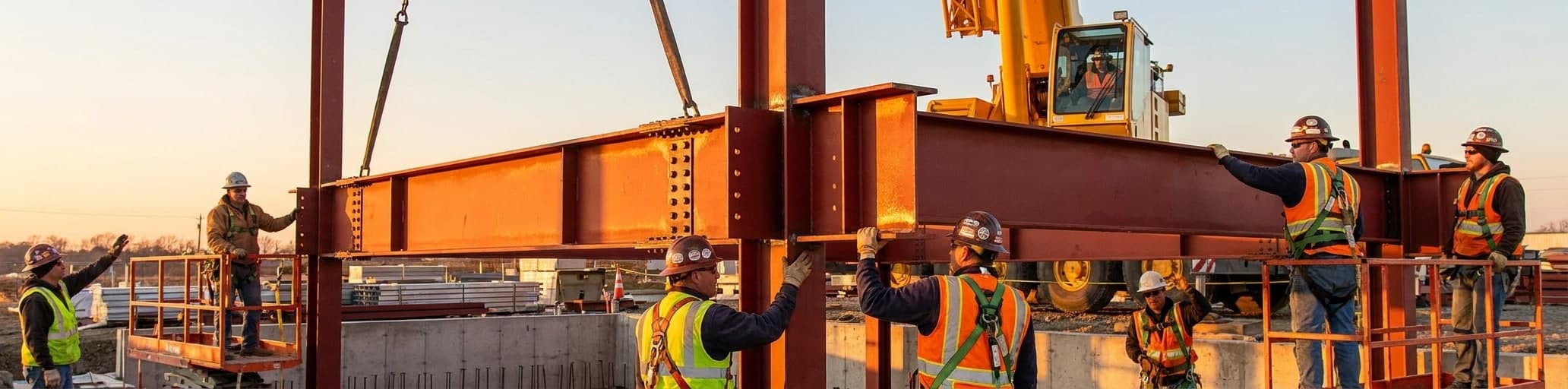

We help you identify qualified steel building contractors by revealing common cost traps and vetting criteria that protect your budget. Choosing a contractor with integrated design-build capability, local permitting expertise, and transparent itemized pricing prevents costly change orders and ensures your project stays on schedule.
Why Local Contractor Selection Matters More Than You Think
Hidden change orders and material price surges can consume your contingency before construction starts, making contractor selection your first line of financial defense.
The Hidden Costs of Choosing the Wrong Contractor
Choosing the wrong steel building contractor rarely announces itself in the original quote — the real cost surfaces later, buried in change orders and scope disputes.
Subcontractor exclusions are a common trap: a proposal looks competitive until the exclusions list reveals that items like waste removal, temporary power, or site access equipment were never included.[1] Those gaps don't stay gaps; they become variations you pay for at premium rates, mid-build.[1] Labor miscalculations add another layer of exposure.
Underestimating productivity against site-specific conditions doesn't just inflate direct wages — it pushes your schedule out, and every extra day on a steel building project means more equipment rental, extended overhead, and compounding costs.[2] Material pricing is equally vulnerable; contractors who fail to lock in steel prices early leave you absorbing market surges that can wipe out your contingency before a single column is set.[2] Across all of these risks, the throughline is the same: a contractor without a structured scope, clear variation-approval workflows, and a realistic contingency fund — typically 10-20% of total project costs — transfers all of that financial exposure directly to you.[2] Knowing what to look for before you sign is why a steel building contractor vetting guide matters as much as the quote itself.
What Single-Source Solutions Actually Mean for Your Timeline
"Single-source" gets used as marketing shorthand, but what it actually means for your schedule is specific and measurable.
Design-build projects complete 102% faster than traditional design-bid-build, with 3.8% less cost growth — advantages driven by two structural features that fragmented delivery simply cannot replicate.[5] First, construction can begin on foundations and site work while interior design is still being finalized, eliminating the sequential hand-offs that add months to conventional multi-contractor timelines.[5] Second, a single provider can identify and order long-lead materials — structural steel, insulated metal panels, pre-engineered components — months before a traditional contractor would even be awarded a contract, locking pricing before market swings consume your contingency.[5] The alternative is scope fragmentation, where pre-engineered systems, structural steel packages, and foundation engineering are split among separate vendors whose responsibilities intersect without clear accountability; those coordination gaps typically surface late in construction as connection conflicts, delayed fabrication changes, or incompatible structural assumptions between trades.[4] A furnish-and-erect model avoids all of that by integrating design, material sourcing, and installation under one provider, synchronizing delivery schedules with erection phases and placing financial accountability for preventable delays on a single entity — not spread across three firms pointing at each other.[5]
How Local Erection Expertise Protects Your Investment
Steel erection is precise work, and the consequences of installation errors don't surface immediately — they accumulate under load cycles and weather stress until a connection fails or a structural audit flags the deficiency.
The most damaging field mistakes are consistent: improper fixing, incorrect member spacing, and poor connections between frames, trusses, and joists — each of which quietly erodes load capacity and creates long-term performance problems that far exceed the cost of getting it right the first time.[7] A contractor without regional experience compounds these risks by applying a one-size-fits-all approach to site conditions — wind exposure, moisture levels, and local soil behavior vary enough that generic solutions routinely underperform in real-world environments.[7] Local knowledge also closes the permit gap before it becomes an emergency: failing to secure required approvals before erection begins can trigger work stoppages, fines, and forced remediation that consume weeks you can't recover on a delivery timeline.[6] Beyond permits, a locally experienced crew arrives with the right lifting equipment — inspected cranes, licensed operators, and a verified lift plan — rather than improvising with whatever is available, which shifts safety liability directly onto you.[6] The difference between a contractor who knows your jurisdiction and one who doesn't often shows up at the final inspection, and by then, the cost of the gap is no longer negotiable.
Five Critical Questions to Ask Before Hiring a Steel Building Contractor
Verify your contractor handles design, fabrication, and erection in-house, because fragmented vendors create gaps where accountability and quality disappear.
Do They Handle Design, Fabrication, and Erection In-House?
The answer to this question separates contractors who can actually deliver from those who are essentially brokers coordinating vendors.
Steel structure contractors are responsible for designing, fabricating, and erecting the steel structures that form the backbone of your building — and when those three functions are fragmented across separate firms, accountability disappears at every handoff.[8] A contractor who covers the full process in-house brings something a multi-vendor arrangement cannot: integrated expertise across estimating, detailing, fabrication, and field erection, so the team building your frame already knows exactly how it was designed and cut.[9] That continuity matters because specialized knowledge of steel properties, fabrication techniques, and erection methods directly affects structural quality, and gaps between those disciplines are where costly rework tends to appear.[8] When you ask this question, listen for specifics — not just a confident "yes, we handle everything," but verifiable detail about who does the structural engineering, where fabrication happens, and whether the erection crew is their own staff or a subcontracted crew hired per project.
Contractors with genuine in-house capability will answer without hesitation, because the same team that stamps the drawings is the team that shows up on your site.[9] Their integrated knowledge also translates directly to cost efficiency: optimizing material usage during design and streamlining fabrication around the actual erection sequence are only possible when the same organization controls both decisions.[8]
Can They Provide Custom Engineering for Your Specific Site?
A contractor who quotes a steel building without first asking for your postal code, soil report, and intended use is already working from flawed assumptions. Every structural load calculation — dead loads from the frame itself, live loads from equipment and personnel, collateral loads from sprinklers or suspended ceilings, plus site-specific wind, snow, and seismic forces — is determined by where your building sits and what it will carry.[11] Wind exposure categories differ between open rural land and surrounded urban lots; snow loads between a coastal lowland and an inland plateau; seismic requirements between fault-adjacent zones and stable interior regions.[11] Incorrect assumptions in any of these variables don't just produce a weaker building — they produce permit rejections, forced redesigns, and structural failures that cost far more than getting the engineering right the first time.[11] The foundation question is equally site-dependent: slab-on-grade works for stable soil with good drainage, while high water tables or unstable ground demand a floating foundation designed to distribute load without settling, and pier-and-beam systems suit buildings needing raised floors or basement access.[12] Each foundation type must be engineered, not selected from a catalog.[12] Beyond the structural frame, soil testing is a prerequisite, not an optional add-on — soft or low-density soils change both the foundation design and the anchor bolt specifications needed to resist uplift during high-wind events.[12] Ask any contractor you're considering to walk you through exactly how they determine your site's load requirements and foundation type.
A contractor with genuine engineering capability will specify who performs the structural calculations, how they obtain local code data, and why their approach to your site differs from a project two counties over. If their answer sounds generic, it is — and a building engineered for someone else's site is a liability you shouldn't accept.[11]
What's Their Track Record with Local Code Compliance?
A contractor's permit history tells you more than their portfolio photos ever will.
Local building departments maintain records of permit submissions, inspection outcomes, and correction notices — and a contractor with genuine jurisdictional experience will have a clean, verifiable trail across recent projects in your area.[13] Wrong assumptions about soil bearing capacity or seismic anchorage requirements don't get caught until a municipal plan reviewer flags them, forcing foundation redesigns after submittal — a delay that costs weeks and transfers the rework expense directly to your schedule.[14] Contractors unfamiliar with regional requirements are consistently more likely to face permit rejections, simply because they're applying generic assumptions to code environments that require site-specific responses.[15] The verification step here is straightforward: ask any finalist for specific municipal permit references — not just project photos — and confirm those submissions with the relevant building department directly.[14] A contractor with legitimate local compliance experience will name the jurisdictions, recall the inspection milestones, and produce documentation without hesitation.
One who responds vaguely, or who can only reference projects from distant markets, is signaling that your project will be their learning experience with your local code office.[13] You can also review how local prefab contractors handle code vetting before your first conversation to sharpen the questions you bring to each candidate.
Steel Building Costs by Size: What Contractors Should Quote You (2026 Pricing Reference)
A 40×60 steel building kit runs $17-$25 per square foot in 2026, but a fully installed shell with concrete and labor costs $33-$44 per square foot depending on your region and slab specifications.
40×60 Steel Buildings: Average Cost Breakdown and What's Included
A 40×60 steel building delivers 2,400 square feet of clear-span space — enough for a workshop, vehicle storage, small commercial operation, or barndominium layout — and it's the most searched building size in the steel construction market for exactly that reason.[16] The price quotes for this footprint swing wildly, and that spread isn't random. In 2026, a kit-only package covering primary framing, roof panels, siding, and hardware runs $25,000-$60,000, while a fully installed turnkey build lands between $57,000 and $106,000 once you add the concrete slab, delivery, and erection labor.[16] On a per-square-foot basis, the kit alone comes in at $17-$25, while a complete installed shell runs $33-$44.[16] Steel tariffs extended into 2026 have pushed base kit prices approximately 8-12% above 2024 levels, so any quote that looks dramatically low is either pre-tariff pricing or a stripped-down scope.[16]
The single most important confirmation before comparing proposals is what each number actually covers. Standard kit prices do not include concrete, delivery, erection labor, doors, windows, or insulation — items that collectively add $20,000-$46,000 to the final bill.[16] Concrete alone for a 2,400-square-foot slab runs $6-$12 per square foot in 2026, putting foundation cost between $14,400 and $28,800 depending on soil conditions, frost requirements, and slab thickness.[18] For vehicle storage or workshop use, a 6-inch reinforced slab is the right specification — the $3,000-$5,000 premium over a standard 4-inch pour costs far less than repairing a cracked slab under heavy loads later.[16] Labor adds another regional variable: Southeast markets run lower due to competitive labor pools, while Northeast projects carry higher wages, stricter code requirements, and weather-driven delays that push total installed cost toward the upper range.[18]
A realistic mid-range 40×60 project in 2026 stacks up like this:
| Cost component | Typical 2026 range |
|---|---|
| Kit package (framing, panels, hardware) | $25,000-$60,000 |
| Concrete slab (2,400 sq ft) | $14,400-$28,800 |
| Delivery | $1,500-$4,500 |
| Erection labor | $8,000-$20,000 |
| Doors, windows, insulation | $5,000-$15,000+ |
| **Total installed (turnkey)** | **$57,000-$106,000+** |
When you request quotes from steel building contractors near me, insist on a fully itemized proposal that specifies each line item — not a single aggregate number. A quote that bundles everything without scope detail is almost always missing something, and what's missing surfaces mid-project as a change order at premium rates.[16]
30×40 and 20×20 Buildings: Small Project Pricing Expectations
Smaller footprints operate under different pricing logic than mid-size builds, and that gap shows up in how contractors structure — and sometimes pad — their quotes. A 20×20 installed steel building runs $11,000-$30,000 for 400 square feet of enclosed space, covering uses like a single-vehicle shelter, equipment storage, or utility structure.[19] Move to a 30×40 — 1,200 square feet — and the fully installed range expands to $24,000-$60,000, or $20-$50 per square foot including the kit, slab, delivery, and erection.[19] Regional load requirements move that range considerably: a standard 30×40 in a low-wind-zone state like Oklahoma or Tennessee typically lands between $16,000-$23,000 installed, while coastal markets in Florida or North Carolina add a 15-25% premium driven by stricter wind and seismic engineering requirements.[20] One reliable cost lever on smaller projects is sticking to standard dimensions — footprints like 30×40 rarely require custom engineering, while odd sizes such as 28×34 regularly trigger design fees that standard sizes avoid entirely.[20] For a line-by-line look at what drives the final number on a smaller build, the complete 30×40 metal building with slab cost breakdown covers site-work variables that most kit quotes omit.
| Cost component | 20×20 (400 sq ft) | 30×40 (1,200 sq ft) |
|---|---|---|
| Installed total range | $11,000-$30,000 | $24,000-$60,000 |
| Cost per sq ft (installed) | $20-$50 | $20-$50 |
| Concrete slab | $2,000-$4,000 | $6,000-$12,000 |
| Erection labor (kit assembly) | $2,000-$4,800 | $6,000-$14,400 |
| Permit fees | $550-$2,000 | $550-$7,500 |
Two line items consistently go missing in low-bid small-project proposals: assembly labor and permit fees. Certified erection crews charge $5-$12 per square foot to assemble a base kit — on a 30×40, that's $6,000-$14,400 before any finishing scope begins.[20] Permit fees average $550-$2,000 nationally but reach $7,500 in larger cities with complex review queues.[20] When you ask steel building contractors near me for quotes on either of these footprints, request each of those figures as explicit line items — a proposal that bundles them into a single installed price almost always signals a scope gap you'll fund as a change order.[19]
Larger Footprints (1500+ sq ft): Why Contractor Buying Power Matters
The per-square-foot math shifts decisively once a project crosses 1,500 square feet. Fabrication and engineering costs distribute across more floor area as footprint grows, so larger steel buildings consistently deliver a lower cost per square foot than smaller structures of equivalent quality.[22] Red iron rigid-frame systems — the standard structural choice for commercial, industrial, and warehouse spans at this scale — run $22-$35 per square foot for the kit package, compared to $12-$18 per square foot for the lighter tubular steel systems used on smaller utility structures.[23] Professional erection labor adds another $5-$10 per square foot on top of those kit figures, meaning the structural frame alone accounts for a significant share of what is often a six-figure total project budget.[23] Standard footprints in the commercial range — 40×60, 50×80, 60×100 — carry a built-in cost advantage over custom dimensions because non-standard sizes trigger engineering fees that common configurations avoid entirely.[22] That's where a contractor's purchasing volume becomes a direct budget variable, not a background consideration. Steel pricing in 2026 remains exposed to tariff-driven fluctuation, and a contractor with enough project volume to lock pricing early — rather than ordering at spot rates as each project materializes — can shield your budget from market swings that smaller or infrequent builders absorb and pass along.[21] Working with an experienced manufacturer also reduces the risk of costly modifications and structural rework, because the engineering is done correctly for your specific site from the start rather than corrected after fabrication.[22] For a complete look at how structural system selection and square footage interact to set the installed number at commercial scale, the industrial warehouse cost breakdown by size for 2026 covers how each variable moves the final budget.
| Structural system | Kit cost per sq ft | Best application |
|---|---|---|
| Tubular steel | $12-$18 | Utility, storage, small ag |
| Red iron rigid frame | $22-$35 | Commercial, industrial, warehouse |
| Erection labor (added to kit) | $5-$10 | All system types |
Red Flags in Contractor Proposals and How to Spot Them
Legitimate proposals itemize every component separately–framing dimensions, panel gauge, insulation R-value, concrete specs, permits–so you can spot what's missing before work begins.
Vague Scope of Work and Hidden Change Order Risks
A proposal that reads "furnish and erect one metal building per customer specifications" is not a scope of work — it is a napkin promise that hands a contractor the legal cover to bill you for everything that phrase didn't define.[24] The low-bid trap works exactly this way: a contractor submits a number 15-25% below competitors, wins the job, and then the "discoveries" begin — site work not included, insulation "supplied" but not installed, foundation listed as "TBD" or "by others."[24] None of that is accidental. Contractors who build their proposals this way know precisely what they are leaving out, and they are counting on the fact that once your slab is poured and your steel is on site, you will pay whatever it costs to finish.[24] The scope section is where this plays out first: a legitimate proposal for a commercial steel building specifies primary and secondary framing dimensions, panel gauge, insulation type and R-value with installation confirmed, concrete thickness and rebar schedule, door and window sizes and quantities, permit fees, and delivery terms — each as a distinct line item, not a bundled total.[24] If any of those items are absent, that is not an oversight; it is a trap door.[24]
Lump-sum quotes without line items make the problem structurally invisible. A proposal that says "$52,000 — complete building" offers no basis for comparison because "complete" is defined only by what the contractor chose to include, and you have no way to verify that definition matches your expectations.[24] The cheapest-looking contracts are consistently the most expensive when finalized, because exclusions function as profit centers: foundations, permits, site prep, crane and rigging, and even unloading steel from the delivery truck are routinely stripped from "all-in" quotes, so a $50,000 package can accelerate past $70,000 once those gaps surface mid-project as change orders billed at premium rates.[25] Contract language compounds the exposure: vague wording around how modifications are priced, who has authority to approve them, and what markup percentage applies creates the conditions for disputes that cost far more to resolve than they would have cost to prevent.[25] Every unresolved assumption becomes the same outcome — an "I thought you were going to…" conversation with your contractor, and in construction, every one of those conversations generates a change order that costs additional money.[26]
Before comparing any proposals from steel building contractors near me, verify that each quote answers four specific questions in writing: what is explicitly included, what is explicitly excluded, how is each change order priced and approved, and who is responsible for engineering and permitting costs.[24] A scope that cannot answer all four before you sign is a scope designed to be completed later — at your expense. Contractors with genuine single-source capability will itemize every material, labor task, and fee without prompting, because there is no hidden margin they need to protect by keeping the scope vague.[24]
Lack of Communication Plans and Project Management Structure
A contractor who communicates poorly during the bidding phase will communicate worse once you've signed. Large construction projects already take 20% longer than scheduled and run up to 80% over budget on average — and communication breakdowns are a primary driver of both outcomes.[28] The mechanics are consistent: information silos where crews work from conflicting or outdated plans, inadequate documentation of field decisions, absence of regular coordination meetings, and no structured path for escalating site issues to a decision-maker before they compound into rework.[28] What that looks like during contractor selection is simple — a contractor who takes days to return calls in the bidding phase is showing you exactly how they will perform mid-build when a connection conflict surfaces and needs a same-day answer.[26] Hesitancy to put decisions in writing is equally telling; a contractor who avoids written communication during early conversations has no interest in creating a verifiable record, and that reluctance signals either an unlicensed operation or an intent to dispute what was agreed to once the project is underway.[26]
The absence of a project management structure amplifies every communication gap. Without a defined coordination process between design, fabrication, and field erection, the conditions exist for materials to arrive without a staging plan, structural members to conflict with mechanical runs, or crews to build against outdated drawings — each requiring costly rework that hits both schedule and budget simultaneously.[28] A contractor whose interests are not contractually aligned with your timeline compounds the problem further: under a cost-plus arrangement, there is no financial incentive to resolve coordination failures quickly, because the contractor still gets paid while the project drifts.[27] The questions to ask any finalist are specific: Who is the named project manager on your build? How are field decisions documented and approved? What is the escalation path when a site issue requires an immediate answer? A vague response — "we'll stay in close touch" — is not a management structure; it is the absence of one.[27] Contractors with genuine accountability built into their workflow will specify communication cadence, change-order approval protocols, and decision authority on site without hesitation, because they have run projects where the absence of those systems cost them money.[26]
No Local References or Completed Project Portfolio
A contractor who cannot produce verifiable local references or a documented project portfolio is not a contractor you're vetting — they're one you're auditioning at your expense. References and recommendations give you direct insight into a contractor's past performance, letting you verify the claims and promises made during bidding before a single dollar changes hands.[30] The right questions to ask are specific: Did the project finish within the agreed budget?
Were additional costs communicated before they were incurred? How did the contractor handle unexpected site conditions?
Would the client hire them again?[31] That last question carries the most weight — repeat business and unprompted recommendations are among the clearest signals that a contractor delivered without excuses.[31] Portfolio gaps are equally telling. Ask any finalist to show documented photos of completed projects comparable in size and use to yours — not renderings, not generic marketing images, but job-site photos showing correct framing, anchor bolt detailing, and panel integration.[29] Contractors with genuine commercial or agricultural steel building experience will answer without hesitation because their portfolio is their best sales tool; a contractor who responds with vague references to distant markets or projects they can't document by jurisdiction is signaling that your build will be their learning experience in your county.[30] Cross-check any references provided by calling the relevant local building departments directly to confirm permit histories match what the contractor described — a clean, verifiable permit trail in your jurisdiction is the one reference that cannot be fabricated.[29]
- Design-build projects complete 102% faster than traditional design-bid-build with 3.8% less cost growth by eliminating sequential handoffs.
- Vague proposals bundling costs without line items hide exclusions that surface as premium-rate change orders mid-project.
- A 40×60 steel building installed costs $57,000-$106,000 in 2026, but kit-only quotes omit concrete, delivery, and erection labor totaling $20,000-$46,000.
- Contractors without regional experience apply generic solutions that underperform against local wind, soil, and code requirements.
- Permit history verification through local building departments reveals whether contractors have genuine jurisdictional experience.
- Improper fixing, incorrect member spacing, and poor connections are the most damaging field errors that erode load capacity under stress.
- Communication breakdowns during bidding predict poor project management, with large projects averaging 20% schedule delays and 80% budget overruns.
- https://metalsolutionstx.com/cost-overruns-and-the-vertical-integration-solution/
- https://contractapp.ca/blog/post/how-contractors-can-avoid-costly-project-mistakes
- https://www.hswilliams.com/services/furnish-and-erect-metal-buildings
- https://www.constructionbusinessreview.com/news/evaluating-steel-building-construction-partners-for-complex-industrial-development-nwid-2375.html
- https://terrapincg.com/news/what-does-a-design-build-contractor-do
- https://www.sentrysteel.com/steel-building-erection-mistakes-to-avoid
- https://www.cmcsteelsolutions.com.au/common-steel-framing-mistakes-builders-make-and-how-to-avoid-them/
- https://pebsteel.com/en/essential-considerations-when-choosing-steel-structure-contractors-2/
- https://swfunk.com/news/hiring-structrual-steel-contractor/
- https://www.eaglecarports.com/blog/metal-building-foundation
- https://norsteelbuildings.com/building-codes-permits/steel-building-codes-loads/
- https://northernsteelbuildings.com/steel-building-foundations/
- https://www.steelstructuresamerica.com/post-frame-metal-building-contractor-guide/
- https://ibarraconstructionservices.com/local-metal-building-designers-vs-national-services-what-to-choose/
- https://www.metalbuildingcompany.com/2025/06/30/choosing-the-right-metal-building-contractor/
- https://steelbuildingkit.com/40×60-metal-building-kit-cost-guide/
- https://www.buildingsguide.com/metal-building-prices/?srsltid=AfmBOoo5bil6sdsGYPIkv4pfFITSWk5oV7UCYSxG6tmcDv9aIXQpWGsj
- https://prometalbuildings.com/how-much-does-a-40×60-metal-building-actually-cost-in-2026/?srsltid=AfmBOoq8WHvQ_Fbfo-BqztPmPjzxpiRnUDNP7nbFe77nJMRq0Lr7yt7m
- https://homeguide.com/costs/metal-building-cost
- https://ameribuilds.com/steel-building-costs-what-to-expect-2026/
- https://www.aametalbuildings.com/metal-buildings/metal-building-prices?srsltid=AfmBOopHmiT9koXzQxtnyMUxcpfxnqAYpgpYmCI4_uF2kiksyNEhnbMX
- https://torosteelbuildings.com/blog/steel-building-prices/
- https://steelbuildingkit.com/steel-building-cost-calculator/
- https://texasmetalexperts.com/?p=2321
- https://metalprobuildings.com/steel-metal-buildings-what-you-need-to-know-before-signing-a-contract/
- https://www.architecturaldigest.com/story/bad-contractors-red-flags-warning-signs
- https://www.lamontbros.com/learning-center/contractor-red-flags
- https://gryphonconsulting.us/top-5-reasons-construction-project-fail-and-how-to-avoid-them/
- https://ibarraconstructionservices.com/10-proven-tips-for-choosing-trusted-metal-building-providers/
- https://www.weathertightcorp.com/blog/what-to-ask-contractor-references-before-doing-business/
- https://www.thomascustombuilders.com/before-hiring-a-contractor-be-sure-to-check-their-references