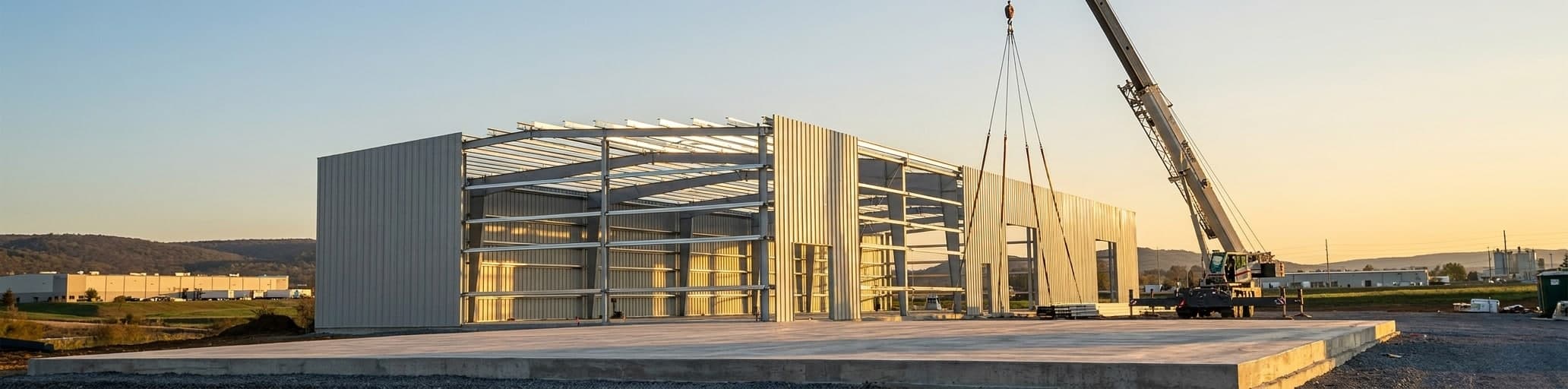

We help Allentown businesses understand how pre-engineered steel buildings deliver significant cost and schedule advantages over traditional construction. Steel structures typically cost 30-50% less per square foot while compressing project timelines from months to weeks, protecting your budget and accelerating your return on investment.
Why Allentown Businesses Choose Steel Buildings Over Traditional Construction
Steel buildings in Allentown cost $25-$40 per square foot versus $200-$450 for traditional construction, freeing your budget for equipment and growth.
The Lehigh Valley's Climate and Why Steel Outperforms Wood & Masonry
Cost Savings: Prefab Steel vs. Site-Built Construction in Pennsylvania The gap between prefab steel and conventional site-built construction is widest when you look at per-square-foot comparisons.
A pre-engineered metal building shell — steel framing and panels — typically runs $25-$40 per square foot, while a fully installed package including site prep, foundation, and interior finishes generally lands between $100-$300 per square foot.[5] Conventional site-built structures routinely exceed that upper range, with traditional construction commanding $200-$450 per square foot when all trades are factored in.[4] For Allentown property owners pricing steel buildings in PA, that gap translates directly to budget remaining for equipment, fit-out, or a second phase of development.
Prefabricated components arrive job-ready with all framing and hardware included, which compresses labor hours on-site and reduces the exposure to regional labor-rate fluctuations that can derail a site-built budget.[4] Ongoing costs tell a similar story: steel structures average annual maintenance at just 1-3% of total building cost, because steel resists the rot, pests, and weather intrusion that force regular repair cycles on wood-framed competitors.[4] Factor in metal roof systems that can cut cooling costs by up to 40% by reflecting solar radiation, and the total cost picture for steel buildings in Allentown, PA improves further across the building's operational life.[4] One number worth tracking separately is the full project budget versus the steel-only quote — permitting, utilities, site grading, and paving are real line items that don't appear in a manufacturer's base price, and overlooking them is the most common reason first-time buyers experience cost overruns.[5]
Speed to Occupancy: How Steel Buildings Compress Project Timelines
For Allentown property owners, time between breaking ground and opening doors is a direct cost.
Every week of construction is a week of delayed operations, extended financing, and deferred revenue.
Pre-engineered steel buildings address that problem structurally: because components are manufactured off-site in controlled factory conditions, site work and fabrication run in parallel rather than sequentially.[7] A typical project moves through four phases — design (1-3 weeks), fabrication (3-6 weeks), delivery and staging (approximately 1 week), and erection (1-3 weeks) — meaning a standard commercial building can reach occupancy in as little as 8-12 weeks from signed drawings.[7] Compare that to traditional site-built construction, which routinely stretches several months to over a year because every phase waits on the previous one.[6] The speed advantage compounds when you look at erection specifically: a simple clear-span structure can be assembled by an experienced crew in 3-5 days, and a medium-sized warehouse in the 50,000-100,000 square foot range typically takes 2-4 weeks to erect.[8] Faster occupancy shrinks the financing window, reduces overhead exposure, and accelerates the return on investment — one industry review notes that faster build times translate directly to quicker ROI and reduced financing costs.[8] For steel buildings in Allentown, PA, where winter weather can stall traditional construction for weeks at a time, the short erection window also reduces seasonal risk: a project that goes from slab to enclosed structure in days rather than months has far fewer opportunities for weather to derail the schedule.[8]
Steel Building Types & Applications for Allentown's Industrial & Commercial Sectors
Pre-engineered steel minimizes on-site labor and timelines while delivering the clear-span flexibility your distribution center needs to reconfigure as operations evolve.
Commercial Warehouses and Distribution Centers
Allentown sits at the center of one of the most active logistics corridors in the country.
The Lehigh Valley currently holds 115 million square feet of industrial space, with 5 million more under development and another 10 million square feet slated for construction.[9] That growth isn't random — the region places 40% of the U.S. population within a seven-hour drive and sits within 100 miles of both the Port of New Jersey/New York and the Port of Philadelphia, with direct access to I-78, I-476, freight rail, and an international airport.[9] Amazon, FedEx, Nestlé, Coca-Cola, Home Depot, and Bridgestone have all built major facilities here for exactly those reasons.[11] For property owners who need to serve that same market, pre-engineered steel is the dominant structural choice — and the numbers explain why.
Fabrication happens off-site in controlled conditions, so on-site labor is minimized and timelines compress sharply compared to conventional construction.[10] Steel joists, girders, and columns are precision-engineered to handle substantial roof loads, which matters when you're storing dense industrial goods, palletized consumer products, or heavy manufacturing materials.[10] Distribution centers built from steel also carry practical flexibility: clear-span interiors eliminate interior columns, giving you unobstructed floor space that can be reconfigured as operational flows change — a feature that's difficult and expensive to replicate in concrete tilt-up or wood-framed construction.[10] If you want to understand how building scale affects your per-square-foot cost before finalizing a footprint, the industrial warehouse cost breakdown by size covers 2026 pricing across common facility sizes.
Agricultural Storage, Equipment Barns, and Grain Facilities
Lehigh County carries a documented agricultural history that spans centuries — corn cribs, granaries, and potato storage cellars were once common features of working farms throughout the region, with examples in Heidelberg Township and Lynn Township dating back to the mid-19th century.[13] Many of those original wood-frame structures are now compromised by the same rot, pest damage, and moisture infiltration that still threatens modern wood construction today.
Farmers and agricultural operators working in and around Allentown now need the same functional variety — grain storage, dry fertilizer storage, flat grain storage, hay storage, and farm equipment shelter — but built to a standard that can hold up across decades without constant repair cycles.[12] Pre-engineered steel is purpose-built for those demands: clear-span interiors eliminate interior columns so you can move large equipment freely, steel panels resist the rodent damage and moisture absorption that degrade grain quality in wood cribs, and sealed metal roofing eliminates the leaks that ruin stored hay or contaminate fertilizer stockpiles.
For operators who need to protect combines, planters, and tillage equipment from Pennsylvania's freeze-thaw winters, a steel equipment barn also removes the structural liability of wood posts shifting in frost-heaved soil — a failure mode that machine sheds built from the late 19th to mid-20th century demonstrated repeatedly.[13] If you're sizing an agricultural steel building for grain, equipment, or commodity storage, the footprint and eave height drive the budget more than any single component — so locking down your storage volume requirements before requesting a quote keeps the project within budget from the first number on the page.
Aviation Hangars and Light Industrial Manufacturing Spaces
Lehigh Valley International Airport (KABE/ABE), located approximately three miles northwest of downtown Allentown in Hanover Township, processed 27.9 million pounds of air cargo in July 2025 alone — a 44.3% increase from July 2024 — and surpassed one million total passengers in 2024, an 8.7% year-over-year gain.[15] The broader Lehigh Valley Airport System also includes Queen City Airport and Braden Airpark, both supporting general aviation activity that generates steady demand for hangar space throughout Lehigh County.[15] Pre-engineered steel is the structural default for aviation hangar construction precisely because the application demands what steel delivers naturally: clear-span interiors with no interior columns obstructing aircraft movement, eave heights that accommodate everything from single-engine piston planes to business jets, and large bi-fold or hydraulic door openings that conventional framing cannot support without costly custom engineering.[14] Light industrial manufacturing spaces in Allentown face a different but equally specific set of requirements — overhead crane rails, process ventilation penetrations, reinforced floor loads for heavy machinery, and wall configurations that can accept future bay additions as production capacity grows — and pre-engineered steel systems accommodate all of them through custom engineering at the design phase rather than expensive field modifications after erection.[14] BIM (Building Information Modeling) software lets engineers resolve clearance conflicts, crane-rail elevations, and door placements in a digital model before a single component is fabricated, which eliminates the costly change orders that tend to surface during construction when those details are left to be worked out on-site.[14]
Allentown Steel Building Costs: Pricing Factors, Permitting, and Total Project Investment
The steel kit represents only 30% of your total project cost, so locking in a material quote with a deposit protects your budget against the price movement most quotes face within 30-60 days.
Material Costs vs. Labor: Where Your Budget Actually Goes
The steel kit — framing, panels, and hardware — accounts for roughly 30% of your total project cost.[18] That single figure reframes how you should read any manufacturer quote: an affordable base price is only the starting point. For steel buildings in Allentown, PA, the remaining 70% distributes across labor, foundation, site preparation, permits, and interior finishing, each carrying its own regional variables that rarely appear in a supplier's opening number.[18]
Material costs for the structural shell run $12-$19 per square foot at commercial scale.[17] The 2026 market is pressing those numbers upward: hot-rolled coil steel is trading near $1,002 per ton, Section 232 tariffs have added a 25-30% burden on North American steel imports, and nonresidential construction input prices jumped at an annualized rate of 7.1% in January 2026.[16] Locking in a material quote with a deposit — rather than treating an estimate as a fixed number — directly protects your budget against mid-project price movement, since most quotes are valid for only 30-60 days.[16]
Labor is the second-largest line item. Certified erection crews charge $5-$12 per square foot to assemble the base structure, and hiring a general contractor to coordinate trades adds another 10-20% to total project costs on top of that.[16] Regional labor rate variation reaches as much as 60% across the U.S., which means Lehigh Valley labor rates — in a dense metro market with active construction demand — sit meaningfully above rural benchmarks.[16] Foundation work adds $5-$10 per square foot for a concrete slab, and site preparation ranges from $3 per square foot on flat, cleared land to over $10 per square foot on uneven or wooded terrain.[17] Interior finishing — insulation, drywall, electrical, plumbing, flooring — accounts for approximately 55% of total costs once the shell is standing.[18]
The table below shows where a typical steel buildings Allentown PA budget distributes across major cost categories:
| Cost category | Typical range | Notes |
|---|---|---|
| Steel kit (materials) | $12-$19/sq ft | Approx. 30% of total project cost |
| Labor (erection crew) | $5-$12/sq ft | Higher in metro markets |
| Concrete slab | $5-$10/sq ft | Varies by size and reinforcement spec |
| Site preparation | $3-$10/sq ft | Condition-dependent |
| Permits and inspections | $5,000-$50,000 | Location and building scope drive the range |
| Interior finishing | ~55% of total | Insulation, drywall, MEP systems |
| General contractor markup | 10-20% of total | Avoidable when self-managing trades |
| Contingency | 7-10% of total | Buffer for scope changes and surprises |
One practical guard against overruns: review vendor quotes for tariff-related surcharges, which currently run $15-$25 per square foot and frequently appear as separate line items after an initial quote is issued.[16] Permitting adds another variable — fees average $5,000-$50,000 depending on jurisdiction and scope, and Lehigh County's PA steel building permit timeline and checklist outlines what triggers the higher end of that range. Sticking to standard rectangular footprints and straightforward roof pitches (2:12 is the most cost-efficient) can reduce total project costs by 15-30% compared to complex layouts, since non-standard dimensions introduce custom engineering fees that compound across every affected component.[16]
Lehigh County Permit Requirements and Local Code Compliance
Pennsylvania's statewide Uniform Construction Code officially transitioned to 2021 International Code Council base standards on January 1, 2026, and steel buildings in Allentown, PA must comply with those standards from the first permit application forward.[20] Any project with a signed construction contract predating that date may still use 2018 codes, but only if the full permit application was submitted by July 1, 2026 — after that cutoff, 2021 standards apply without exception.[20] Pennsylvania operates as a "Home Rule" state where over 90% of the state's 2,562 municipalities enforce the UCC locally, meaning your municipal office — not the county — is the actual permit-issuing authority.[20] For steel buildings in Allentown specifically, the Allentown Planning & Zoning Department requires a zoning permit as the first hurdle for any new footprint, followed by a comprehensive Building Subcode Application with detailed plans for electrical, plumbing, and mechanical systems.[20] Suburban zoning in Lehigh County can be more restrictive depending on the municipality, so confirming the exact zoning district, setbacks, and maximum lot coverage with the Lehigh Valley Planning Commission before finalizing your design prevents costly mid-process plan revisions.[20] Permit fee structures vary across Lehigh County municipalities: most townships calculate fees using either a square-footage model (typically $0.40-$0.84 per square foot) or a construction-value model ($6.00-$10.00 per $1,000 of project cost), and a standard permit package for a new commercial build typically runs $1,200 to $2,000, though projects with complex stormwater management requirements can exceed $8,500.[20] A mandatory $4.50 state UCC surcharge, zoning fees between $50 and $300, and separate trade permits for electrical, plumbing, and mechanical systems at roughly $50 to $100 each layer on top of those base fees.[20] The zoning district your parcel falls in controls which uses are permitted by right, which require a conditional use hearing, and what dimensional standards — setbacks, height limits, lot coverage — must be addressed in your design documents before a permit is issued; in industrial zones, warehousing and wholesale trade uses carry additional criteria including traffic studies, environmental impact documentation, and landscape buffer requirements that must be satisfied as part of the conditional use application process.[19]
Cost Estimator: Foundation, Erection, and Customization Variables
Foundation costs are the most site-dependent line item in a steel building project — and the most commonly underestimated. Every parcel is different: the amount of grading required, soil composition, demolition or site clearing needs, proximity to utility hookups, and environmental sensitivities each add a distinct cost layer before a single column is set.[5] A flat, cleared lot with stable subsoil and existing utility access sits at the low end of that range; a sloped, wooded, or contaminated site with poor drainage and distant utility connections sits at the high end.[5] Most steel building manufacturers price and quote only the steel kit itself, so foundation and site work costs fall entirely outside their published numbers — buyers who compare steel-only quotes without modeling site conditions are working with an incomplete budget picture from the first conversation.[5]
Erection cost carries its own complexity beyond the basic labor-per-square-foot figure. Accurate erection estimates must account for crane rental and rigging time, OSHA and fall protection compliance, and material handling logistics — all of which shift based on structure size, total steel weight, and site accessibility.[21] Scheduling crane time efficiently is one of the highest-leverage cost controls available: delays caused by poor sequencing or incomplete site preparation translate directly into crane overtime charges that compound quickly on larger projects.[21] Bundling steel supply and erection under a single-source provider typically lowers both figures — the supplier knows the kit dimensions, the erection crew works with familiar components, and change orders caused by miscommunication between separate vendors are eliminated before they start.[21]
Customization is where budgets expand fastest when left unmanaged at the design stage. Architectural features like specialty facades, skylights, or non-standard floor layouts add real cost at every affected component: custom framing dimensions trigger engineering fees, non-standard panel profiles increase fabrication lead times, and complex roof geometries multiply labor hours during erection.[5] Rectangular footprints and standard-pitch roofs capture meaningful savings because pre-engineered components are optimized for those configurations, and deviating from them introduces custom engineering work that compounds across every affected detail.[5] The cost-control strategies below apply regardless of building size:
- Bundle steel supply and erection under one contractor to close coordination gaps between trades.[21]
- Finalize crane scheduling before the erection crew mobilizes — idle crane time is billed regardless of why the delay occurred.[21]
- Choose pre-engineered framing over fully custom configurations wherever the application allows, since fewer on-site labor hours mean tighter timelines and lower erection exposure.[21]
- Get two to three erection quotes before committing — regional labor rate variation is significant in active construction markets like the Lehigh Valley, and benchmarking protects your budget.[21]
- Account for utilities, permitting, landscaping, and parking and paving in your working budget before finalizing design — first-time builders who omit these line items consistently experience overruns that a complete project estimate would have surfaced early.[5]
Choosing the Right Steel Building Partner in Allentown: Design, Engineering, and Local Expertise
Single-source turnkey delivery eliminates coordination disputes by placing design, fabrication, and construction under one accountable party responsible for your complete project.
Single-Source Turnkey Solutions vs. Fragmented Contractor NetworksWhen you hire separate firms for design, fabrication, and erection — the fragmented model — you inherit the coordination problems between them. In a traditional design-award-build arrangement, there is no contract between the architect and the contractor, which means disputes over responsibility cannot be resolved through arbitration unless all parties have explicitly agreed to it in advance.[23] The practical result: when something goes wrong on a steel buildings Allentown PA project, each party points at the other, and resolving the dispute consumes time and money that should have gone into your building.[23] A turnkey model eliminates that dynamic by contracting with a single entity responsible for design, procurement, construction, and commissioning — when the project is complete, you turn the key to a fully operational facility, and every phase of the work traces back to one accountable party.[24] That single-point accountability isn't just a contractual convenience; it changes behavior throughout the project, because the contractor who designs the building also builds it and cannot externalize the cost of design errors onto a separate firm.[23]
The cost and schedule advantages of single-source delivery compound across the project timeline. Turnkey projects operate on a fixed-price basis that provides financial certainty before construction begins, with payment terms tied to project milestones rather than open-ended invoicing as work proceeds.[24] When supply and erection are bundled under one contractor, the erection crew works with components they already know — the dimensions, connection details, and sequencing are resolved at the design stage rather than improvised in the field.[22] The design-build structure also fosters collaboration between the designer and the contractor early in the process, which facilitates accurate cost estimating, constructability review, and scheduling before a single dollar is committed to fabrication.[23] Several insurance carriers have noted a measurable reduction in claims on design-build projects compared to traditional fragmented-delivery structures, a data point that matters to Allentown property owners pricing their risk exposure alongside their construction budget.[23] For steel buildings Allentown PA projects specifically, where Pennsylvania's permit and code requirements add coordination complexity on top of normal construction sequencing, single-source accountability keeps the permit process, the fabrication schedule, and the erection timeline synchronized rather than managed by three separate firms working from three separate contracts.
Custom Engineering and 3D Design for Site-Specific Challenges
The gap between a steel building that performs as designed and one that generates change orders throughout construction typically comes down to what gets resolved in 3D before fabrication starts.
Building Information Modeling (BIM) produces a shared digital representation of the complete structure — structural steel, foundation, MEP systems, and site conditions all in one coordinated model — so every clash between a structural member and a conduit run, crane rail, or duct penetration is identified and corrected before components are cut and shipped.[27] The productivity gains behind that process are measurable: at least one pre-engineered building manufacturer using a BIM-to-fabrication workflow reported completing structural detailing 50% faster compared to traditional 2D drafting methods, compressing both fabrication lead times and the overall project schedule.[26] For Allentown sites specifically, the 3D design phase is where site-specific variables get priced accurately rather than discovered as expensive surprises: uneven topography, variable soil bearing conditions, existing utility corridors, and tight setbacks each affect foundation geometry and column placement in ways that surface as change orders when left to be resolved in the field.[27] Foundation analysis using finite element analysis (FEA) technology matches the structural system to actual soil conditions and load paths before concrete is poured, preventing the differential settlement and structural cracking that cost far more to remediate than to engineer correctly at the outset.[27] Complex functional requirements — overhead crane rails at precise elevations, process ventilation penetrations, reinforced floor zones for heavy manufacturing equipment, and large bi-fold hangar door framing — are all resolved in the model during the design phase rather than improvised on-site, which is also where coordination with Pennsylvania steel building manufacturers and local code requirements happens before any steel leaves the fabrication shop.[25][27]
What to Ask Your Steel Building Supplier Before You Sign
The steel building industry has a documented pattern of deceptive pricing tactics — and most of them activate after a non-refundable deposit has already been paid.[30] The most common entry point is a bare-bones initial quote covering only the steel frame, with doors, windows, insulation, gutters, and framed openings conspicuously absent; once the deposit is locked in, a project coordinator reappears with a change order pricing those omitted components at two to three times market value.[30] Knowing the right questions before any money changes hands keeps your negotiating position intact throughout the entire process for your steel buildings Allentown PA project.
- Does the quote include all accessories? Demand an itemized quote covering insulation, gutters and downspouts, framed openings, walk doors, and ventilation before signing. A quote covering only the frame — with accessories described as purchasable later — is the single most common way buyers end up paying inflated prices for essential components.[30]
- Is the total price fixed in writing? Reject any contract clause that allows unilateral price increases after signing. Some dealers issue a low verbal or email quote, then present a revised invoice 10-20% higher once a purchase agreement is signed, claiming steel price movement.[30]
- What panel gauge does the contract specify? Require 26-gauge panels written explicitly into the contract and verify on delivery against the manufacturer spec sheet. Some dealers quote 26-gauge and ship the thinner 29-gauge product, knowing most buyers cannot distinguish them at delivery — which compromises structural integrity and voids warranty coverage.[30]
- Does the engineering package reflect local code requirements? Ask for a stamped package specifying design wind speed, ground snow load, and seismic zone aligned specifically to Lehigh County. A building engineered to generic national defaults can fail Allentown's permit review entirely, with remediation costs that dwarf what correct engineering would have cost at the design stage.[30]
- What does the erection quote actually include? Get explicit written clarity on crane work, foundation bolt-setting, and trim installation. Some suppliers describe erection as included in the base package and then add each of those services as separate line items after signing.[30]
- Is the supplier financially stable and independently verifiable? Check BBB standing, confirm active AISC membership directly at aisc.org rather than accepting a logo on a website at face value, and ask whether the company manufactures what it sells or operates as a broker.[28] Buyers who paid 75% of the total contract price upfront to a supplier citing cash flow problems have found themselves waiting months with no building delivered and no clear legal path to force a delivery timeline.[29]
If any item on a quote is described as "to be determined later" or listed as a future add-on, do not sign until it is fully priced and written into the contract. The leverage buyers have before signing disappears the moment a non-refundable deposit clears.[30]
- Steel buildings cost $25-$40 per square foot for the shell versus $200-$450 for conventional construction, with total installed costs ranging $100-$300 per square foot.
- Pre-engineered steel buildings can reach occupancy in 8-12 weeks compared to several months or over a year for traditional construction due to parallel manufacturing and site work.
- The steel kit accounts for only 30% of total project cost; remaining 70% covers labor, foundation, permits, and interior finishing that often exceed initial estimates.
- Single-source turnkey contractors eliminate coordination problems between separate design, fabrication, and erection firms, reducing change orders and insurance claims.
- Building Information Modeling resolves structural clashes and site-specific variables during design rather than in the field, preventing costly change orders and delays.
- Current tariff surcharges add $15-$25 per square foot to material costs, and Pennsylvania's 2021 code standards apply to all permits issued after July 1, 2026.
- Verify itemized quotes include all accessories, confirm panel gauge specifications in writing, and validate supplier financial stability before paying any deposit.
- https://www.noemamag.com/concrete-built-the-modern-world-now-its-destroying-it
- https://keystonecustomdecks.com/blog/durable-deck-materials-pa-weather/
- https://wellssons.com/damaged-bricks-spalling/
- https://masonsteelcorp.com/steel-building-homes-for-luxury-buyers/
- https://builtmammoth.com/how-much-does-a-steel-building-cost/
- https://www.hcsteelstructure.com/pros-cons-prefabricated-steel-buildings-vs-traditional-construction/
- https://metalprobuildings.com/pre-engineered-steel-building-timeline/
- https://www.mtnssb.com/how-quickly-can-a-metal-building-be-erected-when-done-correctly/
- https://www.wsinc.com/locations/allentown-warehouse/
- https://stevensec.com/warehouse-construction/pennsylvania/allentown
- https://www.lehighvalleynews.com/environment-science/the-lehigh-valley-warehouse-boom-has-brought-prosperity-problems-and-a-notable-culture-change
- https://www.greystoneconstruction.com/markets/britespan-fabric-covered-buildings-for-pennsylvania.html
- https://www.pa.gov/agencies/phmc/historic-preservation/education-outreach/pennsylvania-agricultural-history-project/field-guide-agricultural-resources/outbuildings-and-other-structures-
- https://stevensec.com/pre-engineered-metal-building-company/allentown-pa
- https://grokipedia.com/page/Lehigh_Valley_International_Airport
- https://ameribuilds.com/steel-building-costs-what-to-expect-2026/
- https://www.foxblocks.com/blog/cost-to-build-a-30000-warehouse
- https://masonsteelcorp.com/how-to-build-your-dream-home-using-steel-building-kits-a-beginners-guide/
- https://ecode360.com/13034736
- https://www.newhollandsupply.com/blog/uncategorized/barndominium-regulations-in-pa
- https://steelestimatingsolutions.com/steel-erection-cost-estimator/
- https://www.flemingconstructiongroup.com/the-extraordinary-benefits-of-working-with-fcg/
- https://corporate.findlaw.com/law-library/understanding-project-delivery-methods.html
- https://rdash.ai/blog/turnkey-projects-types-advantages-disadvantages/
- https://www.tylerbuilding.com/post/pre-engineered-metal-buildings-vs-traditional-builds-a-comprehensive-comparison
- https://www.trimble.com/blog/construction/en-US/article/faster-and-better-metal-buildings-with-3d
- https://westernsteel.com/frequently-asked-questions/
- https://www.google.com/goto?url=CAESnAEB7keqTSP2pqM6kkUAA4Nw-IJkBGZzEw0Gy0CKi31jAtsAO20Bab44_qSwvN6LhMN0yYaQMXkrXnmFIN3uPBm2oAcgTl7p7-qy4heeMThNlIY-ehDVg10RC-pQLTo9qGKx9zcsMHrbCjjP_d9w_ZPmL4NOISYf8V54r5777XSetz2DiU1xnifBQf2p_Wro4rY92_wVWpWxvO0lXKE=
- https://www.google.com/goto?url=CAESkAEB7keqTTivK-Ssmicv1NSQBgvcNP7pgxFLgL7znMX3aG-4toU1tUkK1onZsUY1fbpnmgyq9cOohVCxZqFS9ycoQk9ALsFMy4hV8TobY65iHat0Xmkg3y7RS5wOG4TrCHSCT7X15pmHtPmuJFx5FI2uMtBbM1D03ndqPwnEmqCOznXdakXtgrLuR-B6nru7GkA=
- https://www.google.com/goto?url=CAEScwHuR6pNkmvdvMwmiDyKyAevc4DnJgaUKUdHqtlbj1qmgAAwxMstl4MAcrxqzdtTBeRKzrpZtYERXEZ0BlU_ocsyXsbth53Zdz1jyAJBv_mk60Z-zSxYmCETLBRAHQXmbf1hLwPJDcpntr9fvt6DwCH0m_g=