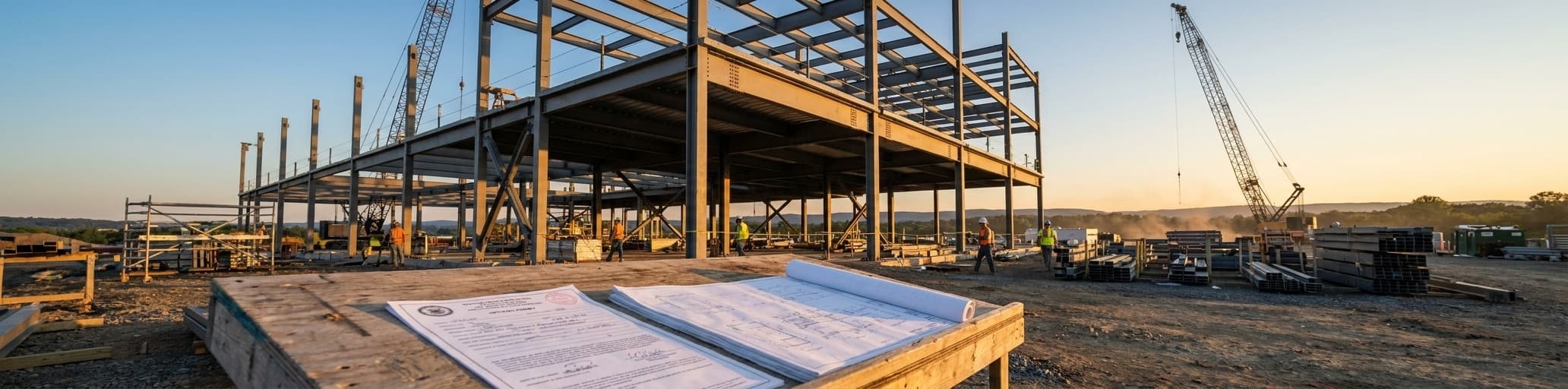

Pennsylvania's steel building permits split between municipalities and the state, with timelines ranging from 1-2 weeks to several months depending on jurisdiction and submission completeness. We help you navigate county-specific code requirements and coordinate design, engineering, and permitting as a single source to keep your project on schedule.
Why Pennsylvania's Permit Process Requires Steel Building Expertise
Know whether your municipality administers permits locally or defers to the state, since that choice determines your timeline and coordination steps.
How Pennsylvania's Tiered Permit System Affects Your Steel Building Timeline
Pennsylvania splits permit authority between individual municipalities and the state Department of Labor and Industry, and which tier handles your project determines how long you wait.
Municipalities can either administer the Uniform Construction Code themselves or opt out entirely, handing enforcement to Harrisburg.[2] For anyone working with steel building manufacturers in Pennsylvania, that distinction is critical: if your municipality has opted out, your application routes to the state rather than a local office, adding coordination steps you need to budget time for.[2] At the local level, commercial permits carry a 30-business-day processing window — residential permits get 15 — though complete, well-prepared submissions often clear in 1-2 weeks.[1] Steel buildings classified as commercial require plans stamped by a registered design professional, and those projects will likely go before a planning commission before final approval lands.[1] When your schedule is tight, the UCC provides two legitimate shortcuts worth knowing: phased construction permits let you break ground on foundations before full plans are approved, and the Department of Labor and Industry offers expedited plan review completed within seven days for an additional fee.[2] Understanding Pennsylvania's commercial steel building code requirements before you submit — including which tier holds jurisdiction over your site — is the single biggest variable you can control on your project timeline.
Why Single-Source Manufacturers Like National Steel Buildings Streamline Permit Approval
Permit requirements for Pennsylvania metal buildings shift with every project — municipality, intended use, and structure type each change what you need to submit.[5] Local zoning laws dictate land use, setbacks, and sometimes even exterior appearance, meaning a warehouse in Erie faces a different documentation set than a farm building in Lancaster County.[5] Manufacturers who are already familiar with typical Pennsylvania standards can flag compliance gaps before submission rather than after a rejection letter arrives.[4] That distinction matters most when your project triggers multiple permit types: beyond the core building permit, projects often need separate zoning permits plus additional sign-offs for electrical or plumbing work depending on the building's end use — and coordinating all of those through a single point of contact keeps your schedule intact.[5] Kit suppliers who deliver materials and step away leave you responsible for hiring a registered design professional, managing code gaps that surface mid-review, and chasing down each permit category yourself — every one of those handoffs adds time and cost.[5] A manufacturer that owns design, engineering, delivery, and installation keeps all of those variables in one place, which is the fastest path to final approval.
If you're evaluating which type of builder to trust with that coordination, vetting local prefab contractors before you commit saves far more time than correcting a bad choice after groundbreaking.
Common Permit Delays and How Experienced Builders Avoid Them
The most common delay triggers for Pennsylvania steel building permits cluster around three failure points: submitting incomplete documentation, missing jurisdiction-specific code requirements, and poor coordination between permit approval and delivery schedules.
Failing to verify local building codes and zoning laws before you submit is one of the most frequent mistakes — it can produce permit denial, forced design modifications, or in worst cases, demolition of completed work.[7] Experienced builders start the permit process well before construction is scheduled, because delaying the application can stall a project by weeks or months.[7] The second failure pattern — code gaps surfacing mid-review — happens when buyers work with kit suppliers who aren't tracking Pennsylvania's municipal variations; a rejection letter means resubmitting revised drawings and restarting the clock, which translates directly into fines, project delays, and potential safety issues if any work was already underway.[6] The third delay point is delivery timing: materials that arrive before permits clear — or before the crew is staged — create storage costs and compress the remaining schedule.[7] Builders who own engineering, permitting, and delivery coordination resolve all three failure points before they surface, which is exactly the kind of proactive project management that keeps your build on schedule.[8] Understanding the prefab building kit delivery timeline shows where those handoffs happen and why single-source accountability keeps every phase locked together.
Pennsylvania County-by-County Steel Building Permit Timelines
Submit a complete permit package to Pittsburgh's OneStopPGH on your first try, because incomplete submissions stall while reviewers wait for missing documents.
Allegheny County Permit Process: What to Expect and How Long It Takes
Allegheny County routes all permit activity through OneStopPGH, the centralized platform managed by Pittsburgh's Department of Permits, Licenses, and Inspections (PLI), where you apply, pay, and schedule inspections in one place.[9] Pittsburgh processed more than 24,000 permits through that system in 2023 alone — volume that explains why a complete first submission matters far more than a fast one.[10] Incomplete packages don't get rejected outright; they stall while reviewers wait on missing documents, and every day you spend resubmitting is a day your steel building schedule slips.[10] Permit fees aren't flat-rate in Pittsburgh — they're calculated on total construction value, which means a larger commercial steel building carries a proportionally higher fee that needs to be in your budget before submission, not discovered afterward.[9] The governing standard across all of Allegheny County is Pennsylvania's Uniform Construction Code (Act 45 of 1999), which adopts the International Code Council's I-Codes — your stamped drawings and structural calculations must align with those standards before PLI advances your application.[9] One factor that regularly catches out-of-area builders: municipalities within Allegheny County, including Bethel Park and Cranberry Township, layer their own zoning rules on top of the UCC, so a commercial steel building permit filed in one suburb can require a materially different documentation package than one filed a few miles away.[10] Bypassing the permit process isn't a viable shortcut — it exposes you to fines, denied insurance claims, and title complications at resale.[10]
Philadelphia and Southeast PA Counties: Unique Requirements and Expedited Options
Central and Western PA Counties: Rural vs. Municipal Approval Paths Central and Western Pennsylvania presents the clearest version of the state's two-track permit system in action.
Many rural municipalities across counties like Centre, Clearfield, Clinton, and Potter have opted out of enforcing the UCC locally, which reroutes your steel building permit application directly to the Pennsylvania Department of Labor and Industry in Harrisburg rather than a local building department.[2] That shift has concrete consequences: you submit a physical application package by mail, examiners assign projects in the order received, and an incomplete submission gets mailed back to you — restarting the entire clock.[2] Your timeline in an opted-out rural municipality depends entirely on the state examiner queue rather than a county office you can walk into or call directly.[2] Municipalities that do self-enforce — including active boroughs and townships across Westmoreland, Butler, Lawrence, and Erie counties — operate under the same IBC/UCC baseline but manage review, inspection scheduling, and certificate of occupancy in-house, which typically keeps communication faster and feedback loops tighter.[12] Either way, local zoning ordinances still govern land use, setbacks, and permitted structure types at the municipal level, so confirming jurisdiction before submission is non-negotiable: filing with the wrong authority doesn't delay you — it forces you to start over.[12] One scheduling tool available regardless of which track applies to your site: phased construction permits let you break ground on the foundation before full building plans are approved, which is the most practical way to keep a steel building project moving while detailed drawings are still in review.[2] If your project lands in a state-jurisdiction municipality and your schedule is tight, the Department also offers expedited plan review completed within seven days of a written request, for an additional fee — a legitimate option worth building into your budget when timing is critical.[2]
The Complete Pennsylvania Steel Building Permit Essentials
Submit a complete documentation package on your first attempt to avoid review delays that slip your project schedule.
Pre-Submission Documentation: What Your County Needs Before You Apply
Before you submit to any Pennsylvania building department, the fastest path through review is a complete package on the first attempt — incomplete submissions don't get rejected outright, they stall while reviewers wait on missing documents, and every day spent waiting is a day your project schedule slips.[13] The UCC requires a permit before construction begins, and for projects in municipalities that have opted out of local UCC enforcement, your full application package routes by mail to the Department of Labor and Industry in Harrisburg, where projects are processed in the order received.[13] For both state-jurisdiction and locally-administered steel building projects, the core documentation set required before submission includes:
- Detailed architectural plans and specifications drawn to current IBC/UCC standards
- A site plan showing the building footprint, property boundaries, and required setbacks
- Stamped structural calculations from a registered design professional
- An energy efficiency compliance report
- Permit fees calculated on total construction value[14]
If a reviewer identifies gaps during the initial check, the department issues feedback and you must revise and resubmit — restarting the review clock entirely.[14] Steel buildings carry one additional pre-submission requirement that catches out-of-area buyers most often: your structural calculations and connection details must reflect the specific snow loads, wind speeds, and seismic values adopted by your county and municipality, since those variables shift across Pennsylvania and must align with the jurisdiction's current code version before any reviewer advances your application.[15] Pulling together zoning approvals, municipal tax parcel documentation, and any required agency pre-approvals alongside the core package before you file eliminates the most common first-submission rejection point and keeps your build on schedule.[14]
Structural and Engineering Documentation: Why Steel Buildings Get Faster Approvals
Pre-engineered steel buildings clear plan review faster than custom-framed construction for one concrete reason: the structural engineering is resolved before you submit, not during review.
Building departments are already familiar with pre-engineered building systems, and the certification accompanying a pre-engineered package assures reviewers of structural integrity without requiring them to verify calculations from scratch.[16] Every pre-engineered order should arrive with engineer-stamped plans and letters of certification as standard — not as an add-on you chase down separately.[16] Where rejections happen, they almost always trace back to site-specific gaps: Pennsylvania's snow loads, wind speeds, and seismic values shift by county and municipality, and your structural calculations must reflect the jurisdiction's current adopted values before any reviewer advances the application.[14] Foundation documentation adds a second site-specific variable — soil conditions and frost depths vary across the state, so most building departments require certified foundation plans alongside the anchor bolt layout, and a missing or incorrect foundation package triggers the same revise-and-resubmit cycle as a structural gap.[16] The practical difference between a package that clears in days versus one that stalls for weeks comes down to whether those jurisdiction-specific values were embedded in your stamped drawings before submission or discovered by a reviewer who then sends them back.
For a closer look at how steel frame load paths and fire ratings factor into what reviewers evaluate, the comparison between steel and wood framing shows exactly where pre-engineered steel documentation creates a structural review advantage.
Post-Approval Inspections and Compliance: Keeping Your Project On Schedule
Once your permit clears, Pennsylvania's UCC triggers a mandatory inspection sequence that determines whether your build stays on schedule or stalls at the worst possible moment.
The required stages for a steel building run in a fixed order: foundation inspection before concrete is poured, framing inspection before wall panels close in, rough-in review for electrical, plumbing, and mechanical systems while framing is still exposed, and a final occupancy inspection confirming every element matches the approved drawings.[18] Each stage must pass before the next phase of construction can proceed — which means materials need to arrive staged around inspection windows, not ahead of reviews that haven't cleared.[18] Confirming your inspection routing before construction starts matters here: municipalities that self-enforce the UCC schedule reviews in-house, while townships that have opted out direct you to a certified third-party code agency instead, and the two paths have different lead times and contact points.[18] In Philadelphia specifically, inspections are requested through the eCLIPSE portal or by calling (215) 255-4040, and a Certificate of Approval issues only after every required inspection passes.[11] Skipping ahead or starting work before a permit is issued carries a direct financial penalty — some Pennsylvania municipalities double the permit fee for any work already underway without approval.[18] The final inspection confirms that construction aligns with the permitted design, that all safety requirements are satisfied, and that the structure is ready for legal occupancy — the document your lender, insurer, and any future buyer will require.[17] Understanding how each construction phase maps to a sequential schedule shows exactly where inspection checkpoints sit within the build timeline and why a single-source manufacturer who owns delivery and installation coordination keeps every phase locked in the right order from day one.
How to Partner With a Pennsylvania Steel Building Manufacturer for Permit Success
Design-build manufacturers include engineer-stamped plans and jurisdiction-specific load calculations in their standard package, eliminating costly revisions when permit reviewers find mismatches.
Why Design-Build Manufacturers Handle Permits Better Than Kit Suppliers
The core difference between a design-build manufacturer and a kit supplier comes down to who owns the risk when a permit reviewer asks a question.
Kit suppliers ship a building package and step away, leaving you responsible for sourcing a registered design professional, managing code gaps that surface during review, and coordinating every separate permit category your project triggers.[21] Some lower-cost package providers ship generic drawings that still require full state engineering review — which adds cost and restarts the clock on your timeline before you've broken ground.[20] A design-build manufacturer produces engineer-stamped plans specific to your building's dimensions, your county's snow and wind load requirements, and your foundation design as part of the standard package, not as an add-on you chase down after the sale.[20] That matters in Pennsylvania because load values shift county by county, and a reviewer who finds a mismatch between your stamped drawings and the jurisdiction's adopted values sends the entire package back for revision.[20] Proper construction also involves design and engineering processes that are expensive and difficult to source independently — a turnkey builder absorbs all of those coordination costs within a single contract rather than leaving them as open variables you discover mid-project.[21] When design, engineering, permitting, and delivery sit under one roof, every jurisdiction-specific requirement gets resolved before submission — not after a rejection letter forces you to start over.[20]
National Steel Buildings's Permit Support: From Submission to Final Sign-Off
Local vs. National Manufacturers: Permit Expertise and Cost Implications The decision between a local Pennsylvania builder and a national manufacturer carries two concrete variables: how deeply the supplier knows your municipality's code requirements, and what that expertise costs at the quote stage. Compliance with local building codes and obtaining the necessary permits is essential for a smooth construction process — and a supplier who isn't well-versed in those requirements creates delays and legal exposure you pay for, not them.[25] The risk with certain national providers is real: large national steel suppliers with little local knowledge ship generic packages that still require full state engineering review, adding cost and restarting your timeline before a single bolt is set.[26] But that category is distinct from national manufacturers who invest specifically in Pennsylvania permit expertise — the difference surfaces when a reviewer finds a mismatch between stamped drawings and your jurisdiction's adopted load values. Location drives structural cost more than any other factor: a building in a high-snow-load county requires a materially different design than an identical footprint in a low-load municipality, and a manufacturer who treats every project as a custom-engineered package absorbs those variables into the quoted price rather than surfacing them as change orders after submission.[27] Value engineering — optimizing the design for maximum cost savings while meeting all code requirements — only happens when the manufacturer owns the engineering process, not when they hand you a generic kit and walk away.[27] The table below maps where local and national manufacturers typically diverge across the variables that matter most to your Pennsylvania permit timeline and budget.
| Variable | Local-only builders | National manufacturers with PA expertise |
|---|---|---|
| Municipal code familiarity | Strong in home county; gaps elsewhere in PA | Consistent across all PA jurisdictions when properly resourced |
| Material pricing | Limited bulk buying power | Lower per-unit costs through volume purchasing |
| Stamped drawings | May require third-party engineer | Produced in-house, jurisdiction-specific |
| Load value accuracy | Varies by project | Embedded at order, matched to your zip code |
| Permit coordination | Often buyer-managed | Single-source accountability from submission to sign-off |
| Change order risk | Higher — gaps surface mid-review | Lower — jurisdiction variables resolved before submission |
For agricultural steel buildings in Pennsylvania's rural counties — where opted-out municipalities route applications to Harrisburg — that last row matters most: a rejected package mailed back from the state examiner queue adds weeks you can't recover, and a national manufacturer with documented PA permit experience is the fastest path to keeping your project within budget and on schedule.[25]
- Pennsylvania splits permit authority between municipalities and the state; opted-out areas route applications to Harrisburg, adding coordination steps.
- Commercial permits process in 30 business days locally, but complete submissions often clear in 1-2 weeks; expedited state review available in 7 days for a fee.
- Incomplete documentation is the #1 permit delay–rejections force resubmission and restart the review clock entirely.
- Structural calculations must match your county's specific snow loads, wind speeds, and seismic values or reviewers will reject and return the package.
- Pre-engineered steel buildings clear plan review faster because structural engineering is resolved before submission, not during review.
- Design-build manufacturers produce jurisdiction-specific stamped drawings and manage all permits as standard; kit suppliers leave you responsible for engineering gaps and coordination.
- Foundation documentation and site-specific variables like soil conditions and frost depths are mandatory–missing details trigger the same revise-and-resubmit cycle as structural gaps.
- https://www.shaler.org/193/Building-Permit-Applications
- https://www.pa.gov/agencies/dli/programs-services/labor-management-relations/bureau-of-occupational-and-industrial-safety/uniform-construction-code-home/historic-buildings/plan-review-and-inspection-requirements
- https://alansfactoryoutlet.com/metal-buildings-pennsylvania-pa/?srsltid=AfmBOoq7X9fUEB20qbayshrI8VD5HRHfbv7wV-ZhUSz9Mqikht5mAyqg
- https://carportdirect.com/metal-buildings-pennsylvania-pa?srsltid=AfmBOooKwJvqrKpEiH55VplaGZ1awMPtOGcsKAL64e9rVK4Ynn58eLL6
- https://bulldogsteelstructures.com/service-areas/pennsylvania/
- https://americanremodeling.net/zoning-permits-101-pennsylvania-homeowners/
- https://titansteelstructures.com/metal-structure-tutorials/mistakes-to-avoid-when-purchasing-a-metal-building-a-complete-buyers-guide/
- https://reichconstructionllc.com/pennsylvania-pre-engineered-steel-buildings-prefab-metal-building-faq/
- https://www.pittsburghpa.gov/Business-Development/Permits-Licenses-and-Inspections
- https://malickbrothersexteriors.com/2025-guide-to-roofing-permits-inspections-in-pittsburgh-and-surrounding-suburbs/
- https://www.phila.gov/services/permits-violations-licenses/apply-for-a-permit/building-and-repair-permits/get-a-building-permit/
- https://www.permitvelocity.com/resources/pennsylvania-building-permits
- https://www.pa.gov/services/dli/apply-for-a-uniform-construction-code-building-permit
- https://www.steelcobuildings.com/navigating-construction-permits-for-steel-buildings-requirements-and-things-to-know/
- https://www.universalsteel.com/navigating-metal-building-permits-and-requirements-a-comprehensive-guide/
- https://www.rhinobldg.com/blog/construction-permits-for-metal-buildings
- https://www.tejjy.com/building-permit-inspection-checklist/
- https://www.newhollandsupply.com/blog/uncategorized/barndominium-regulations-in-pa
- https://www.worldwidesteelbuildings.com/blog/types-of-building-permits/
- https://www.steelstructuresamerica.com/metal-building-permits-codes-and-engineering-requirements-what-you-need-to-know/
- https://www.summitsteelbuildings.com/turnkey-construction-eliminates-hassles-of-building-kits
- https://www.pittsburghpa.gov/Business-Development/Permits-Licenses-and-Inspections/Permits/Commercial-Permits/Special-Inspections
- https://up.codes/viewer/pennsylvania/ibc-2018/chapter/17/special-inspections-and-tests
- https://www.phila.gov/departments/department-of-licenses-and-inspections/inspections/construction-inspections/
- https://www.steelcarports.com/blog/how-to-choose-best-metal-building-supplier?srsltid=AfmBOoqLMY8nfXtuDEyDRuboldfZRrGYpVxDn-MNTSckcHd6XI6cbNji
- https://agribilt.com/coverage-areas/pennsylvania-quonset-huts/
- https://www.alliedbuildings.com/