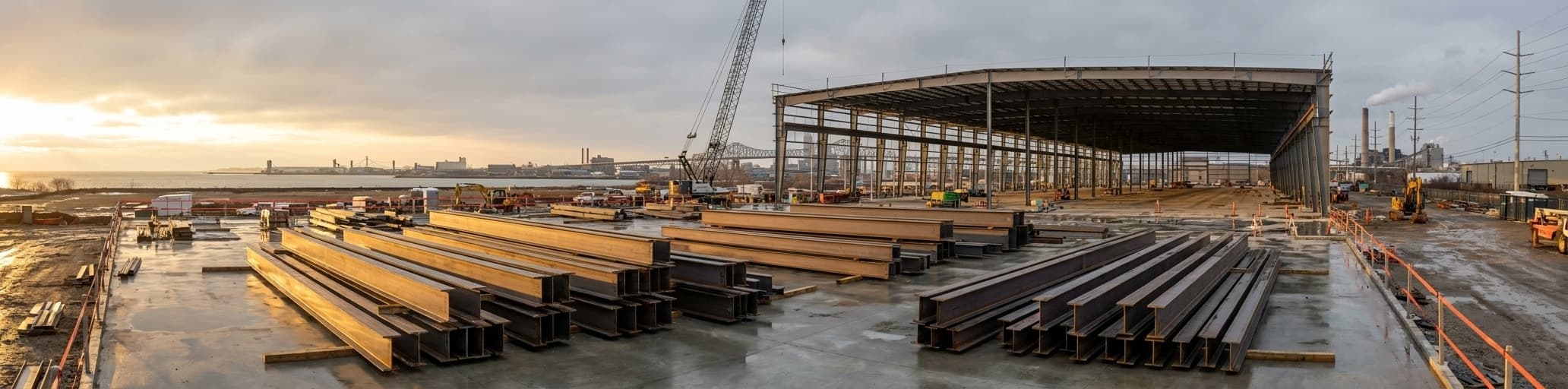

We help Cleveland property owners understand why steel buildings outperform concrete and wood in harsh Northeast Ohio winters while delivering measurable financial returns. Our single-source approach eliminates coordination risk, compresses construction timelines, and keeps projects within budget from engineering through erection.
Why Cleveland Businesses Choose Steel Buildings for Durability and Cost Savings
Steel buildings sidestep the freeze-thaw damage that destroys concrete and wood in Cleveland winters, while adding $30,000-$42,000 to your property's appraised value on day one.
Cleveland's Climate Demands: Why Steel Outperforms Wood and Concrete
Cleveland's winters aren't just cold–they're relentlessly repetitive.
Northeast Ohio's freeze-thaw cycle runs from early fall through late spring, subjecting buildings to roughly half a year of continuous temperature-driven stress.[1] Each time temperatures drop below 32 degreesF, water trapped in micro-cracks and porous surfaces expands by approximately 9%, widening gaps incrementally with every cycle until minor flaws become structural failures.[1] Concrete is especially vulnerable: internal pressure from freezing moisture causes progressive cracking, delaminations, and spalling, and once deterioration begins in a concrete structure, it accelerates exponentially over time.[2] Wood fares no better in Northeast Ohio conditions–maintaining basic weather resistance requires repainting or resealing every 3 to 7 years, and rot or insect damage compounds steadily across a building's lifespan.[3] Pre-engineered steel frame structures sidestep both failure modes: steel doesn't absorb water, doesn't rot, and doesn't develop the freeze-thaw-induced pore pressure that destroys concrete over time.
For property owners evaluating steel buildings in Cleveland, Ohio, avoiding those failure modes isn't just a durability argument–it's a financial one, since reactionary repairs in Northeast Ohio run at least 30% more expensive than preventative maintenance.[1]
Long-Term ROI: Steel Building Ownership in the Ohio Market
The financial case for a steel building in the Cleveland market goes well beyond avoiding repair bills.
Appraisers typically value permanent outbuildings at 50-70% of their construction cost when assessing a property, meaning a $60,000 steel structure adds a conservative $30,000-$42,000 to appraised value on day one.[4] Broader market data shows properties with quality permanent outbuildings–storage facilities, workshops, equipment bays–command a premium of $15,000 to $45,000 over comparable properties without them, and they sell measurably faster because buyers can skip the permitting, design, and construction process entirely.[4] On the operating side, pre-engineered steel buildings are built specifically to deliver low maintenance and long-term ROI; the same steel that resists Cleveland's freeze-thaw cycles also eliminates the repainting, rot repair, and pest remediation cycles that erode the economics of wood structures over a 20-year hold.[6] Wind-resistant construction–a real consideration for Northeast Ohio's Lake Erie-driven storms–can add a further 6.8% to resale value on its own, making the structural choices you make at build time compound over the ownership period rather than depreciate.[5] Stack those figures against a predictable, single-source construction cost, and the math typically shows Cleveland-area steel building owners recovering their full construction investment within five to seven years before resale appreciation is even factored in.[4]
Single-Source Solutions vs. Managing Multiple Contractors
When you hire separate contractors for design, fabrication, site prep, foundation, and erection, you become the de facto project manager–and that role carries real financial exposure.
In the multi-prime delivery model, the owner personally absorbs coordination risk between every trade, and any mismanagement can drive costs up enough to erase whatever savings the approach promised in the first place.[8] The communication breakdown compounds the problem: when contractors rely on a general contractor as a conduit to the owner, the process becomes a telephone game that produces misunderstandings, rework, and delays–all billed back to you.[8] A single-source partner eliminates the exposure by serving as the central coordination hub from design through erection, keeping budget, schedule, and accountability unified under one contract.[7] For Cleveland property owners evaluating turnkey steel building delivery vs. coordinating multiple primes, the practical difference appears in fewer change orders, tighter timelines, and a final cost that tracks the original quote rather than drifting past it.
Steel Building Types & Applications for Cleveland Property Owners
Steel framing handles Cleveland's demanding distribution and agricultural storage needs with clear-span interiors, superior height capacity, and fire-resistant performance that wood and concrete cannot match cost-effectively.
Commercial Warehouses and Distribution Centers
Cleveland's position as a Great Lakes logistics hub drives consistent demand for large-footprint warehousing, and recent projects confirm that structural steel is the default framing choice for serious distribution infrastructure.
Clayco's Amazon fulfillment build in Cleveland totaled 857,420 square feet of warehouse floor plus mezzanine space, with structural steel carrying the primary framing load throughout.[10] That scale isn't unusual for the market–Northeast Ohio's distribution sector regularly requires clear-span interiors wide enough to accommodate high-bay racking, dock-door runs, and mezzanine levels without interior columns interrupting fork-lift traffic patterns.[10] On the smaller end, the Avery Dennison plant expansion in Painesville used structural steel paired with insulated metal panels and achieved wall heights of 47 feet–a spec that illustrates how steel handles the vertical clearance demands of manufacturing and production lines that wood or tilt-up concrete simply cannot match cost-effectively at that height.[11] Pre-engineered metal buildings serve both ends of the size range: regional contractors across the Cleveland market list PEMB delivery as a primary construction method for warehousing and distribution work precisely because factory-fabricated components reduce field labor hours and compress the schedule between permit approval and occupancy.[9]
Agricultural Storage, Equipment Barns, and Grain Facilities
Northeast Ohio's agricultural sector spans grain operations, livestock facilities, equipment-intensive row crop farms, and specialty produce operations–each with storage demands that steel handles better than wood at almost every scale.
Steel buildings won't ignite from a spark near stored hay or grain, and a concrete-slab-and-standing-seam steel combination actively resists the moisture and mold cycles that destroy stored feed and seed over time.[13] For equipment storage, ceiling heights and door widths are engineered to exact specification–tall enough for combines in full header configuration, wide enough for wide-body tractors and attachments like disc harrows or seeding drills–without the structural compromises a wood frame demands at comparable spans.[13] Cold storage and fertilizer facilities carry additional state and county compliance requirements around ventilation, access control, and containment; a steel building designed with those specs from the start costs less to construct and far less to operate than retrofitting a non-compliant structure after the fact.[13] Corrosion prevention is built into the design process through high-quality vapor barriers, ridge vents, wall louvres, and site grading that keeps water moving away from the foundation rather than pooling against it.[13] On the financial side, the permanent 100% bonus depreciation under the Big Beautiful Bill Act means the full cost of a new agricultural steel building can be deducted in the year it's placed in service–making 2026 a compelling time to build rather than defer a facility upgrade.[12] If operational needs expand later, steel's modular structure allows adding bays or opening end walls without tearing down and starting over, which means a building sized for today's equipment roster can grow alongside the operation without triggering a second round of permitting and foundation work.[13]
Aviation Hangars and Industrial Manufacturing Spaces
Aviation hangars require engineering precision that standard commercial buildings don't demand — clear spans of 100 to 200+ feet to eliminate interior columns for aircraft maneuvering, eave heights calibrated for tail clearance, and door systems sized to specific wingspan dimensions.[14] Pre-engineered steel components arrive pre-cut and pre-drilled, cutting on-site construction time by up to 30% compared to conventional building methods, which reduces financing costs and gets revenue-generating hangar space operational faster.[14] Shell-only hangar structures typically run $25-$40 per square foot; turnkey projects with foundation, doors, utilities, and finishes range from $60-$150+ per square foot, with the primary cost drivers being clear span width, eave height, door system type, and regional snow and wind load requirements for Northeast Ohio.[14] Permit packages for aviation projects must satisfy both local building codes and airport authority standards simultaneously, which makes stamped engineering drawings prepared for local permit submission a non-negotiable deliverable — not an optional add-on — particularly for projects subject to FAA-adjacent facility guidelines.[15]
For industrial manufacturing facilities in the Cleveland area, the structural calculus shifts from clear span width to vertical load paths: overhead crane systems at 10-ton capacity and greater require crane runway beams integrated into the primary frame, while heavy equipment operations demand engineered floor load capacities well beyond standard commercial specs.[14] Mixed-use industrial layouts — production floor, mezzanine office, dock doors, and specialized ventilation systems — are addressed in the original framing design rather than retrofitted after erection, preventing the costly structural changes that arise when operational requirements evolve mid-construction.[14] One detail that routinely surfaces late in the build process is floor coating specification: aviation and industrial floors require high-performance polymer systems engineered specifically for chemical exposure, abrasion, and continuous heavy traffic loads, and downtime for floor repairs in an active facility can cost hundreds of thousands of dollars in lost revenue — making floor system selection part of the original build scope rather than a finish-phase decision.[16]
Cleveland Steel Building Costs: What You'll Actually Pay in 2026
Budget your 40×60 Cleveland steel building from current 2026 material and labor costs, not outdated pricing from five years ago, to avoid arriving significantly underfunded at project kickoff.
40×60 Metal Building Pricing with Concrete Slab (Real Numbers)
The honest answer to what a 40×60 metal building costs with a concrete slab in 2026 is this: the number that worked five years ago no longer applies.
Forum data from owners who completed 40×60 garage and shop builds confirms that sub-$100K all-in prices were achievable in earlier cycles, but those same owners now flag that pricing has "ramped up a bit" — an understatement when you factor in current steel, labor, and concrete costs in Northeast Ohio.[17] A realistic Cleveland-area scope for a 40×60 pre-engineered steel building with a concrete slab should budget for the slab itself, electrical rough-in (even if you run interior circuits yourself), permits, insulation, and at minimum one or two utility connections — none of which are optional line items you can defer once the structure is in the ground.[17] The practical planning takeaway: owners who anchored their budget to older data points without adjusting for market movement arrived at project kickoff significantly underfunded, a mistake that stalls timelines and forces value-engineering decisions under pressure rather than by choice.[17] Build your 40×60 Cleveland budget from current material and labor inputs — not what a comparable structure cost half a decade ago.
30×40 Steel Building Costs and Site Preparation Factors
A 30×40 pre-engineered steel building delivers 1,200 square feet of clear-span floor space — enough for a two-vehicle shop, a compact warehouse bay, or a combined equipment-and-storage facility.
In 2026, detached structures at comparable scale average $40 to $70 per square foot nationally, placing a basic 30×40 build between $48,000 and $84,000 before slab and site work are added.[18] That range shifts substantially depending on where you build: labor rates and regional material costs can move a project's total by 15% to 30% in either direction, and site-specific factors — soil conditions, accessibility, and permit fees — carry equal weight in the final installed number.[18] Pre-engineered steel kits reduce upfront costs compared to fully custom construction, but foundation, site prep, and utilities still require their own budget lines regardless of how the structure itself is priced; none of those costs are absorbed into the kit price.[18] For Cleveland-area property owners scoping a 30×40 project, a current 30×40 prefab building cost breakdown that accounts for Northeast Ohio labor rates and local permit requirements will produce a far more reliable working budget than a national average multiplied by square footage — the gap between a published per-foot estimate and an actual Cleveland-specific installed cost can easily reach five figures once site preparation is properly scoped.
How National Steel Buildings' Buying Power Reduces Your Total Project Cost
The line item most Cleveland property owners underestimate in 2026 isn't steel tonnage — it's labor.
On-site construction labor costs as a percentage of total project budgets have climbed to record highs this year, driven by a shortage of certified skilled tradespeople across Northeast Ohio and the broader Midwest.[19] Every additional day your project spends in the field compounds that exposure: each extra on-site day adds management and labor costs that directly erode your return on investment before the building even earns its first dollar.[19] National-scale buying power addresses the problem at its root.
Pre-engineered components arrive pre-cut, pre-drilled, and ready for bolted assembly, cutting on-site construction time by more than 40% compared to conventional field-fabricated approaches — and in a Cleveland labor market where skilled crews bill at premium rates, a 40%-shorter field schedule translates directly to a lower installed cost rather than just a faster ribbon-cutting.[19] Engineering optimization compounds the material-side savings: portal frame designs using high-strength steel can reduce total steel consumption across a project by 10-15%, which lowers both material cost and foundation load, two budget lines that are easy to overlook when evaluating competing quotes.[19] The most expensive cost on any Cleveland steel building project is never the per-ton price of steel — it's the revenue and carrying costs lost to a construction delay, a structural change order mid-erection, or a permit rejection triggered by drawings that weren't engineered for local code from the start.[19] A single-source partner with contracted national pricing absorbs the procurement, engineering, and schedule risk that otherwise lands on your desk, keeping your project within budget without requiring you to become an expert in steel market timing or Northeast Ohio permit timelines.
Permitting, Engineering, and Erection: Your Complete Cleveland Project Roadmap
Ohio Admin. Code 4101:8-3-01 requires your stamped drawings to satisfy Cleveland's specific wind, snow, seismic, and weathering criteria before local approval proceeds.
Cleveland Building Codes and Local Permit Requirements for Steel Structures
Stepping into the permit process without understanding Ohio's layered code structure is how projects stall.
Steel building permits in Cleveland operate under Ohio Admin.
Code 4101:8-3-01, which establishes the climatic and geographic design criteria your stamped drawings must satisfy before any local building official can approve them.[20] The code mandates site-specific compliance across four primary design axes: wind speed, ground snow load, seismic design category, and weathering probability for concrete — each of which carries direct consequences for how a pre-engineered steel frame is specified and detailed.[20] Fire separation distance requirements add another layer: exterior wall assemblies facing a property line must meet minimum fire-resistance ratings, with unrated assemblies permissible only where the fire separation distance clears the thresholds defined in the code's exterior wall element tables.[20] Structural load compliance isn't optional or approximate — minimum uniformly distributed live loads are prescribed by occupancy type, roof live loads vary by slope and tributary area, and allowable deflection limits are set for every structural member category including exterior walls under wind load with different finish systems.[20] One detail that catches steel building applicants off guard: post and frame structures — which include many pre-engineered configurations — must either fall within the prescriptive structural limits of the standard or be accompanied by full structural calculations as required by the building official, and structures outside those limits must comply with the broader Ohio Building Code's structural design provisions rather than the residential code track.[20] Getting the engineering package right the first time, calibrated to Cleveland's local design values, is the fastest path from permit submission to approval.
Wind and Snow Load Specifications for Northeast Ohio
Northeast Ohio's position in the Lake Erie snow belt produces design loads that diverge sharply from statewide averages — and that divergence has direct consequences for how a pre-engineered steel frame must be specified.
Ground snow loads in Ohio's northeastern counties near Lake Erie reach 30 psf or higher, compared to 20 psf in southwestern counties, meaning a building designed to a generic Ohio average is structurally underbuilt for a Cleveland-area site.[22] Wind exposure across most of Ohio falls into ASCE 7 Category B, with a basic design wind speed of 115 mph under ASCE 7-16 — the value your stamped engineering drawings must reference before any local building official will process a permit.[22] Ohio Building Code Section 1603.1.3 requires construction documents to explicitly state roof snow load data, and Section 1603.1.4 mandates complete wind design data, including exposure category and basic design wind speed, as non-negotiable elements of the permit package — not supplemental information that gets added later.[21] Ice load is a separate design consideration that compounds both snow and wind demands: Ohio code requires self-adhering polymer-modified bitumen ice barrier underlayment extending from the eave edge to at least 24 inches inside the exterior wall line, addressing the ice dam accumulation patterns that are endemic to Northeast Ohio winters.[22] For a steel building in Cleveland, all four load axes — ground snow, roof live load, wind speed, and ice barrier — must be accurately reflected in the engineering package from the first submission, because a permit reviewer who finds mismatched or placeholder design values will reject the drawings outright, restarting the clock on your project timeline.[21]
From Design Through Erection: How National Steel Buildings Manages the Full Build
The build sequence for a pre-engineered steel structure follows a defined pipeline: site feasibility analysis, custom engineering, permit coordination, component fabrication, delivery, and erection — and the critical variable isn't which step comes first but whether a single accountable team owns all of them.
Pre-engineered metal building systems use computer-aided design and manufacturing to produce precisely engineered components that fit together with exceptional accuracy on site, eliminating much of the uncertainty and rework risk that open-bid multi-contractor models carry into the field.[24] Components are fabricated in a controlled shop environment to exact specifications, then transported to the construction site for installation, meaning the erection crew isn't discovering fit problems under field conditions — every bolt pattern, beam length, and connection plate arrives already verified against the engineering package.[23] That upstream precision is what allows pre-engineered systems to compress construction timelines by 30 to 50 percent compared to conventional methods, a schedule advantage that compounds directly into lower financing carry costs and an earlier date when the building generates revenue rather than absorbing it.[24] Professional project management integrated into the same contract — covering site preparation, foundation coordination, erection sequencing, and finishing trades — can reduce total project costs by 15 to 25 percent compared to owner-managed multi-prime delivery, according to the American Institute of Steel Construction, because schedule compression and coordinated quality control prevent the rework cycles that inflate final invoices in fragmented build models.[24] For Cleveland property owners evaluating where accountability lives when something needs to be resolved mid-erection, the answer with a single-source approach is unambiguous: one team, one contract, one point of contact from the first stamped drawing to final occupancy sign-off.
Understanding what a qualified steel erectors near me search should actually surface — experience with the structural system being erected, not just general construction volume — is the final checkpoint before committing to any Cleveland-area steel building project.[23]
- Cleveland's freeze-thaw cycles cause concrete to crack and wood to rot, while steel resists water damage and eliminates costly maintenance cycles over 20 years.
- Steel buildings add $30,000-$42,000 to property appraisal value on day one and help properties sell 15-45% faster than comparable properties without permanent structures.
- Single-source steel building contractors reduce project costs 15-25% compared to multi-prime delivery by eliminating coordination risk, change orders, and rework delays.
- Northeast Ohio's ground snow loads reach 30 psf near Lake Erie versus 20 psf statewide, requiring site-specific engineering rather than generic state averages for permit approval.
- Pre-engineered steel components cut on-site construction time by 40-50% compared to conventional methods, directly lowering labor costs in Cleveland's tight skilled trades market.
- 2026 realistic budgets for 30×40 steel buildings range $48,000-$84,000 before slab and site work; older pricing data from five years ago significantly underestimates current costs.
- Ohio Building Code requires stamped engineering drawings to explicitly state roof snow load, wind speed, exposure category, and ice barrier specifications before permit approval.
- https://southwestcoinc.com/the-costly-impact-of-northeast-ohios-freeze-thaw-cycle-on-commercial-buildings/
- https://iibec.org/publication-post/reviving-the-concrete-giants-the-role-of-structures-as-building-enclosures/
- https://home-exteriors.com/how-long-new-siding-last-cleveland/
- https://matadorstructures.com/blog/pole-barns-increase-property-value/
- https://www.foxblocks.com/blog/17-ways-to-increase-the-value-of-your-building
- https://www.wencoconstruction.com/metal-building-construction/
- https://builtmammoth.com/why-hire-a-construction-manager-vs-general-contractor/
- https://www.procore.com/library/cmmp-contracts
- https://www.greystoneconstruction.com/markets/ohio/commercial-general-contractor-serving-cleveland.html
- https://claycorp.com/project/amazon-distribution-center-cleveland
- https://clevelandconstruction.com/general-contracting/projects/avery-dennison-plant-expansion/
- https://ofbf.org/2026/02/02/build-smart-deduct-more/
- https://www.boyersconstruction.com/agriculture-shed-and-shop-construction-services
- https://www.hswilliams.com/metal-building-types/aviation-metal-buildings
- https://www.dailyamerican.com/press-release/story/65119/federal-steel-systems-announces-aviation-hangar-design-services-for-personal-and-commercial-use/
- https://protectiveindustrialpolymers.com/hangar-floors-play-vital-role-hangar-revenue/
- https://www.garagejournal.com/forum/threads/typical-garage-prices.542950/
- https://trusscore.com/blog/how-much-does-it-cost-to-build-a-garage.html
- https://www.steelstructureworld.com/technology/2026-steel-building-cost-trends-what-factory-owners-must-know-before-buying/
- https://www.law.cornell.edu/regulations/ohio/Ohio-Admin-Code-4101-8-3-01
- https://up.codes/viewer/ohio/ibc-2021/chapter/16/structural-design
- https://ohioroofauthority.com/ohio-roofing-building-codes/
- https://stevensec.com/steel-erection-company/cleveland-oh
- https://questarconstructionlp.com/professional-metal-building-supply-solutions-transform-cleveland-commercial-projects/