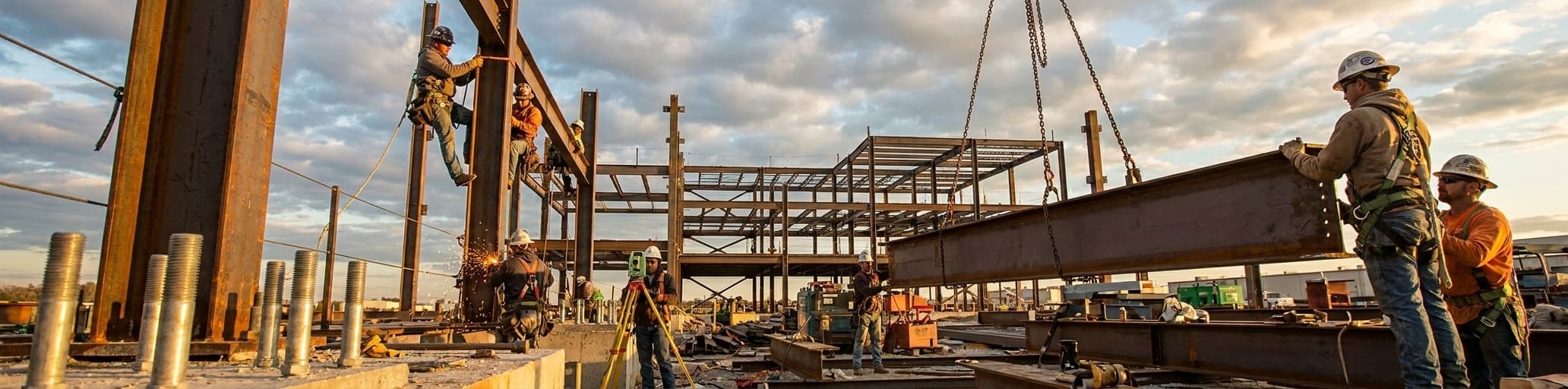

We help you understand that qualified steel erection crews manage far more than bolts and beams–they coordinate lifting, alignment, connections, and handoffs that determine whether your entire project stays on schedule and within tolerance.
What Steel Erectors Actually Do (And Why It's Not Just About Bolts)
Proper frame alignment during erection prevents costly field modifications to cladding, glazing, and mechanical systems that would otherwise compound downstream.
The Full Scope of Steel Erection Work Beyond Assembly
When you search for steel erectors near me, it's easy to assume the job is bolts and beams — set the steel, walk away. The reality is considerably wider.
Under federal regulation, steel erection formally covers hoisting, laying out, placing, connecting, welding, burning, guying, bracing, bolting, plumbing, and rigging structural steel, plus installing metal decking, curtain walls, siding systems, and miscellaneous metals — along with every move a worker makes between those tasks.[2] Once members are lifted into position, the crew must line, level, and plumb the entire frame using wedges, jacks, and pull-lift devices until every column stands within tolerance before final tightening begins.[1] That alignment step is not cosmetic. The "as-built" frame position governs whether cladding panels, glazing systems, and mechanical equipment can actually be installed without costly field modifications downstream.[1] Beyond the primary structure, experienced erectors also manage structural interfaces — how columns anchor to concrete footings — and non-structural interfaces with precision components like façade glazing or elevator shafts that demand tighter tolerances than the steel frame specification alone requires.[1] Steel erection is, in short, a coordinated sequence of lifting, connecting, aligning, and handing off a verified structure — not a single trade swinging a wrench at height.[3]
Why Erection Crew Expertise Directly Impacts Your Project Timeline
The single biggest schedule variable on your steel project isn't material lead times or permit delays — it's crew competency.
Low-skilled or understaffed erection teams generate mistakes that compound: a sequencing error alone, like skipping a perimeter beam before installing roof purlins, can force crews to disassemble completed work and repeat multiple lifts — turning a one-day task into a multi-day setback.[5] Inadequate pre-project planning is consistently cited as the most costly mistake in steel erection; rushing into a lift sequence without constructability review, team alignment, and risk assessment is the fastest route to cascading delays and budget overruns.[4] Experienced crews run the opposite approach: detailers, fabricators, and crew leads meet before fabrication begins to surface conflicts when changes cost the least, then build phased erection sequences around crane availability, delivery schedules, and weather windows.[4] They also track the critical path — the specific activities that control your finish date — and reallocate resources ahead of bottlenecks instead of reacting after the schedule slips.[4] If you're vetting crews before signing anything, the qualifications that actually matter are covered in this steel building contractors vetting guide.
The practical outcome: a seasoned erection crew doesn't just move faster; they protect every downstream trade — mechanical, electrical, cladding — from delay by handing off a verified, in-tolerance frame on schedule.[5]
Common Erection Mistakes That Cost Owners Thousands in Rework
The costliest erection mistakes follow a predictable cascade: errors at the foundation multiply upward through every level of the structure. Anchor bolts set in the slab govern every measurement that follows — frame layout, secondary steel, panel alignment, trim — so a misplaced bolt doesn't just affect one column; it forces dimensional corrections across the entire envelope.[6] A frame erected out of plumb compounds that problem: cladding panels won't seat correctly, door frames go out of square, and every downstream trade inherits a defect they didn't create — yet your budget absorbs the fix.[6] The second category of costly mistakes involves documentation failures.
Erectors who skip recording bolt torque values, roof fastener patterns, and joint conditions don't just create a quality gap; they void manufacturer warranties that would otherwise cover defects years later.[6] Third, under-braced partial frames during progressive erection are vulnerable to wind loading and uneven dead loads — and a structural failure at that stage costs far more to remediate than proper temporary bracing would have cost upfront.[5] Digital fabrication checks, including laser scanning and shop-level pre-assembly validation, meaningfully reduce field misalignments, but only when the erection crew verifies anchor bolt placement before the first lift, not after half the frame is in the air.[5] Each of these failure modes traces back to crew familiarity with the specific manufacturer's system. A crew that has erected across multiple pre-engineered building systems knows exactly where each connection detail is forgiving and where it isn't; generalist labor finds every pitfall the hard way — on your timeline and at your cost.[6]
How to Evaluate Steel Erectors: A Vetting Essentials for Property Owners
Verify three documents before mobilization–certifications, insurance certificates, and OSHA logs–to protect your project from costly violations and injury exposure.
Credentials, Insurance, and Safety Records That Matter
Three documents tell you more about a steel erection crew than any sales pitch: their certification stack, their insurance certificates, and their OSHA logs. For field supervisors and superintendents, OSHA 30 is the baseline credential; OSHA 510 — Construction Safety and Health — is the more rigorous standard that experienced erection leads carry on complex structural work.[9] Workers should hold current trade licenses or union cards as verifiable proof of field hours, not just claimed experience.[7] On specialized tasks like rigging, welding, or working at height, look for documented certifications that go beyond general OSHA compliance — and ask to see them before mobilization, not after a problem surfaces.[7]
Insurance requirements are non-negotiable: request certificates confirming general liability, workers' compensation, and professional liability coverage before any crew member steps onto your site.[8] The workers' compensation requirement isn't just an ethical standard — the average medically consulted construction injury exceeds $44,000 in direct costs, and that exposure lands on your project if a crew carries inadequate coverage.[8] OSHA violations compound the exposure further, with fines running from $1,000 to over $150,000 per infraction, plus the stop-work delays that dwarf what proper compliance would have cost.[8]
For safety records, ask for OSHA logs directly — reputable erection crews provide them on request.[9] A clean record, or a documented history of resolving violations quickly, signals consistent field discipline rather than paper compliance.[8] Steel erection sits on OSHA's explicit list of highest-risk construction phases alongside demolition, excavation, and roofing, so for any complex project, third-party safety validation is worth requiring rather than assuming.[8] Crews who evaluate their own subcontractors on safety records, safety programs, and quality of work — not just bid price — bring that same discipline to your job site.[9]
Questions to Ask Before Hiring: Experience, Equipment, and Local Code Knowledge
Once credentials and insurance are verified, shift your vetting to three areas that reveal whether a crew will actually execute well on your specific project: their relevant track record, their equipment situation, and their familiarity with your jurisdiction's building code. On experience, ask to see completed projects that match yours in scope — a crew that primarily erects warehouses carries different competencies than one that regularly builds hangars, farm facilities, or retail steel shells.[11] Equally important is crew stability: a team that works together year-round on steel erection produces tighter work in less time than a fragmented crew assembled from whoever is available between other trades.[10] Ask directly — is steel erection their primary work, or do they pick up erection jobs when painting and drywall contracts go quiet?
The answer tells you whether you're hiring professionals or generalists.[10] Before discussing price, hand them your building quote or engineering drawings so they're bidding on your actual project, not a generic assumption of scope.[10] On equipment, never assume the quoted price includes everything. Ask line by line whether the quote covers equipment rental (forklifts, lulls, aerial lifts), mobilization fees, and lodging — hidden equipment rental charges of $1,500 to $2,000 showing up at project close are a common complaint with lower-bid crews.[10] Get itemized confirmation in writing before signing anything.[10] The third area — local code knowledge — is where many owners skip a critical question.
Ask the crew directly whether they're familiar with your municipality's building codes and whether they can pull the required permits on your behalf.[12] Buildings that don't meet local code expose you to fines, penalties, stop-work orders, and potential legal liability — none of which appear in the original low bid.[12] A crew working across multiple jurisdictions knows which inspectors require what documentation and can navigate permitting without burning your schedule; one that doesn't will hand you those problems to solve yourself.[12] Pairing this question with a full-service agricultural building contractor checklist before you sign gives you a complete pre-hire framework that covers scope, licensing, and code compliance in one pass.
Red Flags in Quotes and Proposals That Signal Inexperienced Crews
A quote significantly below competing bids is the single clearest warning signal — low bids almost always reflect inexperience, financial desperation, or a plan to recover margin through corner-cutting on materials and labor once you've signed.[14] Crew availability reinforces that signal: reputable erection teams carry backlogs, and a crew that can mobilize immediately likely has no other work because their reputation or track record precedes them.[14] Once you move past price, the contract document itself tells you most of what you need to know.
Weak contracts — vague scope language, no exclusions list, fuzzy payment milestones, or a missing physical business address — indicate a contractor who either lacks operational experience or wants room to renegotiate after you're committed.[14] On payment terms, a good rule of thumb is to avoid advancing more than 20% of the total project cost before work begins; contractors demanding substantially more upfront are often covering cash flow shortfalls on other jobs, not funding yours.[13] Cash-only payment requirements compound that exposure — they eliminate your paper trail, frequently signal that the contractor is operating without proper insurance, and make disputes nearly impossible to document and resolve.[13] High-pressure closing tactics follow the same pattern: any erector who pushes you to sign before you've reviewed the full scope, compared competing bids, or verified credentials is trying to prevent exactly the due diligence that protects you.[13][14] Contractors who are reluctant to pull permits round out the warning list — on steel erection work specifically, avoiding permit inspection removes the one checkpoint that confirms your frame meets structural and code requirements, and a building erected without permits can trigger stop-work orders, fines, and financing or sale complications years later.[14] Before you sign anything, ask the crew directly for a copy of their license and insurance certificates; a legitimate erection crew has these documents ready on request, and hesitation or deflection is itself an answer.[14] Single-Source vs. Fragmented Erection: Why Coordination Saves Money and Stress
The Hidden Costs of Hiring Separate Fabricators and Erectors
When you split fabrication and erection across two vendors, the real cost doesn't appear in either quote — it surfaces later as contract disputes.
Scope gaps between a fabricator's agreement and an erection crew's subcontract consistently produce some of the costliest conflicts in structural steel construction, with million-dollar disputes regularly centering on whether a specific task falls inside the original scope or counts as extra work.[15] The alignment problem goes beyond scope alone.
When a fabricator's upstream contract with a general contractor doesn't mirror the downstream subcontract with the erection crew, a single dispute over field work can pull the fabricator into simultaneous litigation in two separate courts or venues — fighting the same issue on two fronts at once.[15] Payment exposure follows the same fault line: if a pay-if-paid clause in the fabricator's prime contract doesn't flow through to the erection subcontract, the fabricator may owe the erector regardless of whether the owner has paid the fabricator — a cash-flow trap with no connection to work quality.[15] Layer that onto the coordination overhead of multi-prime construction, where a typical project already splits structural steel, general construction, electrical, and plumbing across separate agreements, and a misaligned fabricator-erector divide introduces the kind of design-intent ambiguity that turns on-schedule projects into drawn-out claims.[16] Small errors or omissions at contract formation — between any two of those parties — can cascade into extended time, cost, and stress that far exceeds what a unified delivery structure would have cost from the start.[15] Projects built around a single turnkey contract eliminate the contract seam entirely — fabrication and erection share one accountability chain, so the gap-filling arguments that separate vendors generate when field conditions diverge from shop drawings simply don't have a place to start.
How Design-Build Teams Prevent Communication Breakdowns on Site
National Steel Buildings's In-House ProTrades Division: What Unified Erection Delivers The structural argument for an in-house erection division comes down to one operational fact: general contractors who can self-perform key scopes — steel fabrication, structural erection, specialty system installation — are not dependent on subcontractor availability, which is a real constraint when your schedule can't wait on a crew finishing a job in another state.[22] That independence matters as much as skill. ProTrades crews at National Steel Buildings are factory-trained on the specific pre-engineered system being erected, which matters more than general iron work or sheet metal experience in isolation. A crew that primarily works iron typically struggles with sheeting and trim; one that's mainly sheet metal fights the framing package — and either gap means longer erection time, more budget exposure, and lower quality on your structure.[21] Pre-engineered metal building erection requires both skill sets working together, which is why factory-sponsored training and standing seam roof certifications aren't optional extras — they're the baseline that separates crews who know the system from those learning it on your job.[21] ProTrades crews also carry specialty certifications that cover system-specific door installations, meaning you're not sourcing a separate subcontractor when scope includes specialty openings — an additional mobilization cost and scheduling variable that fragmented delivery routinely generates.[21]
The accountability structure is equally direct. When the crew erecting your steel works under the same organization that fabricated it, scope disputes between fabrication and installation have nowhere to start — no separate party to deflect responsibility when a connection detail needs field resolution.[20] You work with one point of contact from design through final panel, receive updates through one communication channel, and hold one contract accountable for the finished frame.[22] For owners building warehouses, hangars, agricultural facilities, or commercial structures across the country, that single chain of accountability means the frame ProTrades erects matches exactly what engineering designed — every column plumbed, every anchor bolt verified, every downstream trade handed a structure they can work off without inheriting someone else's misalignment.
Finding the Right Steel Erectors Near You: A Practical Decision Framework
Choose steel erectors based on their expertise with your specific building system first, then use geographic proximity as a tiebreaker only when candidates are otherwise equal.
Geographic Availability vs. Expertise: Which Should Drive Your ChoiceThe instinct to search for steel erectors near me and hire whoever is closest makes sense for basic trades — not for structural steel erection. Proximity has real value at the margins: a local crew mobilizes cheaper, typically knows your jurisdiction's inspection requirements, and can respond faster when field conditions shift. Geographic differences genuinely affect construction costs, schedules, and approval processes, so dismissing local knowledge entirely is a mistake.[23] But none of those proximity advantages survive contact with a crew that doesn't know your building system. The correct sequence is expertise first, geography second — and only as a tiebreaker when two candidates are otherwise equal.
The reason expertise dominates comes down to a principle that holds across every construction discipline: your people are the most important factor in a project, far more than budgets, timelines, or equipment.[23] Material and crew availability also varies by region, which means what's accessible in one market may carry longer lead times or higher mobilization costs in another — making it even more critical to verify that a crew's track record matches your specific project type before geography enters the equation.[23] A warehouse erection crew learning a pre-engineered aviation hangar system on your job will cost you more in rework and schedule than a factory-trained crew that travels. For specialized builds — agricultural steel building contractors erecting clear-span farm facilities, crews managing hangar door systems, or teams working precision commercial shells — system familiarity isn't a bonus; it's the difference between a frame handed off in tolerance and one that holds up every downstream trade. The practical test: ask each candidate crew how many completed projects match your building type and scope within the past two years. A qualified crew answers confidently. One that redirects to general experience is telling you exactly where the risk lands — on your schedule and your budget.
How to Request and Compare Erection Proposals Effectively
Getting comparable proposals starts before you send a single request. Hand every candidate crew the same project documents — your building quote, engineering drawings, anchor bolt layout, and any special-scope items like crane rails, specialty doors, or standing seam roof systems — so each bid reflects your actual project, not each contractor's assumption of scope.[24] Without that shared baseline, you'll receive proposals built on different interpretations, and the crew that assumed the least will look cheapest on paper without being the most cost-effective in the field. A clean request also filters crews early: one that responds with clarifying questions about site access, ground conditions, and delivery sequence before pricing is already showing you how it manages work.[25]
When proposals arrive, compare line items, not totals. A lower quote often excludes rigging, lift planning, mobilization fees, supervision costs, standby time, or site-specific requirements that a more complete bid already prices in.[25] What appears to be a $10,000 saving on the summary page can reverse quickly once excluded items appear as change orders after mobilization. Before evaluating any number, confirm that each proposal accounts for the same scope: equipment rental, crew count, erection sequence, temporary bracing, and quality documentation requirements like bolt torque logs and fastener inspection records. The table below covers the line items that most frequently separate a complete bid from an incomplete one.
| Line item | Ask: included or excluded? |
|---|---|
| Equipment rental (forklifts, aerial lifts, lulls) | Included / Excluded / Separate quote |
| Crane mobilization and demobilization | Included / Excluded |
| Rigging and lift planning | Included / Excluded |
| Temporary bracing during progressive erection | Included / Excluded |
| Field supervision and superintendent | Included / Excluded |
| Bolt torque documentation | Included / Excluded |
| Anchor bolt verification before first lift | Included / Excluded |
| Permit pulling | Owner / Contractor |
| Lodging and per diem for traveling crew | Included / Excluded |
Value over price is the right lens for the final decision — upfront investments in qualified erection crews typically save on expenses and rework down the road, while the lowest bid almost always reflects something left out.[24] When two proposals are close on scope and price, the tiebreaker is the proposal document itself: a detailed, itemized quote with a clear exclusions list and defined payment milestones signals a contractor who manages work the same way they manage paperwork.[25] A single-page quote with vague scope language and no exclusions is a preview of the conversations you'll have once steel is in the air. You can find a parallel framework for evaluating what kit pricing covers versus what it doesn't in this metal building kit pricing breakdown — the same line-item logic that exposes gaps in a building kit quote applies directly to erection proposals.
Once you've verified scope alignment, look at how each contractor communicated during the proposal process — responsiveness, specificity, and willingness to answer direct questions about crew qualifications and project-type experience.[25] Strong contractors treat the proposal as a planning document and answer questions about staffing, sequencing, and scheduling before you ask.[24] That discipline during the bid phase is the same discipline that keeps your frame on schedule once the crew mobilizes.
Why Local Relationships with National Capabilities Matter Most
The instinct to frame your search as a trade-off — local familiarity or national reach — is itself a mistake. The two aren't mutually exclusive, and the best erection firms prove it by building genuine local presence through project volume rather than permanent offices.[26] What actually drives outcomes is the communication structure underneath the contract: when a crew contracts directly with you rather than operating as a sub-tier vendor behind a fabricator, you get a person-to-person relationship between your superintendent and theirs — one that can make unencumbered decisions without a third party filtering every field call.[26] That direct line matters more than geography.
A national crew with regional project density knows your local inspection requirements, has vetted regional fabricators and suppliers, and can audible on scheduling when site conditions shift — without waiting for approval from an intermediary who isn't on the ground.[26] The supply chain dimension reinforces the same point: firms that manage their own procurement rather than delegating it to a supplier retain control when markets tighten or disruptions hit, which means your delivery schedule depends on their decisions, not a vendor's.[26] The practical standard for evaluating whether a crew has genuinely earned local knowledge rather than just claiming it: look at their safety record across regional projects. An Experience Modification Rate well below the industry average — the result of consistent field discipline across jurisdictions, not just one lucky project — is the clearest signal that a crew's national capabilities translate into real, repeatable performance wherever they work.[26] You don't have to choose between a contractor who knows your county and one with the resources to protect your schedule; the right firm delivers both, and their safety record and direct-contract structure are where you verify it.[27]
- Steel erection involves far more than bolts–lining, leveling, plumbing, and alignment determine whether downstream trades can install without costly field modifications.
- Crew competency is the single biggest schedule variable; inadequate pre-project planning and sequencing errors cascade into multi-day delays and budget overruns.
- Verify credentials, insurance, and OSHA logs before mobilization; workers' compensation gaps alone expose you to $44,000+ per injury plus fines up to $150,000.
- Compare itemized proposals line-by-line, not totals; hidden equipment rental, mobilization, and supervision costs frequently turn low bids into expensive change orders.
- Expertise and system familiarity matter more than geographic proximity; a factory-trained crew on your specific building type outperforms a local generalist crew.
- Single-source fabrication and erection eliminate contract scope gaps and litigation risk; unified accountability keeps your frame in tolerance and on schedule.
- Evaluate contractor communication, responsiveness, and willingness to answer qualification questions during the proposal phase–that discipline predicts field execution.
- https://steelconstruction.info/Construction
- http://www.osha.gov/laws-regs/federalregister/2001-01-18-0
- https://himalayas.app/career-guides/structural-steel-erector
- https://steelestimatingsolutions.com/structural-steel-erection-project-management/
- https://www.hcsteelstructure.com/top-10-steel-erection-challenges-and-how-to-overcome-them-in-2025/
- https://www.alpha-labor-co.com/blog/metal-building-erection-mistakes
- https://verifypass.com/verification/communities/cst
- https://www.safetpros.com/outsourced-safety-staffing/
- https://www.flemingconstructiongroup.com/government-services/
- https://www.bucksteel.com/blog/steel-buildings/finding-a-steel-building-erector/
- https://www.kloecknermetals.com/blog/10-questions-to-ask-a-structural-steel-fabricator/
- https://pbsbuildings.com/choosing-the-right-contractor/
- https://todayshomeowner.com/home-finances/guides/avoiding-contractor-scams/
- https://www.levelset.com/blog/signs-of-a-bad-contractor/
- https://www.thefabricator.com/thefabricator/article/shopmanagement/a-smooth-structural-fabrication-project-requires-a-good-contract
- https://www3.ambest.com/buglcm/createpdf.aspx?repID=569&RepType=BUG&C=A&M=0&T=4&URatingID=2256568&ViewFull=0
- https://www.structuremag.org/article/bridging-the-gap-between-engineering-and-fabrication/
- https://steeltubeinstitute.org/resources/utilizing-technology-expertise-and-communication-for-better-connection-design-outcomes/
- https://www.thefabricator.com/thefabricator/article/assembly/better-connection-design-speeds-structural-fabrication
- https://shermangc.com/in-house-crews-vs-subcontractor-what-should-you-know/
- https://www.steelsmithinc.com/2017/05/how-to-choose-the-right-erection-crew/
- https://credencegroup.ca/general-contractor-vs-a-subcontractor-industrial-projects/
- https://www.pmainc.com/news/the-3-ps-of-multifamily-project-predictability-process-people-and-product/
- https://swfunk.com/news/choosing-a-structural-steel-contractor-for-your-industrial-facility/
- https://www.downsouthcr.com/how-to-evaluate-a-crane-rigging-contractor-before-hiring
- https://www.enr.com/articles/59963-structural-steel-erector-flips-the-script
- https://westernsteel.com/how-to-choose-steel-building-contractors-in-your-area/