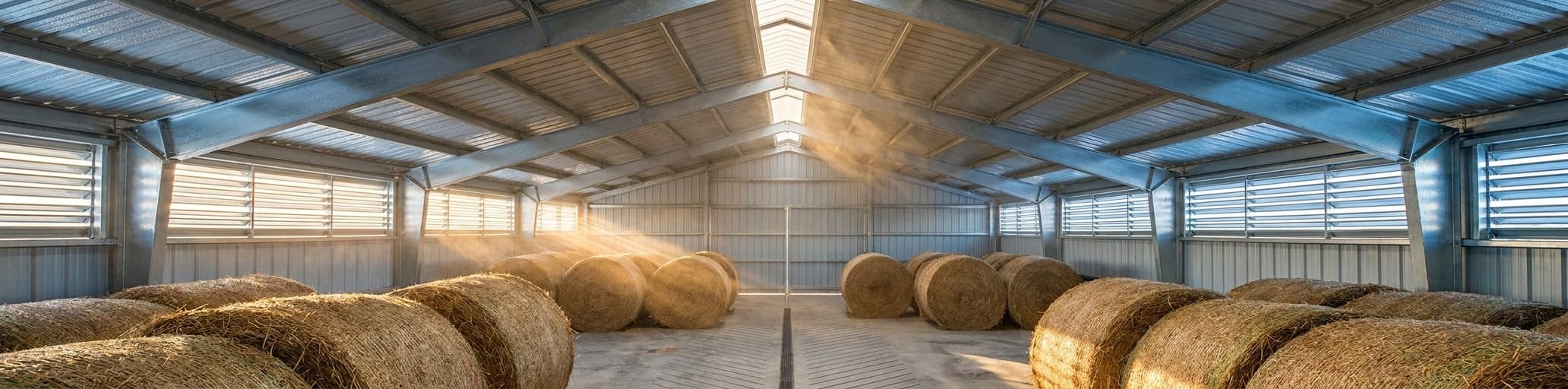

We help you design a 20×40 steel hay barn with ventilation strategies that eliminate moisture damage and protect feed quality year-round. Proper vent placement, Galvalume(R) steel, and passive-plus-active airflow systems keep interior humidity below the mold threshold while reducing operating costs to near zero.
Designing the Ideal 20×40 Hay Barn Steel Structure
A 20×40 steel barn with drive-through gable doors and clear-span trusses lets you move loaded wagons straight through during peak season, eliminating reversing and saving real labor time.
Choosing the right dimensions and layout
The 20×40 hay barn steel footprint — 800 square feet — sits just above the 720-square-foot threshold where a comparable barn comfortably stores around 100-120 large round bales stacked two high, a capacity suited to operations with 10-20 head of cattle.[1] Clear-span steel trusses eliminate interior support posts entirely, so every square foot of floor space is available for bale stacking and equipment movement.[1] Wide-span framing gives unobstructed access for tractors, skid steers, and hay wagons — the maneuvering clearance that affects how fast you load and unload during a tight cutting schedule.[1] For a deeper look at how farm equipment storage building dimensions affect day-to-day time on the clock, the math is worth running before you finalize your footprint.
Door placement is where layout decisions deliver the most return. A drive-through configuration — openings on both gable ends — lets you pull a loaded wagon straight through rather than reversing out, which saves real labor time during peak haying season.[1] For a 20-foot-wide structure, a 16-foot door on each end wall leaves adequate framing on both sides while keeping the full center aisle clear for equipment and stacked bales.
Site orientation and grading are decisions you can't undo after the slab is poured. Set the building pad on ground that slopes approximately 5 inches per 100 feet away from all sides of the structure so surface water drains well clear of stored hay.[2] Positioning the long axis perpendicular to your prevailing wind direction aligns sidewall openings to capture natural cross-ventilation — a zero-cost layout choice that does measurable work against moisture year-round. Plan for 15-20% more capacity than your current herd demands; that buffer accommodates herd growth, efficient stacking patterns, and the air circulation space that keeps hay in good condition between cuttings.[1]
Selecting quality steel components
For hay storage specifically, Galvalume(R) steel is the right substrate for both roof panels and wall cladding.
The coating — 55% aluminum, 43.5% zinc, and 1.5% silicon — creates a dual-protection system: the aluminum layer acts as a moisture barrier while zinc provides sacrificial protection at cut edges and scratches, so corrosion progression stops rather than spreads.[3] That combination delivers 2-4 times better corrosion resistance than standard galvanized steel, with a documented service life of 60 to 100+ years in typical agricultural environments.[3] There's a thermal benefit for hay quality too: Galvalume(R)'s solar reflectivity can reduce roof surface temperatures by 50-60 degreesF, lowering interior air temperatures and cutting cooling-energy demand by 10-25%.[4] Cooler interior air suppresses the heat-driven humidity cycling that degrades baled hay between cuttings.
One specification worth flagging before you finalize your order: if any section of your structure will house confined livestock, specify G100 galvanized steel for those panels instead — ammonia from manure reacts with Galvalume(R)'s aluminum coating and accelerates degradation.[4] For a dedicated 20×40 hay barn steel structure, Galvalume(R) outperforms galvanized on every relevant performance metric and typically costs about 6% less than comparable G-90 galvanized panels — a cost-effective outcome that holds up over decades.[3] Reviewing the long-term cost gap between steel and wood barn materials makes component specification decisions even clearer when you're working within a fixed budget.
Integrating single-source solutions for durability
Working with a single source for your 20×40 hay barn steel structure eliminates the accountability gaps that appear when frames, panels, trusses, and doors come from different vendors. Suppliers who vertically integrate — rolling their own steel, fabricating trusses in-house, and managing components across dedicated manufacturing facilities — control tolerances and delivery timelines in ways that fragmented supply chains simply cannot match.[5] Factory pre-punched framed openings and completed welding ship bolt-ready, cutting on-site labor time by up to 50% compared to conventional construction methods.[6] For a hay barn, tight framing tolerances carry a direct moisture consequence: door openings and panel joints that seat properly at installation remove primary infiltration paths for humid outside air before it ever reaches stored bales.
Consolidated sourcing also means consolidated warranty coverage — look specifically for in-house warranties on structural load performance and a 35-year paint warranty written in plain language and honored by the manufacturer directly, not traced back through a third-party supplier chain.[5] Those terms signal that a manufacturer stands behind the full system, not just individual components. For farms already planning future bay additions or lean-to storage, steel frame farm building systems engineered for seamless add-ons lock in structural compatibility at the design stage — a decision that costs nothing upfront and avoids expensive retrofits later.
Understanding Moisture Risks in Hay Storage
Moisture enters hay storage from three simultaneous directions–ground wicking, panel condensation, and the hay itself–so addressing only one source leaves your spoilage problem intact.
Common sources of moisture in a steel barn
Steel barns face moisture pressure from three distinct directions simultaneously: up from the ground, inward through the building envelope, and outward from the hay itself. Ground moisture is often the first and most overlooked spoilage source — bare soil beneath bale stacks wicks moisture upward into bottom layers long before visible damage appears.[7] The second source is condensation on steel panels.
Metal conducts temperature changes rapidly: on cool nights, warm humid air trapped inside the barn contacts cold panel surfaces and condenses into liquid water that drips directly onto stored bales.[7] The underlying physics are straightforward — steel cools quickly to near outside air temperature while interior air stays warmer and moisture-laden, and under the right humidity conditions the result is essentially localized rainfall forming inside your own structure.[8] Under some circumstances, condensation can occur with only a few degrees of difference between inside and outside temperatures, making it nearly impossible to eliminate without either warming the interior surface or creating a new barrier between the air mass and the metal.[8] The third source is the hay itself: bales loaded above 18% moisture continue releasing water vapor into the enclosed air after stacking, raising interior humidity, widening the temperature gap between the air mass and panel surface, and feeding the condensation cycle all over again.[7] All three vectors work together — which is why fixing only one, such as sealing the floor without managing panel condensation or incoming hay moisture, leaves the spoilage problem intact. If you want to cut condensation at its root, steel building insulation with proper vapor barriers narrows the temperature differential between panel surface and interior air, reducing the condensation trigger before ventilation alone has to carry the full load.
Impact of humidity on hay quality
Humidity doesn't just make hay feel damp — it triggers a specific chain of biological and chemical reactions that strip nutritional value fast.
When hay stored inside reaches 20% moisture, relative humidity within the bale mass can climb to 90-100%, the threshold where mold development accelerates.[9] Fungi are the primary drivers of carbohydrate breakdown in stored forage, and heat-resistant strains remain active at temperatures between 113 degreesF and 150 degreesF — meaning early-stage heating doesn't stop the damage, it speeds it up.[10] As microbial and fungal respiration consume soluble carbohydrates, total nonstructural carbohydrates (TNC) decline while neutral detergent fiber (NDF) and acid detergent fiber (ADF) fractions rise.[9] Higher fiber, lower carbohydrates — that combination directly reduces palatability and digestibility, so your cattle eat less and extract less energy from what they do eat.[9] Dry matter losses exceed 10% when storage moisture sits between 20% and 30%, and temperatures above 140 degreesF suppress digestibility by an additional 14%.[9] Long-term, crude protein concentration drops approximately 0.25% per month from volatilization, which compounds the damage for hay stored across seasons.[9] The financial exposure is real: hay stored in a barn versus outside on sod produced a value difference of roughly $3,350 per 100 tons over just eight months of storage, and losses after 12-18 months run twice as high as losses after nine months.[11] For a 40×80 pole barn alternative or a dedicated 20×40 hay barn steel structure, keeping interior humidity below the mold threshold isn't a secondary concern — it's where feeding cost control actually begins.
Identifying early signs of moisture damage
The first two weeks after stacking are when moisture damage moves fastest — inspect newly stored bales every two to three days during that window, then shift to weekly walkthroughs once internal temperatures stabilize.[7] Four signals warrant attention on each inspection:
- Musty odor — appears days before visible mold develops and is often the earliest reliable indicator of active microbial growth[7]
- Discoloration or surface growth — white-gray patches on bale exteriors confirm fungal activity has already begun consuming dry matter[12]
- Unusual warmth — pressing a hand against the stack and feeling heat above ambient temperature indicates internal respiration is still accelerating[7]
- Wet spots on the floor beneath stacks — ground moisture is wicking upward into bottom bales, often before the top layers show any visible change[7]
Surface inspection only tells part of the story. Internal temperature is the most actionable measurement you can take. A 10-foot steel pipe with holes drilled near the tip, hammered to a point, works as a reliable field-built probe when inserted from the top of the stack into the innermost bales — retrieve a thermometer from the end of the pipe after 10 to 15 minutes.[9] Temperatures between 130 degreesF and 140 degreesF during the first two weeks reflect normal "sweating" — the heat generated by plant respiration as bales reach moisture equilibrium — and carry measurable but manageable dry matter losses of 4 to 5 percent.[9] When readings climb to 150 degreesF-175 degreesF, pull affected bales out of the barn immediately to increase air circulation and slow the heating cycle.[9] Above 175 degreesF, contact the fire department — spontaneous combustion is a documented outcome at those temperatures, and the National Fire Protection Association identifies hay storage fires as a leading cause of agricultural barn losses.[7] One additional sign belongs on every walkthrough checklist: condensation dripping from roof panels onto stored bales. That's not a weather event — it's a ventilation failure signal, telling you warm, moisture-laden interior air is reaching cold steel surfaces before the airflow system can exhaust it.[7] Catching any of these indicators early, before moisture migrates deeper into the stack, is where agricultural steel buildings designed with proper ventilation geometry earn their keep.
Ventilation Strategies for a Moisture-Free Environment
Properly sized passive ventilation with balanced intake and exhaust vents exchanges humid interior air for drier outside air continuously, without electricity or moving parts.
Passive ventilation: ridge vents and sidewall louvers
Passive ventilation runs on a simple physics principle that costs nothing to operate: warm air is less dense than cool air, so it rises and exits through a ridge vent at the roof peak while cooler outside air is continuously drawn in through sidewall louvers or eave openings below.[13] In a 20×40 hay barn steel structure, that convective cycle works around the clock — no fans, no electricity, no moving parts — exchanging the humid interior air loaded with hay respiration moisture for drier outside air before it reaches panel surfaces and condenses.[13] Sizing the system correctly is where most builds fall short.
The standard rule is 1 square foot of net free vent area per 150 square feet of floor space, split evenly between intake and exhaust — for an 800-square-foot footprint, that works out to roughly 5.3 square feet total, with approximately 2.7 square feet at the ridge and 2.7 square feet distributed across sidewall louvers or eave openings.[13] Intake and exhaust must be balanced: a ridge vent with no lower intake has nowhere to draw replacement air from, and the convective cycle stalls rather than ventilates.[13] For hay storage buildings specifically, gable-end louvers and sidewall vents are standard because they add intake area near floor level — exactly where moisture-laden air settles first — and adjustable louvers let you dial back airflow during dry seasons so you're not importing cold, humid outside air unnecessarily.[13] One specification detail that matters before you finalize your order: the ridge vent must be designed specifically for metal building applications, with a mesh or baffled opening that allows airflow while blocking rain intrusion.[13] A standard ridge cap with an incidental gap is not the same thing; a poorly seated vent cap introduces the moisture infiltration the system is built to prevent.[13] Natural ventilation also reduces the building's energy consumption, lowers long-term operating costs, and maintains more consistent interior temperatures than mechanical cycling alone — benefits that compound across the storage season.[14]
Active systems: fans and thermostatic controls
Passive convection works well when outside air is drier than interior air and temperature differentials are favorable — but those conditions don't hold during peak haying season, high-humidity summer nights, or the first two weeks after stacking when freshly baled hay is still actively releasing water vapor.
That's where active mechanical systems take over.[15] Wall-mounted exhaust fans installed high on gable ends pull humid interior air out at controlled volume while intake air enters through the sidewall and eave openings already sized for your passive setup — the two systems work together rather than competing.[15] For roof-mounted applications, power ventilators reinforce your existing ridge vent geometry by creating upward air movement that amplifies the stack effect instead of disrupting it.[15] The critical operational upgrade is pairing any fan with thermostat and humidity sensor controls: automated systems activate when interior temperature or humidity crosses a preset threshold and cycle off once conditions normalize, so you're never drawing in humid outside air when interior air is already drier than what's outside.[15] Multi-speed fans let you run low during mild conditions and ramp up during peak bale respiration heat — the same motor handles both scenarios without manual adjustment.[15] Operating costs are minimal; a typical powered exhaust fan draws less electricity than a 60-watt bulb.[16] For barns without electrical service, solar-powered exhaust fans accomplish the same result with no wiring or ongoing energy costs — better units include integrated thermostats and deliver 20-30 degreesF temperature reductions after installation, running hardest precisely when the sun is heating your roof panels and driving interior humidity up.[16]
Optimizing airflow with strategic placement
Strategic placement is what converts a correctly-sized ventilation system into one that actually moves air where hay moisture concentrates.
Vents should be installed where hot air naturally rises, and balancing intake and exhaust openings maximizes the efficiency of the airflow — an unbalanced system stalls regardless of how large the individual openings are.[17] In a 20×40 hay barn steel structure, that means positioning exhaust points at the highest accessible part of each gable end, where rising moisture-laden air accumulates before contacting cold roof panels, and distributing intake openings low on opposing sidewalls so incoming air travels the full vertical height of the bale stack rather than short-circuiting across an open center aisle.[17] Placement directly controls condensation risk: when warm interior air reaches a cold steel surface before reaching an exhaust point, it drops water — placing exhaust near the peak and intake lower on the walls forces air upward and out before it can cool to the dew point against the panel surface.[18] Exhaust fans belong in unobstructed gable space rather than directly above stacked bales, since hay mass blocks the upward airflow path and forces the fan to draw air over the stack rather than through the open air column where volume throughput is highest.[17] On the intake side, louvers positioned to face the prevailing wind gain a natural pressure differential that supplements both passive convection and mechanical exhaust — reducing fan run time, extending equipment service life, and keeping operating costs low across the full storage season.[18]
Implementing and Maintaining Ventilation Solutions
Skip the installation shortcuts that create pressure imbalances–complete your moisture assessment and placement planning before ordering any hardware.
Step-by-step installation guide
The installation sequence is where planning decisions either pay off or create problems you'll manage for years. Starting with a formal assessment before ordering any hardware prevents the most common failure mode: components that are correctly sized individually but create pressure imbalances when assembled together.[17] Work through these five steps in order — skipping ahead to installation before completing placement planning consistently produces underperforming systems that look complete but don't move air where moisture concentrates.
- Assess moisture load and airflow zones. Walk the building and identify where humidity accumulates — typically low along the floor at the base of bale stacks and high near the roof peak where warm air collects against cold panels. Note any areas where heat or humidity buildup is a recurring issue, since those zones need primary ventilation focus rather than distributed coverage.[17]
- Select the system matched to your conditions. Ridge vents suit the 20×40 hay barn steel structure's sloped roof geometry and provide the best passive airflow across the full footprint.[17] For peak haying season when freshly stacked bales actively release moisture, add exhaust fans at gable ends — they remove air at controlled volume and work with, not against, the passive ridge system.[14] If your site lacks electrical service, wind-powered turbine vents are a cost-effective option that requires no wiring and delivers airflow precisely when outdoor wind is available.[17]
- Map vent placement before cutting any panels. Position exhaust points at the highest accessible area of each gable end. Distribute intake openings low on opposing sidewalls so incoming air travels the full vertical height of the interior rather than short-circuiting at mid-height.[17] For the 800-square-foot footprint, target roughly 2.7 square feet of net free area at the ridge and 2.7 square feet distributed across sidewall louvers — balanced intake and exhaust prevent the convective cycle from stalling.[14] Motorized supply fans, if included, mount 8 to 10 feet above the floor so discharged air deflects back down toward the bale stacks rather than channeling straight across the open air column.[14]
- Install vents with proper sealing at every penetration. Follow manufacturer guidelines for each component and seal all framed openings against water infiltration — a gap around a louver frame or a poorly seated ridge cap introduces moisture at the same point the system is designed to remove it.[17] If you're working with a local prefab contractor for erection, confirm they have specific experience with agricultural metal building ventilation installations, not just residential roofing work, since hay storage applications require floor-level intake placement that general contractors routinely omit.[17]
- Test airflow before stacking bales. Once installed, verify consistent airflow through every intake and exhaust point — an unobstructed path from sidewall louver to ridge vent confirms the convective cycle is active.[17] Check that exhaust fans cycle correctly on thermostat and humidity controls by manually triggering the threshold settings before the first cutting arrives. Catch any blocked or misaligned openings now; debris buildup or a misseated louver blade that restricts intake area reduces system efficiency and forces the remaining openings to compensate, which they can't do at the required volume.[17]
Routine checks and service excellence
A ventilation system delivers consistent results only when its components stay clear and functional between cuttings. Schedule visual inspections every three to six months — during evening hours, shine a flashlight along panel joints, louver frames, and ridge vent seams from inside the barn; any light crossing from outside marks a gap that admits both moisture and pests and needs sealant applied immediately.[19] Gutters and downspouts belong on the same inspection route: after clearing debris, pour a bucket of water into each run to confirm it drains cleanly away from the structure rather than pooling near the slab edge where it wicks into foundation connections.[19] Four specific items belong on every walkthrough:
- Louver blades and intake mesh — clear debris, nesting material, and dust buildup that narrows net free area at intake or exhaust points and stalls the convective cycle[19]
- Panel joints and door perimeters — reapply silicone or polyurethane sealant wherever gaps have opened at framed openings; small gaps admit moisture and pests through the same paths the system is engineered to keep clear[19]
- Fan motors and thermostat controls — manually trigger threshold settings to confirm fans cycle on and off at preset temperature and humidity levels; a failed sensor goes undetected until a humidity event has already damaged stored bales[19]
- Foundation perimeter drainage — verify that grading still directs surface water away from all sides of the structure; soil settlement can redirect flow back toward the slab over time, re-introducing the ground moisture vector into bottom bale layers[19]
The long-term payoff for staying on this schedule is real. Steel doesn't warp, shrink, or shift the way wood does, so louver frames and door openings that seat correctly at installation stay true across decades with minimal intervention.[20] A well-maintained steel farm building routinely performs for 30 to 40 years or more with no structural repairs required — the ongoing maintenance burden reduces almost entirely to keeping penetrations sealed and ventilation paths unobstructed.[20] That's a fundamentally different cost profile from wood construction, where repainting, re-treating, and structural repairs accumulate year after year regardless of how carefully the building was originally built.[20] For a broader look at how routine upkeep patterns translate to long-term roof performance on steel agricultural structures, metal roof lifespan and maintenance factors are worth reviewing before your first full storage season ends.
Troubleshooting and long-term performance
Persistent condensation despite correctly installed ridge vents and sidewall louvers points to one of two root causes: intake blockage or a missing thermal barrier between cold panel surfaces and interior air. When ridge vents and eave openings are clear but dripping continues, the problem is usually that warm interior air is still reaching metal surfaces faster than the convective cycle can exhaust it. The retrofit fix is a condensation-control underlayment applied directly to the underside of roof panels — a woven or felt-backed product that absorbs surface moisture and holds it rather than allowing liquid drips to fall onto stored bales, releasing the absorbed moisture slowly as interior conditions change.[21] This approach handles most unheated agricultural storage scenarios without requiring full insulation.[21] If underlayment alone doesn't resolve it — particularly in climates with large seasonal temperature swings — full roof panel insulation with a vapor barrier on the warm interior side is the complete solution: it keeps warm, humid interior air from ever contacting the cold steel surface where condensation forms.[21] One diagnostic worth running before committing to either retrofit: check that all vapor barrier seams, penetrations, and wall-to-roof transitions are fully sealed, since tears or gaps at those junctions allow moisture to migrate through the insulation and reach panel surfaces even when the insulation itself is correctly specified.[21]
When bale temperatures spike despite adequate ventilation, the troubleshooting sequence is straightforward. Readings between 130 degreesF and 150 degreesF during the first two weeks after stacking are normal — plant respiration as bales reach moisture equilibrium — and carry manageable dry matter losses.[7] Temperatures climbing to 150 degreesF-175 degreesF require immediate action: pull affected bales out of the barn to increase air circulation and slow the heating cycle before the surrounding stack absorbs additional heat.[7] Above 175 degreesF, contact the fire department — spontaneous combustion is a documented outcome at those temperatures and the National Fire Protection Association identifies hay storage fires as a leading cause of agricultural barn losses.[7] One often-missed source of mid-season temperature spikes is stacking height that leaves less than 18 to 24 inches of clearance between the top of the stack and the roof panels — that gap is where hot air accumulates before reaching a ridge vent, and closing it traps heat directly against the hay mass.[12] Reorganizing stacks to restore that clearance and opening any adjustable louvers fully resolves most mid-season heating events without additional hardware.
A steel barn's long-term performance advantage over wood construction shows up not at installation but across the first decade of storage seasons. Buildings that lack condensation management at build often perform acceptably in year one, then accumulate moisture damage progressively as seasonal temperature swings widen and repeat — a pattern that makes root-cause diagnosis harder and retrofit costs higher the longer the issue goes unaddressed.[21] Steel panels don't warp, absorb moisture, or shift at framing joints the way wood does, so a correctly built 20×40 hay barn steel structure that starts with proper vapor management and ventilation geometry holds those tolerances across 30 to 40 years with no structural repairs required.[12] The maintenance burden that remains — keeping louver mesh clear, sealing any new penetration gaps, and confirming thermostat controls cycle correctly before each haying season — is a fraction of what wood construction demands annually in repainting, re-treating, and structural correction.[12] Rotating hay on a first-in, first-out basis and tracking inventory by cutting date keeps older bales from being buried under new deliveries and going unnoticed until spoilage has already spread to adjacent stacks — a management habit that costs nothing and eliminates one of the most common sources of late-season feed loss.[12]
- A 20×40 steel barn stores 100-120 large round bales with clear-span trusses eliminating interior posts for unobstructed equipment access.
- Galvalume(R) steel coating delivers 2-4x better corrosion resistance than galvanized steel with 60-100+ year service life in agricultural environments.
- Moisture damage from ground wicking, panel condensation, and hay respiration can reduce hay value by $3,350 per 100 tons over eight months.
- Passive ventilation requires 1 sq ft of net free vent area per 150 sq ft of floor space, split evenly between intake and exhaust.
- Bale temperatures between 130-150 degreesF during first two weeks are normal; readings above 175 degreesF require immediate removal to prevent spontaneous combustion.
- Properly maintained steel barns perform 30-40+ years with minimal structural repairs, unlike wood construction requiring annual repainting and treatment.
- Balanced intake placement low on sidewalls and exhaust at roof peak forces warm, moisture-laden air upward before it condenses on cold panels.
- https://www.uspatriotsteel.com/metal-barns/metal-hay-barns/
- https://mortonbuildings.com/blog/your-guide-to-planning-the-perfect-stall-barn
- https://quonsetbarns.com/corrosion-resistance-galvalume-explained/
- https://blog.mcelroymetal.com/metal-roofing-and-siding/metal-roofing-for-equestrian-and-agricultural-buildings-durability-protection-long-term-value
- https://mortonbuildings.com/projects/farm
- https://gensteel.com/steel-building-kits/
- https://www.vikingbarns.com/blog/how-to-store-hay-safely-in-hay-barn
- https://bluetexinsulation.com/pages/moisture-in-metal-buildings-causes?srsltid=AfmBOorWjp54wmdLLkm7Wu0caQkK-aiaHae4JgodWb64Ff8hXMPTlBj6
- https://extension.msstate.edu/publications/hay-storage-dry-matter-losses-and-quality-changes
- https://extension.missouri.edu/publications/g4575
- https://extension.umn.edu/forage-harvest-and-storage/preserving-value-dry-stored-hay
- https://americansteelinc.com/blog/hay-storage-metal-barn-solutions/
- https://www.steelstructuresamerica.com/pole-barn-ventilation/
- https://www.alliedbuildings.com/metal-building-ventilation/
- https://storageshedsoutlet.com/blog/smart-barn-ventilation-that-keeps-your-storage-shed-fresh-year-round/
- https://www.seyardsolutions.com/blog/shed-ventilation
- https://www.leecompany.com/resources/how-to-ventilate-a-metal-building/
- https://www.vikingsteelstructures.com/blog/why-ventilation-systems-matter-in-metal-buildings?srsltid=AfmBOorTZ48rnuvuiEjhLPhrjxfw0N8Mix7d_WdJ0EjqYrs3dsipE42r
- https://www.vikingsteelstructures.com/blog/moisture-pest-control-tips-for-long-lasting-metal-structures?srsltid=AfmBOopYtWI6MmaViFEQWsSeT8BZyHYaDozcmllVHCPOnkPT8hufkNmt
- https://www.rigidbuilding.com/agricultural-metal-buildings/
- https://www.steelstructuresamerica.com/pole-barn-condensation/