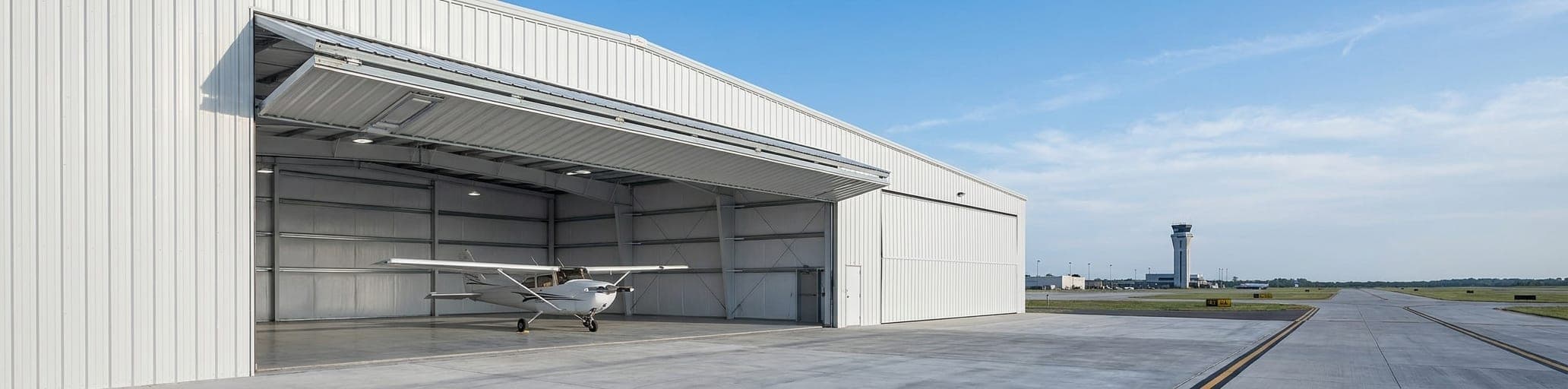

We help you plan and budget for prefab aviation hangars. Our expertise ensures a smooth construction process.
2026 NSB Prefab Hangar Kits: Sizes, Prices & What's Included
The NSB 40×60 kit delivers 2,400 sq ft of unobstructed floor space for $67-$73k, with pre-cut framing and panels included to cut your labor hours on site.
40×60 clear-span for single-engine: $67-$73 k delivered, March 2026 pricing
A 40×60 clear-span airplane hangar gives you 2,400 sq ft of unobstructed floor space–no interior columns interrupting the footprint, just wall-to-wall room to work. [7] That matters when you're taxiing a single-engine aircraft–a Cessna 172, a Piper Cherokee, or a comparable 35-38 ft wingspan plane–because even a modest interior column forces a door-frame dance you don't want at 6 a.m. in low light.
The NSB kit at this footprint delivers at $67-$73k as of March 2026, and that price includes primary I-beam framing pre-cut and pre-drilled, all secondary framing, fasteners, and 26-gauge PBR metal roofing and wall panels. [7] Industry baseline for kit-only steel runs $25-$35 per square foot; the NSB 40×60 lands at roughly $27-$30 per square foot delivered, which keeps you within budget before you add the slab, erection labor, and your door choice. [8] Because the kit ships pre-cut and pre-drilled, your crew spends time assembling rather than measuring and cutting on site–a meaningful reduction in labor hours on a project where every delay carries carrying costs. [8] For a full breakdown of how this size stacks up across spec options, the 40x60x16 metal building kit guide covers framing dimensions, panel choices, and what to lock in before pricing moves.
60×80 for twin turboprop: $113 k with bi-fold door allowance, turnkey in 14 weeks
Step up from single-engine to twin turboprop and your hangar requirements change in two specific ways: door width and primary framing load. Aircraft like the King Air 350 or Pilatus PC-12 carry wingspans of 57-59 ft, so a 60×80 footprint gives you 4,800 sq ft of column-free floor space with enough clearance on both wingtips to move comfortably without spotters.
The NSB 2026 kit at this footprint prices at $113,000–and that figure includes a bi-fold door allowance, which matters because bi-fold doors open vertically in two hinged panels rather than sliding laterally, preserving full opening height even on ramps where side-wall clearance is tight. [9] Column-free interiors are non-negotiable at this aircraft category: interior posts shift your taxi line and introduce a wingtip clearance problem on every single entry. [9] The 14-week turnkey clock starts at signed contract and runs through kit fabrication, delivery sequencing, foundation coordination, and erection–meaning your crew arrives to a site-ready project, not a material pile. At $113k for the kit before slab and erection labor, you're landing at roughly $23.50 per sq ft–proportionally efficient given that the heavier primary I-beam framing and door hardware a turboprop build demands would cost you considerably more in a custom-designed structure.
If you want a full picture of how door specs and framing choices interact with permit requirements, how to build a metal airplane hangar walks through the complete planning-to-construction sequence.
75×100 corporate jet hangar: $219 k, includes 28-ft eave height and 2-ft insulation package
Items bundled vs. line-item upgrades–NSB's transparent quote sheet compared to competitor kits Knowing exactly what a kit price covers is the difference between a budget that holds and one that blows out mid-project. Every NSB quote sheet lists the same standard bundle across all three hangar sizes: primary I-beam framing (pre-cut and pre-drilled), all secondary framing, fasteners, 26-gauge PBR metal roofing and wall panels, detailed engineering plans, and assembly instructions. [12] That bundle is fixed–it doesn't shift between quote and invoice.
What separates NSB from many competitor kits is line-item transparency on everything outside that bundle. Competitors in the prefab market frequently quote kit-only material costs at $20-$40 per square foot, then layer in assembly, ground preparation, door hardware, and insulation as separate surprises–a pattern that routinely adds 10-15% to your total before you've broken ground. [13] NSB's quote sheet calls those items out explicitly: hangar door type and opening dimensions, insulation package (already bundled in the 75×100 corporate spec), electrical rough-in allowance, and foundation coordination–each shown as a discrete line with a current price, not a vague 'by others' note. [10] The practical result is that you can hand your banker, your airport lease officer, or your general contractor a single document where every cost is visible and nothing is deferred to a change order.
If you want to see how that same line-item discipline applies to a standard 40×80 metal building kit, the pricing breakdown there shows exactly which options stay optional and which become essential once construction starts.
Airport Lease Rules & FAA Permits: 2026 Compliance Checklist
A UL-rated roof assembly can eliminate your $28,000 sprinkler system requirement, provided your fire marshal approves the suppression waiver at your pre-construction review.
Fire suppression waivers–when NSB's UL-rated roof assembly saves you $28 k on sprinklers
Fire suppression is one of the largest variable cost items on any airplane hangar permit package, and it's also the one most owners don't see coming until the fire marshal's review. Aviation hangars store fuels and other flammable materials, which puts them under stringent fire safety requirements–typically including fire suppression systems, fire-rated construction materials, and code-compliant emergency exits. [14] On a 60×80 or larger hangar, a fully installed sprinkler system routinely prices out at $25,000-$30,000 before you've touched erection labor or the slab. That line item isn't negotiable unless your structure qualifies for a suppression waiver–and that's exactly where your roof assembly becomes a budget decision, not just a materials choice. NSB's 2026 kits ship with a UL-rated roof assembly, a system independently tested and classified by Underwriters Laboratories for fire resistance.
Under NFPA 409–the standard that governs aircraft hangar fire protection–local Authorities Having Jurisdiction can grant a fire suppression waiver when a roof assembly meets a recognized fire-resistance classification threshold. When your hangar qualifies, the sprinkler line item comes off the permit package entirely, saving you approximately $28,000 on a mid-size build without reducing your structure's compliance standing. The waiver isn't automatic: it depends on aircraft category, hangar footprint, and your local AHJ's discretion. What moves the review in your favor is arriving at the pre-construction fire inspection with the right documentation already assembled–UL classification certificates, test reports, and stamped engineering drawings.
NSB provides that complete file with every 2026 kit, so your fire marshal can make the determination in a single review cycle rather than sending you back for missing paperwork that costs you weeks and carrying costs on a project that should already be under construction. For a broader look at how fire resistance translates directly to cost savings in steel structures, steel farm building fire resistance shows the same principle applied across building categories.
Lease-line setbacks: how NSB's engineer stamps foundation plans to meet 10-ft FAA easement
Environmental review fast-track–NSB supplies geotechnical report templates accepted by 42 state DOT aeronautics divisions Environmental review is where airplane hangar projects stall longest–not because of actual site problems, but because geotechnical documentation requirements differ across state DOT aeronautics divisions, and most owners don't know what format each reviewer expects until they're already in a correction queue. The stakes are higher than a typical commercial build because when an airport sponsor accepts federal Airport Improvement Program funds, every facility designated for aeronautical use becomes subject to binding grant assurances that the FAA enforces through its Airport Compliance Program. [16] Those assurances create a compliance chain that runs from the airport sponsor directly to your individual hangar permit–which means your geotechnical report has to satisfy both the local building official and the airport authority's compliance framework at the same time. A report that checks every technical box but arrives in the wrong format still triggers a resubmission cycle, and in a constrained permitting environment, that cycle costs you weeks before you've broken ground.
NSB removes that variable by supplying geotechnical report templates pre-formatted to the submission standards accepted by 42 state DOT aeronautics divisions. Instead of hiring a consultant to reverse-engineer a state's preferred format from a stack of advisory circulars, you start with a template that already matches what the reviewer expects–correct section headings, required soil classification data, and the bearing capacity documentation format each division uses to clear environmental review. Your geotechnical submittal moves through the state DOT aeronautics division on first submission rather than cycling back for format corrections that have nothing to do with your actual soil conditions.
That's one less resubmission queue between your signed contract and your certificate of occupancy, which keeps your project within budget and on schedule every step of the way. Unique Element: Hangar Door ROI Calculator–Which Door Pays for Itself by 2030?
Inputs: local kwh rate, cycle count per week, door weight, and maintenance intervals
Output table: bi-fold vs. hydraulic vs. stack-leaf–5-year energy and upkeep cost difference The five-year cost picture breaks down across three variables: energy loss through the door assembly, scheduled maintenance, and reactive repair. Bi-fold doors carry an internal truss as standard, seal tighter against wind and weather, and slope at 1:12 when open so water runs off rather than pooling on sheeting–all three traits directly suppress heating and cooling costs over time. [19] Hydraulic doors, by contrast, rely on periodic fluid checks and seal replacements that bi-fold cable systems don't carry, and the external truss standard on most hydraulic doors collects snow, debris, and ice that has to be cleared before every operation cycle in cold climates–adding labor cost that compounds annually. [18] Vertical lift (stack-leaf) doors carry the highest initial price point of the three but deliver superior sealing and insulation that cuts heating and cooling costs more aggressively than any other system, making them the strongest long-term performer on energy spend in temperature-controlled or four-season facilities. [18] The table below puts those differences in one place:
| Door Type | 5-Year Energy Cost | 5-Year Upkeep Cost | Primary Cost Driver |
|---|---|---|---|
| Bi-fold | Low | Low | Cable/strap inspection; no fluid service |
| Hydraulic | Moderate | Moderate-High | Fluid checks, seal replacement, truss debris clearance |
| Vertical lift / stack-leaf | Lowest | Moderate | Higher initial cost; superior insulation reduces ongoing energy spend |
Bi-fold doors fold in half when opening, putting less stress on the building structure than a one-piece hydraulic panel cantilevering outward at 90 degrees–which means your header and end wall carry lower cumulative load over five years, reducing the chance of structural fatigue repairs entering the budget. [19] Hydraulic systems move the full panel weight through two cylinders on every cycle, and in high-cycle facilities those cylinders add hydraulic fluid changes, bearing inspections, and occasional hose replacements to the maintenance calendar in ways bi-fold and vertical lift systems don't. [20] If your facility runs more than 20 cycles per week, the maintenance gap between hydraulic and bi-fold widens enough over five years that the lower upfront cost of a hydraulic door doesn't hold its advantage past year two or three.
NSB-recommended door spec for each kit size, pre-wired in factory to shave 3 days off install
The door spec that belongs on your kit follows directly from aircraft category, door width, and the structural load your end wall carries–not from a price list. For the 40×60 single-engine kit, a bi-fold strap door in the 40-ft-wide range clears the 35-38 ft wingspan of a Cessna 172 or Piper Cherokee without overloading the end-wall framing, and the strap system's lower per-cycle motor strain keeps operating costs in check for private owners cycling the door fewer than 15 times a week.
The 60×80 turboprop kit is already priced with a bi-fold door allowance because bi-fold panels distribute load across hinged sections rather than pushing the full panel weight through hydraulic cylinders on every cycle–a structural difference that matters on a 57-59 ft wingspan clearance opening where cumulative header load adds up over years of daily operation. The 75×100 corporate jet kit calls for a vertical lift door: at 28-ft eave height with a 94-ft wingspan aircraft moving through on a tug, the superior sealing and insulation that stack-leaf systems deliver directly suppress heating and cooling costs on a 7,500 sq ft structure where energy spend compounds fast.
What shaves three days off the install clock on all three kits is factory pre-wiring: doors ship fully assembled, pre-wired, and finish painted, so your crew connects rather than configures on site. [21] Competitor designs that ship in pieces require on-site wiring runs, motor-controller calibration, and limit-switch setup before a single cycle test can happen–work that stacks up quickly on a project where every delay carries carrying costs on a leased airport parcel. You get a door that's ready to operate the day it arrives, which keeps your airplane hangar project on schedule every step of the way.
- Prefab hangars come in various sizes, including 40×60 and 60×80 footprints
- Clear-span framing is crucial for airplane hangars to prevent wingtip strikes
- Kit prices range from $14 to $25 per square foot before delivery and site preparation
- Bi-fold doors are a common choice for large hangars due to their wide opening capability
- NFPA 409 classifies airplane hangars into four groups based on construction type and operations
- Airport lease rules and FAA permits require careful planning and compliance
- Hangar door type affects installation costs, maintenance, and energy efficiency
- https://www.merriam-webster.com/grammar/hangar-vs-hanger
- https://writingexplained.org/hangar-vs-hanger-difference
- https://www.faa.gov/airports/airport_compliance/hangar_use
- https://www.faa.gov/airports/airport_compliance/complaints
- https://aerolawcenter.com/faqs/how-to-handle-disputes-over-aircraft-hangar-leases/
- https://www.hollandsentinel.com/press-release/story/94690/federal-steel-systems-announces-aviation-hangar-design-services-for-personal-and-commercial-use/
- https://www.buildingsguide.com/metal-building-kits/airplane-hangars/?srsltid=AfmBOor5BVGbbeaW_5oGkk7XwIo-rWkHTb4G-5sko1FlVgbIQxqgHDDh
- https://titansteelstructures.com/prefab-building-types/how-much-does-a-metal-aircraft-hangar-cost/
- https://www.alliedbuildings.com/aviation-buildings/
- https://chinasteelbuildsales.com/cost-to-build-a-hangar/
- https://www.steelframestructure.com/steel-hangar-prices.html
- https://www.buildingsguide.com/metal-building-kits/airplane-hangars/?srsltid=AfmBOopHjf069RQx6G_JYvMemBSckx5PQt-_BuY3_70hjJKo-ol04YsU
- https://www.ibeehivesteelstructures.com/blog/prefab-aircraft-hangar-cost/
- https://gaxtent.com/blog/news/11-essential-aircraft-hangar-requirements/
- https://www.faa.gov/airports/engineering
- https://www.faa.gov/airports/airport_compliance
- https://hangarman.com/f/a-guide-to-aircraft-hangar-door-pricing-and-roi
- https://rcidoors.com/types-of-hangar-doors/
- https://www.bifold.com/door-comparisons.php
- https://wellbiltdoors.com/news/hydraulic-vs-bi-fold-hangar-doors-a-quick-comparison/
- https://diamonddoors.com/industries/aviation/