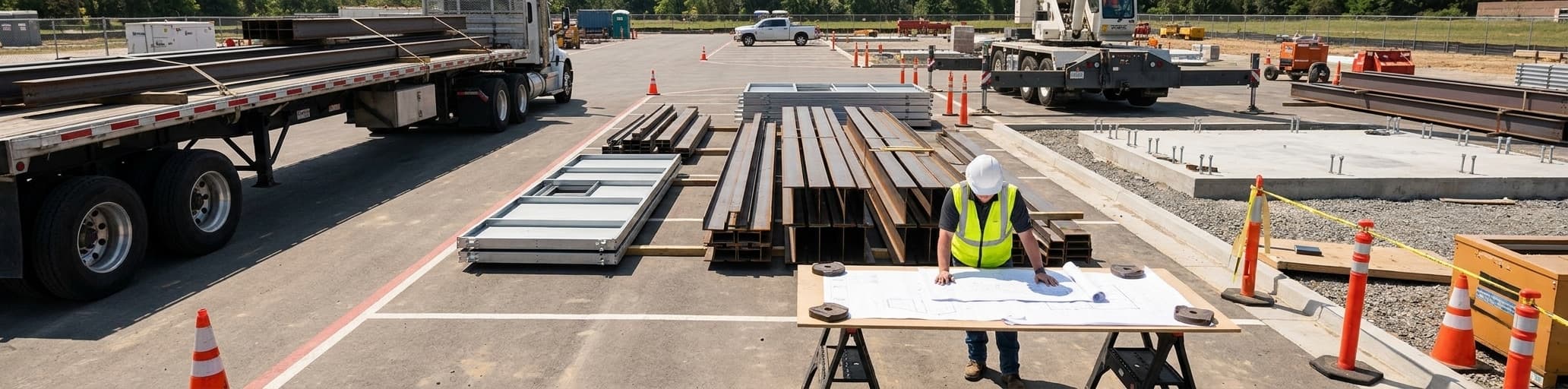

We guide you through NSB's six-step delivery roadmap, from engineering approval to erection, showing exactly how material sourcing, permitting, and weather planning control your timeline. Understanding these variables upfront lets you lock realistic schedules and avoid costly surprises.
From Order to Occupancy: NSB's 6-Step Delivery Roadmap
Every dimension and load calculation in your approval drawings is engineered specifically for your site conditions, not pulled from a generic template.
Step 1 – 48-Hour Engineering Review & Site-Specific Approval Drawings
The moment your order is placed, the engineering clock starts. NSB's in-house engineers begin building a complete set of approval drawings — a detailed structural blueprint of exactly what you ordered, calibrated to your specific site conditions, local snow and wind loads, and building use. This isn't a generic template pulled from a catalog.
Every dimension, load calculation, and component layout is specific to your project.[1] Approval drawings are the first formal step in your building's life.[1] They establish the structural and legal foundation for everything downstream: permits, fabrication sequencing, and foundation anchor bolt placement. Critically, your anchor bolt pattern isn't considered final until permit drawings are complete — which means pouring concrete before that stage creates rework risk you don't need.[1] The 48-hour turnaround on initial engineering keeps your project moving without idle time stacking up early in the schedule. For context on how this phase fits the broader cost and speed picture, see NSB's prefab buildings cost and speed guide.When you receive the approval drawings, don't sign them immediately unless you want fabrication to begin as drawn.[1] This review window is where you position doors, windows, and all openings — decisions that affect both day-to-day function and structural framing.
A dedicated project manager walks through every detail with you: insulation options, door types, interior use requirements.[1] Changes made here cost nothing beyond time. Changes made after fabrication starts cost real money and add real weeks.[2]If revisions are needed, you enter what's called the revised approvals phase — a more detailed version of the original drawings that incorporates your changes.[1] Any modification with structural implications gets flagged before it triggers unnecessary cost increases.[1] Once you sign off, the drawings move directly to the permit phase. At that point, fabrication scheduling can begin in parallel, keeping your steel prefab buildings project on the fastest viable path to erection.[3]
What Really Controls Speed: Material, Code, and Weather Variables You Can Model
NSB's weekly inventory tracking across regional supply nodes ensures your coil allocation locks in at order placement, eliminating the sourcing delays that typically slip fabrication start dates.
Steel Coil Availability Heat-Map (Updated Weekly by NSB Purchasing)
Steel coil is the raw material your building starts as — and its availability at mills and distribution centers closest to your site directly determines how fast fabrication can begin. Delays in sourcing coil, especially for specific gauges or coated finishes, are one of the most common reasons prefab steel buildings slip their fabrication start date. [4] NSB's purchasing team tracks this every week, mapping live coil inventory across regional supply nodes so your project gets assigned to fabrication when material is actually ready to move — not when a supplier estimates it might be.Regional proximity to supply matters more than most buyers realize.
Moving large steel coils across long distances adds both freight cost and transit risk. [5] When your coil source is strategically close to the fabrication facility processing your order, lead times drop and the supply chain becomes far more predictable. [5] NSB's national buying power means purchasing relationships with multiple regional distributors — so when one node shows low stock on a particular gauge, your order routes to the next closest source without stalling your schedule.The heat-map translates raw purchasing data into a format your project manager can act on. Each week, NSB's purchasing team updates availability status across supply regions — flagging tightening inventory before it creates a bottleneck.
If you're planning a 40x60x16 metal building kit or a larger industrial structure, this visibility lets NSB lock your coil allocation at order placement rather than chasing availability after engineering is complete. Specialty finishes and non-standard gauges carry longer lead times regardless of region, so identifying those requirements early is where the heat-map pays off most. [6] Ask your project manager to pull the current availability snapshot for your building specs before your deposit is finalized — it's the single fastest way to validate whether your target erection date is realistic.
Weather Contingency Calculator: Pick Your Region & Erection Season
Weather isn't a surprise in construction — it's a variable you can plan around if you know your region's patterns and build buffer time into the right phases. Steel erection has hard operational limits that don't flex: crane lifts stop when wind speeds exceed 30 mph, welding halts in rain, and concrete foundation work becomes high-risk in freezing temperatures. [7] These aren't judgment calls — they're safety thresholds that affect every crew, in every region, at every project scale. Knowing them before you lock your erection window is what separates a schedule that holds from one that collapses the first week on-site. [8]The practical starting point is matching your target erection season to your region's highest-risk weather window.
In the Northeast and Upper Midwest, winter erection (November through March) adds concrete preheating requirements, slower equipment operation in extreme cold, and snow clearance delays before crews can even start each morning. [9] Cold steel becomes more brittle during handling, and hydraulic systems on cranes slow down — both of which extend your calendar days on-site beyond what the same crew would need in moderate temperatures. [9] Gulf Coast and Southeast builds carry a different risk: summer erection runs directly through hurricane season (June through November), and high humidity accelerates corrosion risk on uncoated components left exposed during assembly. [7] Pacific Northwest projects targeting fall or winter erection face sustained rainfall that makes welding and bolting connections a stop-start process across multiple weeks. [9]The most cost-effective erection windows nationally are spring (late March through May) and early fall (September through October). [9] Both seasons offer moderate temperatures that keep steel dimensions stable during fitting, lower wind event frequency than winter or early summer storm seasons, and ground conditions that support crane positioning without excessive site prep. If your project is an aviation hangar or large commercial structure, the crane hours required are higher, which means weather windows matter even more — a single high-wind day on a large bay erection sets back the entire installation sequence, not just one lift. [8]Building your contingency buffer correctly means assigning delay days by phase, not as a single lump sum at the end of the schedule. Foundation and concrete work in cold-weather regions typically needs 20-30% additional duration from November through February due to curing requirements and freeze-thaw risk. [9] Erection phases in high-wind corridors — Great Plains, mountain passes, coastal areas — should carry a 10-15% buffer on crane-intensive days. [7] Rain-heavy regions add time to welding and connection work, not necessarily to the overall structural sequence.
When you tell your NSB project manager your target region and erection season upfront, these buffers get built into your schedule from day one — keeping your project within budget and on schedule instead of absorbing weather surprises as unplanned cost. NSB vs. DIY Kits: Delivery Week Comparison Table (40x60x16 Example)
Column 1 – Factory-to-Site Transit Days by Region
Transit time — the days between steel leaving the fabrication facility and arriving at your site — is the most predictable variable in your entire delivery schedule, but only if you know your region. Once fabrication is complete, most prefab building kits reach the job site in 3 to 7 days under standard conditions. [4] That window holds for the majority of contiguous U.S. locations served by NSB's national fabrication network. Where it stretches is when regional distance, seasonal weather corridors, or site access constraints enter the picture.The most direct factor is how far your site sits from the nearest fabrication source.
Shorter haul distances mean lower freight cost and a transit window that stays closer to 3 days. Projects in the Mountain West, upper Great Plains, and rural Pacific Northwest typically see the longest transit legs — not because of distance alone, but because fewer direct freight routes service those corridors, and winter conditions can close passes or force rerouting entirely. One real-world example: a Montana customer saw a two-week delivery extension after a Texas facility shutdown caused by a blizzard cascaded through the freight schedule. [10] That kind of exposure disappears when your building sources from a regionally appropriate fabrication node — which is exactly how NSB structures its national buying-power allocation.Site access is where transit days become erection days if you're not prepared.
Standard steel delivery trucks run approximately 75 feet in length and need room to maneuver, stage, and off-load. [10] If your access road can't support that footprint, delivery shifts to smaller trucks or crane-assisted off-load — adding both cost and days to your schedule. For a 40×80 steel building kit, where component volume spans multiple loads, a tight or unpaved access road can stagger your delivery sequence across several days instead of one. Confirming road width, surface condition, and turn radius before your fabrication completes keeps your transit-day estimate from becoming a surprise on delivery day. [3]
Checklist: 12 Pre-Build Actions That Cut 2 Weeks Off Your Timeline
Three site prep actions–soil report, access road confirmation, and utility coordination–sit entirely in your control and directly prevent costly delays.
Site Prep Items You Control (Soil Report, Access Road, Power Drop)
Three site prep items sit entirely in your hands — and each one has a direct multiplier effect on your timeline if you skip it or delay it. The soil report comes first because everything else depends on it. A geotechnical report tells your foundation engineer how deep to excavate, what compaction density to target, and whether your subgrade can support the slab without settlement risk. [11] Weak or unstable soil doesn't announce itself until concrete starts cracking — and by then, the rework cost dwarfs what the report would have cost. Engage a geotechnical engineer before any grading or excavation begins. The report shapes your foundation plan, and your foundation plan shapes your anchor bolt layout.
Those three things are a chain — break any link and you're resequencing work that was already scheduled.Your access road is the second item that's completely within your control — and it's the one most buyers underestimate. Standard steel delivery trucks run approximately 75 feet in length and require room to maneuver, stage, and off-load. [12] If your road can't support that footprint — whether because of width, surface condition, tight turns, or soft ground after rain — delivery shifts to smaller trucks or crane-assisted off-load, adding both cost and days. Confirm road width and turn radius before fabrication completes, not the morning trucks are scheduled to arrive. Muddy or soft ground during a rainy season can stall a delivery entirely, costing you idle crew time and a rescheduled erection window. [12]The power drop and all underground utilities need to go in before your slab is poured — not after. Routing electrical conduit, water lines, or sewer stubs through freshly poured concrete means cutting into it, which adds cost, weakens the slab, and creates inspection complications you don't need. [12] Walk your floor plan with your electrician and plumber before any concrete work starts.
Coordinate trench depths, stub locations, and conduit sizing against your building's intended use — a warehouse, hangar, or agricultural facility each has different service requirements, and getting those specs wrong at the trench stage is far more expensive than getting them right during planning. Once your slab cures, the underground phase is locked in. There's no cost-effective way to revise it. For projects like aviation hangars or large commercial structures, utility coordination is especially critical — high-amperage power drops and specialized drainage requirements need to be confirmed with your local utility provider well before the foundation contractor mobilizes.
Permit Paperwork NSB Prefills for You–What You Still Must Sign
The part of permit paperwork that stops most projects cold is engineering documentation — specifically, getting structural plans that are certified and stamped by a licensed engineer for your state. [13] That's the piece NSB handles for you. Once your approval drawings are signed off, NSB's engineering team produces a complete set of permit drawings: site-specific structural plans, load calculations calibrated to your location, and an anchor bolt plan — all signed and sealed by a licensed engineer. [14] You receive three original stamped sets, formatted for submission to your local building department. [14] For most jurisdictions, this package covers the technical documentation side of the application entirely.What you still need to provide comes down to ownership and intent. Your local building department will require proof that you have legal right to build on the property — typically a title deed or tax statement. [15] You'll also need to declare the building's intended use, its exact location on your parcel, and confirm compliance with setback requirements from property lines and any easements. [13] The permit application itself — the form your jurisdiction uses to formally record the project — requires your signature.
NSB can't sign that on your behalf, and neither can an engineer. That's a legal declaration, and it belongs to you as the property owner.One scenario worth knowing before you submit: if your jurisdiction is in a high-scrutiny area — large metro, seismic zone, or high-occupancy use class like a church or large retail facility — permit review can run significantly longer than average. [13] In those cases, NSB can structure your order as a permit hold, meaning fabrication doesn't begin until your stamped drawings clear review. [13] The tradeoff is straightforward: your order isn't locked against price changes until it releases to production, but you don't risk fabricating steel that can't be used as drawn. For aviation hangars or other high-occupancy structures with complex review timelines, this approach keeps your project within budget by eliminating costly revisions after steel is already cut.Fees are the final item that stays in your hands.
Permit costs vary by jurisdiction, project size, and building use, and they're paid directly to your local building department — not through NSB. [15] Check your local department's fee schedule before submitting, since some areas charge based on square footage while others use valuation tiers. Knowing the fee ahead of time keeps your total project budget accurate and avoids a surprise right when you're ready to pull the trigger on erection.
- NSB's 6-step delivery process begins with custom approval drawings calibrated to your site's specific conditions, snow loads, and wind requirements within 48 hours.
- Changes to door, window, and opening positions cost nothing if made during the approval review phase but become expensive after fabrication starts.
- Steel coil availability at regional mills and distribution centers is the primary factor controlling fabrication speed and should be verified before finalizing deposits.
- Spring (late March-May) and early fall (September-October) offer the most cost-effective erection windows nationally due to moderate temperatures and lower weather risk.
- Foundation work, soil reports, and access road preparation must be completed before steel delivery; geotechnical reports and utility coordination prevent costly rework.
- Weather contingency buffers should be assigned by phase: 20-30% for cold-weather foundation work and 10-15% for high-wind crane operations, not as a single lump sum.
- Standard steel delivery trucks require 75-foot access roads with adequate width and turning radius; poor site access forces smaller trucks and adds days to your schedule.
- https://armstrongsteel.com/blog/direct-buy-process-approval-drawings
- https://ztsteelstructure.com/steel-building-timeline-realistic-schedule-from-design-to-move-in/
- https://metalprobuildings.com/pre-engineered-steel-building-timeline/
- https://www.metfraa.com/blog/how-fast-can-your-peb-be-delivered-understanding-supplier-timelines/
- https://www.millsteel.com/blog/how-regional-access-impacts-project-timelines-and-costs
- https://newtechmachinery.com/learning-center/best-metal-coil-suppliers/
- https://xtdsteel.com/blogs/weather-impact-steel-construction/
- https://reliablesteelerectors.com/the-impact-of-weather-on-steel-erection-projects/
- https://nordicsteel.construction/sun-rain-or-snow-understanding-how-weather-conditions-affect-metal-building-construction-timelines/
- https://www.factorysteeloverstock.com/steel-building-delivery-timelines-2/
- https://metalprobuildings.com/preparing-the-site-what-to-do-before-your-steel-building-erection-begins/
- https://buildway.com/metal-building-site-preparation-guide/
- https://www.rhinobldg.com/blog/construction-permits-for-metal-buildings
- https://armstrongsteel.com/blog/building-permits-and-regulations-for-metal-buildings-in-colorado
- https://harrisconstructorsinc.com/how-to-get-a-permit-for-a-steel-building-in-colorado/