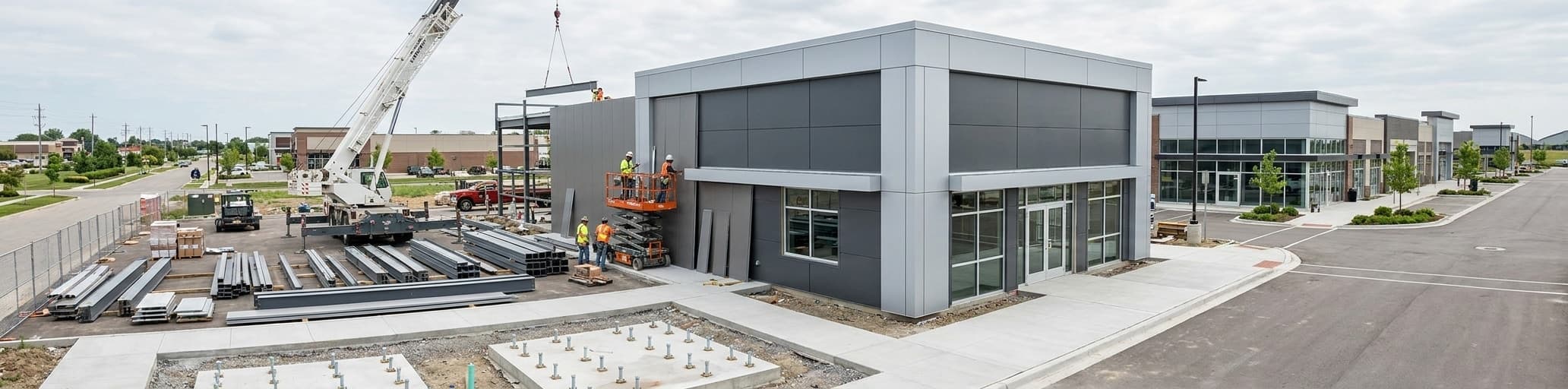

We walk you through all steps of preparing a prefabricated steel retail building so you can compress the contract to opening timeline to 12 weeks. The result is a faster revenue generating store launch that avoids costly delays and protects you from steel price volatility.
Why Speed-to-Shelf Beats Low Bid in 2026
Missing your store's opening date costs an average of $1.1 million daily in lost revenue, making speed-to-shelf the metric that matters most in 2026.
The 90-Day Fast-Open Standard NSB Delivers
For retail metal buildings, the gap between signing a contract and opening your doors directly affects how many selling days you capture — which is why timeline beats low bid as the primary evaluation criterion in 2026. Permanent modular steel structures can realistically reach completion in 60 to 90 days, a pace that traditional stick-built construction simply cannot match. [1] Prefabricated steel alternatives routinely deliver large commercial steel buildings in 8 to 14 weeks, while conventional steel builds stretch to 6 to 12 months. [2] National Steel Buildings structures its retail projects around that 90-day window by running engineering, permitting, steel fabrication, and erection as overlapping phases rather than sequential handoffs — so your store is generating revenue while a competitor is still waiting on a framing crew.
Hidden Costs of Delayed Store Openings
The financial exposure from a delayed opening runs deeper than most pro formas capture.
Retailers can suffer daily revenue losses averaging $1.1 million when store openings face setbacks, and construction costs compound the damage by escalating an average of 5% for every month a project is postponed. [3] Delays also introduce compounding friction across the full opening ecosystem — inventory timing, staffing schedules, and marketing spend all drift out of alignment the longer a build runs over. [4] When performance is measured by how many weeks a store actually spends generating revenue within the fiscal year, the true cost of a low-bid contractor who misses the schedule becomes straightforward to quantify. [4]
Fast-Open Checklist: Permits, Site, Kit, Crew
Running permits, site prep, kit fabrication, and crew scheduling in sequence rather than in parallel is the most common reason retail metal buildings miss opening dates.
On permits: verify the property's Certificate of Occupancy first — if the prior occupant was not a retail business, a change-of-use permit is required, and entitlement hearings can add months to the review. [5] Confirm parking counts and ADA compliance during lease negotiation, not after. [5] Place the steel fabrication order the moment engineering drawings are stamped so a prefab steel building kit ships concurrent with permit review rather than waiting on it.
Book concrete and erection trades at contract signing — crews fill schedules fast, and any gap between slab cure and steel arrival is calendar time you won't recover.
Retail Metal Building Cost Matrix (Updated April 2026)
A 30×40 metal building kit costs $24,000, but true installed costs run $24 to $43 per square foot once you factor in slab, delivery, and erection labor.
30×40, 40×60, 50×80 Turnkey Prices with NSB In-House Erection
For retail metal buildings at the three most common footprints, the turnkey number diverges sharply from the kit price once slab, delivery, and erection enter the calculation.
A 30×40 steel package runs around $24,000 for the kit alone, but installed costs industry-wide average $24 to $43 per square foot when those line items are bundled in. [6] A 40×60 shell lands between $60,000 and $84,000 before erection labor — which adds $10 to $20 per square foot — and the concrete slab adds another $8 to $12 per square foot depending on soil conditions and load requirements. [7] At 50×80, those same per-square-foot multipliers apply across 4,000 square feet, and keeping erection in-house removes the scheduling gap between steel delivery and crew mobilization that routinely extends timelines on multi-vendor builds.
What the Kit Price Leaves Out–And How NSB Bundles It
A standard kit quote covers the primary steel frames, panels, trim, fasteners, and delivery to your jobsite — everything beyond that is typically separate. [8] The items that fill the gap between kit price and true project cost include site work, foundation, permits, erection labor, insulation, and interior systems like HVAC and electrical. [8] Accessories — gutters, windows, skylights, and custom doors — widen that gap further when they're folded into a re-quote rather than priced upfront. [8] NSB's bundled contract rolls those line items into a single scope so the number you approve reflects what it actually takes to reach a certificate of occupancy, not just what it costs to have steel unloaded on your lot. [9]
Using NSB's Real-Time Steel-Buy Calendar to Lock Savings
Steel is a globally traded commodity whose price responds to supply and demand shifts, trade policy changes, and geopolitical events — sometimes within days. [10] A 10% move in steel pricing on a $200,000 building package translates directly to a $20,000 swing in material costs, which means the date you place your fabrication order matters nearly as much as the spec you order. [10] NSB's steel-buy calendar tracks those market cycles — including the seasonal dips that occur around fiscal year-end and during construction slowdowns — so you can time your order to a favorable window rather than buying at whatever price the market is running when your permit happens to clear. [10] Manufacturers with established mill relationships also carry bulk-buying leverage that individual retail metal building buyers can't access independently, giving you a second layer of insulation against spot-market volatility on your pre-engineered steel building project. [10]
Design Moves That Cut Build Time Without Cutting Aesthetics
Pre-approved standard dimensions let you send permit-ready drawings with your fabrication order, eliminating the two to four weeks typically lost to custom engineering cycles.
Pre-Approved Bay Spans for Common Retail Chains
Single-story retail formats cluster around a narrow range of bay spans, which means the structural engineering for those configurations has largely been solved already.
Portal frames for retail superstores typically run 25 to 40 meters in span with frames spaced 6 to 10 meters along the building length, and supermarket layouts are conventionally planned on a 10-by-10-meter column grid that scales to a 20-meter span when the program demands it. [11] The most economical clear-span width for pre-engineered steel buildings used in retail falls between 40 and 100 feet — a range that covers nearly every freestanding chain format without requiring special engineering. [12] When those dimensions are pre-approved in the design library, permit-ready drawings can accompany the fabrication order rather than waiting on a custom engineering cycle, which is where many retail builds lose two to four weeks before a single bolt is set.
NSB Color-Through Panels That Ship with the Frame
When panels ship already finished to your brand spec, you eliminate the gap between steel erection and a separate cladding or painting phase — which can otherwise consume a week or more on a retail metal building project.
Metal panels can be coated in virtually any color to match exact brand hues, with advanced finishes that resist fading, UV exposure, and harsh weather for decades without refinishing. [13] Preformed and insulated panels ship in a wide variety of colors, widths, and profiles, so the exterior look is built into the fabrication order rather than sourced as a follow-on trade. [14] Coordinating panel color with the frame order means the building goes weather-tight and brand-ready in the same erection sequence — no second mobilization, no repainting schedule holding up your certificate of occupancy.
Site-Prep Specs NSB Provides to Your Concrete Contractor
The anchor bolt plan in your permit package tells the concrete contractor what to pour: bolt quantity, diameter, projection height, and column-line locations, so the slab can cure while fabrication is running. [15] The steel building manufacturer determines bolt type, diameter, and quantity from the engineered frame reactions; your foundation engineer uses those load calculations to set footing depth for your specific soil conditions. [16] Misplaced bolts are among the costliest field problems in steel erection — all anchor bolts must be placed within a 1/16" tolerance of the approved location, and getting the full anchor-bolt template to your concrete crew before the pour is the most preventable step between a retail metal building and a blown schedule. [16] [17]
From Contract to Keys: NSB's 12-Week Retail Timeline Walk-Through
Pre-book your trades and final inspection during weeks 3-6 to eliminate the idle gaps that delay most retail metal building projects.
Week 1-2: Engineering, Permit Prints, Anchor-Bolt Plan
Week 3-6: Steel Ordered, Slab Poured, ProTrades Scheduled Once the anchor-bolt plan leaves engineering, weeks 3 through 6 run as two parallel tracks.
Steel components — primary frames, purlins, girts, wall and roof panels — enter factory fabrication, a phase that typically takes three to four weeks for a standard retail footprint and up to six weeks for more customized configurations. [20] Simultaneously, your site crew clears, grades, sets anchor bolts, and pours the slab so it cures while fabrication is still running — eliminating the idle gap between slab completion and steel arrival that stalls most retail metal building projects. [20] ProTrades get formally booked during this same window, not after erection begins; trade crews fill their schedules fast, and any delay in locking them converts finished steel into dead calendar time on your lot. [20]
Week 7-12: Steel Arrives, Erected, Final Punch, CO Issued
Steel arrives in weeks 7 through 12 and gets staged near the foundation in erection sequence — primary columns first, then girts and purlins, then roof sheeting, wall panels, and trim until the building is weather-tight. [21] Doors, windows, and hardware follow before a punch-list walkthrough covers any misaligned panels or missing closure strips. [21] The scheduling move that keeps the CO on time is pre-booking the final municipal inspection at least two weeks out — most building departments have full calendars, and waiting until punch list is complete to request an inspection slot converts finished steel into dead time. [21] Once the inspector clears the structure, the Certificate of Occupancy issues and your retail metal building opens for business. [22]
- Prefab retail buildings can be completed in 60-90 days
- Traditional construction takes 6-12 months
- Delays can result in daily revenue losses of $1.1 million
- Running permits and site prep in parallel reduces construction time
- Prefab steel buildings can be designed to match brand aesthetics
- Anchor bolt placement is critical to avoiding costly field problems
- Pre-booking final inspections ensures timely certificate of occupancy
- https://www.boxxmodular.com/resources/blog/permanent-modular-construction-solutions-for-the-long-term/
- https://www.prefabsteelpro.com/blog/how-fast-can-a-prefabricated-steel-structure-building-be-built
- https://www.fohlio.com/blog/safeguard-your-profits-the-cost-of-delayed-openings-and-ways-to-mitigate-it
- https://caliber.global/blog/rethinking-retail-expansion-and-the-reality-of-lost-revenue
- https://business.lacity.gov/plan-business/starter-kits/starter-kit-retail
- https://www.buildingsguide.com/metal-building-prices/?srsltid=AfmBOopYplDEg2Ffc-BlbqKYCFwwGVAiE9-m5S_K_20khWFMhIPET4Gl
- https://titansteelstructures.com/price-guides/the-2026-steel-building-price-guide-what-to-expect-this-year/
- https://boxmetalbuildings.com/resource-center/blog/metal-building-quote-includes/
- https://www.summitsteelbuildings.com/the-hidden-costs-of-metal-building-kits
- https://www.alliedbuildings.com/pemb-steel-material-costs/
- https://steelconstruction.info/Retail_buildings
- https://www.buildingsguide.com/build/clear-span-buildings/?srsltid=AfmBOoomOzykTL05Kfy42zMyxyPFvfNTloYbd0GCzdA6pR_EE7HfbYLJ
- https://www.westernstatesmetalroofing.com/blog/metal-panel-brand-company-colors
- https://us.mitsubishi-chemical.com/the-many-advantages-of-metal-wall-panels/
- https://www.fortifybuildingsolutions.com/resources/blog/how-to-read-steel-building-anchor-bolt-plans/
- https://www.rhinobldg.com/blog/how-to-anchor-a-metal-building
- https://www.metalconstructionnews.com/articles/foundations-and-anchor-bolts/
- https://armstrongsteel.com/blog/3-easy-steps-understanding-steel-building-blueprints
- https://www.buildingsguide.com/build/metal-building-codes-permits/?srsltid=AfmBOop3ISSlv3atfuBkW9JLOQepCzCoRhorpq0Fcv5mZdjk7wp3FYv-
- https://metalprobuildings.com/pre-engineered-steel-building-timeline/
- https://www.alpha-labor-co.com/blog/pemb-erection-timeline
- https://marbuildingsolutions.com/what-to-expect-during-metal-building-construction-process/