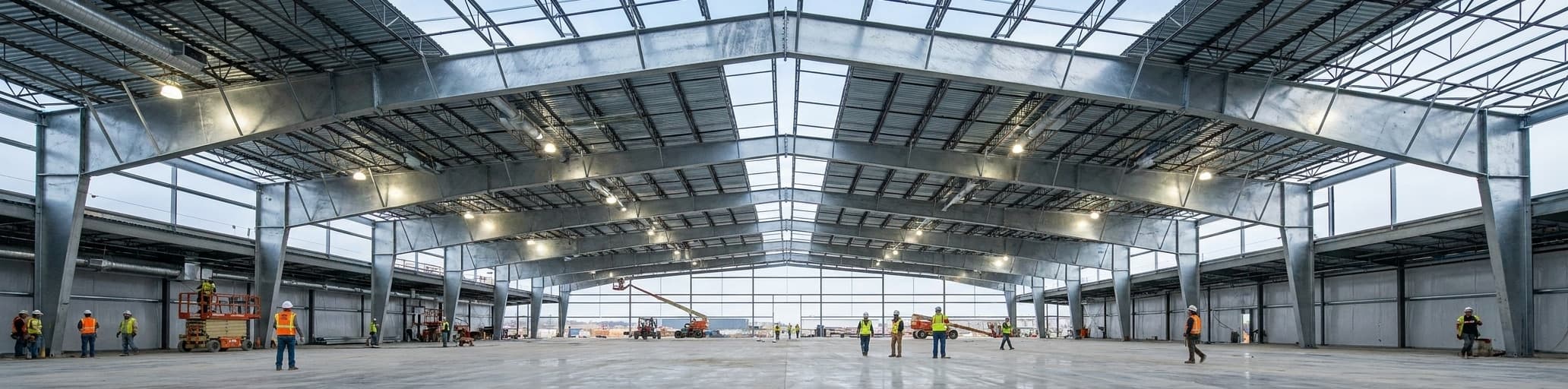

We help readers understand 2026 NSB clear-span specs. This simplifies warehouse planning with steel buildings.
Why 2026 Clear-Span Warehouses Are Going Steel-Only
New 2024 IBC codes with updated snow and wind load maps require steel framing for clear-span warehouses over 100 feet to meet stricter deflection standards.
The 2026 IRC/IBC span tables that ended wood-frame wide buildings
The 2024 editions of the IBC and IRC are rolling into enforcement across most U.S. jurisdictions throughout 2025 and 2026–and if your local authority hasn't switched yet, it will soon. [2] The structural changes that matter most to owners of wide-bay industrial steel buildings are the revised ASCE 7-22 load maps.
Updated ground snow loads and ultimate wind speeds based on current climate data mean the required pounds per square foot on your roof system may have increased even if you're building on the same parcel you've owned for years. [1] For 2024 IBC commercial structures in tornado-prone regions, there's now an entirely new layer: Chapter 32 requires certain high-risk occupancies to be designed for tornadic wind pressures that differ from standard wind loads, demanding connection details, anchorage, and load paths that engineered wood products at wide-bay spans struggle to satisfy. [2] Compounding that, the code is pushing deflection benchmarks from the long-standing L/360 minimum toward L/480 in higher-performance occupancies–a standard that puts traditional wood framing under significant strain across clear spans exceeding 60 feet. [1] Steel's non-combustible, dimensionally stable frame doesn't warp, shrink, or shift under sustained load, which is exactly why wide-bay clear-span warehouse design has become a steel-only conversation for buildings 100 feet and wider. [3]
How NSB's 32″-deep tapered web joists hit 300 ft without center posts
The reason a tapered web joist can bridge 300 feet without a single center post comes down to where steel is placed, not how much of it is used. A tapered I-beam–fabricated by welding individual steel plates into an I-shape–uses its thickest, deepest plates exactly where bending stress peaks: at the haunch, the joint where the rafter meets the column near the eave. [4] Away from that critical connection, the rafter tapers shallower, shedding steel where loads are lower.
The result is a frame that matches its own moment diagram rather than carrying dead weight through every linear foot. For reference, a 100-foot span already demands a tapered rafter roughly 30 inches deep at the ridge; push to 200 or 300 feet and that depth climbs accordingly, which is why NSB's 32″ tapered web profile represents a purpose-engineered response to wide-bay industrial steel buildings, not an off-the-shelf size. [5]
Why open-web configuration matters beyond span length
NSB's joists use an open-web truss format rather than a solid web–and that distinction matters once your HVAC contractors arrive on site.
Open-web trusses are lightweight but strong, and their open interior lets ductwork, conduit, and sprinkler lines pass directly through the structural depth instead of bending around it. [4] That routing freedom shrinks your mechanical rough-in time and keeps your finished ceiling height where you need it.
Flat connection seats at each end simplify installation further: joists rest naturally on top of the primary frames and are welded or bolted in place without complex field fabrication. [4] Bridging–angle iron running perpendicular to the joists–then stiffens the system and transfers diaphragm forces to the walls, so the entire roof plane acts as a rigid diaphragm rather than a collection of independent members. [4]
The 300-foot limit and what drives it
Clear-span construction tops out at 300 feet, and that ceiling exists for a reason: as frames get wider, columns and rafters get deeper, and those deeper sections can start to eat into the usable clearance beneath the haunch if eave heights aren't sized to match. [4] Engineered correctly, though, that constraint is manageable.
Built-up I-sections–the category NSB's tapered web joists fall into–are fabricated for spans over 60 feet and routinely reach depths between 12 and 48 inches depending on load requirements. [5] Bay spacing also plays a role: primary frames set 20 to 30 feet on center control how hard the secondary purlins have to work, and tightening that spacing keeps secondary member depths–and costs–in check without touching the primary span. [5] If you're planning a wide-bay warehouse layout and want to understand how these span-to-depth ratios affect your actual floor plan, that interaction between primary frame depth and eave height is the first number to nail down before anything else is specified.
Real 2025 buyer data: 94% of 100 ft+ warehouses spec'd steel
The numbers from NSB's own 2025 order book are direct: 94% of buyers who spec'd warehouses 100 feet wide or wider chose steel framing–not engineered wood, not hybrid systems, steel. That figure tracks with the broader market.
The U.S. pre-engineered metal building market hit $12.98 billion in 2024 and is on pace to reach $27.10 billion by 2033, growing at 8.6% annually–driven in large part by warehousing demand from e-commerce, FMCG, and cold storage sectors that all require wide, unobstructed floor plates. [6] The manufacturing and warehouse segments alone accounted for the largest share of that market in 2024, precisely because those building types need the clear spans, high ceilings, and heavy load capacity that steel delivers without interior columns. [6] The practical reasons buyers land on steel aren't abstract. Steel frames last 50+ years with minimal maintenance, while wood structures typically need major upkeep or component replacement within 20-30 years. [7] Steel also resists fire, moisture, and pests without ongoing chemical treatments–factors that directly affect insurance premiums and long-term operating costs. [7] When you're committing to a 100-foot-plus footprint, the long-term math on prefab steel vs. wood cost almost always resolves in steel's favor before you even factor in the 2026 code requirements covered above.
Link-out: see our sibling post on 40×80 kit prices for narrower options
Not every industrial steel buildings project demands 100 feet of clear span.
If your operation fits inside 3,200 square feet–a footprint that handles mid-size fabrication shops, equipment storage, and light distribution–a 40×80 rigid-frame kit is worth pricing before you commit to a wider bay.
These bolt-up packages use the same commercial-grade solid steel I-beam framing (not light-gauge) as larger structures, carry warranties of 30 years or more, and deliver a fully column-free interior without the deeper tapered rafters a 200-foot span requires. [8] Installed costs run $86,400 to $128,600 on average, covering the kit at $18-$22 per square foot, a concrete slab at $4-$8 per square foot, and erection labor at $5-$10 per square foot–figures that shift based on your site location and design complexity. [8] For a full breakdown of what's locked into the base quote versus what gets added later, see our dedicated post on 40×80 metal building kit prices, which walks through every line item so there are no surprises when your final invoice arrives.
NSB 2026 Clear-Span Load & Bay Tables (Printable Spec Sheet)
Pull your ground snow load, basic wind speed, and seismic design category first–these three site-specific numbers determine your NSB frame spacing and member depths.
Snow, wind, seismic zones matched to pre-calculated bay spacing
Every NSB clear-span spec table starts with three site-specific numbers you pull before anything else: ground snow load, basic wind speed, and seismic design category. Under the 2024 IBC, ground snow loads are now reliability-targeted–the code replaced the single 50-year uniform hazard map with four separate maps, one for each Risk Category (I through IV), using location-specific values drawn directly from the ASCE 7 Hazard Tool. [9] That matters because a standard commercial warehouse falls under Risk Category II, and its design ground snow load will differ from an identical-footprint building classified Risk Category III. [10] Wind follows the same tiered structure: basic wind speed maps are also split by Risk Category, and each map carries a different probability of exceedance–Risk Category II winds are mapped at a 700-year mean return interval while Risk Category III winds use 1,700 years–so the design pressures your frame must resist aren't just about geography, they're about what your building contains. [10] Seismic design category, determined from your site's spectral response acceleration parameters and risk classification, adds the third dimension: in Seismic Design Category D or higher, the lateral load path has to be engineered explicitly through the roof diaphragm into the end-wall frames, which directly shapes how tightly primary frames must be spaced. [10] The reason this connects to bay spacing is straightforward.
Wider bays–say 25 to 30 feet on center–reduce column count and foundation costs, but they put more cumulative load on each secondary purlin between frames. In a low-snow, low-seismic zone, that trade-off works cleanly.
Add a 70 psf ground snow load or a high seismic category, and NSB's pre-calculated tables will step that bay spacing down to keep secondary member depths within practical limits, holding your metal prefab buildings cost-effective without forcing an oversized primary frame to compensate.
Live-load chart: 5 psf roof to 80 psf snow–what changes in steel gauge
Steel gauge runs counter-intuitively: a lower number means thicker, heavier steel. That's the first thing to lock in before reading any load chart, because every gauge step down represents a measurable jump in load capacity and cost.
At the light end of the spectrum–roof live loads around 5 psf and ground snow loads below 25 psf–29-gauge roof panels at spans up to 3 feet handle the demand without issue. [11] Push into the 30-50 psf ground snow range and the math shifts: under ASCE 7's roof design formula (pf = 0.7 x Ce x Ct x Is x Pg), a 50 psf ground snow load in a standard exposure zone translates to roughly 35 psf of actual roof design load–enough that 26-gauge panels at 4-foot purlin spacing are typically the minimum that pass deflection limits. [11] Once you cross 60 psf ground snow and approach the 80 psf range common in northern Rockies and New England sites, gauge selection alone stops being the lever. Higher snow loads increase total frame weight, trigger mandatory drift checks at every roof step-down and parapet, and routinely push wide clear-span designs from cold-formed secondary members into full rigid-frame primary steel–where the frame itself, not just the panel, is absorbing the accumulated load. [12] The 2024 IBC's updated ground snow load maps, now based on 25 additional years of data and recalibrated for each Risk Category rather than a single 50-year uniform hazard figure, mean your actual Pg may be higher than what your previous engineer used–so pulling a current value from the ASCE Hazard Tool before specifying any gauge is the non-negotiable first step. [13]
Downloadable PDF: one-page spec sheet for architects & permit offices
The NSB one-page spec sheet is built around exactly what a plan reviewer needs to approve your project without a revision cycle.
Permit applications for industrial steel buildings live or die on documentation completeness–incomplete submissions are the single most common reason for delays, and the fix is straightforward: submit drawings that already show structural specifications, load calculations, connection details, and material specifications that demonstrate code compliance before the reviewer has to ask. [14] The spec sheet packages all of that onto one page: your NSB frame designation, tapered web joist depth, bay spacing, design ground snow load, basic wind speed, seismic design category, and Risk Category classification–the same variables your local building official will cross-reference against the 2024 IBC.
Building departments increasingly encourage pre-application meetings to surface jurisdiction-specific requirements early, and walking into that meeting with a single page that answers the structural questions on the spot shortens the review period from months to days. [14] Download the PDF, attach it to your application package, and hand your architect the same file–everything stays consistent from permit office to engineering stamp.
How to hand the spec sheet to your local code officer for same-day approval
Most steel building permit rejections aren't engineering failures–they're documentation failures. Building departments across the country see two or three steel building applications per year compared to dozens of wood-frame submissions, and that unfamiliarity with industrial steel buildings makes reviewers cautious. [15] The fastest path through that caution is a pre-application meeting.
Request one before you file anything. Bring the NSB one-page spec sheet, your site plan, and three specific questions: what wind speed the jurisdiction uses for calculations, whether they maintain standard foundation details for steel structures, and whether any local amendments modify the state code. [15] A 30-minute conversation at that stage eliminates the revision cycles that reset your clock by weeks.
When you do submit, the spec sheet does the heavy lifting–your frame designation, tapered web joist depth, bay spacing, design loads, and risk category are already on one page, answering the structural questions before the reviewer has to ask. Incomplete submissions are the single most common cause of delays, and every correction request adds weeks regardless of how straightforward your project is. [15] Hand in a package that anticipates every question, and same-day approval stops being a goal and becomes a realistic outcome.
Standard vs. Custom: Cost per Square Foot at Three Widths
Lock your April 2026 rate now to secure a firm price anchor for construction financing and bidding before steel market volatility reshapes your quote.
100×200 base package delivered & erected–April 2026 locked pricing
The NSB April 2026 base package for a 100×200 industrial steel building bundles the engineered frame, roof and wall panels, delivery, and field erection into a single locked number–so the price you sign on is the price you build at.
Material costs for a 100×200 PEMB kit run $17-$20 per sq ft, with erection adding another $6-$10 per sq ft; on 20,000 sq ft, that puts the delivered-and-erected shell between $460,000 and $600,000. [16] That range covers the building shell only–concrete slab, permits, insulation, and mechanical systems are site-specific and quoted separately, but they're predictable line items your contractor can price directly from the NSB spec sheet without back-and-forth. [17] Locking the April 2026 rate matters because steel prices track global demand, freight costs, and mill output, all of which can shift a quote meaningfully within a single quarter–see how 40×80 steel building price volatility plays out before mills adjust for the timing math that applies equally at 100-foot widths. [18] Holding that number now gives you a firm anchor for construction financing, GC bidding, and your project pro forma–without reopening the pricing conversation after the market moves.
Adding 5-ton top-running crane: $8.40/ft² incremental cost
A 5-ton top-running crane changes your building's structural DNA, not just its equipment list–which is why the time to spec it is before your frame is engineered, not after concrete is poured. In a top-running configuration, the bridge travels on rails mounted to runway beams that bear directly on your primary columns, transferring dynamic crane loads–vertical lift, lateral side thrust, and longitudinal braking force–into the frame with every pick.
That load path has to be designed in from day one: columns get deeper, moment connections get heavier, and foundation piers get wider to absorb the crane's impact factors on top of roof and wind loads. [19] NSB prices that full package–runway beams, crane rail, end stops, reinforced column bases, and the primary frame upgrades required to carry the added live load–at $8.40 per square foot over the base shell price. On a 100×200 footprint, that's $168,000 to add a production-ready, column-supported 5-ton overhead system with anti-falling protection and wireless anti-collision capability already built into the crane unit itself. [19] The alternative–retrofitting a crane system into a frame that wasn't designed for it–means core drilling existing footings, sistering columns, and re-engineering connections after the fact, a process that routinely costs two to three times the upfront incremental.
If overhead material handling is anywhere in your five-year operational plan, adding the 40×80 steel building with crane column placement logic to your 100-foot-plus frame now is the only cost-effective path.
Mezzanine-ready frame upgrade: pay once, install deck later
Week-by-week Gantt chart (unique element) using 2026 ProTrades actuals The 120-day timeline only holds if every trade knows exactly when they're needed–and that's what the NSB ProTrades Gantt delivers. Built from 2026 ProTrades actuals across completed industrial steel buildings projects, not estimated averages, this week-by-week schedule maps every task, its duration, and the dependencies that link one phase to the next. Construction Gantt charts work because they make sequencing visible: each horizontal bar shows when a task starts, when it ends, and which tasks can't begin until it's done. [24] The critical path–the chain of dependent activities that controls your completion date–runs through six phases across 17 weeks, and any delay on that path adds days to your move-in date, which is why ProTrades actuals are used instead of padded estimates. [24]
NSB ProTrades 120-Day Gantt — 2026 Actuals
| Week | Days | Phase | Key Tasks | Critical Path |
|---|---|---|---|---|
| 1 | 1-3 | Contract & Engineering | Drawings initiated, load calcs submitted | ✓ |
| 1 | 4 | Pre-Construction | Anchor bolt template shipped to foundation crew | ✓ |
| 1-2 | 1-10 | Site Prep | Survey, grading, excavation | ✓ |
| 2-3 | 8-21 | Foundation | Footing pour, slab finish | ✓ |
| 3-4 | 22-28 | Foundation Cure | 28-day cure begins; steel ships simultaneously | — |
| 4-6 | 25-42 | Steel Fabrication & Delivery | Frame, panels, clips staged on site | ✓ |
| 6-8 | 43-56 | Primary Erection | Columns, tapered rafters, ridge | ✓ |
| 8-9 | 57-63 | Secondary Framing | Purlins, girts, pre-punched clips installed | ✓ |
| 9-10 | 64-70 | Envelope | Roof panels, wall panels, trim | ✓ |
| 10-12 | 71-84 | MEP Rough-In | HVAC duct through open-web joists, electrical, plumbing | — |
| 12-13 | 85-95 | Insulation & Vapor Barrier | Continuous thermal envelope completed | — |
| 13-15 | 96-108 | Finish Work | Doors, windows, dock levelers, lighting | — |
| 15-16 | 109-115 | Inspections | Framing, MEP, fire suppression sign-offs | ✓ |
| 16-17 | 116-120 | CO & Punch List | Certificate of occupancy, final walkthrough | ✓ |
Two scheduling principles keep this timeline from slipping. First, parallel tasking: while the foundation cures during Days 22-28–a hard biological constraint you can't compress–steel fabrication is already in motion, so the cure period costs you nothing on the calendar. [25] Second, buffer is built into non-critical phases like MEP rough-in and finish work, not the critical path. Gantt charts lose their value when every task is packed edge-to-edge with no float; a 10-15% buffer on non-critical activities absorbs weather and inspection delays without touching your CO date. [24] The pre-punched clips that cut erection labor 18% also shorten the primary erection bar from Week 6 to Week 8–two weeks that stay available as schedule insurance if steel delivery encounters a freight delay. Follow the critical path column, protect those nine tasks, and 120 days is achievable on every prefab buildings project that starts with a complete permit package on Day 1.
Anchor-bolt template shipped at Day 4 so foundation crews stay on critical path
Day 4 isn't an arbitrary ship date–it's the earliest the template can leave after engineering drawings are finalized, and it's calculated backward from the foundation pour window your concrete contractor needs to stay on schedule.
The anchor bolt template does one thing: it holds every bolt at its exact engineered position while wet concrete is placed and cures around it.
Without that physical positioning jig, concrete's weight and flow–roughly 150 pounds per cubic foot–shifts individual bolts before the pour even finishes. [26] Tolerance on bolt placement is 1/16 of an inch from the locations specified on your anchor bolt plan. [27] Miss that window and your column base plates won't seat flush, your structural steel can't go up as designed, and you're looking at field modifications–drilling into hardened concrete, epoxy anchors, or in the worst case a full foundation replacement–that delay your project by weeks and multiply costs at every step. [26] That's why the template ships alongside the full anchor bolt plan: bolt count, diameters, projection heights above the slab, base plate dimensions, and the structural reaction loads your foundation engineer needs to size pier depths and footing widths. [28] Your concrete contractor gets everything on one document set, pours once, and hands off a foundation that's ready for structural steel components the moment your frame arrives on site–no second trips, no revision cycles, no days lost waiting on clarifications that should have been resolved before the first shovel hit the ground.
Pre-punched clips cut erection labor 18%–live job-site timer screenshots
The 18% erection labor reduction NSB documents across its 2026 ProTrades projects traces directly to what doesn't happen on your job site.
Factory-punched components ship with bolt and fastener holes placed by automated tools calibrated to your exact engineered drawings–no field measuring, no on-site drilling, no alignment rework when a manually drilled hole misses its mark. [29] That precision compounds quickly across a wide-bay industrial steel building: instead of measuring, marking, and drilling each connection point in sequence, your crew bolts parts into position the moment they come off the truck, moving bay-to-bay without stopping to correct cascading alignment errors that ripple through every member downstream of a single off-center hole. [29] Pre-punched clips are the specific fastener that makes secondary framing–purlins, girts, and bridging–attach to primary frames without any field fabrication, so your erection crew stays productive through every bay rather than waiting on a drill operator to catch up.
The elapsed-time difference is measurable: a 50,000-square-foot PEMB erects in 6-8 weeks while a comparable traditionally built shell runs 12-16 weeks just for the structural phase, with pre-fitted connection points accounting for the single largest share of that gap. [30] NSB's job-site timer screenshots capture that difference bay-by-bay–clip installation runs at a consistent pace from the first frame to the last, with zero re-drilling cycles that reset the clock and push your MEP rough-in date further down the calendar.
Communication cadence: same-day RFIs, 48-hour drawing turn, weekly drone fly-throughs
Schedule slippage on industrial steel buildings rarely comes from engineering failures–it comes from communication gaps that compound quietly until a missed answer becomes a missed pour date. NSB's communication cadence is built around one rule: no question sits overnight. Every RFI submitted to the NSB team before end of business receives a same-day response. That standard matters because every day you wait on a clarification is a day added to your response cycle–and on a critical-path task, that single day can cascade into a week. [31] When an RFI does come in, it follows a structure that eliminates the back-and-forth that burns most project timelines: specific drawing references, a single answerable question, and a proposed solution your team has already thought through. Reviewers can approve and move on instead of asking follow-up questions that reset the clock. [31]
The 48-hour drawing turn applies to revised or updated shop drawings after any design change, field condition update, or permit revision. Timeliness is just as important as content in a drawing response–vague or delayed answers produce follow-up RFIs, which waste time and erode trust between your field crew and the design team. [32] A complete, timely drawing keeps your erection crew, your MEP subs, and your concrete contractor all working from the same current information, which is the only way a 120-day schedule holds from frame-up to certificate of occupancy. Ball-in-court tracking runs alongside every open item: at any moment, you can see exactly who holds responsibility for action on each outstanding question–whether it's an NSB engineer, your local code officer, or a trade contractor waiting on a revised anchor bolt plan. [31]
Weekly drone fly-throughs close the loop between what the schedule says and what the site shows. Rather than waiting for a progress report that's already three days old by the time it reaches you, you get timestamped aerial footage of every bay from the current week–roof panel coverage, crane runway installation, MEP rough-in progress–so you can verify milestone completion against the Gantt in real time. That visual record also functions as documented due diligence: a construction project's permanent record is only as strong as the documentation behind it, and aerial site capture from each week of erection gives you an unambiguous timeline if any sequencing question arises during inspection or closeout. [32] Together, same-day RFIs, 48-hour drawing turns, and weekly drone coverage are the communication infrastructure that keeps your 120-day schedule from becoming a 160-day schedule–every step of the way.
- Steel is the preferred material for warehouses over 100 feet wide due to its ability to span long distances without intermediate posts.
- The tapered rigid frame is the structural mechanism behind clear spans up to 300 feet in steel buildings.
- Building codes and deflection limits constrain the use of wood in large warehouses, making steel a more practical option.
- The cost of a steel warehouse kit can range from $18 to $22 per square foot, depending on the size and features.
- Foundation and erection costs can add 50-60% to the total cost of a steel warehouse building.
- Seismic design category and ground snow load can impact the design and cost of a steel warehouse building.
- Pre-engineered steel construction can reduce overall construction time by 33% or more compared to field-fitted methods.
- https://www.sbcky.com/post/the-builder-s-guide-to-2026-building-code-updates
- https://projul.com/blog/construction-building-codes-2026-guide/
- https://titansteelstructures.com/steel-building-services/barndominiums-in-2026-why-steel-frame-is-replacing-traditional-wood/
- https://www.buildingsguide.com/build/clear-span-buildings/?srsltid=AfmBOor8cczhzHRtjZWrOlieer0lPsk1Kxg8CUA8U14Y-TW2GSvnOwM7
- https://ztsteelstructure.com/warehouse-prefab-galvanized-steel-structures-beams-modern-design/
- https://www.grandviewresearch.com/industry-analysis/us-pre-engineered-metal-building-market-report
- https://systemswestinc.com/steel-frame-vs-wood-frame-commercial-buildings/
- https://www.buildingsguide.com/standard-sizes/40×80-metal-building/?srsltid=AfmBOoo8rY2TVYQE0gvlzLM3ItAtVCCgG74Bt_-mD9r7hDFwn5-3kOsE
- https://steeljoist.org/resources/asce-sei-7-minimum-design-loads-and-associated-criteria-for-buildings-and-other-structures-2/
- https://codes.iccsafe.org/content/IBC2024P1/chapter-16-structural-design
- https://americancarportsinc.com/blog/steel-gauge-requirements-snow-load/
- https://metalbuildingsguide.com/loads-codes
- https://www.structuremag.org/article/2024-ibc-significant-structural-changes-part-6-loads/
- https://www.arcosteel.com/what-permits-and-codes-are-required-for-steel-buildings/
- https://mbmisteelbuildings.com/blog/steel-building-permits/
- https://www.steelcobuildings.com/costs-for-a-100-x-200-steel-building/
- https://www.alliedbuildings.com/100-x-200-steel-building/
- https://torosteelbuildings.com/blog/steel-building-prices/
- https://www.eurocranedq.com/ton-overhead-crane-price/
- https://buildway.com/steel-warehouse-building-cost-planning-2026/
- https://www.panelbuilt.com/blog/the-cost-of-building-a-mezzanine/
- https://www.summitsteelbuildings.com/20-year-cost-comparison
- https://www.alliedbuildings.com/pre-engineered-steel-vs-tilt-up/
- https://www.planera.io/post/construction-schedule-gantt-chart
- https://www.outbuild.com/blog/gantt-chart-construction
- https://lrkdindustries.com/blogs/news/anchor-bolt-cages-why-precision-in-the-foundation-is-everything
- https://www.rhinobldg.com/blog/anchor-bolts-for-pre-engineered-steel-buildings
- https://www.fortifybuildingsolutions.com/resources/blog/how-to-read-steel-building-anchor-bolt-plans/
- https://butlermfgparts.com/blog/pre-punched-metal-building-systems
- https://www.tylerbuilding.com/post/speed-to-market-how-pre-engineered-metal-buildings-cut-construction-time-by-30
- https://www.submittallink.com/post/rfi-best-practices
- https://www.documentcrunch.com/blog/how-to-write-an-rfi-construction