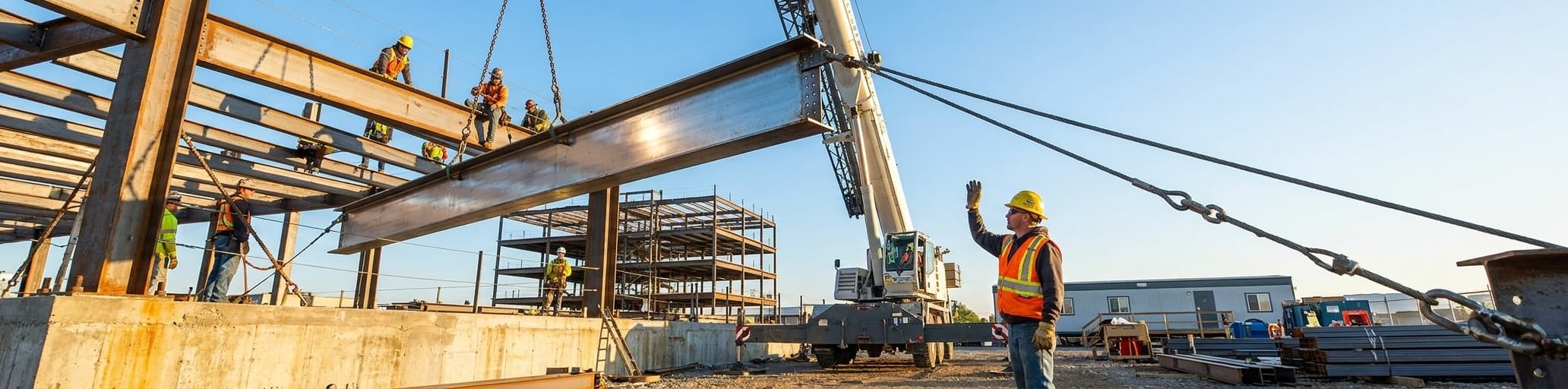

Finding the right local steel building contractor requires vetting engineering credentials, erection capabilities, communication protocols, and supply chain transparency before signing any contract. We help you identify hidden cost categories, red flags, and the structural differences between national-scale and locally accountable builders so your project stays on budget and schedule.
Why Local Vetting Matters More Than Location Alone
Hidden costs like permits, freight, and crane fees routinely turn a $50,000 quote into thousands more unless you vet your contractor against a local checklist first.
The Hidden Costs of Choosing the Wrong Contractor
The hidden costs in a steel building contract rarely appear on the first page. Foundations, permits, site prep, and unloading steel from the delivery truck are frequently excluded from the quote you see first — and a $50,000 package can balloon fast once you discover those gaps after you've already committed.[1] Engineering drawings, freight charges, and crane fees surface as line-item surprises only after you're locked in.[1] That pattern is predictable: exclusions are profit centers for suppliers, and the cheapest-looking quote almost always turns out the most expensive.[1]
Timeline exposure adds a second layer of cost. Permit reviews can run weeks to months depending on your municipality, project scope, and inspection backlog — delays that won't appear anywhere in an initial estimate.[1] Steel lead times shift with markets and freight schedules, and seasonal weather halts concrete pours and erection work without warning.[1] Without written milestones tied to payments — delivery on site, permit approvals, passed inspections — you carry all that schedule risk yourself.[1]
Site and code gaps drive a third category of loss most owners never anticipate. Skipping a soil test is one of the leading causes of foundation failure, and discovering poor soil conditions after breaking ground can force complete footing redesigns mid-project.[3] Failing to verify local zoning setbacks, use classifications, and height limits before signing can result in permit denial or costly modifications that no initial quote accounts for.[3] Choosing the wrong contractor means those issues surface after you've signed — not before. A practical starting point is the local metal building contractors vetting checklist, which walks through exactly what to confirm before any contract changes hands.[3]
What Separates National-Scale Contractors from True Local Partners
The distinction between a national-scale contractor and a true local partner comes down to three operational differences: supply chain control, subcontracting depth, and who answers when something goes wrong. National contractors carry broad inventories and can price competitively on large volume orders, but that scale introduces more potential failure points across the delivery chain and typically means less direct communication with your project team.[4] When a freight delay hits or a material substitution happens mid-build, you're competing for attention alongside dozens of other active projects.
The subcontracting layer is where quality control erodes without warning. When a general contractor brings in a subcontractor for erection, concrete work, or specialty installation, you lose direct oversight of that crew's standards and schedule commitment.[5] Subcontractors may not share the same motivation or alignment with your project that an in-house team would, and their priorities won't always match your timeline.[5] A contractor who controls critical scope in-house keeps quality and accountability under one roof — and one contract — rather than diffused across multiple companies with separate incentives.
Reputation is the final separator. Local and regional contractors build their business on community trust rather than anonymous order volume, which means a single failed project has real consequences for their next one.[4] That accountability produces a different level of responsiveness: faster answers, direct access to decision-makers, and a genuine willingness to solve problems rather than escalate service tickets.[4] National reach has its place for bulk material pricing, but for day-to-day coordination and issue resolution on your specific build, a contractor with real skin in the local reputation game is a structurally different kind of partner.
How Single-Source Solutions Reduce Your Risk
When design and construction are split across separate contracts, every handoff between teams creates a new exposure point — and the numbers confirm it.
Budget overruns affect 73% of traditionally delivered construction projects, driven by fragmented accountability between designers, contractors, and subcontractors who each have separate incentives and separate contracts.[6] A single-source contractor eliminates those gaps by placing design, engineering, fabrication, and erection under one agreement, which shifts the risk of coordination failures from you to the builder — who now has financial skin in solving problems rather than deflecting blame to another party.[7] That structure produces measurable outcomes: design-build delivery runs 102% faster and 4-6% less expensive than split-contract methods, with change orders cut by 6% because conflicts are caught during design, not after steel is on site.[6] For a steel building project specifically — where site prep, engineering stamps, material lead times, and erection sequencing all intersect — having one entity own every phase means your turnkey steel building contract protects your budget and timeline without requiring you to referee disputes between separate parties.[7] Contractors who also control fabrication in-house take that accountability even further: because they manage material quality, production schedules, and pricing at the source, you avoid the long-lead delays and cost fluctuations that hit owners whose builders depend on outside vendors.[7]
The Steel Building Contractor Vetting Checklist: 12 Critical Questions to Ask
Verify your contractor's engineer holds an active PE license in your state within two minutes using your state licensing board database.
Design and Engineering Credentials You Should Verify
Engineering credentials are the most consequential thing to verify before any contract discussion starts, yet most property owners skip straight to price.
Every steel building contractor you evaluate should work with a Professional Engineer (PE) who holds an active license in the state where your project will be built — not a neighboring state, not a lapsed credential, and not a multi-disciplinary stamp applied outside the engineer's area of expertise.[8] A PE stamp carries legal weight: when an engineer stamps your drawings, they accept full professional and legal responsibility for the structural accuracy of that design and its compliance with applicable building codes.[9] Without that stamp, your local building department will reject the permit application regardless of plan quality, which means delays, redesign costs, and a restart on your timeline.[8] Verifying an engineer's credentials takes under two minutes through your state's official licensing board database — search by name or license number and confirm the license is both active and issued for your specific jurisdiction.[8] Expiration dates matter as much as active status: PE licenses typically renew on one- to two-year cycles, and an engineer whose license lapses while your project is mid-build cannot legally stamp any revised drawings until renewal clears.[8] State regulations on stamping scope add another layer to check — many states restrict PEs from certifying work outside their defined field of practice, so confirm the engineer has specific experience with pre-engineered steel building systems, not just general structural work.[9] Non-compliance on any of these points produces the same result: permit rejection, potential fines, and in the worst case, legal liability that lands on you rather than the contractor who handed you uncertified drawings.[9]
Erection Capabilities and In-House vs. Subcontracted Labor
Steel erection is a distinct, regulated skill set — not a general construction task. It covers hoisting, laying out, placing, connecting, welding, guying, bracing, bolting, plumbing, and rigging structural steel members and joists.[10] When you're vetting steel building contractors near you, the first erection question to ask is blunt: does this crew do it themselves, or do they hand it off? A contractor who controls erection in-house has one team accountable for both schedule and quality. When erection is subcontracted, a general contractor must then supervise and ensure that separate company performs safely and to specification — adding a management layer between you and the workers actually raising your building.[11] Subcontractors report directly to the general contractor, not to you, which means communication gaps between you and the crew doing the structural work are built into the arrangement by default.[11]
The labor structure also determines who owns risk when the unexpected happens. A "labor only" arrangement means your erector supplies the workforce and equipment while you manage design prep, materials sourcing, budgeting, and timelines — the right fit only if you have experienced in-house staff accustomed to large-scale pre-engineered metal building design and tight schedules.[12] A "materials and erect" arrangement shifts that responsibility: your partner evaluates the design, value engineers where possible, coordinates timelines, and manages onsite job management.[12] For owners building a warehouse, hangar, agricultural facility, or retail space who want single-source accountability, a contractor who handles both material supply and erection keeps every variable under one contract — and one point of contact when problems surface.
Beyond contract structure, verify who holds the specific qualifications on-site during erection. OSHA requires that a competent person — defined as someone capable of identifying existing and predictable hazards who has authority to take prompt corrective action — conduct pre-shift visual inspections of all cranes used in steel erection activities.[10] A qualified rigger must separately inspect all rigging prior to each shift.[10] These aren't optional protocols; they're federal requirements with direct consequences for structural safety. If your contractor subcontracts erection, those qualifications belong to a third party whose schedule priorities may not fully align with yours. An in-house erection crew reporting to the same contractor you hired gives you one accountable party, one insurance chain, and one team that answers to the same contract you signed — every step of the way.
Communication Standards and Project Timeline Accountability
Communication protocols determine whether you're managing your contractor or your contractor is managing the project. Before any contract is signed, ask directly: who is your single point of contact, what's the update frequency, and what channel do you use when something changes on site.[13] Contractors who answer vaguely — 'we'll reach out when there's news' — are describing reactive communication, not project management.[15] What you actually need is a structured cadence: regular check-ins, written progress summaries, or a shared project dashboard that keeps you informed without requiring you to chase updates during high-stakes phases like permit review or steel erection.[14] The communication plan isn't a courtesy — it's the mechanism that lets you catch problems early enough to solve them without cost consequences.
The timeline discussion deserves the same rigor as the quote itself. A single completion date tells you almost nothing actionable; what you need is a phase-by-phase breakdown covering permit submission, material ordering, site prep, delivery, and erection — each with its own target milestone.[14] That structure gives you real accountability over the build sequence so that if permit approval runs long or a freight delay pushes delivery, you see the impact immediately rather than discovering it at the end when the schedule has already collapsed.[15] Ask specifically how the contractor handles schedule shifts: do they notify you proactively with a revised milestone plan, or do they absorb delays internally until the project is visibly behind?[13]
Change order handling is where timelines and budgets either hold or fall apart. Any scope adjustment — a door relocation, an added window opening, a grade change that affects foundation depth — should be documented in writing with an updated price and a revised timeline before a single additional hour of work begins.[15] Contractors who process verbal change orders create the conditions for budget disputes at the worst possible moment, typically when your steel is already on site and you have no leverage to push back.[13] A written change order process protects both parties, keeps your project within budget, and prevents the small decisions made mid-build from quietly eroding the cost certainty you negotiated at the contract stage.[14]
Common Pricing Traps When Comparing Local Steel Building Quotes
A 50% price difference between steel building quotes almost always comes down to scope coverage and local code requirements, not the structural package itself.
Why Your 40×60 Quote Might Be Half the Price of Another (And What That Means)
When two quotes on an identical 40×60 footprint differ by 50% or more, the gap almost always traces to three variables — and rarely to the one you'd expect. A kit-only price covers the structural package: primary framing, secondary framing, wall and roof panels, trim, base angle, anchor bolts, and erection drawings.[18] That's the skeleton.
The 2,400 square foot concrete slab, labor, permits, doors, windows, and insulation aren't on that invoice — and at $6 to $12 per square foot just for the slab pour, those exclusions eliminate the apparent savings fast.[16] Turnkey pricing bundles all of it into one number, which is why it runs significantly higher — but it's also the only number that reflects what you'll actually spend to walk into a finished, usable building.[16] Location compounds the gap further: labor rates shift dramatically across regions, and code variables like ground snow load, wind speed, and seismic exposure directly change the steel gauge the engineer must specify.[17] A 40×60 engineered for coastal Florida or the Mountain West carries a structurally different cost than the same footprint quoted to Southeast US baseline codes, because pre-engineered steel is never a catalog product with fixed pricing — every quote is site-matched to your location and intended use.[17] The 40×60 footprint is popular precisely because it serves so many applications, from workshops and agricultural storage to clear-span aviation hangars, and each use case can carry different load requirements that move the structural cost before a single accessory is added.[18] So when one contractor's number looks like half of another's, ask two direct questions: what scope does each quote cover, and which code loads is each building engineered to meet. Those two questions explain nearly every pricing gap you'll encounter.
Hidden Costs Contractors Often Leave Out of Initial Estimates
Labor is where initial quotes routinely mislead — and where your actual exposure is largest.
Labor typically accounts for 30% to 50% of total project budget, yet many contractors list it as a single blended number with no distinction between hourly and flat-fee arrangements, and no disclosure of potential overtime charges.[19] When hourly rates apply and erection runs longer than projected due to weather, access issues, or sequencing delays, those extra hours flow directly to your invoice without warning.[20] Equipment rentals follow the same pattern: specialized tools and lifting equipment that the contractor doesn't own get passed back to you as line items only after signing, at whatever daily rate the rental market supports at the time.[20] Material fees open a third category — waste factors, delivery surcharges, and mid-project material substitutions frequently surface as add-ons after the original material list is approved, each individually small enough to seem reasonable but collectively capable of moving the total meaningfully.[20] Two more categories almost never appear on a first quote: jurisdiction-specific taxes and service surcharges, which shift total cost in ways that vary by location and project scope[20]; and insulation, which contractors routinely list as optional even when the building will be heated or cooled.[19] Treating insulation as optional at quote time is a false economy — retrofitting a thermal barrier after steel is erected costs more than specifying it upfront, and the energy savings start the day you occupy the space.[19] Understanding which line items belong in the base quote versus which get added later is the fastest way to compare quotes on equal footing; the 40×80 metal building kit price breakdown illustrates exactly which accessory and labor items shift from optional at quote to essential at build — and how quickly they compound.[19]
How National Buying Power Affects Your Final Invoice
The purchasing structure behind your contractor's supply chain determines more of your final invoice than most owners realize.
Steel mills prioritize bulk orders, which reduces cost per ton but requires large fixed-batch quantities — contractors without that volume buy at retail rates and pass the difference directly to you.[4] When a contractor's material cost is lower because of purchasing volume, the margin pressure to inflate markup disappears, and those savings move to your quote instead of staying in their pocket.[4] But raw buying power alone doesn't protect your budget.
National-scale procurement introduces more potential failure points across the delivery chain — freight delays, material substitutions, and coordination gaps across dozens of active projects — and when those variables go wrong, the recovery costs surface on your invoice as change orders you never anticipated.[4] Foreign and distant sourcing compounds this: what looks like a low base material cost gets offset by freight charges, customs duties, port fees, warehousing, and buffer inventory that quietly erase the apparent savings before your steel ever arrives on site.[4] Shorter supply chains eliminate that exposure — regional delivery routes reduce transportation costs, cut lead times from weeks to days, and remove the tariff volatility that has made distant steel pricing increasingly unpredictable.[21] That's why 68% of U.S. manufacturers planned to increase domestic sourcing in 2025, specifically to recover cost predictability as global logistics costs climbed.[21] Many builders now use a hybrid approach — locking in bulk volume pricing on primary structural steel while sourcing secondary components regionally — to capture mill-tier cost efficiency without the lead-time and logistics risk of a fully national supply chain.[22] For your project, the right question isn't just whether your contractor has buying power — it's whether their supply chain converts that buying power into a lower number on your final steel building cost breakdown rather than absorbing it in freight surcharges, delay buffers, and substitution markups you only discover at invoice time.
Finding the Right Contractor for Your Steel Building Project: A Decision Framework
Ask your contractor to show a portfolio filtered by your specific building type, not total project count, to ensure their expertise matches your needs rather than charging you for their learning curve.
Assessing Contractor Experience with Your Specific Building Type
A contractor who has built warehouses hasn't necessarily built hangars, and one who specializes in agricultural storage may not understand the clear-span framing requirements of a retail space or the acoustically sensitive interior volume of a church. Asking directly what building types a contractor has completed — not just what they're willing to quote — tells you whether their expertise matches your project or whether you're paying for their learning curve.[23] Request a portfolio filtered by building type, not total project count: ten completed commercial structures doesn't confirm anything if you need a column-free aviation hangar with hydraulic bifold door framing.[23] The framing system a contractor uses is the next variable to probe, because it determines how much design flexibility you actually have.[24] A versatile framing system adapts to clear-span agricultural facilities with ventilation-specific eave heights, industrial buildings with overhead crane rails, or steel agricultural building contractors who need to sequence erection around harvest deadlines — but a contractor who works from a limited catalog of standard configurations will force your project to fit their system rather than the other way around.[24]
The most direct question you can ask is whether the building will be engineered specifically for your intended use and your location — not adapted from a standard template.[24] That distinction matters because load requirements shift by use case: an agricultural storage building needs different snow and wind resistance than a retail space in the same zip code, and a heated commercial workshop needs insulation specified at the engineering stage, not added as an afterthought.[24] Contractors with genuine experience in your building type will already know those variables; contractors without it will discover them mid-project. Ask specifically about prior work in your category, then verify it:
- What building types make up the majority of their completed projects?
- Can they show photos and references for a building matching your use case and approximate size?
- What load assumptions did they apply for that building type, and how did local code affect the design?
- Do they offer customization for your specific operational needs — door placement, eave height, insulation spec — or do you adapt to their standard package?[23]
- Was the engineering done in-house or stamped by a third-party PE unfamiliar with their framing system?[24]
Those five questions expose the gap between a contractor with genuine building-type experience and one who has simply built a lot of steel without differentiating between what each application actually demands.[23]
Red Flags That Indicate You Should Keep Looking
Most contractors who will cost you money signal it before you sign anything. The clearest red flag is refusal or hesitation when you ask for proof of licensing and insurance — a legitimate contractor produces those documents without pause because they have nothing to hide, and a contractor who redirects that request is telling you exactly what you need to know.[26] Demanding full payment upfront before any site work begins is a separate but equally reliable warning: responsible contractors use milestone-based payment schedules that tie disbursements to completed phases, not to your trust.[26] A vague or unsigned contract — one that leaves scope, materials, timelines, and change order processes undefined — creates the legal conditions for every dispute that follows, because without documented terms you have no footing when the work falls short or the invoice climbs.[27] Inability to provide a portfolio and at least one reference specific to your building type means you're funding their learning curve on your project.[27] And contractors who downplay permit requirements or suggest you might not need one are the most expensive mistake of all: unpermitted work can trigger stop-work orders, force demolition, generate fines, and render the structure uninsurable and unsellable.[26] Before you sign anything, run through the full-service agricultural building contractor checklist to confirm every credential and scope item is documented — the same verification logic applies whether you're building a warehouse, hangar, or farm structure. Five behaviors that mean you should keep looking:
- They can't produce an active state license and current certificate of insurance on request.[26]
- They require full upfront payment or an oversized deposit before breaking ground.[26]
- Their contract omits scope detail, material specs, milestone dates, or a written change order process.[27]
- They have no portfolio or references relevant to your specific building type and can't connect you with a past client.[27]
- They minimize permit discussions, suggest the project doesn't require one, or can't explain the code variables that apply to your site.[26]
Any single item on that list is reason enough to keep searching. A contractor who checks more than one is showing you a pattern — and that pattern produces cost overruns, schedule failures, and legal exposure, not a finished building.[26]
Why National Steel Buildings Delivers What Local-Only Contractors Cannot
The distinction matters most at the handoff points — the moments in a project where responsibility could slip between parties. Every metal building is custom-engineered to meet the building owner's needs, the site's conditions, and the local regulations that apply to that specific location, which means engineering, design, and coordination must be integrated from the first conversation, not assembled from separate vendors after a quote is accepted.[30] When those functions sit under one contract, the coordination gaps that derail split-contract projects — revised drawings that don't reach the erection crew, material substitutions that bypass the engineer, permits that stall because the stamping PE is in another state — disappear because every handoff happens internally, not between separate companies with separate incentives.[30]
The direct-to-manufacturer model eliminates the broker layer that adds cost without adding accountability. Buyers who search for steel building contractors near them routinely encounter middlemen who present supplier quotes as their own pricing — you pay the broker's margin without gaining any additional project control or service.[28] A contractor who manufactures and engineers in-house can lock in material costs at the point of order, protecting your budget from the steel price fluctuations that hit broker-dependent builders mid-project, because they control the supply chain rather than buying from it.[29] That structure also means when you ask a direct question about lead times, gauge specifications, or engineering revisions, the answer comes from the person who owns the decision — not from someone relaying information from a vendor they don't control.[30] The moment your order is placed, the engineering clock starts, and with in-house engineers building a complete project package from day one, your timeline doesn't stall waiting for a third party to get involved.[30]
The engineering process itself tells you whether a contractor is built to deliver or built to quote. A properly managed project follows a defined sequence: parameters confirmed, schedule agreed, structural calculations completed, drawings issued for permit, fabrication drawings released, and erection drawings delivered to the field — each step feeding the next with no gaps.[30] Contractors who skip steps or use assumptions to accelerate a project create the quality issues and time delays they were supposedly avoiding, and the rework costs land on your invoice, not theirs.[30] One point of contact, one contract, one team that owns every phase from site parameters to stamped drawings — that's what keeps your project within budget and on schedule, every step of the way.
- Hidden costs in steel building contracts–foundations, permits, site prep, freight, and crane fees–frequently balloon after signing.
- Design-build contracts run 102% faster and 4-6% cheaper than split-contract methods by eliminating coordination gaps between separate parties.
- Verify your contractor's engineer holds an active PE license in your state; without it, permit rejection and redesign costs are guaranteed.
- In-house erection teams eliminate subcontracting layers that erode quality control and create communication gaps between you and the crew.
- Quote gaps of 50%+ typically trace to scope exclusions (kit-only vs. turnkey) and code variables, not contractor pricing differences.
- Red flags that signal expensive mistakes: refusing to provide licensing/insurance, demanding full upfront payment, or minimizing permit requirements.
- One point of contact under a single contract protects your budget and timeline by placing design, engineering, fabrication, and erection accountability under one roof.
- https://metalprobuildings.com/steel-metal-buildings-what-you-need-to-know-before-signing-a-contract/
- https://buildway.com/steel-building-cost-breakdown-hidden-fees/
- https://titansteelstructures.com/metal-structure-tutorials/mistakes-to-avoid-when-purchasing-a-metal-building-a-complete-buyers-guide/
- https://www.servicesteel.org/resources/local-steel-suppliers-vs-national-or-foreign
- https://www.nibusinessinfo.co.uk/content/advantages-and-disadvantages-using-contractor-or-subcontractor
- https://cicconstruction.com/blog/single-point-of-accountability-how-design-build-delivery-eliminates-project-risk-across-multiple-markets/
- https://finfrock.com/how-design-build-construction-reduces-risk/
- https://permitcontainerhomes.com/pe-license-verification/?srsltid=AfmBOoqgm3EJiLqV6U6JJ8kZkQ-a-Wk6zKaMuSWrXed309uVBsXO9RxA
- https://edanbrook.com/blog/state-regulations-for-pe-stamping.html
- http://www.osha.gov/laws-regs/federalregister/2001-01-18-0
- https://forresterconstruction.net/general-contractors-vs-subcontractors-how-they-differ/
- https://fse-ok.com/labor-only-vs-materials-erect/
- https://www.steelcobuildings.com/questions-to-ask-a-building-contractor-before-starting/
- https://www.hswilliams.com/blog/what-questions-should-you-ask-a-pre-engineered-metal-buildings-contractor-before-signing-a-contract
- https://www.canaancompanies.com/6-questions-to-ask-before-hiring-a-general-contractor
- https://prometalbuildings.com/how-much-does-a-40×60-metal-building-actually-cost-in-2026/?srsltid=AfmBOorPXw1UlkDgPYdgdmS2wzkRFn_zmzd23V0qNjIBMajMifWo1kAu
- https://futurebuildings.com/blog/where-are-the-steel-building-prices.html
- https://www.factorysteeloverstock.com/metal-building-prices-by-size/
- https://metalprobuildings.com/how-to-save-money-when-buying-a-steel-building-pro-tips/
- https://asestimation.com/blogs/hidden-costs-in-estimating/
- https://www.netsuite.com/portal/resource/articles/erp/local-sourcing.shtml
- https://zhuzoor.com/bulk-buying-vs-local-sourcing-what-works-best-for-indian-builders/
- https://www.metalbuildingcompany.com/2025/06/30/choosing-the-right-metal-building-contractor/
- https://premierbuildings.com/top-9-questions-to-ask-when-choosing-a-prefab-metal-building-contractor/
- https://buildway.com/metal-building-supplier-accreditation-vetting-guide/
- https://luageneralconstruction.com/signs-of-a-bad-contractor/
- https://qebuildings.com/2025/09/how-to-find-a-metal-building-contractor/?srsltid=AfmBOooHULWkaRDoqhdCmiDwrtLIZrVqxXPx5uQ8mcNRDojVt0zL2Kgg
- https://www.garagejournal.com/forum/threads/steel-building-manufacturers-any-experiences.525499/
- https://armstrongsteel.com/locking-your-steel-order
- https://www.cecobuildings.com/blog/engineering-project-planning-and-execution/