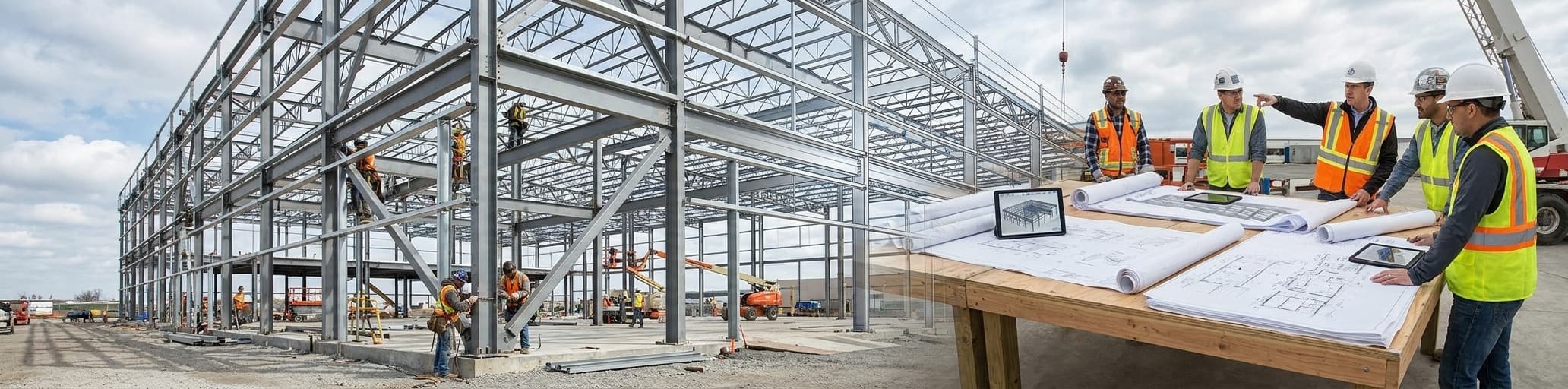

We help you understand how single-source contractors deliver faster timelines and lower costs than traditional general contractor models through parallel project phases and unified accountability. Choosing the right approach depends on your schedule pressure, budget constraints, and internal coordination capacity.
Why the Contractor Model Matters More Than You Think
Design-build construction completes projects 33% faster and cuts costs by 20% compared to traditional contracting by overlapping phases instead of sequential delays.
How single-source vs. general contractor approaches affect your timeline, budget, and final building qualityThe contractor model you choose locks in your risk profile before a single piece of steel ships. Research shows design-build construction — the structural backbone of the single-source model — completes projects 33% faster and delivers 20% in savings compared to traditional low-bid general contracting, while generating roughly half the claims and litigation. [2] That gap exists because of how work flows.
In a traditional model, design finishes, then bidding happens, then a contractor is selected, then construction starts — each phase waiting on the last. With a single-source approach to your commercial steel building construction, those phases overlap: procurement begins while engineering finalizes, and scheduling runs in parallel with design decisions rather than after them. [1] For a warehouse operator watching carrying costs accumulate, a church congregation running on a capital campaign deadline, or an aviation hangar developer with FAA coordination already in motion, that timeline compression isn't a nice-to-have — it's directly tied to how much the project ultimately costs.
If you're also trying to navigate local contractor vetting before committing to a model, the contractor structure is the first decision that determines every variable that follows.
The hidden costs of coordinating multiple vendors–and why they compound over 6-12 months
The hidden costs of multi-vendor coordination don't announce themselves — they accumulate quietly.
Budget overruns on commercial steel projects rarely trace back to one major mistake.
They compound from smaller failures: incomplete drawings that trigger change orders, scheduling gaps that push labor costs up, and misaligned expectations between separate suppliers, erectors, and engineers that generate rework nobody priced in. [3] A short delay on one trade stretches into weeks on another, and a single change order multiplies across multiple specialties. [3] The scheduling impact compounds separately — every additional day a project runs creates drag from extended lease overlap, delayed facility openings, increased financing and holding costs, and vendor rescheduling fees that never appeared in the original quote. [3] Steel projects carry specific exposure here: crane rentals, oversized-load transportation, and erection labor are each billed independently when vendors aren't unified, and all three are highly sensitive to schedule slippage. [4] Over a 6-to-12-month project window, the gap between your original budget and your final invoice widens every time a vendor handoff forces someone to stop, realign, and restart.
What 'single-source' actually means in commercial steel building construction
Most people use 'single-source' and 'design-build' as if they mean the same thing. They don't.
Design-build means one company holds a single contract covering both design and construction — but that company can still outsource engineering, fabrication, or erection to separate vendors working behind the scenes. [1] Single-source goes further: design, engineering, manufacturing, project management, and installation all stay under one roof, with no third-party dependencies running in parallel. [1] That gap matters more than it sounds. When a commercial steel building construction company outsources even one phase — say, structural engineering to an outside firm or erection to a subcontractor they don't directly employ — the handoff problems don't disappear.
They just hide inside what looks like a unified contract. [5] A true single-source provider controls every decision and owns every outcome, which means when a design adjustment is needed mid-project, the engineering, fabrication, and erection teams can realign immediately rather than waiting on external parties to reschedule and respond. [1] That's what eliminates the stop-and-restart cycles that quietly drain construction budgets — and it's why the distinction between 'single contract' and 'single source' is the first question worth asking any commercial steel building contractor before you commit.
Single-Source Steel Building Contractors: The Design-Build Advantage
Parallel design, procurement, and construction phases compress your timeline by eliminating the sequential delays that general contractor models routinely absorb.
Complete responsibility from concept to completion–who owns what and when
Real-world timeline comparison: Single-source vs. general contractor steel projects The timeline gap between single-source and general contractor steel projects is most visible in the transitions between phases — not within any single phase. In the general contractor model, your project runs sequentially: design completes, the project goes to bid, a contractor is selected, procurement begins, and only then does construction start.
Each phase must finish before the next can open, which can add months to your schedule before a single component ships. [8] With a single-source approach, those phases run in parallel — the same team developing your design is simultaneously planning procurement, scheduling erection, and coordinating site logistics. [1] That overlap directly compresses the front end of your timeline, cutting the idle weeks that GC-managed steel projects routinely absorb waiting on bids, selections, and vendor availability. [8] The difference sharpens further when a mid-project adjustment is needed. In a fragmented model, a field condition requiring a design change triggers a chain of external responses — your GC contacts the engineer, the engineer revises drawings, the fabricator adjusts the order, and the erection crew reschedules. [1] In a single-source model, that same adjustment moves through one internal team in days. [1] For a warehouse operator tracking carrying costs, a congregation on a capital campaign timeline, or an aviation hangar developer with FAA coordination already running, that's not a procedural detail — it's the difference between a project that finishes on schedule and one that doesn't.
How to Choose the Right Contractor Model for Your Commercial Steel Building
Choose a single-source contractor if you have a fixed timeline and budget, or a general contractor model if you have experienced staff to manage multiple vendor relationships.
Printable decision matrix: Single-source vs. general contractor fit for your project scopeThe right contractor model isn't universal — it depends on how much schedule risk you can absorb, how much coordination you want to manage personally, and how tightly your budget is fixed before ground breaks. Use the matrix below as a starting filter.
If your project conditions land mostly in the left column, a single-source commercial steel building construction company is the lower-risk path. If they land mostly in the right column, a general contractor model can work — provided you build in the coordination overhead it requires. [1]
| Project condition | Single-source fit | General contractor fit |
|---|---|---|
| Timeline pressure | Fixed opening date, capital campaign deadline, or FAA coordination already in motion | Flexible schedule with no carrying-cost exposure |
| Budget tolerance | Fixed budget with low change-order tolerance | Budget has contingency for coordination gaps and rework |
| Owner construction experience | First or second commercial build; limited vendor management bandwidth | Experienced developer comfortable managing multiple vendor contracts simultaneously |
| Design complexity | Custom engineering required (clear-span aviation hangar, large warehouse, church sanctuary) | Repeatable or simple structure with standardized specs |
| Accountability preference | Single point of contact from approved drawings to standing structure | Comfortable managing separate design, fabrication, and erection contracts |
| Mid-project adjustment risk | High — field conditions, foundation variances, or layout changes likely | Low — site is fully characterized and scope is locked before construction starts |
| Vendor coordination burden | Prefer one team that controls procurement, scheduling, and erection internally | Have in-house project management staff to bridge vendor handoffs |
Red flags that signal a contractor can't deliver on their promises
Most contractors reveal their reliability problems before a single permit gets pulled — you just have to know what to look for.
The clearest early signal is a vague or missing scope of work: if a contractor can't produce a written document that specifies materials, project phases, and deliverables before you sign, you have no legal footing when the job drifts off course. [10] Closely related is missing timeline language — any contract that uses phrases like "completed as soon as possible" without a defined start date, milestones, or a firm completion target gives you no recourse if your warehouse or hangar sits half-framed while carrying costs accumulate. [10] Payment behavior is equally telling: a demand for more than 20-30% upfront before work begins signals financial instability or a pattern of walking away from jobs, and contractors who operate cash-only without any digital payment trail compound that risk significantly. [11] Communication patterns before you sign are a direct preview of how a contractor manages mid-project problems.
If they're slow to answer specific questions about who will engineer your building, who employs the erection crew, or what their process is when a field condition requires a design change, that evasiveness doesn't improve once steel is in the air. [11] The overpromise pattern is subtler but consistent across bad actors: a bid that lands dramatically below every competing quote, a contractor who agrees to your timeline without asking a single question about site conditions or local snow and wind load requirements, or a verbal guarantee on workmanship that never makes it into writing. [11] These tactics exploit the sunk-cost dynamic — once you're committed and mid-project, you're far more likely to absorb change orders and cost overruns than restart with a new contractor. [11] Before committing to any commercial steel building construction company, verify that their license is current in your state, confirm in writing what warranty covers both materials and workmanship after installation, and ask directly whether the erection crew is on their payroll or sourced as a separate subcontract. [10] That last question separates a true single-source provider from a coordinator who looks unified on paper but hands your project off the moment steel ships — taking your accountability with it.
Questions to ask before hiring–and what answers separate competent operators from risky ones
Seven questions separate contractors who can deliver from ones who will cost you.
Start with experience and proof: ask how long they've worked specifically with steel structures, then request a portfolio backed by verifiable references — not just testimonials on their own website. [12] Third-party reviews on search engines and forums give you an unfiltered read on whether their timeline and quality claims hold up in the field. [12] Next, verify licensing and insurance directly — not just by accepting a certificate, but by confirming the policy is active with the carrier, since certificates can reflect expired coverage. [12] A commercial steel building construction company operating without a valid license in your jurisdiction may lose the legal right to collect payment through civil litigation in some states, which tells you something about who absorbs that risk if things go wrong. [12] Ask specifically about safety policies and quality control measures, including how they source materials and whether their workers hold current credentials. [12] Then ask the question most property owners skip: who employs the erection crew — your payroll or a subcontract?
That answer tells you immediately whether you're talking to a true single-source provider or a coordinator who will hand your project off the moment steel ships. [12] Finally, get a detailed written estimate with defined milestones, a firm completion date, and explicit warranty terms covering both materials and workmanship. [12] A bid that lands more than 15-20% below competing quotes on the same scope isn't a bargain — it signals scope omissions, suppressed labor rates, or intent to recover margin through change orders once you're too committed to walk away. [12]
- Design-build construction completes projects 33% faster and delivers 20% in savings compared to traditional low-bid general contracting models.
- True single-source providers control design, engineering, manufacturing, and installation internally, while design-build firms may outsource phases to separate vendors.
- Single-source models run project phases in parallel, while general contractor models run sequentially, eliminating idle weeks between design, bidding, and construction.
- Hidden budget overruns accumulate from incomplete drawings, scheduling gaps, and misaligned vendor expectations rather than single major mistakes.
- Red flags for unreliable contractors include vague scope documents, missing timeline language, demands for over 20-30% upfront payment, and bids 15-20% below competing quotes.
- Single-source delivery is optimal for time-sensitive projects with fixed budgets and owners lacking construction management expertise.
- Verify whether the erection crew is on the contractor's payroll or sourced as a subcontract to distinguish true single-source providers from coordinators.
- https://blog.legacybuildingsolutions.com/design-build-vs-single-source-construction
- https://www.webconmankato.com/blog/design-build-construction-versus-traditional
- https://plannorthpartners.com/hidden-costs-diy-commercial-builds/
- http://www.247pro.com/blog/hidden-and-ancillary-costs-in-steel-building-construction-what-you-need-to-know-before-starting-your-project
- https://www.alliedbuildings.com/industrial-design-build/
- https://blog.southwestbuildingsolutions.com/why-the-design-build-approach-creates-a-smoother-custom-metal-building-experience
- https://nationalsteelbuildingscorp.com/blog/summer-event-venues-steel-buildings-built-in-time
- https://www.hswilliams.com/blog/best-metal-building-company-vs-general-contractors
- https://www.elkayinteriorsystems.com/blog/the-benefits-of-a-single-source-general-contractor
- https://wfjlawfirm.com/red-flags-in-contractor-agreements-5-clauses-to-make-you-pause/
- https://vatterconstruction.com/blog/red-flags-to-look-for-in-a-contractor
- https://armstrongsteel.com/blog/key-questions-to-ask-before-hiring-commercial-metal-building-contractors