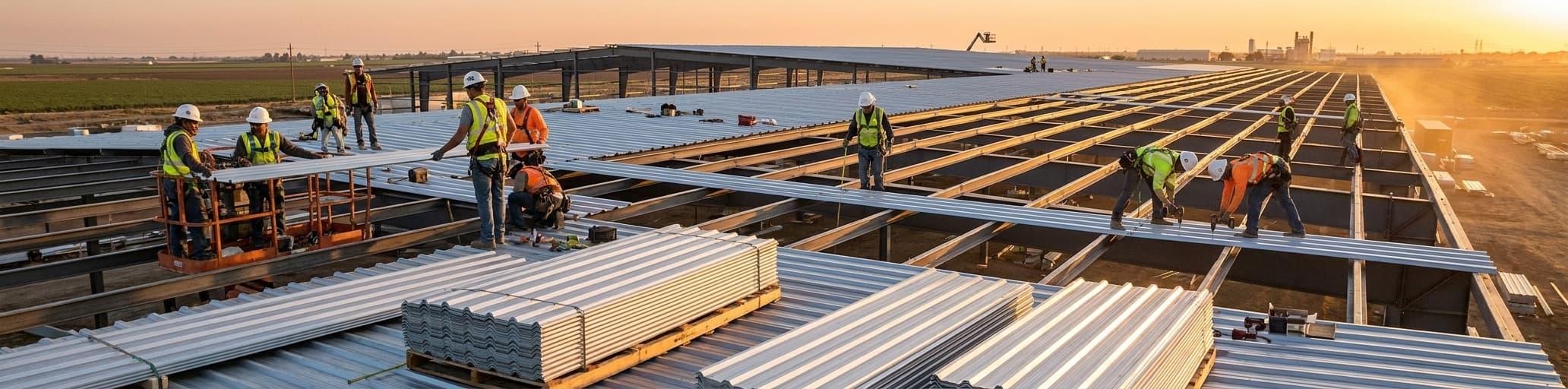

We help you understand corrugated metal roofing labor costs, which typically range from $3-8 per square foot depending on region, pitch, and complexity. Isolating labor from total project cost lets you compare contractor bids confidently and budget accurately before committing.
Labor cost to install corrugated metal roofing: 2026 regional rates
Labor typically accounts for 60% of your corrugated metal roof cost, ranging from $3-$8 per square foot depending on pitch, tear-off needs, and local market conditions.
National average labor rates: $3-$8 per square foot installed
Understanding the labor cost to install corrugated metal roofing starts with one important ratio: labor typically accounts for about 60% of the total project cost, averaging around $7,000 for a standard residential roof.[1] On a per-square-foot basis, total installed prices for corrugated metal panels run $3.50-$15, meaning the labor portion alone lands in the $3-$8 per square foot range for most straightforward projects.[2] That's a wide band, and the spread exists for good reason. A low-pitch warehouse roof with simple corrugated panels on a clean deck sits near the bottom. A steep residential pitch requiring safety rigging, old roof tear-off, and new underlayment pushes toward the top. For commercial and agricultural owners comparing bids, the metal roof installation cost breakdown is worth reviewing before you accept any quote. One useful benchmark: a 1,500 sq ft metal roof runs $13,500-$36,000 installed, or $9-$24 per sq ft all-in — factoring in materials, labor, tear-off, and any decking repairs needed before panels go down.[3] Isolating labor from that total gives you the clearest way to compare contractor bids side by side, since material costs are largely fixed by gauge and profile.
| Roof size (sq ft) | Total installed range | Implied labor at 60% |
|---|---|---|
| 1,000 | $4,000 – $30,000 | $2,400 – $18,000 |
| 1,500 | $13,500 – $36,000 | $8,100 – $21,600 |
| 2,000 | $12,000 – $90,000 | $7,200 – $54,000 |
Keep in mind these totals include materials. Corrugated panels sit at the affordable end of the metal roofing spectrum, which is why they remain a go-to choice for warehouses, barns, and agricultural facilities where budget compliance matters as much as durability.
Regional labor cost breakdown: Northeast, Midwest, South, and West
Region alone can swing your metal roofing bill by 20%-40%, driven by local wage standards, material shipping distance, and how competitive your local contractor market is.[4] The Northeast and West Coast consistently run highest, with total installed steel roofing costs reaching $18-$25 per square foot — labor represents roughly 60% of that figure, putting the labor share at approximately $10.80-$15.00 per square foot in those markets.[4] The South and Midwest land in the $14-$20 per square foot installed range for comparable projects, meaning labor alone runs $8.40-$12.00 per square foot.[4] A single real-world example makes the gap concrete: the same 2,000 sq ft steel roof costs around $35,000 in New York City but only $24,000 in Tennessee — an $11,000 difference on identical materials.[4] Corrugated panels sit at the affordable end of the metal roofing spectrum at $7-$12 per square foot installed nationally, so regional labor rates for corrugated will fall below the benchmarks in the table below, which reflect metal roofing broadly.[4]
| Region | Installed cost per sq ft (steel roofing) | Implied labor at ~60% |
|---|---|---|
| Northeast | $18 – $25 | $10.80 – $15.00 |
| West Coast | $18 – $25 | $10.80 – $15.00 |
| Midwest | $14 – $20 | $8.40 – $12.00 |
| South | $14 – $20 | $8.40 – $12.00 |
For corrugated specifically, apply a downward adjustment from these figures — corrugated panels require less precision per panel and no concealed fastener work, which reduces the skilled-labor premium relative to standing seam or other profile types.[4] If you're in the Northeast or West Coast and comparing bids for a warehouse or agricultural facility, expect your corrugated labor quotes to land closer to $5-$8 per square foot rather than the $10-$15 seen with premium metal profiles. Southern and Midwestern owners typically see corrugated labor in the $4-$7 range, which is one reason large-footprint farm and industrial builds in those regions remain cost-effective to roof in steel. Reviewing a durable metal roofing cost per square foot breakdown before soliciting contractor bids gives you a regional anchor to spot quotes that are out of line before you sign anything.
How material type and roof complexity affect labor pricing
Panel profile and fastener system are the two material variables that most directly move your labor line.
Corrugated exposed-fastener panels sit at the affordable end of the installation spectrum — $3.50-$15 per square foot installed — partly because crews work faster: each screw is visible, placement is straightforward, and no specialized tooling is required for concealed clips.[2] Switch to standing seam, and installed costs jump to $7-$30 per square foot, largely because hidden-fastener systems require slower, more precise placement.[2] The spread between those two profiles creates a 30%-50% labor premium for concealed-fastener work over exposed-fastener work.[2] Metal gauge adds another layer: 29-gauge panels (the thinnest common option) run $4-$10 per square foot installed, while 22-gauge panels reach $20-$30 per square foot — thicker steel is harder to cut, bend, and fasten, which increases time on the roof.[2] Roof complexity compounds every material variable.
A hip roof or a design with dormers and bump-outs costs 15%-25% more than a straightforward gable of equal square footage, because more cuts, more flashing details, and more repositioning are required.[2] Pitch amplifies the effect further: steeper roofs add 15%-35% to the labor figure on any profile type, since crews move slower, safety rigging requirements increase, and material staging becomes more difficult.[2] Put those multipliers together on a corrugated job — steep pitch plus a hip-roof layout — and a base labor rate of $4 per square foot can realistically climb past $6 before a single regional wage factor is applied.
What Drives Corrugated Metal Roofing Labor Costs Up or Down
Steep slopes and irregular roof geometry can double installation time and costs, but larger projects spread fixed mobilization expenses across more square footage, lowering your per-square-foot price.
Roof pitch, size, and structural complexity impact on labor hours
Pitch and structural layout are the fastest ways to turn a straightforward corrugated install into a multi-day project. On a simple, low-slope roof, a crew works quickly and repositions rarely — but steep or complicated roofs can double the total installation time compared to that baseline.[5] The doubling effect comes from three compounding factors: slower movement on pitched surfaces, increased safety rigging time, and the extra cuts required wherever the roof geometry changes direction.
Structural complexity amplifies material waste too. Roofs with multiple hips, valleys, dormers, skylights, or abrupt direction changes require more trim pieces and generate higher panel waste per square foot, which means crews spend a larger share of their hours fitting and finishing rather than laying field panels.[6] A corrugated installation on a complex commercial or agricultural structure can push total installed costs into the $15-$28 per square foot range once steep slopes and irregular geometry stack together.[5] Roof size interacts with all of this differently than most owners expect: a larger roof doesn't reduce the pitch or complexity premium on a per-square-foot basis, but it does spread fixed mobilization costs — crew travel, equipment staging, material delivery — across more square footage, which is why a 10,000 sq ft warehouse roof typically shows a lower installed cost per square foot than a 2,000 sq ft residential job with identical slope and panel type.[6]
Local contractor availability and regional wage standards
Beyond broad regional bands, the density of roofing contractors in your specific labor market may move your quote more than any other single variable.
The Bureau of Labor Statistics tracks roofing wages at the state and metropolitan area level, and the geographic spread is wide: top-paying states and metros show wage rates well above the national mean, while high-concentration states with deep roofing labor pools tend to keep hourly rates more competitive.[8] In practical terms, a rural owner in a low-contractor-density county faces a thinner bid pool — often two or three roofers rather than six or eight — which limits price competition and can add $1-$2 per square foot to corrugated labor quotes regardless of what regional averages suggest.[7] Urban and suburban markets with high roofing employment levels generate more competitive bidding, which pushes installed prices toward the lower end of the regional range.[8] One actionable way to gauge whether you're in a competitive or thin market: if fewer than three licensed metal roofing contractors return calls within five business days, treat your project as a constrained-supply job and budget at the upper end of your region's corrugated labor range.[7] Seasonal availability compounds scarcity — peak roofing season in any region reduces contractor availability even in otherwise well-supplied markets, which is why scheduling your corrugated installation outside summer peak periods routinely saves 10%-15% on labor without changing a single panel specification.[9]
Permitting, inspections, and site preparation costs factored into labor
Permits and inspections are the most common line items missing from corrugated metal roofing labor quotes — and the omission is standard practice, not a contractor oversight. Most base labor estimates explicitly exclude permit fees, inspection charges, and dump fees for old roofing material removal, meaning regulatory costs are borne separately by the property owner.[10] Site preparation labor, by contrast, is generally included: the base quote typically covers labor for site setup and the actual installation work, but stops short of covering any fees that flow to a municipality or waste hauler.[10] What this means practically is that your corrugated labor quote and your total out-of-pocket cost are two different numbers.
To close that gap before you commit, any detailed service agreement should itemize site preparation, material delivery, removal of the former roofing, and any regulatory requirements as separate line items.[11] Failing to separate these costs at the bid stage routinely produces budget surprises at the permit desk or the dumpster pickup — both of which arrive after the crew has already mobilized. The most reliable way to prevent that is to request a written cost breakdown that distinguishes installation labor from permit-and-inspection fees and from waste disposal charges, so each bucket can be verified against local requirements independently.[10]
How to Bid a Metal Roofing Job: Labor Rate Estimates and Estimation Framework
Multiply your roof's footprint by the pitch multiplier, add 10% for waste, then apply your regional labor rate to get an accurate baseline bid before complexity adjustments.
Step-by-step calculation: square footage, pitch multiplier, and regional rate
The formula for estimating corrugated metal roofing labor has four inputs: footprint area, pitch multiplier, waste factor, and regional labor rate. Start at ground level — measure the building's length and width, then multiply to get the footprint in square feet.[12] From there, apply the pitch multiplier that matches your roof slope to convert footprint into true roof surface area, since a 9:12 pitch roof has roughly 25% more surface than its footprint suggests.[12] Add 10% to the result to account for cutting waste, panel overlaps, and minor errors.[12] Finally, multiply the adjusted square footage by your regional corrugated labor rate — typically $4-$7 per square foot in the South and Midwest, $5-$8 in the Northeast and West Coast — to isolate the labor dollar figure before any complexity adjustments.[12]
Pitch multipliers are fixed ratios derived from roof geometry, so they apply regardless of panel type or region.[13] The table below covers the full range of common slopes:
| Pitch (rise:run) | Multiplier |
|---|---|
| 2:12 (low slope) | 1.014 |
| 4:12 (low-moderate) | 1.054 |
| 6:12 (moderate) | 1.118 |
| 8:12 (moderate-steep) | 1.202 |
| 9:12 (steep) | 1.250 |
| 12:12 (very steep) | 1.414 |
To make the formula concrete: a 2,000 sq ft footprint with a 6:12 pitch gives you 2,000 x 1.118 = 2,236 sq ft of true roof area.[12] Add the 10% waste factor and you're estimating material and labor coverage for 2,460 sq ft.[12] At a Midwestern corrugated labor rate of $5 per square foot, that's $12,300 in labor alone — before any steep-pitch premium, complexity multiplier, or permit fee enters the calculation.[13] Running through all four steps before soliciting bids gives you a hard reference number so you can spot immediately whether a contractor's quote is in the expected range or whether it reflects a misread of scope.
Installation timeline: how long does it take to install a 2,000 sq ft metal roof
For a standard 2,000 sq ft structure, a professional crew installs a corrugated metal roof in 1-3 days under straightforward conditions — though other metal roofing types, such as standing seam, typically run 2-5 days for the same footprint due to the precision fitting required around edges, vents, and penetrations.[14] The 1-3 day baseline assumes a simple roof geometry, no underlying deck damage, and favorable weather.[15] Five variables can compress or extend that window significantly:
- Roof pitch and layout — steep slopes and complex geometry with multiple hips, valleys, or dormers slow crew movement and add cutting time, stretching a one-day corrugated job to two or more days.[14]
- Deck condition — if tear-off reveals rotted or damaged sheathing, replacing even a few sheets adds hours; widespread deck damage can push the project back by half a day or more.[16]
- Weather interruptions — rain, high winds, or extreme heat stop work entirely; crews tarp open sections and resume when conditions clear, adding hours to days depending on the forecast.[14]
- Crew size and experience — an experienced, well-coordinated crew working in good conditions completes roughly 20-30 squares (2,000-3,000 sq ft) per day on metal; a smaller or less familiar crew works proportionally slower.[16]
- Permit and inspection sequencing — municipalities that require a mid-project inspection can add a half-day or full-day hold between tear-off and final panel installation, regardless of how fast the crew works.[15]
The practical takeaway: budget 2-3 days for a 2,000 sq ft corrugated metal install on a moderate-pitch, straightforward gable roof with a clean deck. Add a full buffer day if pitch exceeds 8:12 or if the existing roof has never been removed. For commercial or agricultural buildings with larger footprints — 10,000 sq ft or more — expect one to two weeks of scheduled installation time.[14]
Cost estimation tool: Estimates for corrugated metal roofing labor
The most practical budgeting formula for corrugated metal roofing breaks total project cost into three buckets: material costs, labor costs, and other project costs — permits, disposal, and underlayment.[17] For corrugated panels specifically, materials account for roughly 60% of total project cost and labor accounts for approximately 30%, with permits adding $200-$500 as a separate line item.[18] Applied to 2026 national pricing, corrugated metal roofing installation adds $3-$5 per square foot in labor alone, producing an all-in installed range of $11-$19 per square foot when materials are included.[18] The table below converts those rates into dollar figures at four common project sizes, providing a pre-bid anchor before any regional or complexity adjustment is applied.
| Project size (sq ft) | Labor at $3/sq ft | Labor at $5/sq ft | Total installed (low) | Total installed (high) |
|---|---|---|---|---|
| 1,000 | $3,000 | $5,000 | $11,000 | $19,000 |
| 2,000 | $6,000 | $10,000 | $22,000 | $38,000 |
| 5,000 | $15,000 | $25,000 | $55,000 | $95,000 |
| 10,000 | $30,000 | $50,000 | $110,000 | $190,000 |
Permit and inspection fees ($200-$500) and waste disposal charges sit outside these figures as separate owner-borne costs, since most labor quotes exclude regulatory fees by default.[17] The type of metal used in a roofing system also significantly affects cost, and regional labor rates will shift these totals — Northeast and West Coast projects trend toward the upper boundary of the $3-$5 labor band, while South and Midwest corrugated jobs typically settle near the lower end.[17] Single-source vs. fragmented roofing: why turnkey solutions simplify labor costs
Turnkey steel building solutions eliminate contractor coordination overhead
When corrugated metal roofing is sourced through separate vendors — one for panels, one for erection labor, one for underlayment and flashing — every handoff creates a gap where scope disputes, scheduling conflicts, and budget surprises accumulate.
Turnkey metal building construction eliminates that fragmentation by placing design, fabrication, and erection under a single contract, meaning one team owns the entire outcome from the first drawing to the final fastener.[19] Pre-engineered metal buildings arrive with precise specifications already resolved, removing the cost overruns and timeline delays that are common with multi-vendor approaches where no single party controls scope boundaries.[20] Installed turnkey steel buildings run $24-$43 per square foot covering the kit, concrete slab, delivery, and construction — a bundled figure that's directly comparable to fragmented quotes only when every line item in both is accounted for.[21] The practical benefit is bid clarity: one contract number covers everything, so you're not reconciling four separate invoices or mediating between a panel supplier and a roofing crew disputing who is responsible for the ridge cap.
In-house erection labor reduces bid variability and delays
In-house erection crews change the risk profile of a corrugated metal roofing project in a specific way: when the same organization that designed and fabricated the building also employs the crew installing it, there's no margin for interpretation errors between shop drawings and field work.
Partnering with professionals who specialize in metal building erection and prefabricated steel systems delivers faster timelines and lower maintenance costs over the building's life — not as a marketing claim, but because scope ambiguity between fabricator and installer is structurally eliminated.[19] Steel building frames can be erected in days rather than weeks, directly reducing overall project costs while minimizing weather-related delays that would otherwise idle a separately contracted crew.[20] That speed advantage compounds on roofing specifically: a crew familiar with the exact panel system being installed works faster, generates less cutting waste, and encounters fewer mid-project surprises than a general roofing contractor interpreting a spec sheet for the first time on your job site.
National buying power and pre-engineered design lower total installed costs
ProTrades erection division: in-house labor reduces bid variability and delays The budget gap between an original corrugated metal roofing bid and the final invoice rarely comes from materials — it comes from back charges.
Back charges are costs generated when a subcontractor performs defective work, fails an inspection, or requires rework, and those costs get passed up or down the contract chain depending on who absorbs them.[22] In fragmented roofing arrangements, a general contractor sourcing installation labor separately from the panel fabricator creates exactly the conditions where back charges accumulate: one party owns the product specification, another owns the installation, and neither fully controls the interface between them.
Construction contingencies — the funds set aside to cover unforeseen subcontractor issues — typically run 5% to 10% of total project budget, meaning a $100,000 corrugated roofing project carries $5,000-$10,000 in contingency exposure before a single panel is lifted.[22] When an erection crew works for the same organization that designed and fabricated the building system, that contingency exposure shrinks structurally: scope ambiguity between shop drawings and field work disappears, inspection failures tied to material-installation mismatches are eliminated at the source, and there is no separate subcontractor relationship through which back charges can travel.[22] The practical result is a tighter bid, fewer mid-project surprises, and a final invoice that lands closer to the number you agreed to at contract signing — which is the budget compliance outcome that matters most on commercial, agricultural, and industrial corrugated roofing projects.
National buying power and pre-engineered design lower material-labor interface costs
Pre-engineered components manufactured to CNC precision arrive on site with material waste below 3%, compared to the 15-20% waste typical in conventional construction — and that gap matters directly to labor costs because every miscut or ill-fitting panel translates into crew hours spent reworking rather than installing.[25] Factory-controlled assembly reduces total on-site labor hours by 40-60% versus stick-built methods, with bolted steel connections installing 70% faster than field-welded joints, which is where a large share of corrugated roofing labor cost originates on non-engineered projects.[25] Prefabricated metal building costs land 20-40% below traditional construction precisely because these efficiencies compound: reduced material waste, shorter on-site time, and fewer skilled-labor hours produce a structurally lower total installed figure rather than a negotiated discount.[24] The distinction between a true manufacturer and a broker amplifies this further — a broker resells another company's design, introducing a communication layer between the entity that specified the components and the crew installing them, which recreates exactly the interface friction that pre-engineered systems are designed to eliminate.[23]
- Labor typically accounts for 60% of total corrugated metal roofing costs, ranging from $3-$8 per square foot depending on project complexity.
- Regional variation significantly impacts pricing: Northeast and West Coast labor costs $10.80-$15.00 per sq ft, while South and Midwest run $8.40-$12.00 per sq ft.
- Roof pitch and structural complexity can increase labor costs by 15-35% for steep slopes and 15-25% for complex layouts like hip roofs with dormers.
- A standard 2,000 sq ft corrugated metal roof installation takes 1-3 days under straightforward conditions but extends significantly with deck damage or steep pitches.
- Contractor market density matters more than broad regional averages: rural areas with fewer than three available contractors typically cost $1-2 more per sq ft.
- Permits, inspections, and waste disposal fees are excluded from most labor quotes and typically add $200-$500 as separate owner costs.
- Turnkey metal building solutions with in-house erection crews reduce bid variability and back-charge exposure by eliminating scope ambiguity between fabricator and installer.
- https://www.homeadvisor.com/cost/roofing/metal-roof-installation/
- https://www.angi.com/articles/how-much-does-metal-roofing-cost.htm
- https://paccsolutions.com/blog/metal-roof-cost-per-sqft/
- https://roofquotes.com/blog/metal-roof-cost
- https://sqpanel.com/blog/metal-panel-cost-guide-factors/
- https://randeroofing.com/blog/metal-roof-cost-nj/
- https://www.westernstatesmetalroofing.com/metal-roof-cost
- https://www.bls.gov/oes/2023/may/oes472181.htm
- https://jagmetalsllc.com/blog/how-much-does-a-metal-roof-cost/
- https://planner5d.com/costs/cost-of-metal-roofing
- https://tomleeroofingsanf.com/metal-roofing-cost/
- https://roof-installation.com/metal-roof-cost-calculator/
- https://www.roofslopecalculator.com/pitch-roof-cost-calculator/
- https://leveledgeco.com/metal-roof-installation-time/
- https://www.honestaberoofing.com/orlando-fl/about-us/blog/2025/june/how-long-does-it-take-to-roof-a-2000-sq-ft-home-in-orlando-fl
- https://www.nestexteriors.com/knowledge-center/how-long-does-it-take-to-replace-a-roof
- https://apcroofing.com/how-to-calculate-the-cost-of-a-metal-roof-for-your-home/
- https://barrierbossusa.com/blogs/news/metal-roofing-cost-usa-2026-your-complete-price-guide-savings-breakdown?srsltid=AfmBOopLCdmUT8MVSZ_Cc0y8gEmdhVevKORFPfHX1J90gYK_R8ynKvyv
- https://www.metalbuildingcontractorsnearme.com/metal-building-construction-contractor/
- https://americanwesternsteel.com/the-real-cost-of-steel-buildings-in-fort-worth-texas/
- https://www.buildingsguide.com/metal-building-prices/?srsltid=AfmBOopQ6UcUZhl0Bx2qbhFMPT5bvkh3SY6tdZD51M-uhELjgw90XUQo
- https://fse-ok.com/back-charges-change-orders/
- https://armstrongsteel.com/blog/how-to-compare-pricing-on-pre-engineered-metal-buildings
- https://www.panelbuilt.com/blog/prefab-metal-building-prices/
- https://www.prefabsteelpro.com/blog/what-cost-saving-benefits-do-prefabricated-steel-structure-buildings-have