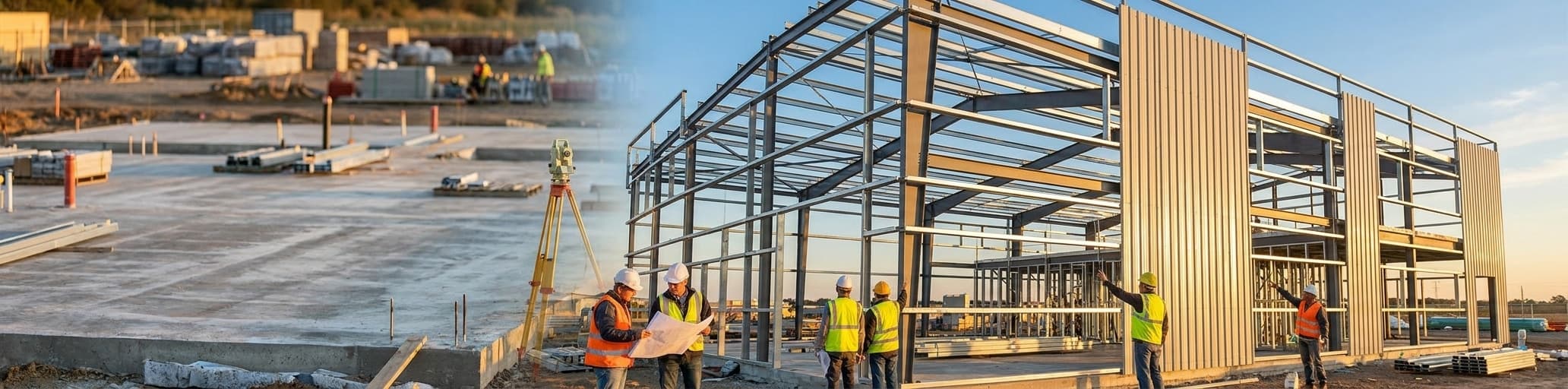

We help you understand metal building costs from $25-$40 per square foot for steel shells to $100-$300 fully installed, accounting for size, location, and customization. Turnkey single-source contracts protect your budget by consolidating coordination and eliminating the hidden costs that typically derail first-time builders.
Metal Building Cost Per Square Foot: 2026 Pricing Breakdown
Budget $100-$300 per square foot for a fully installed metal building, though steel shell alone costs just $25-$40, with site work and labor driving the actual expense.
Current average cost range for metal buildings in 2026
Metal building construction cost per square foot in 2026 splits into two distinct numbers depending on what you're actually pricing. The steel shell alone — framing and panels, nothing else — runs $25-$40 per square foot.[1] Add site preparation, a concrete foundation, and interior finishes, and the fully installed cost climbs to $100-$300 per square foot.[1] That wide range isn't vagueness; it reflects genuine variability across building size, regional labor rates, local code requirements, and the level of finish your project demands.
A bare agricultural storage structure lands near the low end; a climate-controlled commercial facility with electrical, plumbing, and insulated metal panels pushes toward the top. The practical takeaway: never benchmark your budget against a kit price alone.
The steel package is typically the most predictable line item — site work, permitting, and labor are where budgets routinely come apart for first-time builders.[1]
Why metal buildings cost less than traditional construction methods
The cost gap between steel and traditional construction is widest at the materials stage. Wood framing runs roughly $35 per square foot before any siding or brickwork, and concrete can reach $50 per square foot.[2] Steel building kits for commercial use, by contrast, land in the $10-$25 per square foot range for materials, with installation adding another $10-$20 per square foot.[2] For a 10,000-square-foot structure, that difference is stark: comparable wood construction runs $350,000-$500,000 and concrete $500,000-$700,000, while a pre-engineered steel building of the same size typically comes in at $120,000-$250,000.[2] Pre-engineering is the mechanism behind those savings — components arrive at the jobsite pre-drilled and pre-assembled, which means fewer workers accomplish more in less time and material waste is eliminated before the first bolt is turned.[2]
The savings compound over time through dramatically lower maintenance obligations. Steel resists pests, moisture, and rot, keeping annual upkeep to roughly 1% of the initial build cost — about $1,500-$2,500 per year on a 10,000-square-foot facility.[2] Wood and concrete buildings demand 2-4% annually, or $7,000-$20,000 for a structure of the same size, and that figure excludes surprise events like termite remediation, which can add $30,000 in a single incident.[2] Add energy efficiency into the equation — insulated metal panels cut heating and cooling costs by 10-20%, saving an estimated $2,000-$5,000 per year versus $1,000-$2,500 for traditional construction — and the 20-year total cost picture becomes decisive: approximately $350,000 for steel versus $670,000-$1.1 million for wood or concrete over the same period.[2]
How National Steel Buildings' single-source model reduces total project costs
Single-source accountability is the mechanism that prevents the coordination failures most responsible for budget overruns.
In traditional construction delivery, owners contract separately with designers and contractors, which requires coordination between independent parties and routinely produces scheduling conflicts, change orders, and accountability disputes when something goes wrong.[4] Design-build consolidates both services under one contract with a single responsible party, and that integration typically results in faster project delivery, reduced costs, and fewer coordination issues since one team manages the entire process.[4] For metal building projects specifically, a turnkey single-source structure saves time and money directly by reducing coordination overhead and eliminating delays caused by waiting for supplies or subcontractors to align.[4] Because labor is managed by a single team rather than parceled across multiple independent contractors, labor costs become accurately budgeted rather than unpredictably variable.[4] The result is one contract, one point of contact, and complete accountability from concept through completion — closing the gaps where metal building construction cost per square foot most often climbs beyond initial estimates.
If you want a deeper look at where those turnkey steel building advantages show up in real project budgets, the numbers speak clearly.[4]
Key Factors That Affect Your Metal Building Cost Per Square Foot
Doubling your building size from 2,500 to 10,000 square feet can reduce your per-square-foot cost by 15-25% because fixed expenses like engineering and permitting spread across more area.
Building size and how economies of scale impact pricing
Building size is the most reliable lever for reducing metal building construction cost per square foot. The reason is straightforward: fixed costs — engineering, permitting fees, crew mobilization, and equipment — stay largely constant regardless of footprint. Spread those costs across more floor area and each square foot absorbs a smaller share.[5] Buildings above 10,000 square feet typically run 15-25% lower per square foot than comparable structures under 2,500 square feet.[5] The table below shows installed shell costs (building package, foundation, and erection) by common size in mid-cost U.S. markets for 2026 — these figures exclude insulation, MEP systems, interior finishes, and site work.[5]
| Building size | Square footage | Installed shell cost per sq ft |
|---|---|---|
| 30×40 | 1,200 sq ft | $34-$42 |
| 50×100 | 5,000 sq ft | $28-$36 |
| 100×100 | 10,000 sq ft | $25-$33 |
| 100×200 | 20,000 sq ft | $22-$30 |
A 30×30 (900 sq ft) or 40×60 (2,400 sq ft) structure falls near the 1,200-square-foot tier, meaning installed shell pricing typically lands at the higher end of that $34-$42 range — because mobilization and engineering overhead compress down to fewer total square feet.[5] A 2,000-square-foot building follows the same logic: expect shell pricing close to or slightly above the 1,200-square-foot benchmark rather than the more favorable rates that kick in above 5,000 square feet.[5] For large commercial and industrial projects at 40,000 square feet and above, the scale advantage widens further — procurement leverage, crew productivity on repetitive framing bays, and reduced per-unit coordination complexity all compound simultaneously.[5] If you're comparing options across size ranges, the industrial warehouse cost breakdown by size shows how those per-square-foot differences translate into real total-project numbers at scale.
Site location, local codes, and regional labor availability
Where you build is often the single biggest variable outside of building size itself. Labor rates alone can swing up to 60% across U.S. regions — the same erection crew that charges $5 per square foot in rural Tennessee may bill $12 per square foot in coastal Florida or a major metro market.[6] That gap compounds fast on a 5,000-square-foot project. Freight distance from the manufacturer adds another line item that inland buyers rarely anticipate but coastal and remote buyers feel immediately.[7] General contractors tack on 10-20% over baseline project costs, but in tight labor markets — where roughly 94% of contractors report difficulty filling skilled positions — selective bidding means fewer competitive quotes and higher effective rates.[6]
Local building codes translate directly into steel tonnage. A structure engineered for Southern Alberta's snow loads requires fundamentally different framing than one built in the Texas Panhandle, and the material difference shows up in your quote before the first bolt ships.[7] In wind-exposed coastal zones like Florida or North Carolina, stricter load requirements add a 15-25% premium over comparable inland builds — a standard 30×40 installed in Oklahoma typically lands at $16,000-$23,000, while the same footprint on the North Carolina coast routinely costs more before any finish work begins.[6] High-seismic zones carry their own engineering uplift. If your jurisdiction has adopted the 2024 International Building Code, the new ASCE 7-22 tornado provisions for certain Risk Category buildings require heavier steel components and more complex connections in tornado-prone areas, which adds material cost before you've made a single customization decision.[6] Permit fees range from $550 to $2,000 in most markets but climb as high as $7,500 in larger cities, and that figure covers only the permit itself — not the engineering drawings required to pull it.[6]
Customization features: doors, windows, insulation, and roof systems
Every design upgrade moves your metal building construction cost per square foot in one direction. Specific line items make the math concrete: windows run approximately $200 each, and overhead doors reach up to $800 per unit.[6] A straightforward kit with one walk-in door and one overhead door stays predictable, but adding multiple windows, a second overhead door, and a steep roof pitch introduces engineering complexity that raises both material and labor costs.[9] Roof style is its own cost driver: vertical roofs deliver better drainage and leak resistance but sit at the top of the price range, while a standard boxed-eave profile runs roughly 14% cheaper.[6] Steeper pitches in the 3:12-5:12 range demand more steel and more engineering time than shallower 1:12 or 2:12 pitches.[6] Insulation multiplies the effect: fiberglass batt runs $1-$3 per square foot, while spray foam costs $3-$7 per square foot — a gap that compounds fast on a 5,000-square-foot footprint.[6] Fully insulated buildings price out at $20-$50 per square foot installed, compared to $15-$20 for a basic shell package, though the upfront delta often pays back through lower heating and cooling costs over the building's life.[6] Architectural trim, skylights, and roll-up bay doors each make a space more functional but add several dollars per square foot to the final number.[8] The table below shows the cost impact of common customization decisions:
| Customization feature | Estimated cost impact |
|---|---|
| Standard window | ~$200 per unit |
| Overhead door | Up to $800 per unit |
| Fiberglass batt insulation | $1-$3 per sq ft |
| Spray foam insulation | $3-$7 per sq ft |
| Steep roof pitch (3:12-5:12 vs. 1:12-2:12) | Additional steel and engineering costs |
| Vertical roof vs. boxed-eave profile | ~14% premium for vertical |
| Basic uninsulated shell | $15-$20 per sq ft installed |
| Fully insulated building | $20-$50 per sq ft installed |
The practical discipline is separating must-haves from nice-to-haves before requesting a quote. Holding to a standard rectangular footprint, a modest roof pitch, and a minimal door-and-window count keeps per-square-foot costs near the low end of installed ranges; each departure from those defaults triggers incremental engineering, material, and labor costs that never appear in a base kit price.[9]
Real-World Cost Examples: Common Metal Building Sizes and Total Investment
A 40×60 metal building for commercial use typically costs between $34,000 and $64,000 fully installed, with the steel shell starting around $28,000.
40×60 metal building cost breakdown (typical commercial use)
A 40×60 metal building — 2,400 square feet — is one of the most common footprints for light commercial use: auto shops, contractor storage yards, small distribution points, and mixed-use retail-warehouse combinations. The steel shell alone starts around $28,000 in mid-cost U.S. markets.[11] That figure covers the primary steel frame, 26-gauge roof and wall sheeting, trim, fasteners, anchor kit, stamped engineered drawings, and standard erection on a prepared level pad — nothing more.[11] The full installed project, once you add a concrete slab, site prep, and basic commercial finishes, lands between $34,000 and $64,000 or higher depending on customization level and location.[10] The table below breaks that range into its component budget lines for a typical commercial 40×60 build:
| Budget line | Cost range |
|---|---|
| Steel shell (structure + erection) | $28,000-$36,000 |
| Concrete slab (at $5-$7 per sq ft) | $12,000-$16,800 |
| Labor (at $3-$5 per sq ft) | $7,200-$12,000 |
| Insulation, doors, windows, finishes | $8,000-$12,000 |
| **Estimated total project cost** | **$34,000-$64,000+** |
For commercial applications, the finish line almost always sits toward the upper half of that range. Commercial use typically requires insulated walls and roof, at least one large overhead door, multiple walk doors, electrical rough-in, and sometimes a restroom — all of which are separate budget items not included in any base kit price.[11] Labor rates and freight distance from the fabricator compound the figure further: the same 40×60 kit that quotes at $28,000 in a low-cost inland market may cost noticeably more once regional labor rates and delivery distance are applied.[10] If your jurisdiction has strict wind or snow load requirements, expect heavier steel components to push the shell cost above the baseline figures shown here before a single customization is added.[10]
30×40 metal building with concrete slab: materials, labor, and timeline
2000 sq ft metal building: comparing kit-only vs. turnkey erection A 2,000-square-foot steel building sits in an awkward pricing tier — large enough that the kit-only route looks attractive on paper, but small enough that erection labor overhead concentrates into fewer square feet than it would on a 5,000-square-foot structure. The gap between what you pay for the kit and what you pay to have it standing is wider than most buyers anticipate. Steel building kits for commercial use run $10-$25 per square foot for materials alone, with installation added separately at $10-$20 per square foot.[6] That means a kit-only purchase for a 2,000-square-foot building lands at roughly $20,000-$50,000 — but that figure covers panels, framing, and hardware, not the crew that puts it up. Certified erection crews charge $5-$12 per square foot to assemble the base kit, adding $10,000-$24,000 on top of the material cost before site prep, foundation, or any finish work enters the budget.[6] Turnkey pricing bundles those line items under a single contract: turnkey projects for buildings of comparable size typically run $24-$43 per square foot, or $48,000-$86,000 for a 2,000-square-foot footprint, with one point of accountability for schedule and cost.[6] The table below puts both approaches side by side at the 2,000-square-foot scale:
| Delivery approach | Estimated cost per sq ft | Estimated total for 2,000 sq ft | What's included |
|---|---|---|---|
| Kit only (materials) | $10-$25 | $20,000-$50,000 | Frame, panels, fasteners, drawings — no labor |
| Kit + erection labor | $15-$37 | $30,000-$74,000 | Materials plus crew assembly of base kit |
| Turnkey (installed) | $24-$43 | $48,000-$86,000 | Materials, erection, coordination — single contract |
| Fully finished build | $50-$100+ | $100,000-$200,000+ | Turnkey plus MEP, insulation, interior finishes |
The practical decision point is coordination risk. Buyers who source a kit and hire their own erection crew independently take on scheduling responsibility between delivery and crew availability — and prefab kits can cut construction timelines by as much as 30% when that coordination is managed as a single-source process rather than split across vendors.[6] On a 2,000-square-foot project, a scheduling misfire between kit delivery and crew mobilization doesn't just cost time; it costs money in storage, re-mobilization fees, and potential material exposure. Turnkey pricing absorbs that risk into a single contract total, which is why the per-square-foot premium over a kit-only purchase often represents budget protection rather than unnecessary overhead.
Hidden costs and how to budget accurately for your metal building project
Foundation, site prep, and permitting routinely represent 40-60% of total project cost but are often excluded from initial metal building quotes.
Foundation, site prep, and permitting costs often overlooked in per-sq-ft estimates
Foundation, site prep, and permitting are the three budget lines most likely to be absent from a metal building quote — and together they routinely represent 40-60% of total project cost.
Concrete foundations alone run $10-$19 per square foot depending on depth, soil conditions, and reinforcement requirements.[12] Land clearing and grading add $1.50-$5 per square foot on top of that, while full site preparation work — excavation, drainage, and access — can push an additional $2,000 to $20,000 or more depending on site complexity and local rates.[12] The critical context: many metal building manufacturers price and supply only the steel structure, which means the budgetary numbers they provide exclude every one of those line items.[1] Permit fees compound the gap further — ranging from a few hundred dollars in rural jurisdictions to several thousand in urban markets — and that figure covers only the application itself, not the stamped engineering drawings required to obtain the permit.[8] Freight for steel components adds yet another variable: delivery costs may or may not appear in the quoted kit price, and transportation charges shift significantly with fuel costs, load size, and distance from the fabrication facility.[12] A useful way to pressure-test any quote is to check whether hidden site work fees appear in the installed price or are presented separately — that single check surfaces most budget surprises before they become change orders.
The practical discipline for any buyer is to treat the kit price as a materials-only baseline and build distinct cost layers for site work, foundation, permitting, freight, and utility connections before locking a final budget.[1]
Labor erection costs per square foot and why single-source erection saves money
Erection labor is the budget line that surprises most buyers who priced only the kit.
In 2026, certified erection crews charge $6-$12 per square foot for standard structures, representing 25-40% of total project costs — and complex buildings with crane loads, high eave heights, or tight site access push that figure to $15-$18 per square foot.[5] The mechanism keeping those rates lower for pre-engineered steel versus conventional construction is factory precision: components arrive pre-cut, pre-drilled, and pre-welded, so field crews bolt rather than weld.[5] That shift reduces field labor hours by 25-40% compared to conventional structural steel framing, and in union markets where skilled ironworkers bill $75-$120 per hour fully burdened, fewer hours translate directly into a lower line item on your invoice.[5] Where single-source erection changes the math further is coordination.
When the same organization that supplied the building package also manages the erection crew, the package specification — bay spacing, eave height, panel profile, anchor bolt pattern — is designed with erection sequence in mind from the start.[5] Split those responsibilities across a manufacturer and an independently hired crew, and misalignments between the building package and site conditions become change orders: re-mobilization fees, storage costs for steel sitting on-site while crew scheduling resolves, and potential package redesign charges before a single bolt is tightened.[5] A turnkey single-source contract absorbs all of that coordination into one fixed scope, which is why the per-square-foot premium over a kit-plus-separate-crew arrangement often represents schedule insurance rather than added cost — and why it keeps your metal building construction cost per square foot closer to the number you budgeted on day one.[5]
Cost Estimates: estimate your total project investment with National Steel Buildings
A reliable project budget starts with a simple two-step framework before you ever contact a supplier. Take your target square footage and multiply it by $15-$22 to get a baseline materials estimate, then add 25-35% to cover slab, assembly, and regional engineering requirements — that puts your working total in the $24-$43 per square foot range for standard turnkey construction.[6] From there, layer in site-specific variables: soil testing results, local permit fees, freight distance from the fabrication plant, and any code-driven load requirements your jurisdiction enforces.[6] One number most buyers skip: a 7-10% contingency reserve for the unexpected costs that surface during permitting, soil prep, and erection on almost every project regardless of how thoroughly the initial scope is defined.[6] For buyers evaluating a specific size, the 30×40 prefab building cost breakdown shows exactly how those budget layers stack at one of the most common footprints, which gives you a real-project reference point before scaling up or down.
Timing your quote request matters as much as what's in the quote. Steel building quotes are typically valid for only 30-60 days, and locking in a package price when steel is favorable is one of the most effective cost management strategies available before construction begins.[5] Industry forecasts for the remainder of 2026 point to flat or slightly higher steel costs versus 2025, with labor and transportation costs continuing to rise — meaning meaningful price relief is unlikely, and buyers who delay to wait for a lower number are more likely to encounter a higher one.[6] When you're ready to request quotes, come prepared with building dimensions, intended use, eave height, site location, any known code requirements (snow load, wind zone, seismic category), and your target timeline — the more precise your inputs, the more accurate and comparable the proposals you'll receive back.[13] Comparing at least three itemized proposals has been shown to save buyers as much as 28% on final project costs, and the comparison process itself surfaces what different suppliers include in their standard packages versus what they bill as extras.[6]
- Metal building shells cost $25-$40 per sq ft, but fully installed projects range $100-$300 per sq ft depending on size, location, and finishes.
- Larger buildings above 10,000 sq ft cost 15-25% less per sq ft than structures under 2,500 sq ft due to fixed costs spreading across more area.
- Regional labor rates vary up to 60% across U.S. regions, and local building codes for wind, snow, and seismic loads directly increase material and engineering costs.
- Foundation, site prep, and permitting represent 40-60% of total project cost but are often excluded from manufacturer quotes, creating hidden budget overruns.
- Turnkey single-source contracts typically cost $24-$43 per sq ft and reduce coordination risks compared to separately sourcing kits and hiring erection crews.
- Steel buildings require only 1% annual maintenance versus 2-4% for wood or concrete, saving $5,500-$17,500 yearly and $320,000+ over 20 years.
- Steel quotes are valid only 30-60 days; requesting multiple itemized proposals can save buyers up to 28% on final project costs.
- https://builtmammoth.com/how-much-does-a-steel-building-cost/
- https://www.summitsteelbuildings.com/20-year-cost-comparison
- https://calvalleycontractors.com/why-metal-buildings/cost-effectiveness/
- http://www.gonzalesconstruction.com/metal-buildings-construction-advantages.html
- https://terrapincg.com/news/pre-engineered-metal-building-cost-per-square-foot-usa
- https://ameribuilds.com/steel-building-costs-what-to-expect-2026/
- https://norsteelbuildings.com/steel-building-news-industry-trends/how-much-do-steel-buildings-cost/
- https://swfunk.com/news/metal-buildings-costs/
- https://iconsteelbuildings.com/how-much-are-metal-buildings/
- https://www.smaestimating.com/40×60-morton-building-cost/
- https://www.northtexassheds.com/steel-building-cost-guide
- https://pwssteelbuildings.com/the-hidden-costs-of-steel-buildings-what-you-need-to-know-before-your-purchase/
- https://iconsteelbuildings.com/how-much-are-steel-buildings/