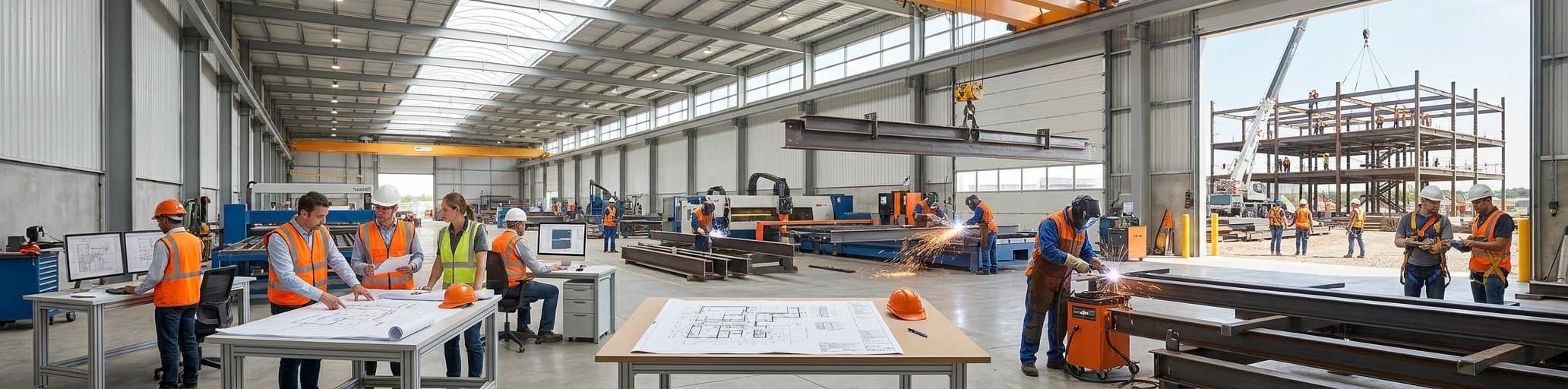

Single-source turnkey steel buildings eliminate coordination overhead by consolidating design, fabrication, and erection under one contract, compressing timelines and preventing the cost overruns that plague multi-vendor projects. We handle every phase on overlapping schedules with unified accountability, so conflicts resolve internally before they reach your job site.
What Is a Turnkey Steel Building and Why It Matters for Your Project
One turnkey contract eliminates the coordination overhead and finger-pointing that typically inflates timelines and budgets across multiple vendors.
Definition: Single-source design, fabrication, and installation under one roof
A turnkey steel building is a construction service where every phase — design, engineering, fabrication, foundation, installation, and finishing — is handled under a single contract with one company.[1][2] You're not lining up an architect, then a fabricator, then a separate erection crew; every component required to erect the building comes through one source.[1] For commercial, agricultural, and industrial property owners who need steel buildings delivered and installed on a defined schedule, that single point of accountability eliminates the coordination overhead that typically inflates both timelines and budgets when multiple vendors share a project.[2]
How turnkey differs from piecing together multiple contractors
The traditional multi-contractor path puts you in the project manager's seat whether you want to be or not.
You source an engineer, a separate fabricator, a transport company, and an erection crew — each operating under its own contract, its own schedule, and its own definition of acceptable quality.[3] When components arrive on site and don't match the engineering drawings, each party points at the other, and the resulting delay lands on you.[4] Beyond scheduling friction, fragmented services stack overhead costs at every handoff — each vendor prices in their margin before passing work downstream, so you pay more while owning less control over the finished product.[3] A turnkey contract from dirt to door collapses that chain: design, fabrication, transport, and erection run under a single production schedule, so conflicts surface and get resolved internally before they ever reach your job site.[3]
Why delivered and installed buildings save 6-12 months of project coordination
The time savings from steel buildings delivered and installed under one contract come down to a simple structural difference: parallel versus sequential work.
When you manage separate vendors, every phase waits on the one before it — engineering must close before fabrication starts, fabrication must ship before transport is booked, and materials must land before the erection crew can mobilize.[5] A single-source provider runs those phases on overlapping production schedules, so site preparation and permitting move concurrently with steel fabrication rather than after it.[5] That alone compresses months of calendar time without compressing any actual work.
Beyond scheduling, there's the coordination tax: every handoff between vendors requires you to translate specs, chase delivery confirmations, and arbitrate when components arrive out of tolerance.[6] On a kit-plus-subcontractor path, accountability for fit and finish is split, which makes resolution slower every time something goes wrong.[6] A turnkey contract eliminates that overhead entirely because conflicts surface and get resolved inside one organization before they touch your job site.[5] For commercial, agricultural, and industrial owners who can't afford months of project management distraction, that compressed timeline is the most direct argument for going single-source from the start.
The Hidden Costs of Multi-Source Building Projects
When fabricator, engineer, and erector operate under separate contracts, a single design revision triggers three independent change order cycles, each adding cost and delay to your timeline.
Communication gaps and finger-pointing when suppliers, engineers, and erectors don't align
When you split a steel project across separate suppliers, engineers, and erectors, poor communication becomes structural — built into the arrangement itself.
Misunderstandings about design specifications, material tolerances, and delivery sequencing are among the most prevalent triggers for construction disputes, arising precisely when information isn't clearly conveyed between disconnected parties.[9] Each vendor interprets scope through its own documentation, and when fabricated steel arrives on site out of tolerance, nobody volunteers accountability — each party points at the contract it signed, not yours.[8] Resolving those disagreements takes time, creating bottlenecks that stall decision-making and push every downstream trade back.[7] The financial damage compounds daily: storage fees accumulate on delivered steel, equipment sits idle, and for agricultural, commercial, or industrial owners whose operations depend on the finished building, delayed completion means lost productivity before a single load moves through the door.[7] You can vet local contractors carefully before signing, but no amount of pre-qualification closes the communication gaps that form naturally when each party's primary loyalty runs to its own contract rather than your project deadline.[8]
Change orders, delays, and cost overruns when accountability is split
Split accountability doesn't just slow your project — it reprices it at every turn.
Nine out of ten construction projects exceed their original budget, with final costs running an average of 28% over estimates.[12] That overrun rarely arrives as a single invoice; it accumulates through change orders, each one processed independently by whichever vendor holds the relevant scope.[11] When your fabricator, engineer, and erector operate under separate contracts, a single design revision triggers three separate change order cycles — each carrying its own markup, approval delay, and schedule impact.[11] Estimating errors alone cause up to 52% of project delays and account for 32% of all construction cost overruns,[10] and when those errors belong to one vendor but affect another's work, no single party has authority to resolve the whole problem.
The downstream costs compound fast: only 25% of projects meet their planned timelines, and just 31% finish within 10% of their original budget when accountability is divided across multiple contracts.[11] For owners planning industrial warehouse construction or commercial facilities where every idle day has a dollar value, each unresolved change order extends that exposure further — adding storage fees on delivered steel, equipment standby costs, and lost revenue before a single operation begins.[11]
Quality control failures and warranty complications across disconnected vendors
Quality control failures expose a structural weakness in multi-vendor projects that change orders and scheduling gaps don't fully capture.
Construction defect claims fall into distinct categories — design defects, material defects, and workmanship defects — and in a fragmented arrangement, each category points to a different party.[14] Material defects alone require tracing claims across the entire supply chain, examining each manufacturer's and supplier's quality control processes, and verifying whether the delivered materials conformed to the contract specifications.[14] When a steel panel arrives out of tolerance or a structural steel component doesn't match the engineering drawings, your fabricator points to the spec sheet, the erector points to the mill certificate, and your engineer points to the fabricator's shop drawings — with no single party authorized to resolve the full problem.[13] Warranty coverage fractures along exactly the same lines: each vendor issues a warranty covering only its own scope, leaving the integration points — panel fit, weather seal performance, load path continuity — outside everyone's coverage.[13] In a single-contract delivery model, that risk transfers to the builder, who assumes liability for coordination failures between design and construction; if the building doesn't perform as specified due to a cross-discipline gap, the builder owns it, not you.[13] On a multi-vendor project, every defect that crosses a contract boundary lands in your lap by default.
How National Steel Buildings's Single-Source Model Eliminates Project Risk
ProTrades's in-house erection crews eliminate costly delays and rework by combining ironworker and sheet metal expertise under unified project management nationwide.
Unified design-to-erection accountability: one company, one timeline, one guarantee
ProTrades in-house erection division ensures consistent installation quality nationwide Erecting a pre-engineered metal building demands a dual skill set most subcontractors don't carry: the structural framing competency of an ironworker and the panel and trim proficiency of a sheet metal worker.[17] Hire a crew strong in one discipline but not the other, and you pay for the gap — in extended build time, rework, and lower finished quality.[17] The ProTrades in-house erection division closes that gap by maintaining crews trained specifically in PEMB installation, so the same team that sets primary frames also sequences and installs roof and wall sheeting without handing the job off mid-build.[17] In-house crews operate under direct supervision from the same project management chain that owns the design and fabrication phases, which means field problems get resolved in hours rather than days — no subcontractor scheduling lag, no finger-pointing across contracts.[18] Consistent quality standards apply across every project because the same people, procedures, and OSHA-compliant safety protocols travel to each job site nationwide, not whoever happened to be available in a given market.[17] Teams that have worked together long enough to know each other's roles complete erection faster and with better craftsmanship than newly assembled crews learning on your schedule.[17] For owners planning agricultural steel buildings, commercial warehouses, or aviation hangars, that institutional continuity is what keeps installation quality predictable from the first anchor bolt to the final trim piece — regardless of where the project lands on the map.[19]
Constant communication protocol: real-time problem-solving from concept through completion
The communication gap between what's designed and what gets built is where most field problems originate.
When a project manager has to relay information across three separate organizations — fabricator, engineer, erector — each message loses fidelity and gains latency.[20] A structured single-source protocol eliminates those translation layers: design engineers, fabrication teams, and field crews share one project management system, so a jurisdictional change in wind or snow load requirements updates the fabrication spec before steel ships rather than after it arrives on site.[13] From the moment your order enters production, every phase — engineering, procurement, and erection scheduling — runs on connected timelines that flag conflicts automatically rather than waiting for a subcontractor check-in call to surface them.[20] When problems do emerge, they get resolved inside one team in hours; there's no blame boundary to cross, no separate contract to reference, and no incentive to delay acknowledgment.[13] That speed of resolution is the practical output of single-source communication — not just fewer meetings, but fewer days lost to problems that only compound when they wait.[21] Turnkey vs. Kit-Only: Cost and Timeline Comparison for Agriculture, Commercial, and Industrial Buildings
Comparison table: total landed cost, labor, timeline, and warranty scope across delivery models
The numbers make the abstract comparison concrete. Steel building kit packages — materials only — run $15-$25 per square foot, while fully installed or turnkey buildings land at $24-$43 per square foot once foundation, labor, and accessories are included.[22] That per-square-foot gap looks narrow until you account for full all-in cost: a 40×60 kit project, after adding site prep, permits, transport, foundation, and erection labor, realistically lands between $83,000 and $169,000 — a range so wide it reflects how unpredictably costs stack when each scope belongs to a different vendor.[6] A turnkey 40×60 from a single-source builder comes in at a median of around $120,000, which overlaps the kit path significantly but replaces variable coordination risk with a fixed contract.[6] The table below breaks that comparison across four decision variables for the three delivery models most owners encounter.
| Delivery model | Total landed cost | Labor arrangement | Coordination timeline | Warranty scope |
|---|---|---|---|---|
| Kit-only (self-assembled) | $15-$25/sq ft materials; $83K-$169K all-in for 40×60 | Owner-managed; separate crews hired per trade | Sequential — each phase waits on the one before it | Fragmented by vendor; no party covers integration points |
| Kit + third-party erector (hybrid) | Materials plus separate erection markup; final cost unpredictable | Split contract; kit supplier and erector each hold independent scope | Sequential with added handoff lag between supplier and erector | Accountability split — fit-and-finish disputes have no single owner |
| Turnkey (single-source) | $24-$43/sq ft installed; ~$120K median for 40×60 | Included; one team carries design through erection | Parallel phases compress calendar time | Single warranty; builder owns all integration liability |
Beyond the raw numbers, warranty scope is where the models diverge most sharply. On a kit-only or hybrid project, each vendor covers its own scope exclusively — panels, frames, and installation each carry separate warranties, with no party responsible for how the pieces interact.[6] When panels don't align or drawings have an error, the kit supplier and the erector point at each other, and the resolution gap lands on you.[6] A turnkey contract transfers that integration liability to the builder: if the building doesn't perform as specified because design and construction didn't connect, the builder owns the fix.[6] For 40×80 warehouse and commercial projects where kit pricing can look deceptively simple, that warranty gap is often the detail that closes the decision — because a $10,000 apparent savings on materials can evaporate in a single disputed rework cycle that no vendor volunteers to own.
Why National Steel Buildings's national buying power reduces material costs while maintaining quality
Real-world project examples: 40×80 warehouse, 30×40 agricultural facility, and 24×30 commercial garage delivered and installed The 40×80 warehouse is where the gap between kit pricing and turnkey reality shows up most sharply. At 3,200 square feet, a commercial warehouse at this footprint runs a median of $174,000 as a fully installed project — a figure that reflects commercial-grade I-beam framing, a reinforced concrete slab, multiple overhead doors, and a single contract covering delivery through erection.[25] Kit-only pricing for an equivalent steel package sits in the mid-teens to mid-twenties per square foot, but that number excludes the slab, labor, transport, and every door opening — costs that routinely add 30-60% on top of the materials quote once the project reaches the field.[26] For warehouse owners who need operations running on a fixed date, the 40×80 all-in cost picture makes the turnkey contract the more predictable path: one price, one timeline, no surprises at the foundation pour.
The 30×40 agricultural facility is the most data-rich size in the industry precisely because it's the most commonly built — 178 completed projects at this footprint put the median all-in cost at $70,000, covering a concrete slab, overhead doors, and a fully erected steel shell.[25] At 1,200 square feet, this footprint handles two to three pieces of equipment, a light workshop setup, or dry storage for seed and supplies without requiring the owner to manage a separate engineer, a separate fabricator, and a separate erection crew.[25] Under a single-source delivery model, site prep and fabrication run concurrently rather than sequentially, so the owner's calendar commitment shrinks to a fraction of what a fragmented build demands — and the $70,000 median holds because there are no inter-vendor markups stacking at each handoff.[26]
The 24×30 commercial garage occupies the smallest footprint of the three examples and illustrates how fixed project costs — mobilization, permits, slab work — compress per-square-foot efficiency for smaller structures. Installed (turnkey) steel buildings land at $24-$43 per square foot once foundation, labor, and accessories are included, and comparable small-footprint builds at the 24×36 size come in around $51,000 at the median for a complete project.[25] A 24×30 commercial garage delivered and installed under one contract gives the owner a standing, code-compliant structure with no erection crew to source, no delivery coordination to manage, and no warranty gap between the panel supplier and the installer.[26] For commercial property owners adding covered vehicle storage or a finished service bay, that single-contract accountability is what keeps a straightforward project from accumulating the subcontractor coordination overhead that inflates both cost and calendar time on multi-vendor builds.[22]
- Turnkey steel buildings eliminate coordination overhead by consolidating design, fabrication, transport, and erection under one contract and accountability.
- Multi-vendor projects average 28% budget overruns and 75% timeline delays due to fragmented communication, sequential workflows, and stacked markups.
- Single-source providers run parallel production phases, compressing months of calendar time while reducing handoff costs and quality control gaps.
- In-house erection crews trained specifically in PEMB installation deliver consistent quality nationwide under direct project management supervision.
- Turnkey 40×60 buildings cost ~$120,000 with fixed pricing and unified warranty, versus kit-only projects ranging $83,000-$169,000 with fragmented accountability.
- Warranty coverage fractures across vendors on multi-source projects, leaving integration points like panel fit and weather seals unowned by any party.
- Single-source communication protocols flag conflicts automatically through connected timelines, resolving field problems in hours rather than days.
- https://silverspurcontractors.com/turnkey-metal-buildings/
- https://www.summitsteelbuildings.com/turnkey-building-solution
- https://btsteel.co.za/industry-insights/the-advantages-of-turnkey-structural-steel-fabrication/
- https://americanwesternsteel.com/the-turnkey-steel-building-advantage-for-midland-businesses/
- https://yarmouksteel.net/what-are-turnkey-contracting-services-in-steel-construction/
- https://www.steelstructuresamerica.com/pole-barn-kit-vs-turnkey-cost/
- https://www.kppblaw.com/project-pitfalls-the-impact-of-stakeholder-misalignment-on-construction/
- https://pollackpeacebuilding.com/blog/conflict-in-construction/
- https://www.guardianpc.com.au/causes-of-construction-disputes/
- https://www.mccormicksys.com/blog/most-common-construction-estimating-mistakes-and-how-to-fix-them/
- https://www.sage.com/en-us/blog/construction-project-cost-overruns/
- https://premiercs.com/blog/how-to-prevent-construction-cost-overrun-expert-methods-that-actually-work
- https://finfrock.com/how-design-build-construction-reduces-risk/
- https://www.conradscherer.com/resources/common-types-of-construction-defect-claims/
- https://cicconstruction.com/blog/single-point-of-accountability-how-design-build-delivery-eliminates-project-risk-across-multiple-markets/
- https://www.selectlee.com/2025/02/25/the-benefits-of-design-build-vs-design-bid-build-for-large-projects/
- https://www.steelsmithinc.com/2017/05/how-to-choose-the-right-erection-crew/
- https://www.raecobuilders.com/blog/2025/1/13/3-advantages-of-self-performing-construction
- https://sentryusa.com/south-dakota-service/pemb-erection-services/
- https://cmicglobal.com/resources/article/The-Benefits-of-Construction-Project-Management-Software
- https://www.ecisolutions.com/blog/residential-construction/top-10-communication-strategies-in-construction-project-management/
- https://torosteelbuildings.com/blog/steel-building-prices/
- https://www.summitsteelbuildings.com/the-hidden-costs-of-metal-building-kits
- https://steelbuildingkit.com/steel-building-kits-the-complete-guide-to-cost-companies-and-best-options-in-2025/
- https://www.steelstructuresamerica.com/metal-building-cost/
- https://www.buildingsguide.com/metal-building-prices/?srsltid=AfmBOopttg_wPxOjwBqC7LeWs_ERfvYQYnYOj1VPllcX-ARG0WWPllO2