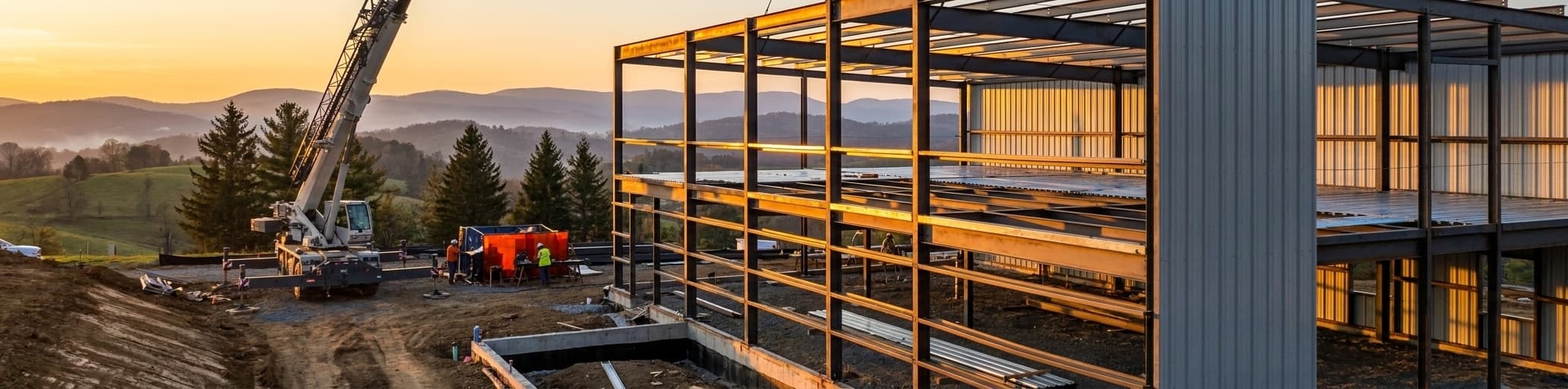

We help Morgantown property owners navigate steel building design, permitting, and costs while accounting for West Virginia's demanding snow and wind loads. Single-source steel partners deliver stamped engineering, transparent pricing, and accountability from permit through erection without the coordination gaps that inflate traditional construction budgets.
Why Morgantown property owners choose steel buildings over traditional construction
Steel buildings arrive with stamped drawings and load calculations already completed to Morgantown code, so your permit package is ready before site work begins.
How Morgantown's climate & building codes favor steel structures
Morgantown sits in the Appalachian highlands where snow accumulation, ice storms, and sustained wind loads are real structural risks every season.
West Virginia's adopted building code addresses all of them directly: construction documents must include roof snow load data, wind design data, seismic design data, and atmospheric ice load specifications before a permit can move forward.[1] Steel buildings are engineered to meet those thresholds cleanly.
The code even includes a dedicated structural integrity provision specifically for steel frame, open web steel joist, and composite steel-and-concrete frame structures, which tells you the standard was written with steel in mind for demanding load environments.[1] On the permitting side, the City of Morgantown requires an energy efficiency report for every new residential and commercial structure, and commercial projects of three or more units must submit five complete sets of plans signed by a licensed design professional.[2] Pre-engineered cold-formed steel buildings arrive with stamped drawings and load calculations already completed to local code specs, so your permit package is ready before site work begins — no scrambling for an engineer after the fact, and no costly redesigns mid-project.
Cost Savings: Steel vs. Wood & Concrete in West Virginia
The upfront cost of a pre-engineered steel building shell typically runs $25-$40 per square foot, with fully installed projects — site prep, foundation, and interior finishes included — landing between $100 and $300 per square foot.[4] Wood framing starts lower on paper, but Morgantown's snow and wind load requirements mean wood structures need heavier reinforcement to pass inspection, which closes that gap quickly.
Concrete presents a different tradeoff: a 2017 initial cost-of-construction study found that concrete masonry with precast floors was the least expensive structural system at the time of construction, yet both cast-in-place and precast concrete can recoup their higher upfront cost through fire resistance and long-term durability.[3] Precast specifically showed a total cost of ownership 45% lower than in-situ concrete construction.[3] Steel threads the needle between the two — lower initial outlay than concrete, more durable and maintenance-free than wood, and engineered precisely to meet load thresholds without the reinforcement add-ons that inflate wood project budgets in West Virginia's climate.
One factor that catches first-time buyers off guard: site preparation, grading, and foundation work are often excluded from manufacturer quotes, so comparing a steel shell price against a wood framing bid that buries those costs is an apples-to-oranges exercise.[4] Getting a complete, line-by-line estimate upfront is the only way to keep your steel buildings Morgantown, WV project within budget from day one.
Single-Source Advantage: Design, Engineering & Erection in One Partnership
When you hire separate firms for design, engineering stamps, and erection, every handoff between them creates a gap where disputes, delays, and cost overruns can hide.[5] In a traditional split-delivery model, the owner ends up coordinating between an architect, multiple engineers, a general contractor, and dozens of suppliers — and when something goes wrong, each party points at the others, leaving the owner to absorb the cost.[5] A single-source model changes that dynamic entirely: one contract covers engineering, procurement, and construction, so accountability rests with one team from concept through physical handover.[6] Procurement under a unified model also unlocks something a small regional firm cannot offer — centralized buying power that locks in material pricing and eliminates supply chain surprises before they reach the job site.[5] For steel buildings in Morgantown, WV, where local snow load engineering and commercial permit requirements must be addressed simultaneously, that integration isn't a luxury.
It's how projects stay on schedule and within budget without the property owner becoming a full-time project manager.
Understanding how turnkey contracts compare to shell-only pricing shows exactly where coordination failures show up in the final bill when trades aren't unified from day one.
Steel Building Types & Applications for Morgantown Businesses & Farms
Pre-engineered steel buildings compress construction timelines and eliminate interior columns that reduce usable floor space, making them ideal for Morgantown's expanding industrial corridors.
Commercial Warehouses & Industrial Facilities for Morgantown's Growing Economy
Morgantown's industrial footprint is actively expanding.
Enrout Properties is preparing a new 27-acre "Floyd Farm Pad" in the Morgantown Industrial Park, positioned near the Uffington Bridge with future access to both I-79 and I-68, specifically designed to attract large-scale manufacturing and distribution users.[7] Growth at that scale creates immediate demand for warehouse and distribution space that can be erected quickly and expanded without a full rebuild.
Pre-engineered steel buildings address both requirements — components arrive sequenced for fast erection, compressing the construction timeline compared to wood or concrete alternatives, and clear-span interiors eliminate the interior columns that would otherwise cut into usable floor space.[8] Actual projects in Morgantown already confirm the pattern: two pre-engineered metal buildings were recently supplied and constructed for Jo's Globe Distributing Co., a retail beer distributorship operating locally, delivered as a turnkey package from engineering through erection.[9] For owners planning distribution centers, truck storage facilities, or light manufacturing space near Morgantown's growing industrial corridors, understanding how warehouse square footage affects per-foot costs is the first step toward an accurate budget before committing to a site.
Agricultural Steel Barns & Farm Storage Solutions for WV Climates
West Virginia's hill-country weather is hard on farm infrastructure — ice loads, wet winters, and high humidity accelerate rot in wood-framed barns faster than in most states.
Steel removes those failure points entirely.
Steel barns resist termites, heavy rain, wind, snow, hailstorms, lightning, fire, and mold — the full list of conditions that compromise wood structures season after season.[10] For Morgantown-area operations, that translates directly to hay sheds, equipment storage, livestock pavilions, and stables that need no repainting, no post-straightening, and no pest treatment to maintain structural integrity over decades.[10] Clear-span interiors also matter here: a forty-foot-wide door for combining equipment or a column-free livestock pavilion layout can be specified at the design stage and engineered to WV load codes without the workarounds that wood framing requires.[10] Farmers weighing the long-term numbers on agricultural steel building sizing and pricing consistently find that the maintenance savings alone justify the initial step up from pole-barn construction, before factoring in fire resistance or the structural confidence that comes with stamped engineering drawings.
Residential & Specialty Uses: Garages, Workshops & RV Storage
Residential property owners in Morgantown face the same snow and wind load requirements as commercial builders, which makes a pre-engineered steel garage or workshop the most direct path to a structure that passes inspection without a mid-project redesign.
Standard enclosed garage configurations run from 18×36 up to 54×45 for commercial-scale shops, all engineered to handle wind loads up to 170 MPH and snow loads up to 65 PSF — thresholds that meet or exceed West Virginia's building code requirements.[11] Workshops follow a similar size range: a 50×150 fully enclosed building gives a contractor or fabricator column-free floor space that a wood-framed shop cannot match at comparable cost, and options like lean-tos, walk-in doors, windows, and insulation can be specified at the design stage rather than retrofitted later.[11] RV and boat owners face a specific sizing challenge that generic residential garages rarely solve — standard door heights fall short for Class A motorhomes, and open carport structures let ice accumulate on panels through Morgantown's freeze-thaw winters.
Dedicated RV carports sized at 30×45 with 12-foot eave clearance address both problems: vertical roof panels shed ice load instead of holding it, and the footprint accommodates a fifth-wheel trailer with room for walkway access along the sides.[11] Lead times for residential structures across West Virginia typically run four to eight weeks from order to installation, with customization across 13-plus colors and multiple roof styles available without extending that window.[11] Understanding RV storage building sizes and costs before requesting a quote prevents the common mistake of undersizing the structure and discovering clearance problems after the concrete slab is already poured.
Steel Building Costs & Financing: What Morgantown Builders Actually Pay (2026 Pricing Guide)
Steel building shells in Morgantown run $25-$40 per square foot, while fully installed projects with site prep and finishes range $100-$300 per square foot depending on size, customization, and site conditions.
Price Range Breakdown: Square Footage, Customization & Local Site Factors
Steel building prices in Morgantown follow a predictable two-tier structure. The metal building shell — structural framing and wall and roof panels — runs $25 to $40 per square foot.[4] A fully installed project with site prep, foundation, and interior finishes lands between $100 and $300 per square foot.[4] Three variables move your number within those ranges more than any other factor:
- Building size: cost per square foot falls as total square footage rises, so a 15,000-square-foot distribution facility costs less per foot than a 2,500-square-foot shop with comparable load specs[4]
- Customization level: standard configurations hold cost down; specialty facades, skylights, and non-rectangular floor plans each add to the total[4]
- Site conditions: grading depth, soil type, demolition of existing structures, ecosystem constraints, and utility access all create project-specific cost layers no manufacturer's shell quote covers[4]
The table below shows where each cost component sits in a typical Morgantown project budget:
| Cost component | Shell-only quote | Fully installed project |
|---|---|---|
| Steel framing and panels | $25-$40/sq ft | Included |
| Site prep, grading, and excavation | Not included | Significant — varies by parcel |
| Concrete foundation | Not included | Varies by slab thickness and load |
| Interior finishes | Not included | Varies by intended use |
| Utilities, permits, and paving | Not included | Project-specific |
| **Total project range** | — | **$100-$300/sq ft** |
For context on what steel competes against in West Virginia: a custom stick-built home runs $200,000 to $440,000 for a residential structure before land costs, with land adding roughly $44,800 per acre in the state.[12] A steel building in a comparable footprint can be engineered, permitted, and erected well below those figures — and without the extended construction timeline wood framing requires in a snow-load environment.[4] The single most common budgeting mistake on steel buildings in Morgantown, WV is accepting a manufacturer's shell price as a project price. Grading, excavation, and concrete alone can represent a significant portion of total project cost, yet those line items rarely appear in a standard manufacturer quote — which is why a line-by-line estimate that separates shell, site work, foundation, and finish costs is the only way to compare bids accurately.[4]
How to Get an Accurate Quote Without Hidden Costs or Surprises
The gap between a manufacturer's advertised price and your actual project cost comes down to what the quote excludes — and the list is longer than most buyers expect. Installation labor alone adds 30-60% on top of the steel shell price, and that figure doesn't yet include site prep, foundation work, delivery, or permits.[13] Some providers advertise the cheapest possible number online, then surface significant additional charges after you've placed a deposit — once local load requirements, soil conditions, or code-mandated engineering reviews are factored in.[15] The only defense against that outcome is a fully itemized quote that breaks every cost into discrete line items before you commit. When reviewing proposals for steel buildings in Morgantown, WV, verify that each of the following cost categories appears explicitly — not bundled or assumed:
- Steel framing, panels, and trim
- Delivery and freight to your specific Morgantown-area site
- Site clearing, grading, and excavation
- Foundation type and concrete work
- Engineering stamps and permit fees
- Erection labor (typically $5-$12 per square foot)[13]
- Insulation, if required for your building's use
- Utility rough-ins: electrical, plumbing, and HVAC connections
- Customizations: roll-up doors, windows, skylights, and partition walls
Any of those categories left blank in a competitor's quote is a cost that will surface later — either as a change order or as a surprise invoice after ground is broken.[14] Accessories and add-ons alone can increase a base building price by 20-30%, and delivery fees vary based on distance from the fabrication facility and current fuel costs, neither of which is fixed at the time of a preliminary estimate.[15] Once you have comparable line-item quotes in hand, build a contingency buffer of 10-15% of total project cost into your own budget to absorb weather delays, soil surprises, or minor scope changes without derailing the project.[14] That buffer isn't pessimism — it's the standard practice of every experienced commercial builder working in West Virginia's variable terrain.
Financing Options & Tax Incentives Available to Morgantown Property Owners
Morgantown property owners building or expanding with steel have access to five distinct construction loan programs, each suited to a different borrower profile. Veterans and qualifying surviving spouses can access up to 100% financing through a VA construction loan with no monthly mortgage insurance requirement, closing on both land and build in a single structured event.[16] Non-veteran buyers with a 640-plus FICO can use FHA construction at 3.5% down, while conventional construction requires 5% down on a primary residence build and carries no permanent mortgage insurance once the loan converts.[16] For larger commercial or specialty projects above conforming county loan limits, jumbo construction financing extends up to $4.5 million for borrowers carrying a 720-plus FICO and tiered reserve requirements.[16] Files that fall outside agency guidelines — atypical site conditions, non-standard structures, or mixed-use classifications — can move through a portfolio program reviewed directly by an internal lending committee rather than automated underwriting.[16] One factor worth planning around early: if you already own your Morgantown-area parcel free and clear, the land equity counts toward the loan-to-value calculation and can reduce or fully eliminate the cash down payment requirement at closing.[16]
Beyond the loan structure itself, storm-resilient construction opens a separate track of financial benefits. Insurers, nonprofits, and state governments across the country — including West Virginia — offer insurance discounts and tax credits that reward property owners for building to standards that exceed ordinary code requirements.[17] In states where the FORTIFIED designation applies, insurance discounts can reach as high as 55%, and four states offer tax credits up to $5,000 for homeowners who strengthen structures against severe weather.[17] Pre-engineered steel buildings, which are engineered to specific wind and snow load thresholds and carry stamped structural documentation from day one, are well-positioned to qualify for those upgrading incentives — particularly in Morgantown's Appalachian environment where ice loads and high-wind events are recurring seasonal factors.[17] On the federal side, interest paid on a construction loan during the build phase is treated under IRS Publication 936 home mortgage interest deduction rules once the structure becomes the borrower's primary residence, a detail worth confirming with a tax professional before finalizing your loan structure.[16] Stacking a favorable construction loan program with available storm-resilience incentives is the most direct way to keep total project cost within budget without compromising the structural specifications your WV building permit requires.
Choosing the Right Steel Building Partner: What Sets National Steel Buildings Apart
A single-source partner with local permit expertise and pre-engineered site-specific drawings eliminates the multi-week coordination burden that catches unprepared builders off guard.
Local Expertise Meets National Buying Power: Why Size & Reach Matter
From Permit Navigation to Erection: The ProTrades Advantage in West Virginia In West Virginia, pre-engineered steel building permits are submitted to the local government agency for your specific jurisdiction — the City of Morgantown and Berkeley County both serve as the filing authority depending on your parcel's location — and before any permit application can move forward, contractors must first obtain a Contractor's License from the WV State Tax Department.[20] That licensing requirement is separate from the permit itself and catches unprepared builders off guard: a Business Registration Certificate issued by the Tax Department must be displayed at the place of business at all times, and no permit application can proceed without it.[20] Permits exist for two distinct reasons — to confirm your structure is appropriate for the zone where you want to build, and to verify the design is structurally safe for its intended use — and both reviews happen independently.[21] Zoning approval comes first; building permit approval follows once zoning is cleared.[21] The structural safety review is where local conditions add complexity: while West Virginia establishes minimum snow and wind load standards, a local building official can impose higher requirements for a specific plot based on its direct surroundings, meaning a standard manufacturer's load spec may need upward revision after the site review.[21] Any construction activity within a mapped 100-year floodplain adds a Floodplain Certificate requirement on top of the standard commercial package.[22] A single-source partner who already knows Morgantown's local permit office, carries the required Contractor's License, and arrives with stamped drawings pre-engineered to site-specific load thresholds compresses what would otherwise be a multi-week coordination problem into a straightforward document submission — and then stays through erection to ensure the finished structure matches the approved drawings without requiring a second inspection visit to close out deficiencies.
How to Vet a Steel Building Supplier: Key Questions for Morgantown Projects
Choosing the wrong steel building supplier rarely reveals itself on the first call — it shows up months later as a frame that doesn't match the foundation drawings, a permit that gets rejected because the load calcs weren't stamped to local code, or a "complete" kit missing the parts needed to make it weather-tight.[23] The most reliable filter isn't price — it's whether the supplier can answer specific, verifiable questions before you sign anything. Start with credentials: any contractor working in West Virginia must hold a valid WV Contractor's License, carry general liability insurance, and maintain a surety bond. Ask for physical copies of all three and verify currency — a confident, legitimate supplier has these documents ready without hesitation, and any reluctance is a disqualifier.[24] Next, confirm whether the supplier fabricates its own steel or resells frames from a third-party plant. A company that runs its own fabrication lines controls weld quality, section tolerances, and coating consistency in ways a reseller cannot — and when a section arrives wrong, in-house fabricators have clear accountability while resellers have less of it to point to.[23] Ask directly: "Do you fabricate this yourself, or are you sourcing frames elsewhere?" A genuine fabricator can show plant photos or production documentation; a reseller typically cannot.[23]
Once credentials and fabrication accountability are confirmed, move to the quote itself. Force every supplier to quote the same scope before comparing numbers — a "kit" price and a "turnkey" price answer entirely different questions, and comparing them head to head is how buyers get surprised by change orders after ground is broken.[23] When reviewing any proposal for steel buildings in Morgantown, WV, verify that each of the following categories appears explicitly and separately, not bundled under a single line:
- Engineering stamps sealed to West Virginia's local code requirements
- Freight and delivery to your specific parcel
- Erection labor, quoted separately from the shell price
- Permit fees and contractor licensing costs
- Site-specific load adjustments if a local building official imposes higher snow or wind requirements than the standard specification
- Warranty terms for the frame, panels, and coating — each covered separately, with exclusions stated in writing[24]
After the quote, ask for references from projects of similar type and scale completed within the past twelve months — not a curated logo wall, but actual client contacts you can call.[25] When you reach those references, go beyond "were you happy with the work" and ask whether the supplier stuck to the quoted budget, how change orders were handled, and whether the erection crew passed local inspection on the first visit without requiring rework.[25] A supplier who answers vetting questions plainly and in writing, provides current license and insurance documentation without delay, and connects you directly to recent clients is showing you exactly how they will behave when something goes wrong mid-project — which is the part of the relationship no price quote can reveal.[24] You can also review how experienced prefab contractors handle the vetting process to benchmark what transparent answers actually look like before your first supplier call.
- Steel buildings meet Morgantown's snow, wind, and ice load requirements more efficiently than wood or concrete alternatives without costly reinforcement add-ons.
- Steel building shells cost $25-$40 per square foot, but fully installed projects including site prep and finishes range from $100-$300 per square foot depending on customization and site conditions.
- Single-source steel building contracts that integrate engineering, procurement, and construction eliminate coordination gaps and supply chain surprises that inflate costs in split-delivery models.
- Pre-engineered steel buildings arrive with stamped drawings and load calculations already completed to local code specifications, streamlining Morgantown's permit process significantly.
- Verify steel building suppliers fabricate their own frames rather than reselling third-party products, as in-house fabricators maintain direct accountability for weld quality and coating consistency.
- https://up.codes/viewer/west_virginia/ibc-2015/chapter/16/structural-design
- https://www.morgantownwv.gov/690/PLL-Help
- https://nitterhouseconcrete.com/precast-concrete-vs-steel-framing-vs-wood-framing/
- https://builtmammoth.com/how-much-does-a-steel-building-cost/
- https://namtrungcons.vn/en/what-is-epc-contractor/
- https://www.doubleblackconstruction.com/best-to-use-one-turnkey-provider
- https://www.blackdiamondrealty.net/category/company-news/
- https://cdmg.com/metal-building/morgantown-wv
- https://www.rutherfordconstructioncorp.com/recent-projects/
- https://www.steelsmithinc.com/steel-building-types/steel-barns-for-farms-ranches-and-agriculture/
- https://www.getcarports.com/locations/west-virginia?srsltid=AfmBOorVOAYEBHqmvu_4HRW9ZbFcBcmiw2W3-OF2rtWiHy_Gud2jaXKU
- https://www.houzeo.com/blog/how-much-does-it-cost-to-build-a-house-west-virginia/
- https://metalstructuresales.com/steel-building-installation-cost/
- https://swfunk.com/news/metal-buildings-costs/
- https://norsteelbuildings.com/steel-building-news-industry-trends/how-much-do-steel-buildings-cost/
- https://www.buildbuyrefi.com/barndominium-construction-loans-best-lender-for-building
- https://fortifiedhome.org/incentives/
- https://www.nahb.org/news-and-economics/housing-economics/national-statistics/framing-lumber-prices
- https://wvpublic.org/story/economy/nucor-plant-construction-brings-unprecedented-growth-challenges/
- https://reichconstructionllc.com/united-states-pre-engineered-steel-buildings-50-states-guide-faqs/
- https://www.steelsmithinc.com/building-permits-are-an-essential-early-step/
- https://www.berkeleywv.org/580/Building-Permit-Process
- https://kafafab.com/best-metal-building-company/
- https://www.jbsteelconstruction.com/blog/what-to-look-for-when-hiring-a-metal-building-contractor
- https://realmhome.com/blog/questions-to-ask-general-contractor