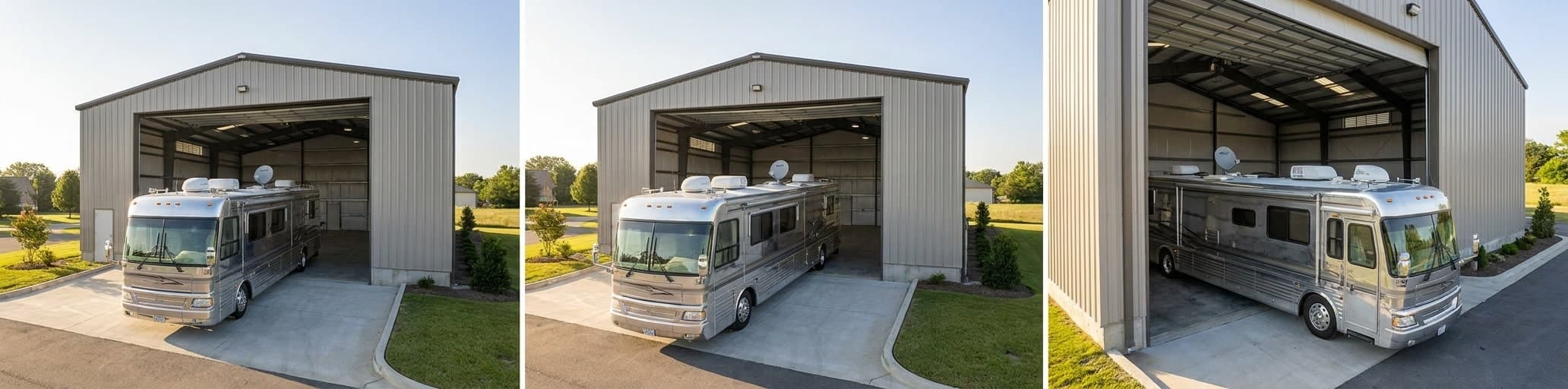

We help you right-size an RV storage building by accounting for actual vehicle dimensions–rooftop equipment, deployed slideouts, and combined tow lengths–rather than manufacturer specs that consistently underestimate real-world clearance needs.
Why RV Storage Buildings Matter More Than Carports and Covers
Water damage from seal failure costs $5,000 to $15,000 in repairs, but a purpose-built storage building prevents the exposure cycle before costs begin.
The Real Cost of Leaving Your RV Exposed Year-Round
Prolonged outdoor exposure degrades your RV's gelcoat, aluminum siding, rubber seals, roof material, and tires — damage that starts as a cosmetic issue and compounds into structural failure.[2] In extreme heat, RV roof surfaces can exceed 140 degreesF, which accelerates the breakdown of sealants and roof membranes that are your first line of defense against water intrusion.[1] Once those seals fail, moisture spreads behind walls and beneath floors for months before any visible sign appears — by the time soft spots show up, the repair scope has already grown well beyond what you first expected.
The repair costs are not small. Major water intrusion and delamination repairs typically run $5,000 to $15,000, and severe structural damage can exceed $20,000.[1] Full roof replacements cost $3,000 to $8,000 or more, while sidewall delamination adds another $1,500 to $4,000 per panel on top of that figure.[1] RV repair labor rates often run $100 to $150 per hour, meaning any hidden damage that a shop opens up quickly multiplies into a much larger invoice.[1]
Most RV insurance policies exclude water damage caused by wear and tear, seal failure, or poor maintenance — which is precisely the kind of damage unprotected outdoor storage produces.[1] Even when a claim is approved, deductibles typically run $500 to $1,000 or more, on top of annual premiums ranging from $500 to $1,500 for recreational users.[1] A purpose-built RV storage building eliminates the exposure cycle before the cost cycle begins.
How a Dedicated RV Storage Building Protects Your Investment
Single-Source Steel Solutions vs. Piecing Together Carports and Shelters The gap between a pieced-together shelter system and a purpose-built steel building becomes clear when you look at what each approach demands of you over time. Fabric covers rip, sag, and trap condensation directly against your RV's surfaces.[6] Wood carports require scraping, painting, staining, and sealing every few years just to maintain structural integrity — a recurring cost cycle that never ends.[6] Even a standalone open metal carport, while more durable than wood or fabric, addresses only top-down exposure and leaves your rig fully accessible to wind-driven moisture from every side.[5] A pre-engineered steel building ordered as a complete system eliminates every layer of those problems at once.
The framing, roof panels, wall panels, doors, and fasteners arrive as matched components, engineered to work together and bolt together without field modification.[7] That's the core advantage of a single-source approach to steel buildings: one set of engineering specs, one delivery, one installation crew, and one warranty covering the complete structure — rather than three separate vendors each disclaiming responsibility when a seal fails or a roof panel leaks.[6] Pre-engineered steel also scales without compatibility headaches. If you add a lean-to for a second vehicle or expand a bay after purchasing a larger rig, the original structural drawings support the addition cleanly, without the guesswork of retrofitting components sourced from suppliers who never coordinated with each other.[6]
RV Storage Building Sizes: Finding the Right Footprint for Your Needs
Account for rooftop AC units, satellite dishes, and solar panels–which add 1 to 2 feet–when calculating your RV's actual storage height requirement.
Standard RV Dimensions and How They Drive Building Size
The dimension that catches most owners off guard is height — not the figure on the spec sheet, but the clearance your rig actually needs. Class A motorhomes run 11 to 13.5 feet tall, and fifth wheels reach the same range, but neither figure accounts for rooftop AC units, satellite dishes, solar panels, or vent covers, which commonly add 1 to 2 feet above the base roofline.[8] A Class A listed at 12 feet with a rooftop AC unit can push 13.5 feet in practice — right at the U.S. legal maximum — leaving almost no usable margin under a building with a nominal 14-foot eave.[9] Width introduces a second variable owners frequently underestimate: most RVs measure 8 to 8.5 feet wide with slideouts retracted, but deployed slideouts extend 2 to 3 feet per side.[8] A single-slideout Class C parked in a building that was sized only around closed-position width will either prevent you from using your interior living space while stored or create contact risk during entry and exit if drive aisle width wasn't planned around the deployed footprint. Length then sets the building's depth dimension and the door opening you need. Class A motorhomes and large fifth wheels reach 40 to 45 feet, travel trailers span 13 to 40 feet, and those figures apply to the RV alone.[8] If you're storing a fifth wheel still hitched to the tow truck, combined length can exceed 60 feet in a single bay — a footprint that drives the structure well beyond what most owners initially estimate.[8]
| RV class | Typical height | Typical width (slides closed) | Typical length |
|---|---|---|---|
| Class A motorhome | 11-13.5 ft | 8-8.5 ft | 26-45 ft |
| Class B campervan | 8-9.5 ft | 7-8 ft | 18-24 ft |
| Class C motorhome | 10.5-12 ft | 8-8.5 ft | 25-35 ft |
| Fifth wheel | 11.5-13.5 ft | 8-8.5 ft | 25-45 ft |
| Travel trailer | 7-12 ft | 7-8.5 ft | 13-40 ft |
| Pop-up camper (closed) | 4.5-5.5 ft | 7-7.5 ft | 8-16 ft |
Manufacturer spec sheets are the starting point, not the final number. Most only report the base roofline height, not the equipment mounted above it.[9] Before you size a building, measure your rig from the ground to the tallest fixed point — AC unit, vent cover, solar panel, or antenna — and record that number as your true clearance requirement.[8] Add a minimum of 2 feet above that figure for comfortable door-frame clearance, then add slide-out depth to your width when planning drive-aisle spacing. Those three adjusted dimensions — not the brochure specs — are what determine whether a steel garage building fits your rig on day one and still fits it after you add a rooftop solar array two years from now.
Common RV Storage Building Sizes: 20×40, 30×40, 40×60, and Beyond
Translating your adjusted RV dimensions into a steel building footprint requires applying a buffer on top of what you measured. SpareFoot recommends a minimum of 2-3 feet of clearance on all sides for safe maneuvering and exterior access.[10] Icon Steel puts the working recommendation higher — at least 5 feet added to both length and width, and at least 2 feet above the tallest fixed point — so the building stays functional when you swap to a larger rig or add rooftop equipment.[6] Run those buffers across the five common RV classes and four standard footprints cover nearly every scenario. A 20×40 building fits Class B campervans and small pop-ups, which top out around 24 feet long; the extra width beyond the rig itself lets you walk the perimeter and open storage bays without pressing against a wall.[10] A 30×40 footprint handles Class C motorhomes and mid-size travel trailers up to 35 feet, and the added bay width accommodates deployed slideouts without forcing you to retract them on entry.[10] Class A motorhomes and large fifth wheels are where the 40×60 footprint earns its place: most Class A coaches and large fifth-wheel trailers fit a 40-foot depth, but SpareFoot notes those larger vehicles frequently need a minimum ceiling clearance of 15 feet, making eave height selection as critical as the floor plan itself.[10] For the largest Class A coaches, destination trailers, or any combined-length configuration where the tow vehicle stays hitched, SpareFoot's 50-foot depth category applies — pointing toward a 40×80 or 50×80 building.[10] Icon Steel puts the total installed cost range for a 40×60 at $38,400 to $115,200 depending on spec choices, a figure that climbs with both footprint and eave height.[6]
| Building footprint | Best-fit RV classes | Typical RV length covered | Recommended minimum eave height |
|---|---|---|---|
| 20×40 | Class B campervans, pop-ups, small travel trailers | Up to 24 ft | 10-12 ft |
| 30×40 | Class C motorhomes, mid-size travel trailers | 25-35 ft | 12-14 ft |
| 40×60 | Class A motorhomes, large fifth wheels, large travel trailers | 35-45 ft | 14-16 ft |
| 40×80 or 50×80 | Largest Class A coaches, destination trailers, RV-plus-tow-vehicle storage | 45+ ft or combined length | 16+ ft |
RV Storage Size Selector: Match Your Fleet to the Right Building
The tables earlier in this article size buildings around a single rig. The harder problem is a mixed fleet — a Class A stored alongside a travel trailer, or a fifth wheel that stays hitched to the tow truck when it comes in. The decision matrix below maps common fleet configurations to minimum building specs, using the RV dimension data that catches most buyers off guard. Class A motorhomes and fifth wheels frequently push to the U.S. legal height maximum of 13 feet 6 inches once rooftop A/C units, solar panels, and satellite dishes are factored in — manufacturer spec sheets almost never include that equipment.[9] Class B campervans, by contrast, typically stand between 8 and 9.5 feet including rooftop components, which means they can often fit a standard carport or smaller garage footprint without the high-eave steel building that a Class A demands.[9] Slideouts are the width variable that collapses a plan that looked adequate on paper: fifth wheels typically carry multiple slideouts, each extending 2 to 3 feet per side when deployed, so a building sized around closed-position width will either block access to the interior or force you to retract before every entry.[8] The matrix below treats deployed slideout width and true rooftop height — not brochure specs — as the controlling dimensions for each scenario.
| Fleet scenario | Controlling dimension | Minimum footprint | Recommended eave height |
|---|---|---|---|
| Single Class B campervan | Height: 8-9.5 ft with rooftop gear | 20×24 | 12 ft |
| Single Class C motorhome (no slideouts) | Height: 10.5-12 ft; length: up to 35 ft | 30×40 | 14 ft |
| Single Class C motorhome (with slideouts) | Deployed width adds 2-3 ft per side | 40×40 | 14 ft |
| Single Class A motorhome or large fifth wheel | Height: up to 13.5 ft with equipment; length: up to 45 ft | 40×60 | 16 ft |
| Fifth wheel stored hitched to full-size pickup | Combined length 55-65 ft; height governed by fifth wheel | 40×80 | 16 ft |
| Class A plus one travel trailer, separate bays | Two length runs; independent door access per bay | 60×60 or dual 40×60 | 16 ft (Class A bay), 14 ft (trailer bay) |
| Mixed fleet: Class C plus Class B, shared bay | Width governed by Class C deployed slideouts | 40×50 | 14 ft |
Two scenarios consistently drive buyers toward a larger footprint than they initially planned. First, fifth wheels stored without unhitching from the tow vehicle: the trailer alone reaches 25 to 45 feet, and adding a full-size pickup extends the combined length well past 60 feet — a depth that forces the 40×80 footprint regardless of how compact the fifth wheel itself appears.[8] Second, any Class A at the top of its height range: many arrive from the factory with rooftop A/C already pushing them to 13 feet 6 inches, leaving almost no working margin under a building with a 14-foot nominal eave once door frame thickness is accounted for.[9] Specifying a 16-foot eave for any Class A or tall fifth wheel isn't upsizing for comfort — it's the minimum that keeps a rooftop A/C replacement from immediately invalidating your clearance. How Much Does an RV Storage Building Cost? Real Numbers for 2026
Breaking Down RV Storage Building Costs: Materials, Labor, and Site Prep
Price Comparison: Steel RV Storage vs. Carports vs. Outdoor Parking Monthly rental rates reveal a clear cost ladder across the three storage formats, and that ladder matters when you're deciding whether to rent space or own a building outright. Outdoor uncovered RV parking — a designated spot in a fenced or gated lot — runs $75 to $200 per month depending on location, facility security, and whether utilities like electrical hookups are included.[15] Covered parking adds a carport-style roof over an open-sided stall and typically costs $150 to $450 per month for RV-sized spaces.[15] Fully enclosed indoor RV storage, which provides four walls, a locking door, and the highest security tier, runs $150 to $400 or more monthly in most markets, with climate-controlled options in urban areas pushing well above that ceiling.[13] The table below maps monthly cost ranges to what each format actually delivers.
| Storage format | Typical monthly cost (RV-sized) | Weather protection | Security level | Climate control |
|---|---|---|---|---|
| Outdoor uncovered | $75-$200 | None | Perimeter fence, shared lot | No |
| Covered outdoor (carport-style) | $150-$450 | Top-down only (roof, no walls) | Perimeter fence, shared lot | No |
| Enclosed indoor | $150-$400+ | Full enclosure | Individual lock, gated, surveillance | Available at premium |
The monthly rental math reframes the steel building decision quickly. An enclosed indoor RV storage rental at $250 per month costs $3,000 per year and $15,000 over five years — before any rate increases.[14] A purpose-built 40×60 steel building carries a one-time installed cost, and once the structure is paid for, monthly carrying costs drop to property taxes and minimal maintenance rather than recurring rent.[13] Outdoor uncovered parking is cheaper per month but delivers no weather or security protection, and the RV damage costs documented earlier in this article — water intrusion repairs alone running $5,000 to $15,000 — can eliminate years of rental savings in a single repair event.[14] Covered carport storage sits in the middle: it handles top-down sun and rain exposure but leaves the rig fully open to wind-driven moisture and unrestricted access from every side, which is the exact vulnerability that produces sidewall delamination and seal failure over time.[13] The clearest way to evaluate the comparison is to weigh the cumulative rental cost over your expected ownership timeline against the one-time capital cost of an enclosed steel building that eliminates the exposure risk entirely — and retains equity rather than disappearing into monthly rent.[15]
National Steel Buildings Cost Transparency: What Your Quote Includes
The most common budget problem in steel building projects isn't an overpriced quote — it's a misread one.
The advertised kit price typically represents only 40-60% of your total project cost, which means a buyer who budgets only the structure will hit multiple unexpected line items before the building is usable.[16] A transparent quote separates two distinct categories: what travels with the engineered kit, and what gets priced separately based on your specific site.
The kit itself covers the primary steel frame, roof and wall sheeting in your selected color, trim, fasteners, J-bolt anchor hardware, stamped engineered drawings matched to your local wind and snow load requirements, and a standard installation crew on a prepared, level pad.[17] Doors and windows included in your selected base package are part of that same line item.[17] What sits outside the kit price — and must be budgeted as separate line items — includes the concrete foundation and any grading or drainage work, permit fees and local code engineering revisions, electrical and plumbing rough-in, insulation upgrades beyond any included standard, additional roll-up doors or walk doors beyond the base package count, and any accessory features such as lean-tos, skylights, gutters, or custom trim.[17] One additional variable worth building into your timeline: steel building quotes are typically valid for approximately 30 days because raw steel pricing moves with global supply and demand, and suppliers must protect themselves against those fluctuations between the quote date and your order date.[16] Comparing quotes from multiple suppliers against the same locked specifications — identical footprint, eave height, door package, gauge, and certification level — is the only reliable way to verify you're evaluating equivalent structures rather than buildings with hidden scope differences.[16] An unusually low quote almost always signals lower-grade steel, uncertified engineering, or a stripped base package that rebuilds cost through expensive field add-ons.[16]
Designing Your RV Storage Building: Features That Protect and Last
Choosing 16-foot eaves as your minimum ensures Class A motorhomes with roof-mounted A/C units fit safely inside with adequate clearance for doors and maneuvering.
Roof Pitch, Height, and Clearance Specifications for Tall Vehicles
Eave height is the single most consequential structural decision in an RV storage building — wrong by two feet and entire vehicle classes cannot enter the bay. The industry breaks into three clear tiers: 14-foot eaves cover most travel trailers, fifth wheels, and Class C motorhomes; 16-foot eaves handle Class A motorhomes and most vehicles with roof structures; 18-foot eaves accommodate tall fifth wheels with rooftop A/C units already installed and sailboats stored with masts down.[18] Door clearance requires a separate specification from eave height. RV storage buildings use commercial-grade roll-up doors ranging from 12 to 14 feet wide and 14 to 16 feet tall, with 14-foot width as the minimum for Class A access and 12-foot width as the floor for boat trailer entry.[18] The most common planning error is sizing the building to the manufacturer's published height. That figure almost never includes permanently mounted roof accessories — A/C units, antennas, satellite domes, and solar panels — which can push a rig several inches to more than a foot above the spec sheet number.[19] A Class A motorhome listed at 13 feet on the manufacturer sheet can reach the U.S. legal road maximum of 13 feet 6 inches once factory-installed A/C is counted.[19] Against a 14-foot nominal eave, that leaves less than 6 inches of working margin before the door frame itself consumes what remains — which is why 16-foot eaves are the correct minimum for any bay intended to store Class A coaches. The door spec must follow from the tallest vehicle the unit will ever accept plus a buffer for maneuvering; a boat and RV storage building designed around a Class A motorhome with rooftop A/C needs a taller door opening than the same footprint built for a fifth wheel without rooftop equipment.[18]
| Vehicle type | Recommended eave height | Minimum door width | Minimum door height |
|---|---|---|---|
| Travel trailers, Class C motorhomes, fifth wheels without tall rooftop gear | 14 ft | 12 ft | 12-14 ft |
| Class A motorhomes, arched-roof boats | 16 ft | 14 ft | 14-16 ft |
| Tall fifth wheels with rooftop A/C, sailboats stored masts-down | 18 ft | 14 ft | 16+ ft |
Ventilation, Drainage, and Weatherproofing for Long-Term Storage
Ventilation is the variable that separates an RV storage building that protects your rig from one that quietly damages it. A sealed, unventilated steel enclosure traps heat and humidity against seals, roof membranes, and interior surfaces — the exact conditions that accelerate the failures you built the structure to prevent. The fix is passive and low-cost: ridge vents combined with soffit vents create continuous natural airflow that exhausts moisture without a fan or power draw.[20] The minimum spec to make the system work is one square foot of vent opening per 150 square feet of floor space; below that threshold, humidity accumulates faster than natural convection can remove it.[20] Gable vents on end walls push heavier, moisture-laden air — including any off-gassing from holding tanks — toward exits before it can condense on interior surfaces or your RV's painted panels.[20]
Drainage operates at two distinct scales. At the slab level, concrete under the RV bay must carry a slight pitch toward floor drains or the building perimeter; a flat slab holds standing water that migrates under tires, accelerates dry rot, and freezes into hazardous ice patches in colder regions. For mixed-use facilities housing livestock alongside RVs, a gravel-filled drainage channel along the back wall of the animal zone — graded at a minimum 2% slope toward collection points — directs waste fluids away from the building entirely, a detail that runs $5 to $8 per linear foot but prevents contamination from ever reaching the vehicle bay.[20] A floor transition strip at the zone boundary stops liquid from bridging between surfaces with different drainage gradients.[20]
Weatherproofing requires inspection at every penetration point in both the building envelope and the RV itself. On the structure, retighten loose fasteners on metal panels every two to three years, since thermal expansion and contraction back screws out over time, and reseal flashing around ridge vents, wall penetrations, and door frames annually — a gap at a door frame creates a moisture entry point that undoes everything else.[20] For the RV in long-term storage, inspect and reseal caulking around every window, roof vent, and slide-out with weatherproof RV sealant before the storage period begins, since even a minor gap allows water intrusion that spreads invisibly behind walls for months.[21] Pest-proofing follows the same perimeter logic: block exhaust pipes, air intakes, utility penetrations, and slide-out gaps with mesh, expanding foam, or rubber gaskets, because rodents that enter during storage will chew wiring and nest in insulation regardless of how tightly the building itself is sealed.[21]
Why Pre-Engineered Steel Outperforms DIY Kits and Local Builders
The failure mode of a DIY steel kit isn't obvious at delivery — it shows up six months later when a panel gap allows moisture into the structure or a door frame doesn't clear the rig you actually own. Pre-engineered steel buildings arrive as complete matched systems: frame, roof panels, wall panels, fasteners, and foundation anchor hardware, all designed and fabricated together so every component fits without field adjustment.[24] Generic DIY kits assembled from components sourced across multiple vendors carry no such guarantee — tolerances between a frame from one supplier and panels from another are calculated separately, and any mismatch gets resolved in the field by whoever is installing, not by the engineer who stamped the drawings.[23] For an RV storage building where door height, eave height, and structural load ratings are interdependent specifications, field improvisation on any one of those variables can invalidate the others.
Permitting is where the engineering gap becomes a schedule problem. Pre-engineered steel buildings ship with stamped drawings from a licensed professional engineer matched to your local wind and snow load requirements, which is what local authorities need to issue a permit without additional review cycles.[23] A local builder working from a generic kit — or a property owner self-managing a DIY assembly — typically cannot produce that documentation at the permit application stage, which adds weeks to the approval process and sometimes requires a separate third-party structural review that costs more than the savings the kit appeared to offer.[22] Understanding what DIY metal building assembly actually involves versus a fully managed erection will clarify both the timeline and the real labor cost before you commit to either route.
Over a full ownership period, the lifecycle math favors pre-engineered steel by a wide margin. Steel resists pests, rot, mold, and moisture as a material property rather than a maintenance outcome — wood-framed alternatives require recurring repainting, re-treating, and structural inspection just to maintain baseline integrity, a cost cycle that never ends.[22] Pre-engineered steel structures built to manufacturer specifications routinely deliver 50 to 100 years of service life without major structural repairs.[23] Insurance premiums for steel buildings also run lower than for wood-framed construction because the risk profile — fire resistance, storm resistance, pest immunity — is demonstrably better, and insurers price that difference into annual premiums.[22] A local builder quoting a wood-framed or hybrid structure may show a lower construction bid, but the combined maintenance, insurance, and repair cost over a 20-year horizon consistently closes that gap and then reverses it.
- Unprotected outdoor RV storage causes water damage repairs costing $5,000-$15,000 and structural repairs exceeding $20,000, which insurance typically doesn't cover.
- RV height clearance requires measuring to the tallest rooftop equipment (AC units, solar panels, antennas), not manufacturer specs, which can add 1-2 feet above listed dimensions.
- Deployed slideouts extend 2-3 feet per side, requiring wider building widths than closed-position measurements to allow interior access without retraction.
- A 40×60 steel building with 16-foot eaves costs $38,400-$115,200 installed and pays for itself within 5 years versus $250/month enclosed storage rental.
- Pre-engineered steel buildings arrive as matched systems with stamped engineering drawings, eliminating field improvisation and permitting delays that DIY kits require.
- Kit prices represent only 40-60% of total project cost; foundation, permits, doors, and site work add substantial separate line items beyond the advertised structure price.
- Steel buildings deliver 50-100 years of service life without major repairs, while wood-framed alternatives require recurring maintenance, painting, and treatment costs.
- https://tooltroopers.com/blogs/tooltroopers/rv-water-damage-statistics?srsltid=AfmBOop1gyPZHwYDIEWcK4l5LgkMyL_VwWACIHjjQk80nIadeulgpxUN
- https://poliglow.com/blogs/news/how-to-protect-your-rv-from-uv-damage?srsltid=AfmBOoqzROvyw1phVNSWYKG2wZARt-eKVY8Dyj54MWcbNVJfAmgzbHoI
- https://thecinnamonhollow.com/rv-garage-vs-rv-carport/
- https://www.innowave-studio.com/post/rv-storage-investment-trends-demand-and-opportunities-in-2025
- https://norsteelbuildings.com/steel-building-planning-design/carport-vs-garage/
- https://iconsteelbuildings.com/metal-building-for-rv/
- https://bullbuildings.com/why-you-should-choose-a-metal-shelter-for-your-rv/
- https://rvshare.com/blog/rv-dimensions-explained/
- https://www.recnationstorage.com/blog/how-tall-is-an-rv-a-complete-guide-on-rv-height-and-width/
- https://www.sparefoot.com/rv-storage.html
- https://www.storagebuildingcompany.com/resources/2025/8/25/rv-storage-construction-cost-complete-guide-to-building-your-facility
- https://www.homeadvisor.com/cost/garages/build-rv-garage/
- https://www.recnationstorage.com/blog/vehicle-storage-cost-guide/
- https://storeassure.net/blog/vehicle-storage
- https://www.goodboystorage.com/when-do-you-need-a-vehicle-storage-unit-instead-of-parking
- https://iconsteelbuildings.com/how-much-are-steel-buildings/
- https://www.northtexassheds.com/steel-building-cost-guide
- https://wasatchstructures.com/boat-rv-storage
- https://outrig.com/how-tall-is-an-rv-a-complete-guide-to-rv-height/
- https://matadorstructures.com/blog/rv-livestock-pole-barn-storage/
- https://brsutah.com/how-to-prep-your-rv-for-long-term-parking-in-a-self-storage-facility/
- https://goldtierstructures.com/blogs/news/metal-buildings-vs-traditional-construction-which-is-better?srsltid=AfmBOoq76Panor-vAqYl9voFTQxlrLbyZ9EhuGpZvxTkaN-YlVIfCAnm
- https://metalcarportsandbuildings.com/2026/04/03/7-reasons-steel-buildings-are-perfect-for-rural-properties/
- https://norsteelbuildings.com/us/steel-building-basics/what-is-a-pre-engineered-metal-building/