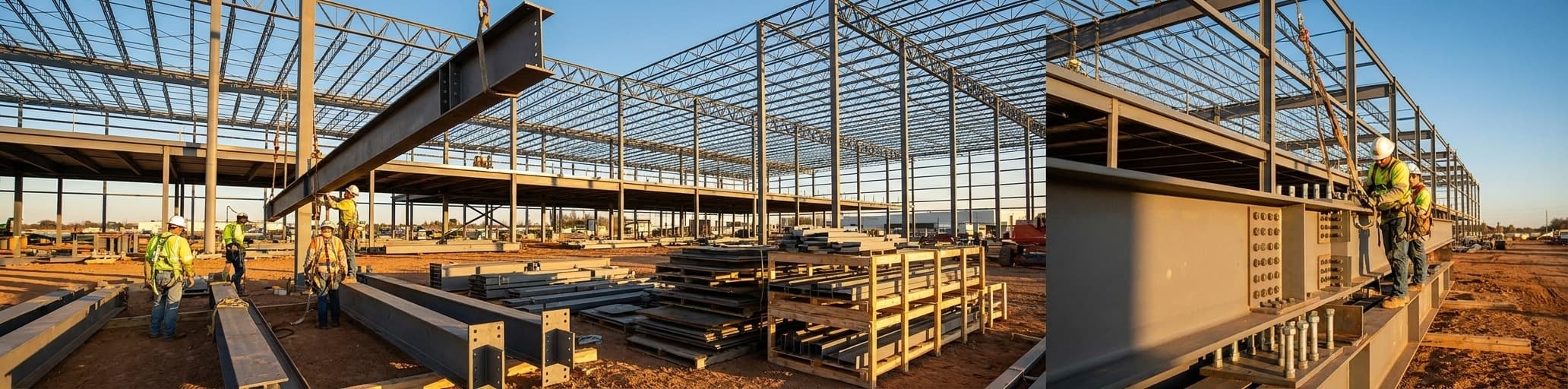

We help you navigate 2026's shift toward integrated design-build contractors who eliminate coordination gaps and budget overruns. Choosing a contractor with in-house erection, national buying power, and clear project ownership protects your timeline and final cost.
The Modern Steel Building Contractor Landscape in 2026
Integrated design-build contracts eliminate coordination errors and accountability gaps by keeping design, fabrication, and erection under one team from start to finish.
Why the steel building industry is shifting toward integrated design-build models
The steel building industry is shifting away from fragmented project delivery–where owners coordinate separate architects, engineers, fabricators, and erectors–toward integrated design-build models where one contractor owns the entire process. Several forces are pushing this change at once.
Labor shortages are driving fabricators toward automation and AI-powered workflows, but those tools only deliver their full value when design and fabrication share the same data environment from day one. [1] Meanwhile, AI-driven detailing tools, 3D modeling, and BIM platforms now allow teams to work on the same structural model in real time, catching clashes before steel is cut and eliminating the coordination errors that fragment traditional delivery. [2] When design, engineering, fabrication, and erection operate as separate contracts, those digital efficiencies get lost at every hand-off point. For commercial warehouse owners, agricultural operators, aviation hangar developers, and anyone else evaluating a steel building contractor, that fragmentation translates directly into schedule risk, budget overruns, and accountability gaps that no single vendor is responsible for fixing.
The integrated model eliminates the gaps–one contract, one timeline, one team accountable for every phase.
What to Expect During Your First Consultation with a Steel Building Contractor
A transparent quote breaks your steel building project into four distinct cost buckets so you see exactly where every dollar goes.
Transparent pricing models: How reputable contractors structure quotes in 2026
The most common question owners ask a steel building contractor is also the least useful one: "What's your price per square foot?" That number hides everything that actually determines your final cost. Two warehouses with identical footprints can carry completely different steel tonnage depending on clear span requirements, local wind and snow loads under ASCE 7-22 standards, door opening sizes, and insulation system choice. [3] In a volatile 2026 market, a $/SF figure without those inputs isn't a quote–it's a guess with a dollar sign in front of it. [4] A transparent quote breaks your project into four distinct cost buckets so you can see exactly where every dollar goes.
The steel package–framing, roofing, siding–runs $25-$35/sq. ft. for a basic shell, $35-$55/sq. ft. for a rigid-frame commercial building, and $60-$100+/sq. ft. for fully finished or complex structures. [3] Foundation and concrete typically adds $8-$12/sq. ft. for a standard slab; erection labor adds another $10-$20/sq. ft.; and permitting and site prep vary by municipality and can't be estimated without a site address and jurisdiction review. [3] Understanding what's optional at quote versus essential later is what separates a budget that holds from one that blows up mid-project.The structural mechanism that protects your budget is the deposit-and-lock approach. Once your scope is finalized–span, height, load requirements, openings, insulation system–a deposit triggers a materials commitment that pulls your steel package out of weekly market movement. [4] A reputable contractor's quote will define exactly what's locked (primary frames, secondary steel, panels), how long the lock holds, and which design changes would reopen pricing. [4] A 30-day quote validity window is standard practice; it gives you time to make a confident decision while protecting the contractor from absorbing market shifts after scope is agreed. [4] If the contractor can't explain their escalation clause clearly, the low number on that quote is a liability, not a discount.
Communication cadence and project ownership: Red flags and green flags in contractor proposals
A contractor proposal tells you far more than scope and price–it tells you who owns the project when things get complicated. The clearest green flag is a named project manager assigned before you sign, with a defined communication schedule written into the contract: weekly status updates, milestone notifications at permit submission, steel release, and delivery, and a direct line that doesn't route through a call center. That structure signals the contractor has managed enough projects to know exactly where communication breaks down and has built systems to prevent it. Red flags look like the opposite: proposals that say "our team will be in touch" without specifying who, contracts that list fabrication and erection as third-party services the contractor merely "coordinates" rather than owns, and quote documents with no mention of how change orders get communicated or approved.
That vague language isn't an oversight–it's a liability disclaimer dressed as a project structure.Project ownership language in a proposal is worth reading word for word. A contractor who writes "we manage the erection subcontractor" is telling you that when the erector falls behind, you'll be mediating between two separate businesses. A contractor who writes "we are responsible for on-site erection" owns that risk. The same logic applies to permitting: "we assist with permits" versus "we pull and manage all permits" are two entirely different commitments with entirely different cost and schedule implications for you.
Before signing anything, ask directly: who calls the county inspector, who resolves a shop drawing rejection, and who adjusts the delivery schedule if steel arrives late? Hedged answers confirm what the proposal's ownership language already signals–and local prefab contractors who blur these lines consistently show up in project delays and budget overruns.
Steel Building Contractor Costs, Timelines, and Deliverables: 2026 Reality Check
Confirm which warranty components are transferable to future buyers, as assignable coverage directly affects your building's resale value.
Warranty, maintenance, and post-installation support: What responsible contractors guarantee
A steel building warranty has multiple layers, and knowing which layer covers what protects you from expensive surprises years after the last bolt is tightened. Workmanship coverage–typically 180 days from installation–addresses errors in how the building was assembled, not material defects. [5] Paint systems carry separate protection: responsible contractors back premium coatings against fading, chalking, and peeling for up to 20 years, with prorated coverage after the first decade. [6] Primary steel framing often carries the longest protection of all–some contractors guarantee full frame replacement at no cost if it rusts through under normal conditions. [6] Panel warranties cover manufacturing defects across roof, wall, and gable components, subject to proper drainage maintenance. [6] Before you sign anything, confirm exactly which components each warranty tier covers, how long each window runs, and whether coverage is assignable to a future buyer–transferable coverage directly affects resale value and is worth asking for in writing.Maintenance requirements are minimal but non-negotiable for keeping your coverage active. Keep debris clear of the roof, maintain proper drainage around the perimeter, and avoid direct chemical exposure to panels. [6] For tubular frames, regular cleaning with mild soap and warm water is the standard requirement–no commercial cleaners. [5] What voids coverage matters as much as what's included: improper modifications, fire or lightning damage, and failure to maintain drainage are standard exclusions across the industry. [5] A contractor who hands over keys without also handing over a written maintenance guide–not a verbal summary, an actual document you can file and reference–is giving you coverage you can't reliably keep.
That guide should specify maintenance tasks by interval so there's no ambiguity about what you're responsible for between inspections.Post-installation support is where contractors who stay accountable separate from those who disappear after final inspection. A direct claims contact–not a general customer service queue–is the baseline expectation. Response time matters: 24 to 48 hours to schedule an inspection after a claim submission is a reasonable standard, and contractors who can't commit to it in writing usually can't meet it in practice. [6] Ask specifically how your contractor handles a warranty claim on a building engineered to local wind and snow loads.
If a structure fails under conditions within its rated specifications, that's a warranty issue, not an insurance claim. [6] A contractor who hedges that distinction is planning to route post-installation problems toward your insurance policy rather than their own warranty obligation–and that's worth surfacing before you sign, not after a storm.
How to Choose a Steel Building Contractor That Delivers Results
Contractors with national buying power and in-house erection divisions lock in better steel prices and eliminate the coordination failures that turn into costly change orders.
Why in-house erection divisions and national buying power matter to your bottom line
Steel is a commodity with weekly price swings, and how your contractor sources materials determines how much of that volatility reaches your budget. Large-volume manufacturers maintain long-term relationships with steel mills and buy in bulk, which lets them lock in more favorable pricing before market spikes hit. [7] Those savings move downstream to you–meaning a steel building contractor backed by national buying power can often deliver on identical scope for less than a smaller local competitor without compromising material quality. [7] Contractors who purchase project-by-project are fully exposed to market conditions at the moment of purchase, and that exposure reliably shows up as change orders mid-build rather than a line item in the original quote. [8]The in-house erection question is just as consequential.
When fabrication and field assembly are handled by separate companies, coordination failures become your problem to mediate–the fabricator points at the erector when timelines slip, and the erector points back at shop drawings. [8] You also absorb a markup layer that subcontracted erection always carries, visible or not. A contractor with its own erection division owns that risk entirely: scheduling, crew performance, and sequencing become internal problems solved before they reach your schedule. [8] That accountability structure directly reduces soft costs–the delays, rescheduling fees, and carrying expenses that rarely appear in a quote but reliably appear on a final invoice.When a single contractor controls both buying power and on-site erection, they have fewer external variables to blame when costs shift, which means a stronger incentive to prevent the shift in the first place. [7] Beyond pricing, scale also delivers access to a wider variety of components, faster lead times, and more refined processes that streamline everything from quoting to delivery. [7] Before signing, ask two direct questions: does this contractor run its own erection crew, or does it subcontract field assembly?
And how many steel structures does it deliver per year? Those answers tell you whether you're working with a contractor who owns your project from first steel to final inspection–or one managing pieces of it through other people's schedules.
- The steel building industry is shifting toward integrated design-build models where one contractor manages design, fabrication, and erection to eliminate coordination errors and schedule risks.
- Price per square foot quotes are misleading without accounting for span requirements, load specifications, door openings, and insulation choices that significantly impact final costs.
- Transparent quotes break costs into four buckets: steel package ($25-$100+/sq ft), foundation/concrete ($8-$12/sq ft), erection labor ($10-$20/sq ft), and permitting/site prep.
- A deposit-lock approach protects your budget by committing materials once scope is finalized, with clear documentation of what's locked and how long the lock holds.
- Verify contractor ownership language: distinguish between contractors who 'manage' subcontractors versus those who directly own erection and permitting responsibilities.
- Warranty coverage has multiple layers with different durations: workmanship (180 days), paint systems (up to 20 years), and primary steel framing (potentially full replacement).
- Large-volume contractors with national buying power and in-house erection divisions absorb market volatility and coordination risks better than project-by-project local competitors.
- https://isenj.com/top-steel-fabrication-trends-for-2026/
- https://www.steelarchdesigners.com/blog/steel-detailing-trends-2026.php
- https://titansteelstructures.com/price-guides/the-2026-steel-building-price-guide-what-to-expect-this-year/
- https://www.tylerbuilding.com/post/2026-metal-building-cost-variables
- https://steelbuildingsandstructures.com/warranty/
- https://www.pacificbuildingsinc.com/metal-building-warranty/
- https://www.google.com/goto?url=CAEShgEB7keqTd4JeJwzux59v8uSjOyGpRo4A-PWOSwjdCbPeoaUJT5MjpVkTAFlclDFss6pQPoVj4psa9c29ksix6–kfvGPtus5vM0OVMhTnIdO5Eu7qEquG5JZRFo8TAmjIxMMCjcYnVJXSIZ0i2bItEy5SUZCA0B6zFvKwUtHaPfV6yWcKmA-w==
- https://www.google.com/goto?url=CAESigEB7keqTZrhkKUaiAhTf8jNmuViNHes4tZ34uZ0V_g9NUhvSMHjfriJ_rOPorVTYTlY59BJOu0upCaXURbGQ_V1qeLRNIRHK6xjqtcwE27R8dkwT-BxjNQVP5Dp1L2OfWOzLKXmoW2cO-LfuUmry89bzmGnipl8CyHiKBDr4nLf8kxJiKB8mZpsP4Y=