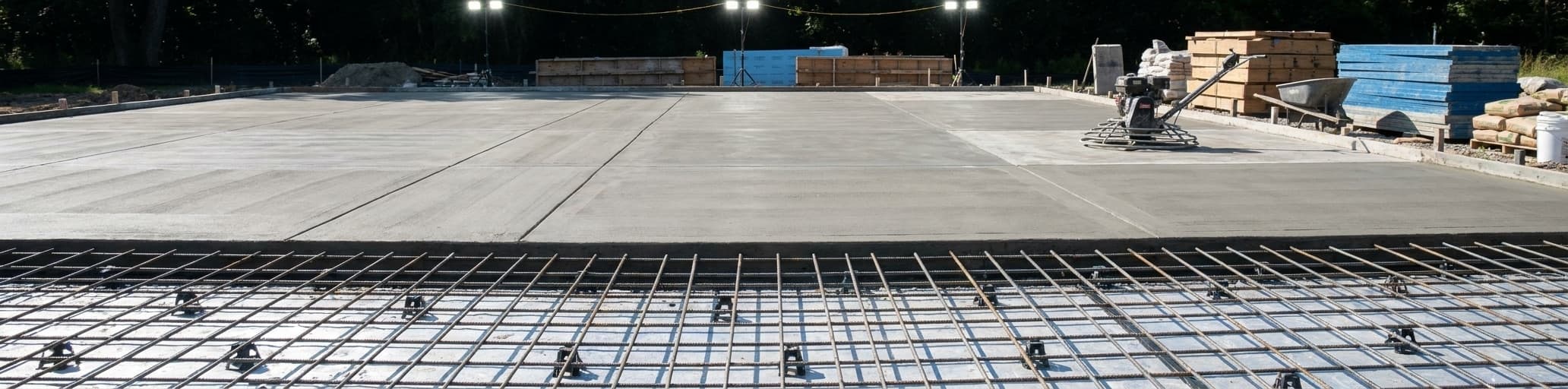

A 30×40 concrete slab costs $6,600 to $16,800 installed depending on thickness and reinforcement, with regional labor rates and site conditions creating swings of $6,000 or more. We help you understand that proper slab thickness, rebar placement, and PSI specifications directly impact durability and long-term cost, making upfront decisions far more valuable than cutting corners.
30×40 Concrete Slab Cost: Direct Pricing & Variables
A 30×40 concrete slab typically costs $6,600 to $11,400 for a 4-inch pour, with regional labor markets shifting quotes by 40% or more.
Total installed cost range for 4-inch and 6-inch slabs in 2026
A 30×40 concrete slab covers 1,200 square feet, and that footprint works in your favor on pricing. Larger slabs spread fixed mobilization costs across more area, pulling the per-square-foot rate toward the lower end of the national range. For a standard 4-inch pour, installed cost runs $6 to $12 per square foot nationally, putting a 30×40 slab at roughly $6,600 to $11,400 total in an average U.S. market.[1] A 6-inch slab — the spec most steel building anchor bolts, heavy equipment pads, and load-bearing foundations require — enters foundation-grade pricing territory at $6 to $14 per square foot, or roughly $7,200 to $16,800 for the same 1,200 square feet.[2] Those ranges assume standard site conditions; regional labor markets can shift a quote by 40% or more for identical work, with coastal states like California and New York running toward the top of the range while central U.S. markets tend to land at or below the national average.[1][3] If you're budgeting a 30×40 metal building with slab cost, use these installed slab ranges as your foundation-cost floor before adding the structure above it.
| Slab thickness | Installed cost per sq ft | Total cost for 1,200 sq ft | Concrete volume needed |
|---|---|---|---|
| 4 inches | $6-$12 | $6,600-$11,400 | ~14.8 cu yd |
| 6 inches | $6-$14 | $7,200-$16,800 | ~22.2 cu yd |
The volume gap between thicknesses drives a meaningful share of that cost difference. A 6-inch pour needs about 50% more concrete by volume than a 4-inch pour — roughly 22.2 cubic yards versus 14.8 cubic yards for 1,200 square feet.[1] At 2026 ready-mix prices of $125 to $175 per cubic yard delivered, that extra concrete volume alone adds approximately $1,100 to $1,300 in material cost before a single hour of labor is billed.[1]
Cost per square foot breakdown by thickness and reinforcement type
Thickness sets the baseline cost, but reinforcement type is where the real per-square-foot spread happens on a 30×40 footprint. Wire mesh — the entry-level option for light storage and sheds — adds $0.30 to $0.80 per square foot.[4] Fiber mesh, blended directly into the concrete mix, runs $0.40 to $0.60 per square foot and saves labor time because there's no reinforcement grid to place and tie.[4] Standard #3 rebar at 18 inches on center, the specification most metal building manufacturers require, adds $0.50 to $1.50 per square foot.[4] Post-tension cables cost the most at $1.50 to $3.00 per square foot, but they're the right call for expansive clay soils where long-term cracking is a persistent risk.[4] Across 1,200 square feet, switching from wire mesh to post-tension cables alone can add $1,440 to $2,640 in reinforcement cost before any change in thickness or concrete mix grade.
| Reinforcement type | Added cost per sq ft | Common application |
|---|---|---|
| Wire mesh | $0.30-$0.80 | Light storage buildings, sheds |
| Fiber mesh | $0.40-$0.60 | General-purpose pours, time-constrained schedules |
| #3 rebar (18" OC) | $0.50-$1.50 | Garages, metal building foundations, driveways |
| Post-tension cables | $1.50-$3.00 | Expansive soils, high crack-resistance requirements |
Thickness multiplies whatever reinforcement cost you're carrying. A 6-inch pour uses 50% more concrete by volume than a 4-inch slab, and an 8-inch pour doubles the volume entirely.[5] Combine a 6-inch thickness with rebar on a 1,200-square-foot footprint, and your total reinforcement and material uplift can add $2,500 or more over a basic 4-inch wire-mesh pour at the same location — before regional labor rates are applied.[4][5]
How site conditions and regional labor rates impact your final bill
Labor alone accounts for 40% to 50% of total concrete slab cost in most U.S. markets, but that share climbs to 60% to 70% in high-demand metros like New York, San Francisco, or Boston.[6] The gap translates directly to your quote: a garage slab priced at $5,000 in Tennessee routinely runs $6,500 to $7,000 in Massachusetts or California for identical thickness and reinforcement.[6] National pricing data puts central-state concrete work around $5.35 per square foot installed, while coastal markets reach $8.50 per square foot — a nearly 60% swing that adds roughly $3,780 to a 1,200-square-foot footprint before any site variable enters the equation.[8] Rural markets often offset lower wage rates with higher material transportation fees, so the cheapest labor market doesn't always produce the lowest all-in number.[7]
Site conditions layer on top of regional premiums and can dwarf the cost of concrete itself. A flat, accessible lot with stable soil and good drainage typically adds $500 to $1,500 in preparation costs — gravel base, simple excavation, basic forming.[6] Stack multiple site challenges — demolishing an existing slab, cutting a sloped grade, stabilizing clay or fill soil — and prep costs can reach $5,000 to $10,000 before the first cubic yard of ready-mix arrives.[6] Uneven terrain, rocky ground, or poor drainage each require excavation, leveling, and compaction work that skilled crews bill at $3 to $8 per square foot in labor alone.[6] Urban job sites add permit fees, restricted equipment access, and higher debris disposal costs that rural projects rarely encounter.[7] On a 30×40 footprint, these compounding factors mean two quotes for the same slab spec can differ by $6,000 or more — purely due to geography and ground conditions.
Slab Thickness, Reinforcement & PSI: What You Actually Need
A 6-inch slab costs 15-20% more upfront but lasts 25-30 years versus 15 years for 4-inch concrete under vehicle loads.
Why 4-inch vs. 6-inch matters: load capacity and cost trade-offsThe mechanical difference between a 4-inch and 6-inch slab is fundamentally about how load travels through concrete to the subgrade. Four-inch slabs are correctly specified for foot-traffic applications — patios, walkways, shed pads — where sustained vehicle stress is absent.[9] Under vehicle loads, 4-inch concrete flexes. That flexing is the origin of cracking: a passenger car or SUV weighing 3,000-5,000 lbs applies load across four contact patches each roughly the size of a hand, and a 4-inch section lacks enough mass to distribute that point load without deflecting.[9] A 6-inch slab provides the depth to spread the same load across a broader subgrade area, absorbing freeze-thaw stress and resisting deflection — studies indicate a 6-inch slab in a freeze-thaw zone lasts approximately 50% longer than a 4-inch pour built to identical standards, even when both are properly constructed.[10] For steel building foundations, where anchor bolt embedment, forklift traffic, and concentrated column loads are the operating reality, that load-distribution margin isn't a luxury. If you're still weighing concrete thickness options for your 30×40 steel building, the load profile of your intended use is the single most important variable to nail down before the first form board goes in.
The cost trade-off favors the thicker spec more than upfront pricing implies. Labor — forming, finishing, curing — costs the same at either thickness; only concrete volume changes.[10] A 6-inch pour runs roughly 15-20% more in total material cost than a 4-inch pour for the same footprint.[10] A 4-inch slab under vehicle or equipment loads typically shows edge cracks within 5-10 years and requires full replacement within 15; a properly constructed 6-inch slab on a prepared subgrade routinely reaches 25-30 years with minimal intervention.[9][10] Spread those costs across a 30-year operating horizon, and the 6-inch slab costs less per year — the upfront premium buys service life the thinner specification simply cannot deliver under real working loads.
Rebar, wire mesh, and fiber reinforcement: which adds what to your budget
The reinforcement decision matters more than most buyers realize — not because the options are expensive, but because choosing the wrong one at the wrong application produces slabs that fail within 2 to 5 years and cost $6 to $18 per square foot to remove and replace.[11] Wire mesh (6×6 W2.9/W2.9) handles one specific job well: it holds shrinkage cracks tight at hairline width during and after curing, preventing them from widening into visible gaps.[11] Installed, wire mesh runs $0.35 per square foot on average, making it the cost-effective call for pedestrian-only slabs — patios, walkways, and shed pads where no vehicle or equipment load ever appears.[12] What wire mesh cannot do is resist the point loads a vehicle or forklift applies. A single #3 rebar has nearly four times the cross-sectional steel area of a single W2.9 mesh wire, and in a standard 18-inch grid, a rebar mat provides roughly 26% more steel per linear foot than standard mesh — along with far greater resistance to flexural cracking under load.[11] Installed rebar (standard #4 at 18 inches on center, the residential vehicle-slab spec) runs $1.50 to $2.50 per square foot — a premium of $0.65 to $2.65 per square foot over wire mesh, or $260 to $1,060 more on a 400-square-foot slab.[12] Against a $2,400 to $7,200 replacement cost when a wire-mesh slab fails under vehicle traffic, that premium is straightforward insurance.[12] Fiber mesh occupies a third position: synthetic polypropylene fibers blended directly into the mix at 1 to 1.5 pounds per cubic yard cost $7 to $12 per cubic yard of concrete and reduce plastic shrinkage cracking in the first 24 hours of curing, but provide no structural reinforcement and do not replace rebar on any load-bearing slab.[11] Steel fibers at 25 to 60 pounds per cubic yard cost $40 to $80 per cubic yard and deliver moderate structural reinforcement, making them a reasonable wire-mesh substitute for some industrial floors — but traditional rebar remains the industry standard for any slab supporting columns, vehicles, or heavy equipment.[11]
| Reinforcement type | Installed cost | What it actually does | Right application |
|---|---|---|---|
| Wire mesh (6×6 W2.9) | ~$0.35/sq ft | Controls shrinkage crack width | Pedestrian-only slabs |
| #3 rebar (18" OC) | $0.50-$1.50/sq ft | Structural tensile resistance | Garages, metal building foundations |
| #4 rebar (18" OC) | $1.50-$2.50/sq ft | Higher tensile capacity, vehicle loads | Driveways, equipment pads |
| Synthetic fiber mesh | $7-$12/cu yd added to mix | Early-cure crack control only | Supplement to rebar, not a replacement |
| Steel fiber mesh | $40-$80/cu yd added to mix | Moderate structural reinforcement | Industrial floors, commercial pavements |
One installation detail controls whether any reinforcement — rebar or mesh — actually works: chair placement.[12] Reinforcement performs only when it sits in the middle to upper half of the slab, where tensile stress concentrates under bending loads.[12] For a 4-inch slab, that means 2 inches above the gravel base; for a 6-inch slab, 3 to 4 inches above the base.[12] Chairs — plastic or concrete supports costing $0.10 to $0.30 each, placed every 3 to 4 feet — hold the steel at that elevation.[12] The common shortcut of laying reinforcement flat on the gravel and dragging it up during the pour almost always leaves the steel near the bottom of the slab, where it contributes almost nothing to structural performance.[12] On a 30×40 steel building foundation, where anchor bolt loads and forklift traffic are the operating reality, verifying chair placement before the pour starts is the single most important quality-control step you can take — once the concrete is moving, it cannot be corrected.[12]
PSI specifications for light-duty, commercial, and heavy industrial use
PSI — pounds per square inch — measures how much compressive force cured concrete can withstand before failure.[13] The number is set by mix design, not by finishing or curing technique alone: a 3,000 PSI mix contains roughly 470 pounds of cement per cubic yard, while a 4,000 PSI mix requires about 580 pounds per cubic yard, and that additional cement is the direct source of both higher strength and higher material cost.[13] The spec you need is a function of your actual load profile, not a preference for a bigger number.
| Use case | PSI spec | Context |
|---|---|---|
| Sidewalks, patios, shed pads | 2,500-3,000 | Pedestrian loads only; no vehicles or equipment |
| Residential garages, standard driveways | 3,000-3,500 | Passenger vehicles; minimum accepted by most residential codes |
| Commercial slabs, parking lots, moderate vehicle traffic | 3,000-4,000 | Light to moderate vehicle loads |
| RV pads, workshops with car lifts, anchored equipment | 4,000 | High-stress contact points; commercial threshold |
| Industrial floors, loading docks, forklift traffic | 4,000-5,000+ | Structural footings; heavy vehicles and sustained point loads |
| High-rise, accelerated-schedule, or specialized pours | 6,000+ | Requires admixtures and controlled curing protocols |
The mistake that generates the most costly failures is treating PSI as a substitute for slab thickness.[13] A 4-inch slab at 4,000 PSI has stronger concrete than a 6-inch slab at 3,000 PSI on the mix ticket — but slabs fail in flexure, not compression, so the thinner slab still bends and cracks under heavy loads regardless of PSI.[13] For a 30×40 steel building foundation carrying column anchor bolt loads and forklift traffic, the correct specification is 4,000 PSI combined with 6-inch thickness — elevating PSI while keeping a 4-inch section does not resolve the structural problem.[14] Overspecifying PSI without matching thickness to the load also wastes budget: a 5,000 PSI slab placed on a poorly compacted subgrade will fail faster than a properly installed 4,000 PSI slab on stable, prepared ground, because performance starts below the concrete, not in the mix ticket.[14] On any commercial or industrial project, the engineer of record and local building code set the minimum PSI — if the two differ, the more restrictive requirement governs, and no preference or cost pressure overrides it.[14]
Material & Labor Cost Breakdown for a 1,200 Square Foot Slab
Order 10% extra concrete to account for waste, and avoid costly short-load fees by ensuring your 1,200 square foot slab exceeds the 10 cubic yard minimum threshold.
Concrete volume Estimates: cubic yards needed and material pricing
Calculating exact concrete volume starts with one formula: multiply length by width by thickness (all in feet), then divide by 27 to convert cubic feet to cubic yards. For a 30×40 footprint, that math is straightforward across common thicknesses — but the number you order should always include a 10% waste buffer to account for over-excavation, form overage, and spillage.[5] A 4-inch pour on 1,200 square feet requires approximately 14.8 cubic yards net, or 16.3 cubic yards with waste factored in. A 6-inch pour rises to 22.2 cubic yards net (24.4 ordered), and an 8-inch pour — the spec for heavy industrial floors and dock approaches — reaches 29.6 cubic yards net, or roughly 32.6 ordered.[5] Every one of those volumes clears the standard truckload threshold of 10 cubic yards, which matters for pricing: orders below that threshold trigger short-load fees of $43 per cubic yard or more, an add-on that inflates effective per-yard cost by 20-50% on small pours but doesn't apply to any full 30×40 slab.[15] Ready-mix delivered pricing runs $125 to $175 per cubic yard nationally in 2026, with the Southeast averaging $120 to $150 per cubic yard and the West Coast reaching $150 to $200 per cubic yard for standard 3,000-4,000 PSI residential and light commercial mixes.[5] The Concrete Network pegs the 2024 national average at $179.89 per cubic yard across a $160 to $195 range — confirming ongoing upward pressure that shows no sign of reversing.[16] Beyond base price, three surcharges inflate material cost without adding concrete: delivery distance charges of approximately $9.75 per mile beyond the supplier's free-delivery radius, weekend and after-hours delivery premiums of $8 per cubic yard, and winter cold-weather surcharges of $5 to $7 per cubic yard for heated mixes and ice-melting additives.[15] On a 30×40 pour, a rural site 40 miles from the nearest batch plant — with a 20-mile free-delivery radius — adds roughly $195 in mileage fees on top of base material cost, before any weekend or winter premium applies.[15] For a full picture of how material cost fits into total 30×40 metal building with slab pricing, the table below maps volume to delivered material cost across all three common thicknesses, using the national price range and the 10% waste-adjusted order quantity.
| Thickness | Net volume | Order with 10% waste | Material cost at $125/yd³ | Material cost at $175/yd³ |
|---|---|---|---|---|
| 4 inches | 14.8 cu yd | 16.3 cu yd | ~$2,037 | ~$2,852 |
| 6 inches | 22.2 cu yd | 24.4 cu yd | ~$3,050 | ~$4,270 |
| 8 inches | 29.6 cu yd | 32.6 cu yd | ~$4,075 | ~$5,705 |
These figures represent concrete material and standard delivery only — reinforcement, forming, labor, and site prep are separate line items.[5]
Labor, site prep, and finishing costs that contractors often underestimate
Ready-mix concrete material represents only 20-35% of the final invoice on a professionally installed slab — labor and finishing account for 40-60%, and site-prep extras cover the rest.[17] Most buyers build their budget around the concrete cost and then receive a contractor quote that is $3,000 higher on a standard project, because finish-driven labor is rarely visible in early estimates.[17] The finish type is the single biggest budget variable: a broom or float finish runs $2.50-$5.00 per square foot in labor, exposed aggregate climbs to $6-$10 per square foot, and stamped concrete reaches $10-$18 per square foot in labor alone — not counting color hardener, release agents, or sealer.[17] Experienced concrete finishers currently bill $25-$45 per hour depending on region, up 15-20% from 2021 levels, which means any quote from a project completed two or three years ago is no longer a reliable benchmark for a 2026 pour.[18] On a 1,200-square-foot 30×40 footprint, switching from broom finish to stamped concrete can add $9,000 or more in labor before a single material specification changes.
| Finish type | Labor cost per sq ft | Total labor for 1,200 sq ft |
|---|---|---|
| Broom or float finish | $2.50-$5.00 | $3,000-$6,000 |
| Exposed aggregate | $6.00-$10.00 | $7,200-$12,000 |
| Stamped concrete | $10.00-$18.00 | $12,000-$21,600 |
| Sub-base (4" compacted gravel) | $0.50-$1.50 | $600-$1,800 |
| Vapor barrier (6-mil polyethylene) | $0.10-$0.20 | $120-$240 |
| Cold-weather protection | $1.00-$3.00 | $1,200-$3,600 |
Sub-base preparation is the line item most frequently missing from owner-built estimates and the most common reason a contractor's quote exceeds a self-calculated number.[17] A proper 4-inch layer of compacted crushed stone or bank-run gravel costs $0.50-$1.50 per square foot, adding $600-$1,800 across a 1,200-square-foot footprint.[17] Skipping it doesn't eliminate the cost — it defers it: slabs on expansive or poorly draining soils without a proper sub-base settle and crack within a few years, requiring full removal and replacement at $6-$18 per square foot.[17] A 6-mil polyethylene vapor barrier adds another $0.10-$0.20 per square foot — a $120-$240 line item for the full 30×40 slab — and is required under any interior concrete floor to prevent moisture migration from the subgrade.[17] Cold-weather pours add a separate and often overlooked cost: any pour scheduled below 50 degreesF requires heated forms, insulated curing blankets, or accelerating admixtures at $1-$3 per square foot, since concrete curing at those temperatures fails to reach design strength and water in the mix can freeze below 32 degreesF, causing permanent structural damage.[18] On a 1,200-square-foot footprint, a pour that slips into late fall or early winter can add $1,200-$3,600 in cold-weather protection costs that appear nowhere in a warm-season estimate.[18]
Hidden expenses: grading, drainage, and frost protection in cold climates
Grading and drainage are the two line items contractors cut first on low-bid jobs — and the two that cause the most slab failures over time. On a site that isn't already level, minor slope corrections may be folded into a contractor's site prep allowance, but significant grade changes, drainage rerouting, or retaining work add $500 to $3,000 or more before any concrete is ordered.[19] Excavation and grading on a standard site costs $1.50 to $5.00 per square foot; rocky ground or sites requiring deep cut-fill work reaches $6 to $10 per square foot.[20] The hidden math gets worse on uneven ground: every half-inch of subgrade irregularity across a 1,000-square-foot slab adds approximately 1.5 extra cubic yards of concrete — a pour-day cost that never appears in the original quote but lands on the invoice.[20] Poor drainage compounds the damage long after the pour is complete, accelerating subgrade erosion and slab cracking — which is why establishing a positive drainage slope of at least 2% away from any structure isn't optional.[20]
Frost protection introduces a separate and often larger cost category for any project in the Northeast, upper Midwest, or Mountain West. Where the ground freezes, footings must extend below the local frost line — 42 to 48 inches deep across much of the Northeast and upper Midwest — which can effectively double the foundation concrete volume compared to a simple slab-on-grade in a warmer climate.[19] A monolithic slab in Georgia costs far less than a frost-wall foundation in Minnesota for the identical building footprint, and that difference has nothing to do with labor rates or material prices.[19] Beyond foundation depth, the American Concrete Institute requires a minimum 4,000 PSI mix with air entrainment at 3 to 6% air content for any slab in a freeze-thaw climate — a specification that adds $5 to $15 per cubic yard over a standard mix and is the single most important defense against surface spalling and scaling from freeze-thaw cycling and deicing salts.[20] Skipping air entrainment in those climates produces visible surface defects within 3 to 5 winters, turning a cost-saving shortcut into a full replacement.[20] A properly built slab with air entrainment lasts 30 to 50 years or more; one without it in a freeze-thaw zone rarely reaches 10 years of acceptable surface condition.[5]
Scheduling a pour in cold weather adds yet another cost layer that warm-season budgets never account for. Any pour below 40 degreesF requires heated enclosures, insulated curing blankets, or accelerating admixtures — precautions that add $2 to $4 per square foot to the installed cost and carry real quality risk if the crew cuts corners.[19] Calcium chloride accelerators, the most common cold-weather admixture, run $5 to $10 per cubic yard as a surcharge on top of base mix pricing.[20] Concrete placed directly on frozen subgrade fails regardless of the mix design — no amount of PSI or admixture corrects that fundamental error — and ACI 306R requires concrete temperature to remain above 50 degreesF throughout the entire curing period on any compliant cold-weather pour.[20] On a 30×40 footprint scheduled in late fall or early winter, these compounding cold-weather measures — heated mix, blankets, extended curing time — can add $2,400 to $4,800 in protection costs that appear nowhere in a warm-season contractor estimate, making fall scheduling timing one of the most consequential budget decisions on any cold-climate slab project.[19][20]
Why Steel Buildings on Concrete Slabs Outperform Other Foundation Options
Concrete pier systems like Perma-Columns deliver 100-plus years of service life by eliminating embedded wood entirely, outlasting your steel frame.
How a properly engineered slab integrates with National Steel Buildings's design
Long-term durability: concrete slabs vs. post-frame and pier foundations The lifespan gap between foundation systems is wider than most buyers expect before they build. Wood posts buried directly in the ground — the traditional post-frame method — carry a realistic service life of 20 to 40 years, and that range is heavily dependent on soil drainage; wet or clay-heavy soils push longevity toward the lower end regardless of preservative treatment.[24] Post-in-concrete footings, where a wood post is set into a hole and concrete is poured around the base, extend that to 40 to 60 years by reducing direct soil-to-wood contact, though the method creates its own risk: a concrete collar that traps water rather than draining it accelerates decay faster than an unprotected wood post in well-drained soil.[25] Concrete slabs on grade reach 40 to 70 years under normal loading conditions, and precast concrete pier systems like Perma-Columns — which eliminate embedded wood entirely — are rated at 100-plus years of service life.[25] For a 30×40 steel building carrying forklift traffic, anchor bolt loads, and column forces concentrated at specific points, the foundation must outlast the steel frame above it, not become the project's weakest link.
| Foundation type | Realistic service life | Primary failure mode |
|---|---|---|
| Wood post in ground | 20-40 years | Rot at soil interface, moisture-driven decay |
| Post in concrete footing | 40-60 years | Water trapping at collar, frost heave |
| Concrete slab on grade | 40-70 years | Cracking on expansive soils, freeze-thaw spalling |
| Concrete pier (precast) | 100+ years | Minimal — eliminates treated wood entirely |
The structural difference between a slab-on-grade and a pier foundation matters most on difficult soils. Engineering research identifies stiffened slab-on-grade foundations — slabs with reinforced perimeter grade beams — as having the highest probability of foundation failure on expansive clay soils, while buildings supported entirely on concrete piers show the lowest failure rates in those same conditions.[24] Frost heave compounds the risk: a slab-on-grade in a freeze-thaw climate is far more vulnerable to heave-driven cracking and settlement than a pier-supported building, because the continuous slab surface gives frost pressure nowhere to release without cracking the structure.[24] Concrete piers also offer a construction sequencing advantage that slabs cannot: when piers are installed before the building shell goes up, the interior concrete floor is poured after the structure is enclosed, protecting the fresh pour from wind, precipitation, and temperature extremes that routinely cause surface defects and strength loss on open-site pours.[24] That sequencing also eliminates the need to pre-plan all below-slab HVAC, plumbing, and electrical rough-ins before concrete is placed — a coordination failure that adds cost and delay to more slab-on-grade projects than most owners anticipate.[24] For a pre-engineered steel building on a 30×40 footprint, a properly reinforced monolithic slab remains the standard foundation choice because it provides the continuous bearing surface anchor bolts require — but on sites with expansive soils or aggressive freeze-thaw cycling, the soil report should drive the conversation before a slab spec is finalized.
Single-source advantage: coordinating your slab with your steel building project
When the concrete contractor and the steel building supplier operate as separate entities with no contractual relationship, the most predictable outcome is a slab that doesn't match the building's anchor bolt plan — and no single party accountable for fixing it.
Design-build delivery eliminates that fragmentation by placing one team in control of both design and construction from the first conversation through project closeout, creating a single point of responsibility for every decision.[26] The practical effect on a 30×40 project is direct: because designers and builders work from the same data set, design decisions account for construction realities before a form board goes in, and problems that surface during design development — an anchor bolt cluster that conflicts with a planned control joint, a slab edge that needs a grade beam under a concentrated column load — get resolved in hours at zero material cost, instead of appearing as change orders mid-pour when the correction requires demolition and re-pour.[26] That timing difference is where the real budget risk lives on multi-contractor projects.
Fast-tracking, the overlapping of design and construction phases that a unified team can execute, typically reduces total project duration by 30 to 50% compared to sequential design-bid-build delivery — a schedule compression that means the building is operational weeks earlier, generating revenue instead of carrying idle-site costs.[26] Professional contractors coordinating both the foundation and the steel erection from a single set of drawings also develop comprehensive schedules that account for every phase: material deliveries, crew sequencing, inspection windows, and concrete curing time before steel erection begins — eliminating the idle-crew gaps that inflate labor invoices on fragmented projects.[27] Design-build projects also typically achieve 15 to 25% cost savings compared to conventional construction approaches because the team makes cost-informed design decisions continuously rather than discovering budget overruns after bids come in.[26] On a 30×40 footprint where the concrete slab cost and the steel kit represent two of the three largest budget line items, that coordination structure is the most reliable path to keeping both numbers within the original budget — every step of the way.
- A 30×40 concrete slab costs $6,600-$11,400 for 4-inch thickness and $7,200-$16,800 for 6-inch, with regional labor rates varying by up to 60% between coastal and central U.S. markets.
- Six-inch slabs cost only 15-20% more in material but last 25-30 years versus 15 years for 4-inch slabs under vehicle loads, making them more cost-effective over time despite higher upfront expense.
- Reinforcement choice significantly impacts cost and performance: wire mesh costs $0.35/sq ft for pedestrian slabs, while #3 rebar at $0.50-$1.50/sq ft is required for vehicle and equipment loads.
- Reinforcement effectiveness depends entirely on proper chair placement in the middle-to-upper half of the slab; laying steel flat on gravel renders it structurally ineffective.
- Site preparation costs of $500-$10,000 and cold-weather protection of $1,200-$3,600 are frequently omitted from initial estimates but significantly impact final project costs.
- A 4,000 PSI concrete mix does not substitute for adequate slab thickness; slabs fail in flexure not compression, so a thin high-PSI slab still cracks under heavy loads.
- Design-build delivery with unified control of foundation and steel erection reduces project duration 30-50% and achieves 15-25% cost savings versus separate contractors.
- https://calcshed.com/concrete-slab-cost/
- https://homeguide.com/costs/concrete-slab-cost
- https://www.angi.com/articles/concrete-slab-cost.htm
- https://metalamericaconcrete.com/blog/concrete-slab-cost-and-what-to-know-in-2026/
- https://www.concreteblockcalculator.com/knowledge-base/cost-of-concrete-slab/
- https://www.ezhomesearch.com/blog/what-does-a-concrete-slab-cost/
- https://royalconcreteoh.com/how-much-does-a-concrete-slab-cost/
- https://www.homeadvisor.com/cost/outdoor-living/concrete-slab/
- https://www.slabcalc.co/guides/concrete-slab-thickness-comparison
- https://www.localconcretecontractor.com/blog/how-thick-should-a-concrete-driveway-be
- https://metalamericaconcrete.com/blog/wire-mesh-vs-rebar-for-concrete-reinforcement/
- https://concreteslabcost.com/rebar-vs-wire-mesh-cost/
- https://www.rocketconcretecompany.com/blog/concretepsi
- https://caseconstruction.com/concrete-strength-101-a-guide-for-busy-general-contractors-and-developers/
- https://www.lawnstarter.com/blog/cost/concrete-price-per-yard/
- https://www.concretenetwork.com/concrete-prices.html
- https://www.concretecalculatormax.com/calculators/slab/concrete-slab-cost-calculator
- https://costflowai.com/blog/concrete/
- https://www.myconcretecalc.com/learn/concrete-slab-cost
- https://estimators.us/concrete-slab-cost/
- https://lococoncrete.com/metal-building-concrete-slabs/
- https://www.hybrid-steel.com/resources/steel-building-foundations/
- https://foundationauthority.com/foundation-anchor-bolt-systems/
- https://framebuildingnews.com/flashback-concrete-piers-in-post-frame-construction-durability-cost-and-design-considerations/
- https://buffalorivertruss.com/blog/pole-barn-foundation-options/
- https://www.gonzalesconstruction.com/services/design-build-delivery/
- https://nordicsteel.construction/building-success-the-top-benefits-of-enlisting-professional-steel-building-contractors/