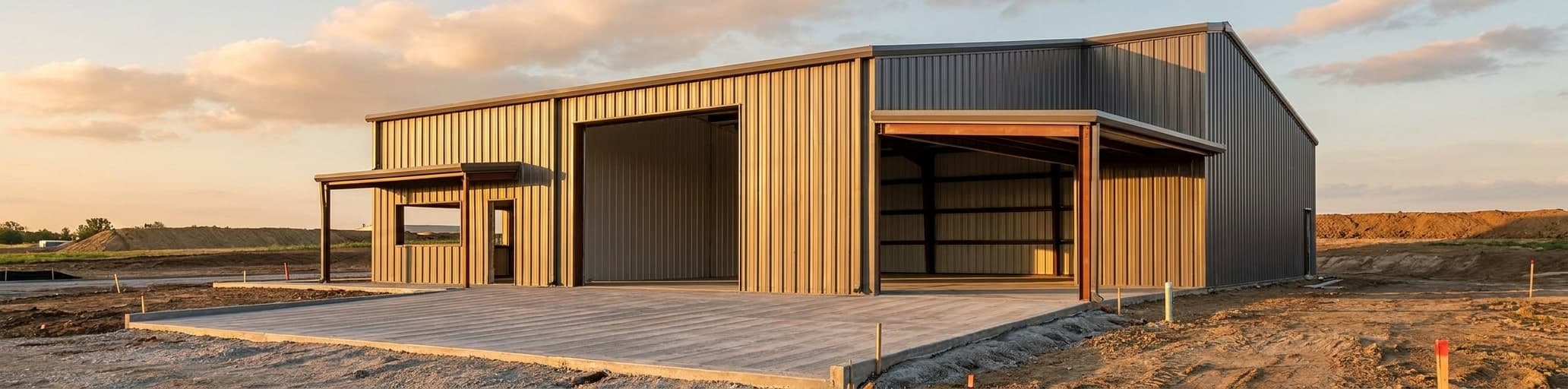

We help you understand 30×60 metal building costs, foundation specs, and layout options so you can make informed decisions before breaking ground. Proper soil testing, concrete specifications, and single-source procurement eliminate costly mistakes and deliver a durable structure built to perform.
How much does a 30×60 metal building actually cost in 2026?
A 30×60 metal building costs $27,000-$63,000 installed and gives you 50% more space than a 30×40 without proportional cost inflation.
Base pricing: $15-$25 per square foot for a 1,800 sq ft structure
Real-world cost comparison: 30×60 vs. 40×80 and 30×40 alternatives Size choice drives total project cost more than almost any other variable. Metal building kit materials run $10-$25 per square foot, with erection labor adding another $5-$10 per square foot on top.[3] Applied across three common footprints, that produces a meaningful spread:
| Footprint | Square feet | Kit + assembly range | Practical fit |
|---|---|---|---|
| 30×40 | 1,200 | $18,000-$42,000 | Single-use shop or garage |
| 30×60 | 1,800 | $27,000-$63,000 | Dual-purpose layout, equipment plus workspace |
| 40×80 | 3,200 | $48,000-$112,000 | Commercial or multi-bay industrial scale |
The 30×60 occupies a useful middle position: 50% more floor space than a 30×40 for a cost premium that stays proportional, while the jump to a 40×80 nearly doubles both the square footage and the kit-plus-labor outlay.[3] For owners who need clear-span room for two to three vehicles plus a dedicated work zone, the 30×60 avoids the higher slab, site prep, and erection costs that come with a significantly wider building.
The pole barn question comes up often at this size: is prefab steel worth it compared to a post-frame structure? A fully installed 30×40 pole barn runs $18,000-$24,000,[4] which lands at the low end of an equivalent steel kit-plus-assembly range. The tradeoff appears in longevity: steel buildings resist corrosion, pests, mold, and fire damage, with a service life of 50-100 years.[3] Appraisers also value pole barns at only 50-70% of construction cost when assessing a property,[4] which can limit the equity return relative to the sticker price. For a permanent facility that will carry daily operational loads — vehicles, equipment, commercial inventory — steel's durability and appraised standing make the modest cost premium straightforward to justify.
Concrete Slab & Foundation Specifications for 30×60 Buildings
Your 30×60 slab must simultaneously distribute building weight, resist wind uplift forces, and maintain level support–three functions that proper specification ensures and improper design undermines.
Why slab design matters: load capacity, climate, and long-term durability
The slab is not just a floor — it is the load-transfer system that keeps your entire 30×60 structure performing as engineered, and it typically represents 15-25% of your total project cost.[5] Pre-engineered steel buildings concentrate force at discrete column points rather than spreading it continuously along wall plates, creating both downward and horizontal load vectors that a standard residential slab design does not address.[5] Metal buildings also generate significant wind uplift forces — the structure acts as a large sail during high-wind events — so the foundation must function as ballast to keep the building anchored to the ground, not merely a surface to rest on.[6] Every properly designed slab must accomplish three simultaneous functions: distribute the building's weight to prevent settling, resist uplift forces from wind and seismic activity, and maintain a level support surface that preserves structural integrity across the building's service life.[5] Climate determines how aggressive your specification needs to be.
In northern climates, frost penetration demands footings as deep as 48 inches, because frozen soil expands with enough force to heave and crack even a well-reinforced slab.[5] Concrete strength is specified — not suggested — at 3,000-4,000 PSI for most steel building applications; using a weaker mix voids the manufacturer's structural warranty and reduces long-term load capacity.[5] A 6-mil polyethylene vapor barrier placed over the compacted gravel base before the pour is equally non-negotiable, preventing ground moisture from migrating through the slab and creating condensation or interior storage damage.[5] Getting these details right during concrete thickness selection keeps the foundation from becoming the most expensive line item you never budgeted for.
Recommended slab thickness, reinforcement, and drainage for 30×60 footprints
For a 30×60 pour, the thickness decision hinges on how the building will be used.
Light storage applications can work with a 4-inch slab reinforced with welded wire mesh (6×6 W1.4/W1.4 standard).[7] Any 30×60 layout that will see vehicle traffic, forklifts, or heavy equipment needs a 6-inch slab with #4 rebar on an 18-inch bidirectional grid — the extra inch and a half of concrete depth, combined with stronger reinforcement, meaningfully reduces cracking risk under point loads.[7] The cost premium is roughly $1.15 per square foot, which adds about $2,070 to a 1,800 sq ft pour: a straightforward trade-off when the alternative is slab repairs.[7] Rebar in a concrete slab is laid center-to-center in a grid pattern at 18 to 24 inches apart in both directions, with pieces fastened together at intersections using wire.[8] For foundation applications specifically, tighter 18-inch spacing is standard practice to maximize tensile resistance where load concentrations are highest.[9] Perimeter beam depth follows soil conditions rather than a single national standard: stable sandy or loamy ground accepts a 12-inch perimeter beam, but expansive clay soil — common across much of the South and Midwest — demands a 24-inch beam to resist the soil's seasonal expansion-contraction cycle before it can crack the slab edges.[7] Drainage is resolved at the grading stage, not after the pour: the finished grade must slope away from all four sides of the slab so surface water never pools against the perimeter beam, where sustained moisture accelerates soil movement and undermines the foundation over time.[7]
Site prep Essentials: grading, soil testing, and permitting before pouring
Soil testing is the single most important step you can take before any concrete work begins on a 30×60 project, and skipping it is among the most common and costly mistakes in steel building construction.[5] A geotechnical engineer takes samples at multiple depths across your building site and analyzes soil composition, bearing capacity, moisture content, and expansion potential.[5] Sandy and gravelly soils typically support 2,000-3,000 pounds per square foot, while clay soils vary dramatically — expansive clay can swell when wet and shrink when dry, cracking slabs and stressing column connections in ways that emerge years after the pour.[5] The $500-$1,500 cost of a soil test frequently prevents correction expenses that run into the tens of thousands: one 60×80 equipment storage owner discovered her clay site required a complete redesign after materials were already ordered, adding $18,000 to the budget and six weeks to the schedule.[5] Your soil report then feeds directly into the foundation engineer's specifications for depth, reinforcement, and drainage provisions.
With soil data in hand, grading becomes a precise operation rather than guesswork. Clear the building footprint of all vegetation, topsoil, and organic debris — organic material decomposes underground and creates settlement voids beneath the slab over time.[11] Rough grading establishes drainage patterns first: the finished grade must slope away from the building in all directions to prevent water from pooling against the perimeter beam.[11] The gravel base beneath the slab — typically 4-6 inches deep — must then be compacted in lifts, with each 4-6 inch layer brought to at least 95% of specified Proctor density before adding the next.[5] A plate compactor or vibratory roller achieves this; hand tamping does not.[5] Underground utility conduits (electrical, water, sewer) should be stubbed and trenched at this stage, before the slab pours — retrofitting utilities through cured concrete costs significantly more and often requires breaking the slab.[10]
Permitting runs parallel to grading and soil work, not after it. Most building departments require stamped structural drawings, foundation plans, and a detailed site plan before issuing any approval — and no physical work should begin until the permit is in hand.[11] Engineering fees for permit-ready foundation drawings typically run $500-$2,000 depending on project complexity, and building permits generally cost 1-3% of the total construction value.[5] Jurisdictions also schedule two key inspections: one before the concrete pour to verify excavation depth, formwork dimensions, anchor bolt positioning, and rebar placement; and a second after the pour to confirm the completed foundation matches the approved plans.[5] Scheduling both inspections in advance is non-negotiable — skipping the pre-pour inspection and proceeding without sign-off can result in forced removal of completed work.[11] Working with vetted steel building contractors who understand anchor bolt tolerances and jurisdiction-specific inspection requirements keeps the permit process predictable and the pour on schedule.
30×60 Metal Building Layouts, Uses & Real-World Applications
A 30×60 metal building's 1,800 square feet of uninterrupted floor space lets you run workshop, storage, and production simultaneously without compromising any function.
Workshop + storage configuration: maximizing 1,800 sq ft for dual-purpose work
A 30×60 steel building's clear-span interior — 1,800 square feet uninterrupted by load-bearing columns — makes genuine dual-purpose use practical rather than a compromise.[12] On the workshop side, the footprint comfortably handles full tool organization, multiple workbenches, dedicated equipment zones, and enough open floor to accommodate a small vehicle fleet simultaneously.[12] The storage function runs alongside it without conflict: steel construction seals out moisture, deters theft, and shields inventory or materials from environmental damage that open-sided or wood-framed alternatives simply cannot match.[12] For production-oriented owners, the same floor accommodates machines, active workspaces, and separate storage areas for raw materials and finished goods — all within a single structure.[12] The configuration works because the open floor plan lets you adjust zone placement, door positioning, and work area sizing to match how your operation actually runs, not a predetermined template.[12]
Agricultural and farm use: equipment storage, livestock shelter, and hay barn setups
The 30×60 footprint is well-matched for mixed-use farm operations because it accommodates equipment storage, livestock quarters, and dedicated hay space within a single structure — without forcing a trade-off between any of them.[14] On the equipment side, the clear-span interior handles tractors, hay balers, and their attachments without internal columns restricting maneuvering room, and the customizable layout lets you position wide roll-up door openings exactly where access is needed for large machinery.[13] Metal panels seal out moisture and weather damage that shortens the service life of expensive equipment stored in open-sided or wood-framed alternatives.[13]
Livestock configurations typically run stalls along one long wall, freeing the center for an aisle and the opposite end for utility rooms. Standard horse stalls require a minimum of 12×12 feet per animal, with 14×14 feet for larger breeds such as warmbloods or drafts.[14] Aisle width should reach at least 10 feet — 12 feet is the practical standard — to allow safe horse handling and tractor access simultaneously.[14] Ventilation is non-negotiable: horses and cattle need 8-12 air changes per hour to prevent respiratory damage from ammonia and humidity accumulation, achieved through gable vents at each end wall, a ridge vent along the roof peak, and optional cupolas for supplemental airflow.[14] Stall flooring in steel agricultural buildings works best as compacted crushed stone (4-6 inches deep) topped with rubber mats rather than full concrete — concrete is too hard on hooves and joints, and horse urine degrades concrete surfaces over time.[14]
Hay storage occupies its own designated zone, separate from stalls — a deliberate fire-risk and dust-exposure management decision rather than a convenience choice.[14] As a practical capacity benchmark, 40 standard bales fill roughly a 10×12 footprint stacked to ceiling height, so a 30×60 layout can reserve a 10×20 hay bay and still retain full stall, aisle, and tack room allocations without crowding.[14] For operations where hay volume is the primary sizing driver, the hay storage barn sizing guide provides a capacity-to-footprint matrix covering structures from 30×40 through 60×120 to help you right-size before ordering.
Commercial and light industrial: garage bays, contractor bases, and retail spaces
The 30×60 footprint earns its place in commercial and light-industrial applications because the clear-span frame removes internal columns entirely, letting you configure garage bays, contractor staging areas, or retail display zones exactly where operations demand.[15] The modular bolt-up bay structure means a contractor base today can convert to a light-industrial tenant space tomorrow — or split between a storefront end wall and a rear service area — without structural modification.[15] That layout flexibility, combined with low operating costs and the ability to add bays as the business grows, makes the 30×60 a practical starting point for owners who want a permanent facility without committing to a single use.[15] A flex-space configuration at this footprint can attract a wider range of tenants over time precisely because the shell adapts rather than dictates: office space, warehouse storage, and light manufacturing can all occupy the same structure at different points in its service life, serving startups now and growing or entirely new tenant types later without major remodel costs.[15]
National Steel Buildings 30×60 Cost & Customization Estimates
Four critical spec decisions–roof style, frame gauge, door configuration, and insulation–shift your 30×60 building cost by $18,000 or more before site conditions apply.
Cost estimator: roof style, height, doors, and insulation impact on final price
Four spec decisions shift your 30×60 quote more than any other variables before site conditions enter the picture: roof style, frame gauge, door configuration, and insulation package. Starting with roof style, vertical panel roofing costs 15-20% more than horizontal panel alternatives, but vertical panels shed water along the seams rather than across them — a meaningful performance difference in high-rainfall regions like the Southeast.[16] That single upgrade moves a basic 30×60 kit priced at $32,400-$39,600 into the $40,000-$50,000 tier when paired with a higher-spec frame.[16]
Frame gauge connects directly to building height and regional load requirements. Upgrading to 12-gauge steel increases material costs by 15-25%, but delivers the structural integrity required for taller sidewalls, heavier snow loads, and commercial-grade use.[16] In hurricane-prone jurisdictions, higher engineering certifications are mandated by code and add 15-30% to the base cost regardless of the gauge you select — a regional factor worth building into your budget before comparing vendor quotes.[16]
Door and insulation choices stack on top of those two decisions. Fully equipped configurations — tall roll-up doors sized for vehicles or equipment, comprehensive insulation, and windows — push the base structure alone to $50,000-$60,000 before any foundation or site work is factored in.[16] Insulation warrants treatment as a first-order decision: it controls condensation, sustains interior comfort, and reduces long-term energy costs, with spray foam and structural insulated panels outperforming standard fiberglass batts on thermal performance for climate-controlled spaces.[16] The table below shows how these spec tiers translate to kit price ranges for a 30×60 footprint.
| Spec tier | Key configuration | Kit price range |
|---|---|---|
| Basic | Standard gauge, horizontal panels, no insulation | $32,400-$39,600 |
| Mid-spec | 12-gauge steel, vertical roof panels | $40,000-$50,000 |
| Fully equipped | Tall doors, full insulation, windows included | $50,000-$60,000 |
| Total installed | Kit + slab + labor + permits (all tiers) | $48,600-$72,000+ |
Customization options that affect pricing: lean-tos, office mezzanines, and utility systems
Three add-ons consistently move a 30×60 quote beyond the base kit tier: lean-tos, office mezzanines, and utility rough-ins.
Each addresses a specific operational need, and each carries a predictable cost impact before a single site condition is factored in.
A lean-to — a single-slope roof extension attached to one or both sidewalls — is among the most cost-effective ways to expand covered square footage without commissioning a full additional structure.[17] A 10-foot-wide lean-to added to one long wall of a 30×60 building adds 600 square feet of covered space at roughly 40-60% of the per-square-foot cost of the primary structure, making it a practical option for equipment staging, covered vehicle storage, or a sheltered loading zone.[17] Office mezzanines occupy vertical space that would otherwise go unused: a 12×20 mezzanine built into one end of the building delivers 240 square feet of finished office or storage area without expanding the footprint, typically at a cost of $15,000-$25,000 installed depending on flooring, stair configuration, and railing spec.[17] Utility systems — electrical panels, lighting circuits, plumbing lines, HVAC rough-ins — are conduit and stub decisions made before the slab pours, not after.[17] Trenching and stubbing all utilities during site prep costs a fraction of what retrofitting through cured concrete demands later, and the customizable features available on prefab steel buildings mean you can spec the conduit locations, panel sizing, and drain placements to match your layout before the pour rather than adapting around a fixed slab.[17]
Why single-source design-build saves money compared to shopping components separately
The hidden cost of assembling a 30×60 project from separate vendors isn't in any single line item — it's in the gaps between them. When you source the steel kit from one supplier, hire a separate foundation contractor, and bring in a third crew for erection, each party works from its own drawings, pricing assumptions, and tolerance standards.
Coordination failures between trades are where projects go over budget: anchor bolt placements that don't match the kit's column pattern, foundation specs that weren't engineered for the actual structural loads, or erection labor that charges time-and-materials to work around components that don't fit as expected. Pre-engineered metal buildings (PEMBs) managed through a single source eliminate that risk by design — one company handles design, fabrication, delivery, and construction, meaning every component is manufactured to fit every other component before anything ships.[19] The Metal Building Manufacturers Association estimates that single-source PEMB projects reduce portions of the installation schedule by 30 to 50 percent compared to conventional builds, and the single-source model produces fewer errors in delivered materials because one manufacturer controls all tolerances from the start.[19] Material savings compound on top of that: built-up framing used in PEMBs saves at least 25 percent in material usage compared to traditional designs that rely on standard hot-rolled sections, which tend to over-engineer structural members in areas where full capacity isn't required.[19] Stacking that material efficiency against the 10 to 20 percent cost savings PEMBs produce compared to custom builds, the price advantage of single-source procurement builds at every phase — design, fabrication, and erection.[18] Every component also falls under a single manufacturer's warranty rather than a patchwork of separate supplier guarantees, which matters when a panel, connection, or frame element needs a warranty claim years after installation.[19] For owners weighing their procurement approach, the turnkey vs. shell pricing comparison reinforces the same conclusion: the margin lost to multi-vendor coordination rarely appears in original quotes, but it almost always appears in the final invoice.
- A 30×60 metal building costs $27,000-$63,000 for kit and assembly, positioning it as a cost-effective middle option between smaller and larger footprints.
- Concrete slab represents 15-25% of total project cost and must be engineered specifically for metal building loads, wind uplift, and regional soil conditions.
- Soil testing before construction is critical; skipping it can result in costly foundation redesigns costing tens of thousands of dollars.
- A 6-inch reinforced concrete slab with #4 rebar on 18-inch grid is required for vehicle traffic and heavy equipment, costing about $2,070 more than basic 4-inch slab.
- Roof style, frame gauge, door configuration, and insulation are the primary cost drivers, with vertical roof panels costing 15-20% more than horizontal alternatives.
- Single-source pre-engineered metal building procurement reduces installation time by 30-50% and eliminates coordination failures between multiple contractors.
- The 30×60 clear-span design accommodates dual-purpose layouts for workshops, storage, equipment bays, and agricultural operations without internal load-bearing columns.
- https://www.cascadingfallsinc.com/what-do-prefab-metal-building-cost-to-construct
- https://metalprobuildings.com/30×60-steel-building-kit-whats-included/
- https://homeguide.com/costs/metal-building-homes-cost
- https://matadorstructures.com/blog/pole-barns-increase-property-value/
- https://mbmisteelbuildings.com/blog/steel-building-foundation/
- https://www.jrhengineering.net/post/metal-building-foundation-design-engineering-solutions
- https://www.northtexassheds.com/concrete-foundation-steel-building-guide
- https://www.procore.com/library/calculators/rebar-calculator
- https://www.rakenapp.com/rebar-calculator
- https://www.metfraa.com/blog/site-preparation-requirements-for-pre-engineered-metal-building-installation/
- https://metalprobuildings.com/preparing-the-site-what-to-do-before-your-steel-building-erection-begins/
- https://bullbuildings.com/30×60-metal-building/
- https://cmtcomponents.com/agricultural-pole-barn-sizes/30×60/
- https://metalbuildingsus.com/metal-buildings-connecticut/metal-barn-guide-connecticut/
- https://trusteelbuildings.com/steel-buildings/flex-space/30×60/
- https://chinasteelbuildsales.com/how-much-does-a-30×60-metal-building-cost/
- https://www.getcarports.com/30×40-metal-building-vs-40×60-metal-building?srsltid=AfmBOoogAHyWao0VG9EXcB0HGQ7GZOB5ik_R8Ta3kaq_WFiJCX2AwFNH
- https://swfunk.com/news/metal-buildings-costs/
- https://www.metalconstructionnews.com/articles/features/metal-building-systems-pre-engineered-metal-buildings/