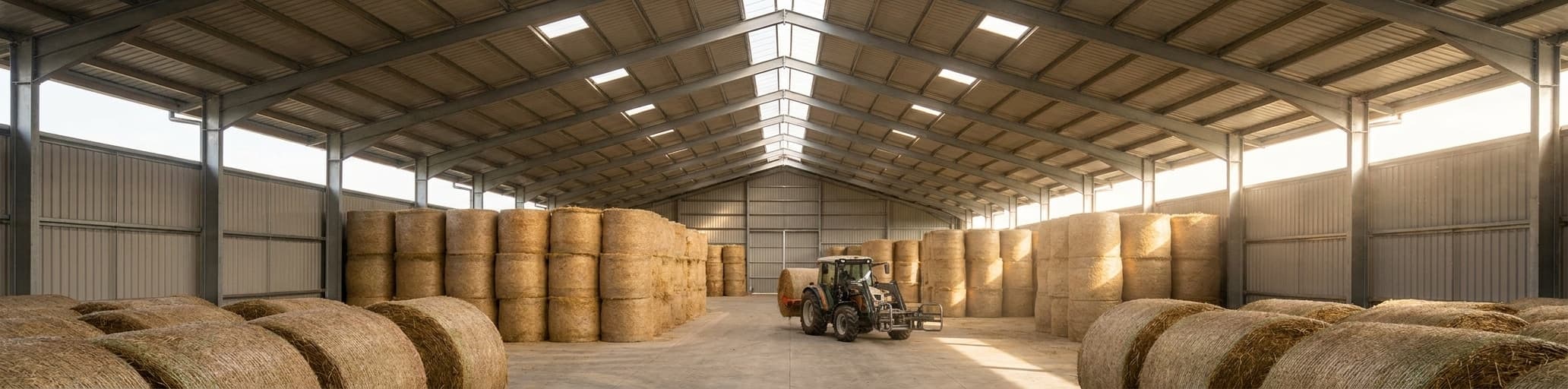

We help you match hay barn size to your herd type, climate, and equipment needs without overbuilding or undersizing. Proper sizing combined with clear-span steel framing and passive ventilation keeps your hay dry and accessible for years while protecting your investment.
Standard Hay Storage Barn Sizes and Bale Capacity: From 30×40 to 60×120
A 40×50 barn gives you the 40-foot span needed for a center drive lane, letting you unload with a tractor instead of hand-carrying every bale to the back.
30×40 and 40×50 barns: ideal for small operations storing 1,000-2,500 bales
A 30×40 footprint gives you 1,200 square feet of covered floor space, and it sits at the low end of practical hay storage barn size for operations running 30-60 head through a full winter feeding season. Bale type is the variable that determines whether 1,200 square feet is enough or a squeeze: round bales require significantly more floor area per ton of dry matter than small square bales do, so the same footprint stores far fewer tons when you're working with 1,000-pound rounds versus 50-pound squares.[8] At $15-$40 per square foot installed for a simple steel or post-frame structure, a 30×40 hay barn typically costs $18,000-$48,000 before site prep, depending on eave height, door configuration, and local labor rates.[9] Stepping up to a 40×50 adds 800 square feet and brings the total to 2,000 square feet — and that added width is where the layout changes meaningfully. A 40-foot interior span lets you run a 10-12-foot center drive lane without losing usable stacking depth on either side, which means you can unload with a tractor instead of hand-carrying bales to the back wall.[9] That operational detail separates a barn you'll use efficiently every day from one you'll work around every time the hay wagon arrives. For a side-by-side breakdown of how footprint translates to actual stacked bale counts across common round and square bale dimensions, the steel hay barn sizes guide covers the math in detail.
| Footprint | Total sq ft | Installed cost range | Key layout advantage |
|---|---|---|---|
| 30×40 | 1,200 sq ft | $18,000-$48,000 | Compact coverage for small square bale storage |
| 40×50 | 2,000 sq ft | $30,000-$80,000 | Wide enough for a center drive lane with round bales |
50×80 and 60×100 barns: mid-size farms managing 3,500-6,000 bales with room for equipment
The 50×80 footprint — 4,000 square feet of covered floor — marks the point where hay storage barn size shifts from pure storage into operational infrastructure. At $15-$40 per square foot installed, a 50×80 structure typically costs $60,000-$160,000 depending on eave height, door count, and local labor rates.[9] The 80-foot depth is the functional driver: it allows a 12-14-foot center drive lane with 30-plus feet of stacking depth on each wall, which means a tractor or skid steer can pull in, deposit or pull a bale stack, and exit without a three-point turn. That eliminates the daily bottleneck that slows down smaller barns during peak feeding season. Stepping to a 60×100 adds 2,000 square feet and pushes installed cost to roughly $90,000-$240,000 at the same per-square-foot range.[9] The extra 10 feet of width makes dual-aisle layouts practical — two parallel drive lanes with a dedicated equipment staging bay at the closed end — which matters when you're cycling 5,000-plus bales through a single season and can't afford a traffic jam inside the barn. At both footprints, materials account for 65-75% of total project cost, so the structural choice between steel frame and post-frame wood carries real long-term weight: metal frames are essentially maintenance-free, while wood structures require ongoing upkeep that compounds over time.[9] For detail on how moisture barriers and wall construction interact with these larger footprints, the 40×80 hay storage building moisture barrier guide covers the specific wall and roof specs that protect nutrient value at scale.
| Footprint | Total sq ft | Installed cost range | Primary workflow advantage |
|---|---|---|---|
| 50×80 | 4,000 sq ft | $60,000-$160,000 | Center drive lane with 30+ ft stacking depth on each side |
| 60×100 | 6,000 sq ft | $90,000-$240,000 | Dual drive aisles with dedicated equipment staging zone |
60×120 and larger: commercial operations and hay dealers storing 8,000+ bales with workflow efficiency
At 60×120 — 7,200 square feet of covered floor space — a hay barn crosses from farm-scale storage into territory where workflow design determines throughput as much as raw square footage does. Drive-through access with wide door openings sized for skid steers and full-size tractors becomes non-negotiable at this scale, and clear-span interiors free of interior posts are what make high-volume bale movement practical without equipment weaving around obstructions.[10] For hay dealers cycling 8,000-plus bales through a single season, concrete floors throughout the building — not just at the entry apron — recover the cost in labor saved: skid steers push bales across concrete without losing traction or creating ruts that disrupt staged loading lanes, and floor drains with interior concrete curbs contain loose feed and simplify cleanup between inventory turns.[10] Overhead and sliding doors belong on the eave side — the long wall — to maintain unobstructed high-traffic access regardless of weather or snowpack.[10] As volume and business mix evolve, partition walls can divide the storage floor into dedicated zones (dealer inventory, farm reserve, active outbound staging) without touching structural posts, keeping the building adaptable across growing seasons without triggering a redesign.[10] Steel siding and roofing eliminate the painting, rot, and rodent-chewing cycles that compound maintenance costs when a commercial operation depends on the structure every working day.[10]
| Feature | Why it matters at 8,000+ bales |
|---|---|
| Clear-span interior, no posts | Equipment moves without routing around obstructions |
| Wide eave-side doors | Drive-through access stays clear in all weather |
| Concrete floors with drains | Skid steer traction, easy cleanup, no ruts |
| Partition walls (addable) | Separates dealer inventory, farm reserve, and staging zones |
| Steel siding and roofing | No paint cycles, rot, or rodent damage at commercial scale |
| Ridge vents and eave overhangs | Passive moisture control across a large storage footprint |
Critical Dimensions for Dry, Functional Hay Storage: Height, Span, and Ventilation Design
Stack your full annual inventory vertically with 20-foot eave height and a 4:12 roof pitch paired with continuous ridge venting to prevent condensation damage.
Roof pitch and eave height: why 18-22 feet minimum prevents moisture trapping and allows vertical stacking
Two dimensions control whether a hay barn stays dry and functional year over year: eave height and roof pitch.
For vertical stacking, the math is direct — round bale storage requires a minimum of 14 feet of sidewall for two-tier stacking, and commercial operations running a telehandler to reach a third tier need 18-20 feet of sidewall clearance.[13] The 20-foot-to-trusses target that experienced hay producers recommend isn't headroom for its own sake; it's the margin that lets you stack your full annual inventory vertically instead of spreading it across floor area you can't afford to sacrifice.[12] Roof pitch works alongside eave height to pull warm, moisture-laden air out before it condenses on bales.
A minimum 4:12 slope — roughly 18 degrees — is the agricultural standard: shallower pitches cause warm air to spread out and stagnate under the roof deck rather than rise toward the ridge vent, which turns the roof into a condensation surface during cold weather.[11] Undersized or poorly designed ridge vents compound the problem; the result is condensation dripping directly onto stored bales, a pattern well documented in older barn designs that relied on spaced cupolas rather than continuous ridge openings.[11] A continuous open ridge vent sized to the barn's full width, combined with eave overhangs of 2-4 feet to deflect rain and snowmelt away from sidewall openings, completes the passive moisture-control system — and steeper roof pitches carry an additional advantage in northern climates: snow is far less likely to block the ridge opening and choke off winter ventilation.[11] Where passive ventilation alone isn't sufficient in high-humidity regions, an insulated roof liner installed beneath the sheeting — a perforated steel or non-woven polypropylene panel — intercepts condensation before it can drip onto the bale stack, and at $1.50-$3.00 per square foot of roof area it consistently delivers the highest return on investment of any single upgrade available for an enclosed hay storage structure.[13]
Bay spacing and column placement: 40-60 foot clear spans eliminate interior posts that block bale movement
The structural decision that most directly affects daily barn operations isn't eave height or door width — it's whether interior support columns exist at all.
A round bale spear mounted on a tractor or a hay squeeze handler requires not just 10-14 feet of vertical clearance but an unobstructed operating width across the full working floor, and any interior column forces the operator to detour, reposition, or hand-carry bales around the obstruction.[13] Metal post-frame and pre-engineered steel construction both achieve 40-80-foot clear spans routinely, eliminating center columns entirely — and for any operation cycling more than 50 round bales per season, that clear interior isn't a design preference but a functional requirement.[13] A 40×60 clear-span barn, for example, can store 250-300 round bales with equipment moving freely from end wall to end wall without routing around structural posts.[14] The practical planning rule that follows from this: reserve at least 20% of total floor area as dedicated equipment access lanes — a figure consistently underestimated during initial barn planning — and size the remaining floor for stacked bale storage based on your calculated annual inventory.[13] No other construction method at agricultural price points matches these span capabilities, which is why clear-span steel framing has become the default structural choice for agricultural buildings where equipment access and storage density must coexist on the same floor plan.[13]
Sidewall sealing, ridge vents, and overhang design: steel barn features that keep hay dry without active climate control
The passive ventilation system in a steel hay barn runs on physics, not electricity. Cool air enters low through eave or soffit openings, picks up moisture released by respiring hay and warmer interior air, and rises toward the ridge where it exits through continuous venting — a convective loop that operates on temperature differential alone, even on windless days.[16] The engineering rule that makes or breaks this system is intake-to-exhaust ratio: intake area at the eave must equal or slightly exceed exhaust area at the ridge.[16] When exhaust venting outpaces intake, the barn depressurizes and draws replacement air through gaps in sidewall panel laps and around door frames rather than through controlled openings — which means unfiltered ground-level moisture enters through paths you can't monitor or seal after the fact.[17] Continuous soffit vents running the full perimeter of the eave, rather than spaced individual openings, wash the underside of the roof deck completely and eliminate the stagnant hot-air pockets that form between isolated vent locations.[17] Ridge vents function particularly well on metal-roofed structures because steel conducts heat readily — the roof deck itself drives warm, moisture-laden air upward and out, amplifying the stack effect without any supplemental equipment.[16]
Sidewall sealing addresses the ground-level half of the moisture problem. Steel panel seams left unsealed at laps and base trim allow capillary moisture from soil and wind-driven rain to migrate into the wall cavity and condense on interior panel surfaces, eventually dripping onto bale stacks positioned near exterior walls.[15] Sealing every panel seam and applying a vapor barrier at the slab perimeter before concrete placement eliminates these infiltration paths at the source.[15] Eave overhangs of 2-4 feet complete the system by protecting soffit vent openings from wind-driven rain and snowmelt — without the overhang, precipitation enters directly through the intake vents that are supposed to admit only dry outside air, undermining the moisture-control logic of the entire assembly.[16] In high-snow-load climates where accumulation could temporarily reduce ridge vent performance, the continuous soffit intake along the full eave perimeter remains the more critical component: even partial ridge coverage still allows the stack effect to move air, and snow behaves more like an insulating blanket than a true air barrier, so a few inches of coverage over the ridge opening causes far less disruption than a blocked soffit run would.[17]
Choosing the Right Size Without Overbuilding: NSB's Sizing Planner Notes and Design Process
Account for herd type, climate zone, storage duration, and equipment access together to right-size your barn and avoid undersizing for one factor while overlooking another.
Sizing factors: herd type, climate zone, storage duration, and equipment needs in one assessment
Different herd types produce meaningfully different storage demands even at identical head counts. Feedlot cattle eat mostly grain with minimal roughage, while bred cows wintered on hay as their primary diet require barn capacity calibrated to that full roughage load throughout the feeding season.[18] Equine operations push hay dependency further still: extension guidance recommends that 70%-100% of a horse's total daily feed come from pasture or hay, at 1.5%-3% of bodyweight per day — a consumption band that makes horse operations among the most hay-storage-intensive enterprises per animal unit on a farm.[19] Climate zone amplifies all of these baseline figures.
Forage demand isn't constant across months: stocking rates and feeding requirements shift as seasons and weather conditions change, and an operation that relies on pasture for most of the year may still need barn space sized for a full winter carry during drought years, when summer pastures underperform and stored hay must fill the nutritional gap.[19] Storage duration — the consecutive months a herd depends entirely on covered, dry feed rather than pasture — is what converts daily intake rates and herd type into an actual barn footprint number. Equipment access requirements close the assessment: feed storage facilities must be located at a convenient distance from feeding areas and remain accessible to tractors for daily delivery, and handling equipment such as front-end loaders and scrapers set real dimensional constraints on minimum aisle widths and door clearances before any bale layout is drawn.[18][19] Running all four variables together — herd type, climate zone, storage duration, and equipment access — in a single pre-design review prevents the most common sizing error: optimizing for one factor while inadvertently undersizing the barn for another.
How National Steel Buildings's custom engineering prevents costly mistakes and ensures code compliance
Sizing a hay barn correctly on paper means nothing if the structure fails plan review. Permits for enclosed agricultural structures almost universally require PE-stamped drawings that demonstrate the design meets local wind, snow, and seismic loads for your specific county.[20] Generic certified drawings use conservative assumptions that apply broadly, but site-specific engineering optimizes each structural member for your exact exposure category, ground snow load, and soil conditions — details that vary county to county and that inspectors increasingly scrutinize as agricultural enforcement tightens.[20] Codes also change without notice, meaning an engineering package that cleared review on a neighboring property two years ago may not satisfy the currently adopted code version on your site today.[21] The practical consequence: a framing upgrade specified after panels are cut and shipped adds redesign cost, material waste, and schedule delay that far exceeds the upfront cost of accurate, location-specific engineering.[21] For a hay barn carrying multi-year inventory and operating heavy bale-handling equipment, the load path from roof to foundation must account for wind uplift, snow drift at the ridge, and the dynamic loads a telehandler or skid steer generates near exterior walls — none of which generic drawings capture, and all of which a permit reviewer can flag before a single anchor bolt is set.[20][21]
| Engineering approach | What it accounts for | Permit outcome |
|---|---|---|
| Generic certified drawings | Conservative national averages across exposure categories | May pass or require plan-review revisions depending on jurisdiction |
| Site-specific PE-stamped plans | Your county's exact design wind speed, exposure category, ground snow load, seismic zone, and soil bearing capacity | Satisfies local plan-review standards; satisfies foundation inspection requirements |
| No stamped drawings | No engineered load verification | Cannot obtain a permit for enclosed structures in most jurisdictions |
The steel gauge, column spacing, purlin sizing, and anchor-bolt pattern in a correctly engineered hay barn are not interchangeable variables — each one is a direct output of your site's load inputs.[21] Swapping a lighter gauge or wider column spacing to trim material cost without re-running the engineering creates a structure that may look identical but performs differently under design-level wind or snow events, and the liability for that gap sits with the property owner, not the fabricator.[20] Getting stamped structural and foundation drawings right before fabrication starts is the single step that closes the loop between a correct sizing calculation and a building that stands inspection, carries its rated load, and protects your hay inventory for the decades you need it to.[21]
From design approval to erection: single-source timeline and support that keeps your project on track
The permitting phase alone can span one to twelve weeks depending on your jurisdiction's plan-review backlog, and revisions triggered by incomplete drawings add another one to two weeks on top of that.[23] Allow two to eight weeks for design and engineering before a permit application is even submitted, which means a realistic pre-construction window runs ten to twenty-two weeks from first design conversation to breaking ground — not counting concrete cure time.[23] A single-source turnkey approach compresses that window by eliminating the handoff gaps where schedule slips most often occur: design, engineering, permit submission, fabrication scheduling, and erection coordination all move through one point of contact instead of across independent vendors who each carry their own lead-time buffers.
The erection phase, once foundation and permitting are correctly sequenced, moves quickly. A 30×40 structure with a four-person crew typically takes three to six days to frame and panel — but that clock does not start until the concrete foundation has fully cured, a process that requires up to 28 days to reach design strength and cannot be rushed without creating structural risk at the anchor bolt connections.[22] Building a 10-15% budget contingency into the total project cost before fabrication begins protects against the scope adjustments and material pricing shifts that arise between engineering approval and erection day.[22] Anchor bolt placement is the one step where a single error ripples through every phase that follows: columns that fail to align with misplaced bolts require drilling new holes or cutting and re-welding base plates, adding measurable cost and pushing every downstream milestone.[22]
| Phase | Typical duration | What controls timing |
|---|---|---|
| Design and site-specific engineering | 2-8 weeks | Project complexity, site load inputs, drawing revisions |
| Permit review and approval | 1-12 weeks | Jurisdiction backlog, completeness of submitted package |
| Fabrication and delivery | 4-10 weeks | Mill lead times, building size, order volume |
| Foundation pour and cure | 28 days minimum | Concrete hydration — cannot be accelerated |
| Frame and panel erection | 3-6 days (30×40 scale) | Crew size, equipment availability, weather |
Submitting a complete, engineer-stamped permit package from the start is the most effective way to avoid revision cycles that push your permit window toward twelve weeks instead of one.[23] When design, engineering, permitting, fabrication, and erection are coordinated through one accountable team, the result is a hay barn that stays within budget and is in the ground before the next feeding season demands it.
- A 40×50 barn with a center drive lane enables tractor unloading instead of hand-carrying bales, fundamentally changing daily operational efficiency.
- Eave height of 20 feet and a minimum 4:12 roof pitch are critical for vertical stacking and proper moisture control through passive ventilation.
- Clear-span interior construction without support posts is essential for operations cycling more than 50 round bales per season to avoid equipment routing around obstructions.
- A continuous ridge vent combined with full-perimeter soffit intake and 2-4 foot eave overhangs creates an effective passive moisture-control system based on temperature differentials.
- Site-specific PE-stamped engineering drawings are required for permit approval and must account for your county's exact wind speed, snow load, and soil conditions before fabrication.
- Reserve at least 20% of total floor area for dedicated equipment access lanes, a figure consistently underestimated during initial barn planning.
- The complete project timeline from design to erection spans 10-22 weeks before foundation cure, making early permit submission with complete drawings critical to avoid revision delays.
- https://sites.udel.edu/canr-animalscience/2018/05/10/hay-cost-calculator/
- https://farmingwork.com/cattle-feed-calculator/
- https://yielix.com/calculators/hay-bale-needs
- https://extension.missouri.edu/publications/g4575
- https://www.beefresearch.ca/topics/stored-forages/
- https://hayandforage.com/article-5708-Battle-of-the-bales-dry-hay-versus-baleage.html
- https://www.morningagclips.com/sizing-a-hay-storage-building-practical-guidance-for-small-and-mid-size-operations/
- https://homeguide.com/costs/cost-to-build-a-barn
- https://homeguide.com/costs/pole-barn-prices
- https://www.shermanpolebuildings.com/hay-feed-sheds/
- https://dairy.extension.wisc.edu/articles/natural-ventilation-in-dairy-buildings/
- https://talk.newagtalk.com/forums/thread-view.asp?tid=169935&DisplayType=nested&setCookie=1
- https://polebarnkits.org/hay-barn/
- https://agribilt.com/metal-barn-buildings/
- https://www.hansenpolebuildings.com/tag/ventilation/?srsltid=AfmBOoow0pkwC3LD9fF2sAyamwko7MKF8EIWDw8xCREvTwQWXVhPI4bi
- https://www.seyardsolutions.com/blog/shed-ventilation
- https://www.greenbuildingadvisor.com/article/lstibureks-rules-for-venting-roofs
- https://extension.oregonstate.edu/catalog/ec-1514-beef-production-small-farms
- https://njaes.rutgers.edu/E296/
- https://metal-america.com/complete-guide-to-metal-buildings/
- https://trusteelbuildings.com/faqs/
- https://iconsteelbuildings.com/how-to-erect-a-metal-building/
- https://metalprobuildings.com/steel-building-blueprints-everything-you-need-to-know-before-you-build/