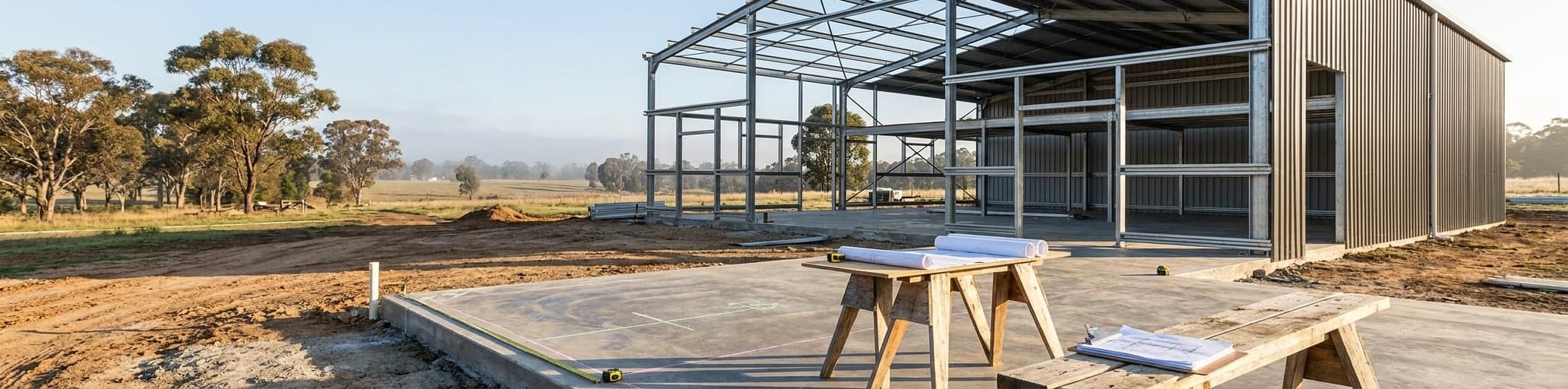

We help you navigate turnkey versus shell pricing by explaining how single-source contractors eliminate coordination gaps that multiply costs across separate vendors. Choosing one accountable builder with in-house crews, proper engineering, and clear permits protects your budget and timeline from the design stage forward.
Why Single-Source Contractors Outperform Multi-Vendor Approaches
When one contractor owns the entire sequence, coordination conflicts get resolved in meetings instead of triggering costly rework after construction begins.
The Coordination Problem When Hiring Separate Steel, HVAC, and Electrical Contractors
Hiring three separate contractors for a barndominium — one for the steel shell, one for HVAC, and one for electrical — looks like a way to control costs.
In practice, it creates a coordination structure where each trade operates in a silo, focused on its own scope and balance sheet without fully considering the needs of the other disciplines.[10] The Clyde & Co construction analysis describes the resulting dynamic plainly: when everyone holds coordination responsibility, no one holds ultimate accountability, and issues fall through the cracks.[10] For a barndominium buyer, that gap shows up as a mechanical rough-in that conflicts with the steel framing dimensions, an electrical panel location that the HVAC contractor didn't know about, or a slab pour that happens before conduit sleeves are confirmed — each a small oversight that triggers a costly redesign or rework sequence.
Ambiguous roles and unclear ownership between stakeholders are explicitly identified as factors that hinder project delivery, compounding the financial damage of any single trade delay.[9] The Birmingham Group's 2026 construction risk analysis reinforces the mechanism: a missed scope item becomes a change-order dispute, a late submittal becomes a procurement delay, and a procurement delay becomes overtime and rework.[11] On a barndominium project with three independently contracted trades, each of those failure points multiplies because no single entity owns the sequencing. Single-source coordination eliminates that finger-pointing by placing design, fabrication, and erection responsibility with one accountable party — meaning schedule conflicts surface in a coordination meeting rather than on the job site after the slab has already cured.
How Integrated Design-Build Teams Prevent Budget Overruns and Delays
National Steel Buildings's Turnkey Advantage: ProTrades In-House Erection Division The decisive advantage of an in-house erection division isn't philosophical — it's operational.
When a steel building company employs its own erection crews rather than farming assembly out to independent subcontractors, labor costs are known rather than bid, scheduling is controlled directly rather than negotiated against competing jobs, and quality standards are enforced by the same people who understood the engineering decisions made at the design table.[14] That consistency matters on a barndominium project because crews familiar with the structural drawings are the ones setting anchor bolts and raising frames on site — closing the gap between drawing and reality that causes rework on shell-only builds coordinated across separate vendors.[14] Financing outcomes also improve under a single-source structure: lenders gain confidence when one contractor provides comprehensive contracts, carries consistent insurance, and maintains a verifiable track record of on-schedule completions — documentation that fragmented multi-subcontractor builds struggle to produce cleanly.[14] The single-point accountability structure means when a question arises mid-erection — a framing dimension that doesn't match a site condition, an anchor bolt placement that needs field verification — the answer comes from the same organization that stamped the drawings, not a phone chain between three separate companies.[15] Cost control is tighter for the same reason: there are no markups flowing between multiple contractor layers, and the in-house team's institutional knowledge of material costs and assembly sequences produces estimates that hold through completion rather than expanding with every change order.[14] For any buyer searching for barndominium contractors near me, the practical question isn't just who can erect a shell — it's who owns the outcome from first drawing to final bolt, with no gap between those two points for delays or budget drift to fill.[15]
Regional Compliance and Site Prep: What Changes Your Barndominium Quote
Your barndominium quote depends on which jurisdiction controls your land–county, city, or private deed restrictions–each with separate permit timelines and requirements.
Zoning Regulations for Barndominiums Across the United States
Zoning authority for barndominiums is not uniform — it fractures along jurisdictional lines that vary state by state and, in some states, county by county within the same hour's drive.[16] Texas illustrates the extremes clearly: most Texas counties lack formal zoning authority and cannot dictate whether land must be classified as residential, agricultural, or commercial, which makes rural barndominiums far more feasible than in metro corridors.[18] Cross into a city's limits, however, and the regulatory structure changes entirely — cities hold full zoning and building code authority, can mandate exterior masonry percentages, restrict metal cladding, and require multiple inspection phases before issuing a Certificate of Occupancy.[18] The band of land between the two — the Extra Territorial Jurisdiction, or ETJ — adds a third layer of complexity, where county building permit authority may coexist with city control over subdivision approval, and written clarification of jurisdiction is essential before land closes.[18] Beyond government zoning, private deed restrictions quietly block more barndominium projects than any permit office does; a parcel can be fully compliant with county codes and still prohibit a metal structure because of recorded subdivision covenants.[18] Outside Texas, the pattern repeats with regional variation: some jurisdictions restrict metal-clad residences outright due to aesthetic standards, while rural areas without municipal sewer systems trigger additional septic permitting requirements that vary by lot size and soil percolation rates.[16] The permits you will typically need — building, zoning, septic, electrical, and driveway — each carry separate application timelines and documentation requirements, and starting the permitting process late is one of the most reliable ways to stall a barndominium project before a single anchor bolt is set.[17] If you are evaluating sites in states with stricter coastal or hurricane-zone codes, understanding how regional wind and weather requirements affect barndominium compliance before selecting a parcel can prevent costly redesigns after a site is already purchased.[16]
Foundation and Site Preparation Costs That Vary by Location
Foundation type is the first location-specific variable that splits barndominium budgets, and your soil determines the decision before your contractor does. On flat, stable land, a concrete slab at $4-$10 per square foot is the most affordable and common option — but heavy clay or sandy soils require additional compaction, reinforcement, or engineering review before any concrete is poured, adding both cost and schedule time before framing can begin.[21] Sloped or uneven terrain shifts the calculus toward a crawl space foundation at $6-$12 per square foot, which also creates accessible utility space beneath the structure and improves drainage on parcels with natural grade challenges.[21] For sites in tornado-prone regions, a partial basement — placed only under the living area to control cost — runs approximately $33 per square foot for excavation and concrete work alone.[21] Pier foundations, which elevate the structure on beams and create a ventilated crawl space, cost between $8,000 and $22,000 depending on site conditions and building dimensions.[21] None of those figures are interchangeable: the foundation type that works on one parcel can be structurally or financially impractical on the next, which is why soil assessment precedes any accurate foundation estimate.
Beyond the slab, the physical condition and topology of your land drives the rest of your site preparation budget in ways that are easy to underestimate on a first walkthrough. Selecting a parcel that is naturally elevated or can be graded economically for water runoff, with minimal tree clearing and brush removal, keeps preparation costs near $3,000-$5,000 on favorable sites.[21] Dense vegetation, rocky terrain, or significant grade changes push those figures higher — and erection crews typically require a 40-foot clearance radius around the building perimeter for safe equipment operation, meaning more land may need clearing than the footprint alone suggests.[21] A 30×40 metal building with living quarters on a compact suburban lot faces a fundamentally different site budget than the same structure on rural acreage, where staging areas, access roads, and material storage add logistical costs before a single truck arrives. Regional labor markets compound the variation: rural areas with lower wage rates produce different trade costs than sites near metro corridors where skilled laborers command premium wages, and material delivery surcharges increase with distance from supply centers.[20] Drainage planning — swales, culverts, French drains, or retaining walls on sloped parcels — is a line item many buyers overlook entirely until stormwater pools against the foundation after completion, requiring costly correction that proper site grading would have prevented from the start.[21]
How Pre-Engineered Steel Structures Simplify Code Approval
The permit application is where commodity kits fail and engineered systems succeed — and the difference comes down to documentation.
Most jurisdictions require stamped engineered drawings, load calculations for wind, snow, and seismic conditions, and full code compliance documentation based on IBC and ASCE standards before they will accept a permit submission.[23] Commodity kits rarely include any of that.
When the documentation isn't part of the package, the burden shifts entirely to the buyer, who must then hire an independent engineer, pay for site-specific calculations, and resubmit — adding weeks or months and thousands of dollars before a single anchor bolt is set.[23] A properly engineered steel building package eliminates those failure points by aligning with local code requirements from the design stage rather than retrofitting compliance after a rejection.[23] The mechanism is straightforward: when load calculations, connection details, and structural member sizing are resolved during engineering, the permit office receives a complete, code-matched submittal rather than a generic spec sheet that inspectors must interpret — and incomplete submittals are one of the most reliable ways to trigger a revision cycle that stalls construction indefinitely.[22] Steel buildings also transfer loads differently than wood framing, which means anchor bolt placement must align precisely with the steel frame and foundation design must match engineered specifications.[23] Suppliers who provide integrated foundation plans as part of the building package eliminate the misalignment risk that causes failed inspections; those who ship components without coordinated foundation engineering leave buyers to reconcile two separately designed systems on site, often at the framing stage when corrections are most expensive.[23] A real-world illustration of the difference: in a documented 30x72x15 barndominium project built with state-stamped engineered drawings, coordinated anchor bolt layouts, and site-specific structural calculations, permitting moved forward without delays or revisions, and installation crews followed clear plans without unexpected field adjustments — because the engineering was complete and accurate before the permit application was filed, not after it was rejected.[23] Once a barndominium includes living space, it is also typically reclassified as a residential structure, which triggers stricter permitting, inspections, and energy efficiency requirements that non-residential steel buildings don't face.[22] Pre-engineered systems designed specifically for residential use account for those additional requirements during engineering, so insulation values, fire ratings, and occupancy classifications are part of the stamped drawings rather than discovered as deficiencies during inspection.[22]
Selecting the Right Barndominium Contractor: Vetting Essentials and Next Steps
Ask your contractor five specific questions about licensing, insurance, in-house trades, and fixed bids before signing anything.
Five Critical Questions to Ask Before Committing to a Contractor
Most barndominium buyers spend more time comparing kit prices than vetting the contractor who will determine whether the project actually finishes on time and within budget. That sequence needs to reverse. The vetting conversation happens before the contract is signed — and five specific questions separate contractors who deliver from those who generate change orders and delays.[24] Choosing the wrong builder based solely on price is one of the most common and costly mistakes in barndominium construction, because an extremely low bid often signals gaps in licensing, insurance, or scope definition that surface as expensive surprises mid-build.[24]
The five questions every owner should ask are:
- Is your contractor's license active in my state, and can I verify the license number myself? Licensing requirements vary by state, county, and municipality — what's required in Texas may not apply in Vermont — and verifying the license number directly through your state's contractor licensing board takes minutes but protects against legal and financial exposure if something goes wrong on site.[25]
- What insurance do you carry, and will you provide a Certificate of Insurance naming me as the certificate holder? At minimum, a barndominium contractor must carry general liability and workers' compensation. Request the certificate directly from the insurer — not just from the contractor — and confirm the coverage is current and sufficient for your project size.[26]
- Which trades are performed in-house, and which are subcontracted? A turnkey quote that routes electrical, plumbing, and HVAC to three separate subcontractors operates differently from a package where those scopes are managed under one roof. Know exactly who touches your project, because each subcontractor relationship is another coordination point where scope gaps and schedule conflicts can develop.[24]
- Will you provide a fixed bid with a fully itemized breakdown — not an estimate? A bid is a firm price for a defined scope; an estimate is an approximation that can expand. Every bid you receive should specify exact materials, their sources, labor costs, subcontractor responsibilities, site condition assumptions, exclusions, and allowances — any vagueness is a future change order waiting to be issued.[25]
- How are delays handled in the contract, and what does the warranty cover? The contract should specify a start date, completion date, and what happens — financially — when the contractor causes a delay. Warranties should cover materials, equipment, and labor, and any manufacturer warranties on materials should transfer directly to you.[25]
Beyond credentials and contract terms, the pre-signing conversation itself tells you something concrete: a contractor who responds slowly to questions during the bidding phase will respond the same way once work begins.[25] Poor communication accounts for 48% of all project rework on U.S. construction sites, making responsiveness during the vetting stage a reliable predictor of how problems get handled mid-build — not just a courtesy metric.[25] Ask how the contractor plans to keep you updated: text, weekly calls, a project management app, or on-site meetings. Then ask what happens when something unexpected occurs — not whether it might, but when it does. A contractor who gives a clear, specific answer to that question has built enough barndominiums to know the answer from experience.[26]
Evaluating Contractor Communication and Problem-Solving Track Record
Getting an Accurate Turnkey vs. Shell Quote from National Steel Buildings The quote conversation is where everything else in this article becomes concrete numbers — and the accuracy of the number you receive depends entirely on the specificity of what you bring to that conversation.
Before contacting any steel building contractor, have four inputs ready: your target footprint and eave height, your finish level (shell only, partial interior, or full turnkey), your construction timeline, and your site location.[30] Without those inputs, any figure a contractor provides is an approximation that will expand when actual site conditions diverge from what the supplier assumed.[29] Two packages priced at $48,000 and $78,000 can look identical on a spreadsheet and perform nothing alike on your land — the difference lives in steel gauge, the paint system's durability rating, whether trusses are engineered to your county's specific wind and snow loads or built from generic tables, and whether stamped PE drawings ship with the package or get sourced separately at your expense.[29] When you request a quote, ask specifically whether the price includes site-specific load calculations, coordinated anchor bolt layouts tied to the foundation plan, and a full bill of materials broken down by structural system — not a single per-square-foot line item.[29] A complete quote specifies materials, sourcing, exclusions, and the site assumptions the price depends on; anything less is an estimate with unpriced variables waiting to become change orders.[30] For a build that includes living quarters, confirm that the engineering package addresses residential code requirements — insulation R-values, fire ratings, occupancy classifications — explicitly in the stamped drawings, because items left to your GC's interpretation tend to surface as deficiencies during inspection rather than before it.[29] If you're working through metal building home floor plan options alongside your quote request, have the preferred layout in hand so the structural engineering reflects actual room placement, door and window counts, and load-bearing wall locations — changes made after engineering is complete add both cost and schedule time that a properly scoped first submission avoids entirely.[29]
- Single-source contractors eliminate coordination gaps that cause costly rework when multiple independent trades operate in silos without clear accountability.
- Zoning and regulatory requirements for barndominiums vary dramatically by jurisdiction, county, and even between city and rural areas within the same region.
- Foundation type is determined by soil conditions and site topology, with costs ranging from $4-$10 per square foot for slabs to $33 per square foot for partial basements.
- Stamped engineered drawings with site-specific load calculations prevent permit rejections and costly redesigns that generic commodity kits frequently trigger.
- Verify contractor licensing, insurance, and in-house capabilities before signing; poor communication during bidding predicts mid-project responsiveness and problem-solving.
- Complete quotes must include site-specific load calculations, coordinated anchor bolt layouts, and full bill of materials; per-square-foot estimates mask hidden variables that become change orders.
- https://mybarndoplans.com/barndominium-kits/
- https://summertownmetals.com/building-kits/huntley-barndominium/
- https://mybarndoplans.com/georgia-barndominiums/
- https://gensteel.com/building-faqs/steel-building-prices/cost-to-build-barndominium/
- https://www.buildingsguide.com/barndominium/?srsltid=AfmBOooZau90EWqVKXkFyaV_U3cVP0AoNqx0PK9Zfe3e1NglJFRaYGtJ
- https://alansfactoryoutlet.com/blog/barndominium-cost/?srsltid=AfmBOorEG_vzzmF4ouy0k8J1iTKW1P0suaZZjWWOGjLclPBfseMVIRrx
- https://www.factorysteeloverstock.com/barndominium-prices/
- https://costtobuildahouse.com/blog/articles/cost-to-build-a-barndominium
- https://www.cottinghambutler.com/post/project-delays-and-cost-overruns
- https://www.clydeco.com/en/insights/2024/12/managing-coordination-risks-in-complex-constructio
- https://thebirmgroup.com/construction-risk-management/
- https://www.fhwa.dot.gov/reports/designbuild/designbuild4.htm
- https://www.plcconstruction.com/epc-vs-design-build-whats-right-for-industrial-projects/
- https://texascompletebarndosolutions.com/the-complete-guide-to-building-a-barndominium-in-texas/
- https://americanwesternsteel.com/the-turnkey-steel-building-advantage-for-midland-businesses/
- https://fabral.com/know-the-codes-for-barndominiums-when-and-where-can-you-build/
- https://info.fbibuildings.com/blog/barndominium-permits
- https://texascompletebarndosolutions.com/can-you-build-a-barndominium-anywhere-in-texas-county-vs-city-rules-explained/
- https://metal-america.com/how-much-does-it-cost-to-build-a-barndominium/
- https://www.steelstructuresamerica.com/barndominium-cost/
- https://info.fbibuildings.com/blog/barndominium-site-prep
- https://norsteelbuildings.com/steel-building-applications/what-is-a-barndominium/
- https://titansteelstructures.com/steel-building-services/barndominium-kits-what-steel-framed-home-buyers-need-to-know-before-they-build/
- https://amiron.pro/blog/barndominium-builders-near-me-a-step-by-step-checklist-to-choose-the-right-team/
- https://barngeek.com/checklist-for-hiring-a-barn-contractor.html/
- https://buildmybarndo.com/how-can-you-find-a-good-barndominium-builder/
- https://www.customstructuressd.com/what-to-look-for-before-hiring-a-barndominium-contractor
- https://bidwellbarndominiums.com/how-to-choose-the-best-barndominium-builders-in-florida/
- https://www.builtwestern.com/barndominium-materials
- https://www.steelstructuresamerica.com/barndominium-planning-checklist/