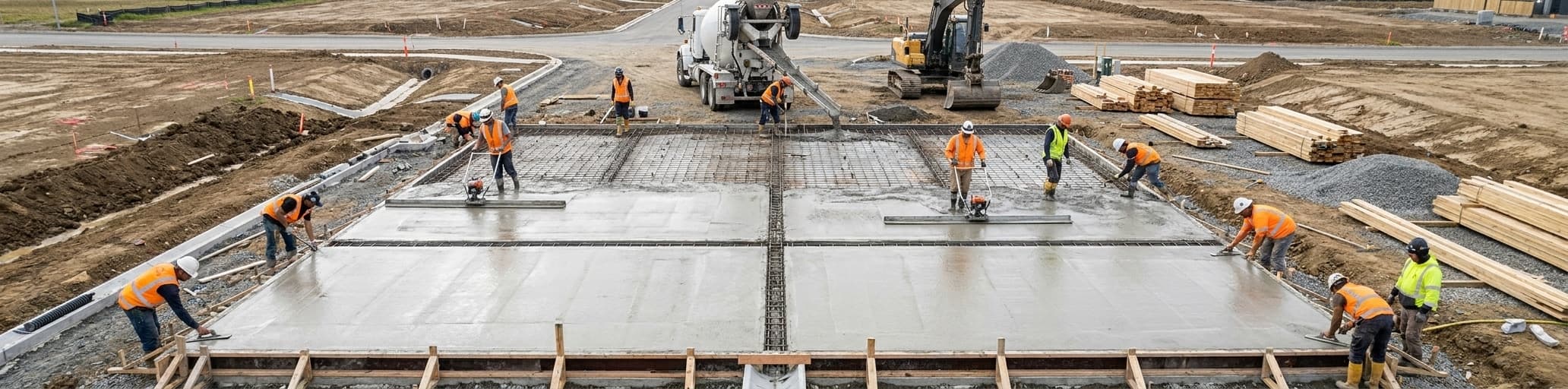

We help you understand 30×40 concrete slab pricing, from material and labor costs to regional variations and hidden site prep expenses. Getting the foundation spec right upfront prevents costly modifications after your steel building is already erected.
What Does a 30×40 Concrete Slab Actually Cost in 2026?
A 30×40 concrete slab costs $6,600 to $11,400 at 4 inches thick or $8,200 to $14,400+ at 6 inches, depending on your load requirements and regional pricing.
Average total cost range for a 30×40 slab (4-inch vs. 6-inch thickness)A 30×40 concrete slab covers 1,200 square feet and costs roughly $6,600 to $11,400 installed at 4 inches thick in an average U.S. market.[1] That translates to $5.50 to $9.50 per square foot — on the lower end of the national $6 to $12 range because larger slabs spread mobilization and setup costs across more area.[1] Step up to a 6-inch thickness, the standard for workshops, equipment pads, and heavy-load applications, and material volume increases by roughly 50%, which pushes total installed cost meaningfully higher.[1] Since materials account for about 50 to 60 percent of the overall price, a 6-inch pour on a 30×40 slab typically adds $1,500 to $3,000 or more compared to a 4-inch pour, depending on your region and reinforcement requirements.[2]
The table below shows how the two thickness options compare at the national average price range for a 1,200 sq ft slab:
| Thickness | Concrete volume | Installed cost range | Typical use |
|---|---|---|---|
| 4 inches | ~14.8 cubic yards | $6,600 – $11,400 | Sheds, light storage, basic pads |
| 6 inches | ~22.2 cubic yards | $8,200 – $14,400+ | Workshops, garages, heavy equipment pads |
Choosing between 4 and 6 inches is not just a budget decision — it's a load decision. A 4-inch slab suits most agricultural storage and light commercial uses. A 6-inch slab is standard where vehicle traffic, heavy machinery, or a steel building with significant point loads will bear down on the foundation. If you're pairing the slab with a prefabricated steel structure, the 30×40 metal building with slab cost typically factors in a 6-inch engineered slab as the baseline, because the combined project demands it.[2] Getting the thickness right from the start is far cheaper than grinding out and replacing an undersized slab after the building is already erected.
Cost per square foot: How 2026 pricing breaks down
The per-square-foot figure in any concrete bid bundles materials, labor, finishing, and basic site prep into a single number — but understanding what moves that number helps you evaluate any quote you receive. In 2026, $7-$9 per square foot is the practical planning baseline for a standard 4-inch pour in an average U.S. market, with the full $6-$12 range representing realistic variation across conditions and regions.[4] Of that installed price, labor accounts for roughly $3-$5 per square foot on a flat, accessible site — though sloped lots, hand-hauling, or decorative finishes push labor alone to $6-$8 per square foot.[1] Materials, delivery, forming, and a basic broom finish make up the balance, with ready-mix concrete and reinforcement together representing about 50% of total installed cost in most projects.[1] Two benchmarks are worth keeping in mind when reviewing bids: anything quoted significantly below $5.50 per square foot usually means site prep, reinforcement, or finish work is being omitted, while anything above $13 per square foot outside high-cost coastal markets warrants competitive bids before you commit.[1]
Regional labor markets and batch-plant proximity shift that per-square-foot figure by 40% or more for identical scope. High-cost metros — California, New York, the Pacific Northwest — push standard work toward $12-$18 per square foot, while competitive rural markets in the South can come in closer to $5.50-$7.[4] In high-demand metro areas, cement mason compensation can exceed $70-$80 per hour, which pushes labor's share of the total above 50%.[1] On a 1,200 square foot slab like a 30×40, those regional swings represent a difference of $7,000 or more in the final bill — which is why a "30×40 concrete slab cost near me" search can return a frustratingly wide spread of numbers, all of them technically accurate for their specific markets.[1]
Why concrete slab costs vary so dramatically by region and site conditions
Regional pricing swings of 40% or more for identical scope come down to four compounding variables: aggregate availability, labor market rates, batch-plant proximity, and climate requirements.[6] Ready-mix concrete prices alone range from roughly $120-$150/yd³ in the Southeast to $150-$200/yd³ on the West Coast, and cement mason labor rates vary by a factor of two between regions — California and New York sitting consistently at the top, while Texas, the Southeast, and the Midwest run significantly cheaper.[6] Large metro areas like Chicago and Los Angeles tend to cluster near the national average, while contractors in smaller markets frequently quote below it.[6] Cold-climate regions layer on further expense: protecting fresh concrete from freeze-thaw cycles requires heated materials, air-entrained additives, and cold-weather blends, which carry winter surcharges of $5-$7 per cubic yard or more on top of the base mix price.[5] Delivery distance adds another variable — suppliers typically charge $9.75 per mile beyond their standard 20-mile delivery radius, meaning a job site 35 miles from the nearest batch plant pays roughly $195 in freight before a shovel hits the ground.[5] Weekend and after-hours pours add $8 per cubic yard on top of that.[5] These variables stack: a cold-climate project with a distant batch plant poured on a Saturday can run $20-$30 per cubic yard more than a comparable pour in a mild Southern market on a weekday.[6][5] That math explains why two accurate quotes for the same 30×40 slab can land thousands of dollars apart — the scope is identical, but the conditions are not.
Concrete Material and Labor Costs: The Real Numbers Behind Your Quote
A 30×40 slab requires 14.81 to 22.22 cubic yards depending on thickness, making ready-mix delivery your only practical option at $125-$200 per yard.
How many cubic yards of concrete does a 30×40 slab require?
The math is straightforward: multiply length x width x thickness (in feet), then divide by 27 to convert cubic feet to cubic yards.[7] For a 30×40 slab at 4 inches thick, that works out to 30 x 40 x 0.333 = 399.6 cubic feet, or approximately 14.81 cubic yards.[8] At 6 inches thick, the volume rises to 30 x 40 x 0.5 = 600 cubic feet, or approximately 22.22 cubic yards.[8] Always order 5-10% more than the calculated volume to account for spillage, subgrade irregularities, and any miscalculation — running short mid-pour is far more disruptive than having a partial yard left over.[8]
| Thickness | Cubic feet | Cubic yards | Overage buffer (7%) |
|---|---|---|---|
| 4 inches | ~400 cu ft | ~14.81 yd³ | ~15.85 yd³ |
| 6 inches | ~600 cu ft | ~22.22 yd³ | ~23.78 yd³ |
At 14-22 cubic yards, ready-mix truck delivery is the only practical option — bagged concrete is cost-effective only for small pours under roughly one cubic yard.[7] For reference, an 80 lb bag yields approximately 0.022 cubic yards, meaning a 4-inch 30×40 slab would require around 665 bags — an impractical quantity that would create significant cold-joint risk if mixed sequentially rather than poured continuously.[8] Ready-mix suppliers deliver concrete in full cubic-yard increments, so round your order up to the nearest whole yard and confirm the plant's standard delivery radius before you schedule the pour, since batch plants typically charge a per-mile surcharge beyond 20 miles that affects your total material cost.[7]
Material costs: Concrete, rebar, wire mesh, and finishing supplies
Ready-mix concrete is typically the largest single material line item, and its delivered price varies more than most buyers expect. Nationally, standard 3,000-4,000 PSI residential mixes run $125-$175 per cubic yard delivered, with the Southeast averaging $120-$150/yd³ and the West Coast pushing $150-$200/yd³.[6] The national average in 2024 sat at $179.89/yd³, and the Producer Price Index for ready-mix rose from 393.5 in December 2025 to 400.0 by April 2026 — confirming continued upward pressure heading into the second half of the year.[6] Applied to a 30×40 slab, that means concrete material alone costs roughly $1,850-$2,600 for a 4-inch pour and $2,800-$3,900 for a 6-inch pour before labor, reinforcement, or finishing are factored in.
Reinforcement is the second material cost to nail down, and the right choice depends on your load scenario, soil conditions, and local code requirements. The four common options for a 30×40 slab break down as follows:
| Reinforcement type | Cost per sq ft | Best application |
|---|---|---|
| #3 rebar at 18" on center | $0.50 – $1.50 | Garages, workshops, metal building foundations |
| Wire mesh (welded wire fabric) | $0.30 – $0.80 | Light storage, sheds, low-traffic pads |
| Fiber mesh (polypropylene) | $0.40 – $0.60 | Crack resistance in standard residential pours |
| Post-tension cables | $1.50 – $3.00 | Expansive or unstable soils |
On a 1,200 square foot slab, the spread between wire mesh and rebar reinforcement alone represents a difference of $240-$840 in material cost — and that gap widens further if post-tension cables are required.[9] Standard #3 rebar at 18 inches on center in a grid pattern is the baseline recommendation for most garage floors, workshops, and metal building foundations because it meaningfully reduces cracking from temperature changes, soil movement, and point loads.[9] Wire mesh handles light storage applications where vehicle traffic and heavy equipment are absent. Post-tension cables are worth the premium on expansive clay soils because they virtually eliminate cracking — but consult a structural engineer before specifying them, since installation requires specialized crews.
Finishing supplies are frequently omitted from kit-price comparisons but add real cost to any poured slab. Forming lumber, stakes, and release agent are required before the pour; a curing compound applied immediately after finishing slows moisture loss and directly affects long-term slab strength.[6] Concrete forms and their setup represent a significant portion of the labor cost — and setting forms on an irregular or sloped site adds both material and time.[6] A broom finish requires no additional materials beyond a concrete brush and curing compound, but any upgrade — exposed aggregate, color hardener, or a smooth trowel finish for an interior floor — adds both material cost and crew skill requirements.[6] Budget finishing supplies and forming materials at roughly $0.50-$1.00 per square foot for a basic broom-finished slab on a flat site, which on a 30×40 pour works out to $600-$1,200 before any decorative options enter the picture.[9]
Labor costs and equipment rental: What contractors actually charge
Labor on a 30×40 slab covers more scope than most buyers expect: form-setting and staking, reinforcement placement, coordination with the ready-mix driver, the pour itself, floating, finishing, and post-pour cleanup.[11] In 2026, that full package runs $3-$5 per square foot on a flat, accessible site, which translates to $3,600-$6,000 in labor cost alone for a 1,200 square foot slab.[11] Angi's data pegs a simpler floor of $2-$3 per square foot for basic pours — but that reflects minimal-scope flatwork, not the complete labor package a structural slab requires.[10] Either way, labor represents one-third to one-half of total installed cost, which means crew efficiency and site conditions carry as much budget weight as the concrete mix itself.[10][11]
Site accessibility is where labor estimates diverge most sharply from the final bill. When a ready-mix truck can back directly to the forms, the crew pours at standard pace and labor stays in the quoted range.[11] Restricted access — narrow gates, steep slopes, or obstacles blocking truck positioning — forces contractors to either pump concrete via a boom pump or transport it manually by wheelbarrow, both of which substantially increase labor hours and add equipment rental costs on top of the base quote.[10][11] Boom pump rental typically adds $800-$1,500 for a half-day engagement plus a per-yard pumping surcharge; wheelbarrow crews covering distance on a 1,200 square foot pour can effectively double the on-site labor time.[11] Confirming truck access before scheduling the pour eliminates this cost risk entirely — and any contractor worth hiring will ask about access before quoting. For a deeper look at how labor, slab thickness, and site factors combine into a single project number, the 30×40 concrete slab cost breakdown by price per square foot walks through each line item in detail.
Regional labor markets drive a wide spread even for identical scope. The table below shows how labor cost per square foot shifts across markets for a standard 30×40 pour:
| Region | Labor cost per sq ft | Market context |
|---|---|---|
| South / rural Midwest | $2.00 – $3.50 | Competitive, lower wage floor |
| National average markets | $3.00 – $4.50 | Midwest, Mid-Atlantic |
| High-cost metros (CA, NY) | $4.50 – $7.00+ | Elevated mason wage rates |
Homewyse's May 2026 national average for fully installed cement slab work sits at $10.33-$12.65 per square foot — a bundled installed figure that captures labor, materials, and standard site prep together, consistent with what full-service contractors quote for structural slabs like garage floors and steel building foundations in average markets.[12]
Site Preparation, Grading, and Hidden Costs That Add Up Fast
A $25-$200 soil test before excavation prevents costly redesigns by identifying expansive clay or contaminated fill early in your project.
Excavation and soil preparation: Why this phase determines your final bill
Excavation and site prep is the phase that most reliably turns a firm bid into a moving target, because no contractor can see what's below grade until they start digging.
For a standard 30×40 slab on level, accessible ground with soft soil, total excavation and grading runs $1,100 to $5,600, or $2.50 to $15.00 per cubic yard.[13] Soil conditions compress or blow out that range fast: sandy and loose soils excavate at the low end, while clay, hardpan, or rock ledge requiring jackhammering can reach $50 to $200 per cubic yard — and hitting an unexpected rock shelf during foundation excavation can push total excavation costs past $15,000 to $20,000 before the concrete truck is even dispatched.[13] Beyond the dig itself, the grading process involves leveling the subgrade, adding and compacting a subbase layer of sand or gravel, and verifying drainage grade — all of which must be completed and inspected before forms are set.[10] Slope multiplies every line item: a pitched lot demands more cut-and-fill work, additional hauling, and sometimes retaining structures that fall entirely outside the concrete bid.[13] Underground obstructions — buried pipes, utility lines, abandoned footings — require extra caution and manual work that slow crew pace and inflate hourly costs regardless of what the original quote said.[13] Soil testing is the cheapest available insurance at $25 to $200 per sample; identifying expansive clay or contaminated fill before excavation begins lets you specify the correct reinforcement type, select the appropriate mix design, and avoid a costly slab redesign after money has already been spent.[13] For a 30×40 application specifically, site prep alone — grading and drainage — typically adds $5,000 to $6,500 to the project before concrete costs are calculated, which is why a soil test before you break ground is money well spent.[3] Most excavation contractors also carry minimum mobilization fees of $500 to $800, meaning even a simple, flat-site job carries a floor cost before a cubic yard of dirt moves.[13]
Drainage solutions and perimeter turn-downs: Essential additions to budget
Drainage is the budget line most buyers skip — and the one that determines whether a 30×40 slab performs for decades or starts deteriorating within years. A properly graded site requires a minimum slope of 1/8 inch per foot away from any structure, directing surface water away from the slab perimeter and preventing pooling at the foundation edge.[14] When that grade isn't established during site prep, water infiltrates beneath the slab, erodes the compacted subbase, and creates the void conditions that cause cracking and settling.[14] If your site has existing drainage problems, budget $500 to $18,000 for a drainage system depending on scope — a range that spans the difference between a simple French drain on a mildly sloped lot and a full retention or dispersal system for a site with serious water management challenges.[10] Additional drainage below the slab itself adds another cost: sand or gravel under the concrete provides a permeable layer that prevents moisture from wicking up through the slab, and that material cost needs to be calculated separately from the concrete volume.[10] Installing drainage infrastructure during the pour is far cheaper than retrofitting it later, and any concrete bid that ignores surface drainage is leaving a significant structural risk off the quote sheet entirely.[14]
Perimeter turn-downs — also called thickened-edge footings — are a separate addition that surprises many first-time slab buyers. Where a standard slab pours at uniform thickness across the entire footprint, a turn-down thickens the concrete at the perimeter edges and extends deeper below grade, creating an integrated structural footing that resists frost heave and lateral soil movement.[14] For garages, workshops, and steel building foundations specifically, a thickened edge is standard practice rather than an optional upgrade — and it adds both concrete volume and forming labor to the project.[14] When comparing quotes for a 30×40 metal building with slab cost, confirm whether the turn-down footing is included in the concrete scope or treated as a separate foundation line item, since its omission is one of the most common sources of budget overruns between the initial quote and the final invoice.[14] Budget drainage grading, subslab drainage material, and the perimeter turn-down together as a package, and verify all three are explicitly itemized in any concrete bid before you commit.[10]
Permit, inspection, and utility location costs you need to anticipate
A 30×40 slab at 1,200 square feet clears the threshold that triggers a building permit in virtually every U.S. jurisdiction — and skipping that step carries consequences far more expensive than the permit itself. For concrete flatwork and structural construction, permit fees run $500 to $2,000 on average, while commercial projects are often calculated at $0.15 to $0.84 per square foot or 1% to 5% of total project value.[15] As a rule of thumb, budget 0.50% to 2.00% of total construction cost for permitting across most markets.[15] On a 30×40 slab project with a total installed cost in the $10,000-$18,000 range, that works out to roughly $100 to $360 at the low end of residential permitting — but commercial applications, ag-industrial use designations, or projects in high-regulation jurisdictions can push fees well past that floor.[15] Building without a permit doesn't just risk fines or a stop-work order; retroactive permits — pulled after construction is already complete — cost $2,000 to $8,000 and require inspectors to evaluate finished work that's already been covered.[15] If your timeline is tight, permit expediting services are available for $300 to $2,000, excluding permit fees, and can cut standard processing time roughly in half.[15]
Inspections are a separate cost line that most concrete bids don't include. Standard home and building inspection fees run $100 to $500, and many jurisdictions require multiple inspections at different construction phases — subgrade verification before the pour, reinforcement inspection before concrete placement, and a final structural inspection after cure.[15] If work fails inspection at any stage, expect a re-inspection fee of $40 to $100 on top of whatever correction costs arise.[15] Residential permits are typically approved within two weeks; commercial permits run closer to four weeks in most markets.[15] New construction projects frequently require utility pre-approvals before a building permit can even be issued — a step that applies directly to slab work involving new electrical conduit, plumbing rough-ins, or sewer connections.[16] Confirming which utility pre-approvals your jurisdiction requires before submitting the permit application eliminates the most common source of processing delays, since an incomplete application restarts the review clock entirely.[16]
How a 30×40 Concrete Slab Fits Into Your Complete Steel Building Project
Your concrete slab represents 20-35% of total installed cost, making early specification critical to avoid expensive foundation modifications after construction begins.
Slab-only vs. slab plus steel building: Total project cost comparisonPricing a 30×40 concrete slab in isolation — $6,600 to $14,400 depending on thickness and region — tells you what the foundation costs, not what the project costs. The number shifts substantially when a pre-engineered steel building goes on top of it. A 30×40 steel building package, covering the rigid frame, roof and wall panels, trim, and fasteners, starts around $16,000 for a standard configuration in competitive markets.[18] That package represents only 40-50% of total installed project cost, with foundation, erection labor, and accessories making up the balance.[17] When you combine all three — slab, package, and erection — a 30×40 installed steel building shell runs $34 to $42 per square foot in mid-cost U.S. markets, putting total shell cost between $40,800 and $50,400 for 1,200 square feet, excluding insulation, MEP, interior finishes, and site work.[17] The table below shows how the cost tiers stack against each other:
| Budget scenario | What's included | Total cost range |
|---|---|---|
| Slab only — 4-inch | Foundation, grading, forming | $6,600 – $11,400 |
| Slab only — 6-inch | Foundation, grading, forming | $8,200 – $14,400 |
| Complete installed shell | 6-inch slab + building package + erection | $40,800 – $50,400+ |
The practical takeaway: the slab represents roughly 20-35% of the complete installed shell budget, not a minor line item you finalize after everything else is locked.[17][18] Getting the slab spec right early — correct thickness, proper reinforcement, engineered turn-downs — prevents the most expensive outcome on any steel building project: a foundation that has to be modified or replaced after the structure is already up. For a full breakdown of how each component interacts and what the national average installed price lands at across different spec levels and regions, the 30×40 prefab building cost calculator walks through every line item in detail.
Why National Steel Buildings's turnkey approach simplifies foundation planning
Most steel building suppliers price and deliver only the steel package — frames, panels, and fasteners — leaving you to separately source, vet, and manage a concrete contractor, an excavation crew, a grading sub, and a permit expediter before a single anchor bolt gets set.[21] That coordination burden carries a real cost beyond the obvious headache: every handoff between separate contractors is a potential schedule gap, scope gap, or budget gap where the slab subcontractor's spec doesn't match the building engineer's anchor pattern, or where the excavation crew grades to the wrong elevation.[19] Not every builder provides complete turnkey construction for their metal structures — and the ones that do reduce complications precisely because foundation design, steel engineering, and erection are managed under a single scope rather than across three separate contracts.[19] A turnkey provider who handles the foundation alongside the building package eliminates the most common source of expensive mid-project corrections: a slab that was poured to the wrong spec for the structure going on top of it.[20] Beyond the direct cost risk, consider the time cost of sourcing and managing independent trades — time spent communicating between contractors to keep schedules aligned and changes communicated is time pulled directly from running your operation.[21]
How single-source accountability changes your foundation budget conversation
When foundation work and steel package pricing sit inside the same contract, every variable that drives slab cost — thickness, reinforcement type, anchor bolt pattern, turn-down depth — gets resolved during engineering rather than discovered during construction.[19] A turnkey provider designs the foundation to match the building's actual load path and anchor requirements from the start, which means the slab spec isn't a generic thickness estimate but an engineered number tied to the specific frame configuration you're ordering.[20] Services like grading, excavation, and concrete represent a significant portion of a metal building budget — but since many manufacturers supply only the steel, those costs frequently go unquantified until a separate contractor submits a bid that doesn't account for the building's foundation requirements.[21] Single-source accountability closes that gap: one estimate covers both the structure and the slab it sits on, which is the only way to get a complete project number rather than a kit price that grows by 30-50% once site work, foundation, and erection are added back in.[21] For a project like a 30×40 steel building where the slab alone represents 20-35% of total installed cost, having foundation scope managed by the same team that engineered the building is the most direct way to keep the complete project within budget.[19][21]
Next steps: Getting an accurate quote for your 30×40 foundation and building
Getting an accurate quote for a 30×40 foundation and building project starts with one piece of information most buyers overlook: your exact location.[23] A precise address or zip code unlocks the local seismic, snow, and wind load data that determines how the steel frame must be engineered — and since two buildings with identical square footage in different locations can carry substantially different structural demands, any pricing without that data is a rough estimate at best.[23] From there, a complete project quote divides into three sequential scopes: site excavation and foundation, steel components, and on-site installation — each of which depends on inputs that feed the others.[23] Once the steel building is engineered, you receive a permit drawing package that includes the anchor bolt layout and precise column load calculations, which a foundation engineer then uses to design and stamp the slab and footing system for your specific site conditions.[22] That sequence matters because the foundation cannot be accurately priced until the building is spec'd, and the building spec depends on site-specific load conditions.[22][23] Before requesting a quote, have four things ready: your location, the building's intended use, any site access constraints, and your target timeline.
A supplier with full turnkey scope can turn those inputs into a complete project estimate covering foundation, steel package, and erection — rather than a kit price that omits the two largest cost drivers entirely.[23]
- A 30×40 concrete slab costs $6,600-$11,400 for 4-inch thickness and $8,200-$14,400 for 6-inch thickness, translating to $5.50-$9.50 per square foot installed.
- Regional variations of 40% or more occur due to concrete delivery costs, labor rates, climate requirements, and batch-plant proximity affecting final pricing.
- Labor represents one-third to one-half of total installed cost, with restricted site access requiring boom pumps or wheelbarrow transport that can double labor hours.
- Site preparation including excavation, grading, and drainage typically adds $5,000-$6,500 before concrete costs and is frequently underestimated in initial budgets.
- A 30×40 slab represents 20-35% of total installed steel building project cost, making proper foundation specification critical to avoid expensive mid-project modifications.
- Perimeter turn-down footings, subslab drainage material, and proper grading are standard requirements often omitted from initial quotes, creating hidden cost risks.
- Building permits cost $500-$2,000 for residential concrete work and require multiple inspections at different construction phases before slab completion.
- https://calcshed.com/concrete-slab-cost/
- https://homeguide.com/costs/concrete-slab-cost
- https://www.concreteblockcalculator.com/knowledge-base/cost-of-concrete-slab/
- https://costflowai.com/blog/concrete-slab-cost-2026/
- https://www.lawnstarter.com/blog/cost/concrete-price-per-yard/
- https://www.concretenetwork.com/concrete-prices.html
- https://www.concretenetwork.com/concrete/howmuch/calculator.htm
- https://www.howmuchconcrete.io/measurement/30×40-concrete-slab
- https://metalamericaconcrete.com/blog/concrete-slab-cost-and-what-to-know-in-2026/
- https://www.angi.com/articles/concrete-slab-cost.htm
- https://www.cdaperformanceconstruction.net/post/how-much-does-a-concrete-slab-cost
- https://www.homewyse.com/services/cost_to_install_cement_slab.html
- https://homeguide.com/costs/excavation-cost
- https://www.myconcretecalc.com/learn/concrete-slab-cost
- https://homeguide.com/costs/building-permit-cost
- https://www.phila.gov/services/permits-violations-licenses/apply-for-a-permit/building-and-repair-permits/get-a-building-permit/
- https://terrapincg.com/news/pre-engineered-metal-building-cost-per-square-foot-usa
- https://www.northtexassheds.com/steel-building-cost-guide
- https://www.summitsteelbuildings.com/understanding-concrete-foundations
- https://iconsteelbuildings.com/steel-building-residential-homes-and-barndominiums-the-future-of-modern-living/
- https://builtmammoth.com/how-much-does-a-steel-building-cost/
- https://norsteelbuildings.com/steel-building-foundations/an-introduction-to-building-foundations/
- https://www.summitsteelbuildings.com/calculating-the-cost-of-a-steel-building