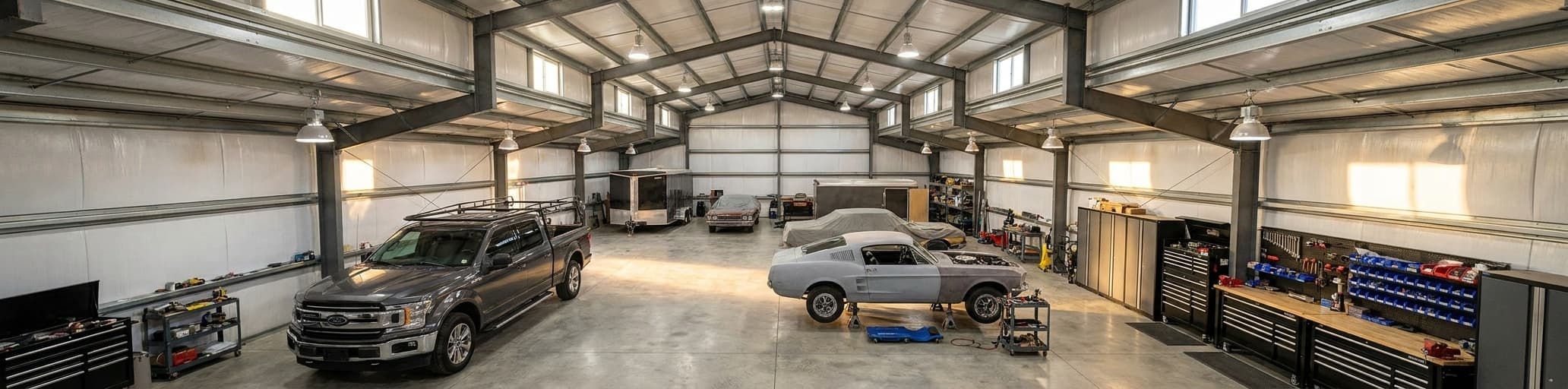

A 40×60 metal garage delivers 2,400 square feet of flexible, column-free space perfect for parking, workshops, or storage, with total installed costs typically ranging from $34,000 to $64,000. We help you understand how pre-engineered steel construction accelerates your timeline and simplifies coordination compared to traditional site-built alternatives.
What you're really getting with a 40×60 metal garage
A 40×60 metal garage delivers 2,400 square feet of column-free space–enough to park six to eight vehicles, run a working shop, and still reconfigure zones as your needs change.
How much usable space does 2,400 square feet actually give you?A 40×60 metal garage gives you exactly 2,400 square feet of column-free floor space — enough to park six to eight standard vehicles depending on how you orient the bays.[1] That footprint sits in a practical range: large enough to run a working shop, store farm equipment, or divide into dedicated zones for parking, tools, and storage, yet not so large that it pushes you into commercial construction territory.[1] The real value of the footprint shows up in flexibility.
You can configure an open floor plan for vehicles, split the space into a workspace zone with a separate storage bay, or set aside a utility room and still have room to move equipment freely.[1] What changes the livable feel of 2,400 square feet isn't the floor area itself — it's eave height and clear span, which determine whether a truck with a rack clears the door or a full-size RV fits without a custom workaround.[1]
Why Eave Height and Clear Span Matter More Than Footprint
Single-Source Steel vs. Site-Built: What Changes Your Timeline The timeline gap between a single-source steel building and a site-built garage comes down to one structural difference in how work gets organized.
Stick-built construction runs in strict sequence: foundation first, then framing crews arrive, then each trade waits for the previous one to finish.[3] A week of rain stops framing cold, and that single delay cascades into pushed-back electrical, plumbing, and finishing schedules.[3] A pre-engineered 40×60 metal garage runs on a parallel track instead — while your slab is curing, the primary steel components are already being cut, drilled, and labeled at the factory.[3] Once the kit arrives on-site, erection moves fast: a smaller crew bolts the entire frame together in a fraction of the time a comparable wood structure would take to frame, because every connection point was engineered to fit before a single piece left the plant.[3] Permitting also tends to move faster with a pre-engineered package because the manufacturer provides stamped, engineered drawings upfront — already designed to your local wind and snow load codes — giving the building department a pre-verified package to review rather than custom plans built from raw measurements.[3] That single-source accountability eliminates the coordination gaps between designer, fabricator, and erector that routinely add weeks to site-built projects.
For a closer look at how installation crew selection affects your overall schedule, metal garage builders near me covers seven questions worth asking before you hire.
Real 40×60 Metal Garage Costs: Breaking Down the Price
A 40×60 metal garage typically costs $34,000 to $64,000 installed, with the steel structure alone running $16,000 to $28,000 before foundation, labor, and customization.
How much does it cost to build a 40×60 garage? (2026 pricing by component)The structure alone on a 40×60 metal garage starts around $28,000 in most markets — and that figure covers only the steel frame, roof and wall sheeting, trim, fasteners, and stamped engineered drawings.[5] Every other cost lands as a separate line item. Once you add the concrete slab, erection labor, and functional upgrades, total installed cost typically falls between $34,000 and $64,000 or more depending on location, spec level, and finish requirements.[4]
Those costs break down by component as follows:
| Component | Typical cost range |
|---|---|
| Steel structure (frame, sheeting, trim, drawings) | $16,000-$28,000 |
| Concrete slab foundation | $9,000-$15,000 |
| Erection labor | $7,200-$12,000 |
| Customization (insulation, doors, windows, finishes) | $8,000-$12,000 |
| **Total installed range** | **$34,000-$64,000+** |
Steel material averages $8-$10 per square foot, and because steel is a commodity, market conditions move that number in either direction.[4] Erection labor adds $3-$5 per square foot on top of material costs — $7,200 to $12,000 for a 40×60 footprint.[4] The concrete slab is an entirely separate budget item at $5-$7 per square foot, putting a standard 40×60 foundation between $9,000 and $15,000 before site grading or soil prep are factored in.[4] Electrical, plumbing, and permit fees sit outside all of these ranges and vary by municipality and site conditions.[5] If you're deciding between a 40×60 and a smaller footprint, the cost breakdown for a 30×40 prefab building shows how per-square-foot costs shift as you scale up.
Concrete slab, foundation, and site prep: What to budget separately
National Steel Buildings cost comparison: Kit vs. turnkey erection The choice between a kit and a turnkey build is really a question of who manages the coordination risk. A standard 40×60 steel building kit — frame, sheeting, trim, and stamped engineered drawings — typically runs $22,868 to $29,892.[8] That number covers materials only. Erection labor is a separate contract, ranging from $3 to $10 per square foot depending on crew rates and regional labor markets, which puts assembly cost between $7,200 and $24,000 for a 2,400-square-foot footprint.[8] The foundation adds approximately $14,000, and erection another $18,000, before you've touched electrical or permitting.[8] When you add those figures to a mid-range kit price, a self-managed kit project lands in the same total ballpark as a turnkey package — except you're the one scheduling crews, resolving conflicts between trades, and absorbing any delay costs when sequencing breaks down. One practical note from real project experience: building manufacturers typically supply stamped engineered drawings as part of the kit package, so the engineering line item that sometimes appears on contractor proposals as a separate expense is often already covered.[9] Confirming that upfront saves you from paying for something you've already purchased.
| Cost line | Kit (self-managed) | Turnkey (single-source) |
|---|---|---|
| Steel package | $22,868-$29,892 | Included |
| Erection labor | $7,200-$24,000 (hired separately) | Included |
| Foundation | ~$14,000 (coordinated separately) | Included |
| Stamped engineered drawings | Typically included with kit | Included |
| Coordination and scheduling | Owner's responsibility | Provider's responsibility |
The financial case for turnkey erection isn't that it's cheaper on paper — it's that it removes the scenarios where self-managed projects go over budget. When an erection crew arrives before the slab is ready, or a foundation contractor misses a utility rough-in, those are owner-absorbed costs in a kit arrangement.[8] A single-source contract transfers that exposure to the provider, who has a direct financial incentive to keep sequencing tight. For most property owners who aren't professional construction managers, the coordination value of a turnkey package is worth pricing against the kit approach before committing to either path.
Layout Options and Configurations That Actually Work
A 15×40 rear utility partition splits your 2,400 square feet into dedicated zones while keeping foot traffic out of the main work bay.
Interior layout Estimates: Parking vs. storage vs. work zones The 2,400 square feet in a 40×60 metal garage rewards deliberate zone planning more than any other single decision. The most proven configuration for owners who need both workspace and vehicle access is a 15×40 office or utility partition — 600 square feet — running across one end, leaving 1,800 square feet of uninterrupted shop floor for lifts, equipment, and moving room.[10] What makes that split effective is placement: a rear utility section keeps foot traffic out of the main bay, separates parts storage and administrative work from active vehicle service, and still leaves enough depth for four lift bays with circulation room on all sides.[10] For operations that don't need a formal office, repurposing the same 600-square-foot zone as a dedicated parts room or enclosed storage section solves a different but equally common problem — keeping consumables, tools, and seasonal items out of the main floor area without sacrificing the clear-span flexibility that makes a 40×60 footprint worth building.
Four layout splits that work well across different use cases, with approximate square footage per zone:
| Layout type | Parking zone | Storage zone | Work zone |
|---|---|---|---|
| Auto shop (4 lifts) | ~800 sq ft (vehicle staging) | ~400 sq ft (parts/supplies) | ~1,200 sq ft (active bays) |
| Workshop plus storage | ~600 sq ft (2-3 vehicles) | ~600 sq ft (enclosed storage) | ~1,200 sq ft (open shop) |
| Equipment storage plus repair | ~1,200 sq ft (tractors/equipment) | ~400 sq ft (parts/tools) | ~800 sq ft (repair zone) |
| Open flex plan | ~1,600 sq ft (vehicles + equipment) | ~400 sq ft (wall-mounted/lofted) | ~400 sq ft (workbench zone) |
Partial partition strategies — a half-wall or curtain divider rather than a full framed wall — work well when operations need visual separation between zones without locking in a permanent layout.[10] Door placement drives how well any of these splits function day to day: entry points positioned to support workflow keep vehicles, foot traffic, and material flow from crossing each other, while poorly placed doors create aisle conflicts that cost time on every shift.[10] Clear-span construction means there are no interior columns forcing those decisions — every zone boundary and door location is fully owner-controlled, which is the practical advantage that makes zone planning worth doing before a single column is set.[10]
Eave height, roof pitch, and door placement for your specific use case
Door clearance is where eave height decisions get technical, and the math matters more than most owners realize until it's too late to change.
An overhead sectional door's hardware requires roughly 16 inches of clearance above the door opening to park when open — add at least 12 inches for the roof system and a nominal 4-inch concrete slab, and a 14-foot door actually requires a minimum eave height of 16 feet 4 inches with a standard flat-bottom chord truss.[11] Scissors trusses are sometimes proposed as a workaround — they allow a taller door opening in a shorter-eaved building by sloping the interior bottom chord — but they cost 15 to 30 percent more than standard trusses of the same span and load rating, and equipment driven too close to the sidewall risks contact with the sloped lower chord.[11] In nearly every case, specifying the correct eave height upfront is more cost-effective than engineering around a shorter one after the fact.[11] For specific use cases, the practical eave benchmarks break down clearly: a 12-foot eave suits owners working within local height restrictions or preferring a lower-profile structure; a 14-foot eave handles boats on standard trailers and full-size trucks with racks; a 16-foot eave opens the building to taller lifts, RVs, and commercial equipment without requiring any door modifications.[10] Roof pitch affects water-shedding performance rather than usable clearance — a vertical roof panel orientation costs more upfront but outperforms a horizontal panel system in long-term drainage and weather resistance, particularly in climates with heavy snow or sustained rain.[10] Door placement shapes workflow more than any other single layout variable: entry points positioned to separate vehicle access from pedestrian traffic and parts flow prevent the aisle conflicts that cost time on every shift, while a poorly placed side door can make even a well-zoned floor plan feel cramped in daily operation.[10]
From Quote to Keys: What to Expect in Your 40×60 Project
Your 40×60 metal building kit price covers only 40 to 60 percent of total costs, so budget $60,000 to $108,000 installed rather than anchoring to the kit sticker price.
Is it cheaper to buy a metal garage or build one? (And why the answer matters)The question itself contains a hidden assumption worth unpacking.
When most owners ask whether it's cheaper to "buy" versus "build," they're comparing a metal building kit purchase against site-built wood-frame construction — but the financially useful comparison is between a metal kit (materials only) and a fully installed metal building (turnkey). A metal building kit typically runs $10 to $30 per square foot and covers only the steel frame, wall panels, roof, and fasteners delivered to your site.[12] The critical detail: that kit price represents just 40 to 60 percent of your total project budget once foundation, erection labor, and site work are added.[12] A 40×60 workshop budgeted at a $36,000 kit price can land anywhere from $60,000 to $108,000 fully installed — a range that makes the kit-only number essentially useless for financial planning.[12] On the metal-versus-wood question, metal wins on upfront cost in most scenarios, and the advantage compounds over time: lower maintenance requirements, longer structural lifespan, and potential insurance premium savings mean the gap between steel and wood widens with each passing year of ownership.[12] The answer to the original question, then, is that buying a steel kit is cheaper than building with wood — but only if you budget for the complete installed cost from day one rather than anchoring to the kit sticker price and letting foundation and labor costs arrive as surprises.[12]
Design, permitting, and fabrication timeline with National Steel Buildings
The design-to-delivery sequence for a 40×60 metal garage follows a predictable path once you understand what triggers each stage — and where the real schedule risks live.
After specs are finalized, stamped engineered drawings calibrated to local wind and snow load codes are typically produced within one to two weeks, giving your building department a pre-verified permit package rather than custom plans requiring independent structural review.[14] Fabrication runs in parallel where jurisdictions allow separate foundation and building permits, and a standard 40×60 steel package typically requires four to eight weeks of factory production time.[13] Once materials arrive on-site, an experienced crew familiar with pre-engineered building systems can assemble the full frame in three to five days — every connection point was engineered and labeled at the factory, so bolting the structure together moves at a pace conventional framing can't match.[13] A crew trained specifically on pre-engineered steel erection can reduce total project time by 20 to 30 percent compared to a general contractor working through an unfamiliar system on your project.[14] Continuous communication between the design team, fabricator, and installation crew is what keeps each stage from stalling the next — delays most commonly occur when those parties are not aligned on sequencing, custom adjustments, or delivery timing.[14] The single biggest on-site variable is foundation readiness: a slab that isn't fully cured or a site that isn't backfilled when the delivery truck arrives forces a rescheduled delivery that adds weeks, not days, to the calendar.[14] Coordinating steel delivery to arrive just before erection begins — rather than sitting on-site through weather cycles — is a logistics discipline that matters as much as the fabrication timeline itself, and it's one of the clearest advantages of working with a provider ranked among the best metal garage companies who manages design, fabrication, and erection as a single accountable contract rather than three separate vendor relationships.[14]
Why communication and custom engineering prevent costly surprises
Communication failures are the most common source of cost overruns in steel building projects — not material prices, not labor rates.
When detailers, fabricators, and erectors work from different drawing revisions, fabricated steel doesn't match site conditions.[16] An approved drawing confirms design intent, not fabrication readiness: a stamped permit set can pass a building department review and still contain connection details left vague, dimensions misread during shop work, or coordination gaps invisible until steel arrives on-site and won't align.[16] For a 40×60 metal garage, the practical risk shows up precisely in connection details — assuming a standard connection where a custom one is required creates structural weaknesses found during erection rather than during engineering review, when fixes cost exponentially more.[15] Inaccurate shop drawings, even by small amounts, can stop installation crews and trigger a chain reaction of delays: one incorrect measurement forces new parts to be fabricated or revised drawings issued before work resumes.[17] Custom engineering matters here because a generic spec sheet doesn't account for your site's soil bearing capacity, local snow loads, door header height for a tall lift, or the eave clearance a loaded hay wagon actually needs — each of those variables must be engineered deliberately, not assumed from a catalog default.[15] The answer to preventing costly surprises on a 40×60 project isn't a larger contingency budget; it's a single-source provider who controls design, fabrication, and erection under one contract, so a revision changing a header height is immediately reflected in shop drawings, the delivery sequence, and the erection plan — rather than discovered by a crew working from an outdated set on pour day.[17]
- A 40×60 metal garage provides 2,400 square feet of column-free space suitable for 6-8 vehicles or flexible zoning of parking, workshop, and storage areas.
- Pre-engineered metal buildings run parallel construction timelines with factory fabrication occurring while foundations cure, reducing total project time versus sequential stick-built construction.
- Total installed cost for a 40×60 metal garage ranges from $34,000 to $64,000+, with the steel structure alone starting around $28,000 before foundation and labor are added.
- Kit-only pricing of $10-30 per square foot represents just 40-60% of total project budget; complete installed cost is the only meaningful financial planning figure.
- Eave height must be specified correctly upfront based on door clearance needs; a 14-foot door requires minimum 16'4" eave height, and correcting this later costs significantly more.
- Single-source turnkey providers eliminate coordination gaps between design, fabrication, and erection teams, preventing costly delays from miscommunication and misaligned drawing revisions.
- Layout planning with deliberate zone separation–such as a 600 sq ft utility partition–maximizes functionality while maintaining the clear-span flexibility that justifies the 40×60 footprint.
- https://qebuildings.com/2025/09/how-much-is-a-40×60-metal-building/?srsltid=AfmBOoqjSwjKdLRabzxQ_U1I_VznGmLybX16tsgRnjRE1VmeMSkBCyrk
- https://cdmg.com/building-faqs/ultimate-guide-to-designing-your-metal-building
- https://iconsteelbuildings.com/metal-building-vs-stick-built/
- https://www.smaestimating.com/40×60-morton-building-cost/
- https://www.northtexassheds.com/steel-building-cost-guide
- https://buildmax.com/realizing-the-cost-of-a-40×60-concrete-slab/?srsltid=AfmBOopJ88vWXVaX7oJAY97r2IKajUzryDd26tEJMn7QSzshtzP8yIYd
- https://www.carportsadvisor.com/blog/metal-building-foundation-options?srsltid=AfmBOor3M9lhvzU5L2t1bKIOdDst0bkHFf_9EreK9aspP63O18-TrCFV
- https://quonsethutkit.com/40×60-metal-building-cost-prices/
- https://www.practicalmachinist.com/forum/threads/cost-for-new-construction-engineering-site-plans-for-metal-building.399614/
- https://metal-america.com/40×60-metal-building-guide/
- https://www.hansenpolebuildings.com/tag/overhead-doors/?srsltid=AfmBOorQw2cUlyQfwuDYJYj9olbcystQkZeZhu99-FuLsYPUp-k2A_Xl
- https://iconsteelbuildings.com/how-much-are-metal-buildings/
- https://www.mtnssb.com/how-quickly-can-a-metal-building-be-erected-when-done-correctly/
- https://peb.steelprogroup.com/steel-structure/building/metal-building-construction-time/
- https://tjsteeldetailers.com/common-mistakes-in-steel-detailing/
- https://www.gsourcedata.com/why-structural-steel-projects-fail-despite-approved-drawings/
- https://excel-steel.com/steel-fabrication-failures-that-can-derail-commercial-building-construction-projects/