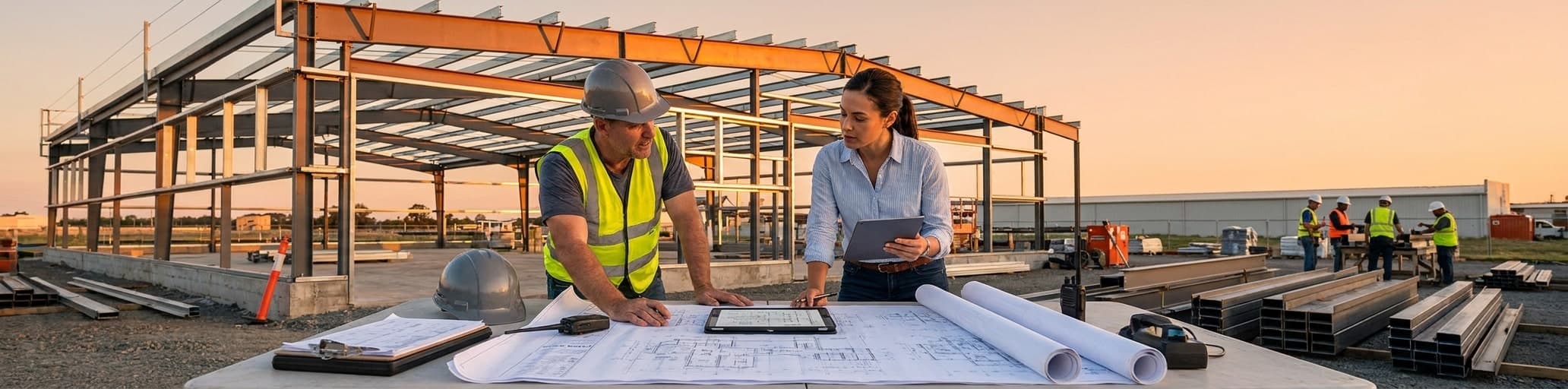

We help you navigate the seven critical questions that separate metal garage builders who protect your budget from those who let costs spiral through poor planning and accountability gaps. A single-source builder with turnkey responsibility, transparent change order discipline, and fixed-price contracts keeps your project on schedule and within the estimate you signed.
Why the Right Metal Garage Builder Makes or Breaks Your Project
Nearly 70% of construction projects exceed budget due to hidden costs–choosing a builder who handles design through erection prevents the coordination gaps that drain your finances.
The hidden costs of hiring the wrong builder
Most buyers underestimate both hidden costs and time commitment when planning a metal garage project — quotes that look competitive on paper routinely expand well before a building is finished.[1] Industry data backs this up: nearly 70% of U.S. construction projects exceed their initial budget, with poor cost estimation, unforeseen site conditions, and material price spikes driving the overruns.[3] A builder who miscalculates steel quantities, misreads structural drawings, or prices labor without accounting for your region's current market rates will pass those errors to you through change orders.[2] Fabrication and labor costs are the most consistently underestimated line items — estimators who focus only on raw material price routinely miss the complexities that inflate the final invoice.[2] Permit fees, inspection costs, and code compliance requirements vary significantly by jurisdiction, and a builder unfamiliar with your local regulations will either miss those line items entirely or price them wrong.[3] If you want to understand what vetting a contractor actually looks like before you commit, the local prefab contractors vetting guide walks through the questions that separate builders who protect your budget from those who quietly drain it.
What separates one-off contractors from turnkey solution providers
The structural difference between these two models comes down to who owns the outcome.
A one-off contractor handles a single phase — typically erection — then hands off responsibility to the next vendor in line, leaving you to coordinate between the steel supplier, the engineer, the permit expediter, and the crew.[4] When those teams operate in isolation, gaps appear: fabrication that doesn't match the field drawings, delivery schedules nobody synced, and installation crews working from incomplete specs.[4] A turnkey provider collapses that chain into a single contract, placing design, engineering, fabrication, delivery, and erection under one point of accountability.[5] Professional installers already familiar with the building system catch fit-up problems before they become field fixes, and every component arrives staged to industry standards.[5] The cost is higher upfront — turnkey labor adds to the total project price — but what you're purchasing is accountability, not convenience.[5] For property owners running commercial, agricultural, or industrial operations on a fixed schedule, that distinction is exactly what keeps a metal garage project within budget and on time rather than dragging through change orders between vendors who each blame the last one.
How National Steel Buildings's single-source model protects your investment
The protection starts before any steel gets ordered. Seventy percent of construction cost overruns trace directly to errors in the initial estimate — quantities missed, labor priced below local market, or scope gaps no one caught until a crew was already on-site.[7] A single-source model compresses that error margin by keeping design, engineering, fabrication, and erection inside one workflow, where every number feeds the next without translation loss between disconnected vendors.[7] That means the figure your project starts with reflects your actual regional labor market, your site's specific conditions, and the complete scope — not a generic template handed off between teams who have never spoken.[7]
Where single-source accountability shows up most clearly is in change order discipline. The most effective way to manage change orders is to minimize them through deep pre-construction planning, where every scope decision gets resolved before fabrication begins.[8] When the team that designs your building is also the team that fabricates and erects it, incomplete drawings don't get passed downstream — they get resolved internally before they become your cost.[8] Any change that does arise gets flagged immediately, priced line-by-line with full transparency, and requires your approval before action is taken, keeping you in firm control of both scope and budget every step of the way.[8] Construction contracts are designed to identify risk, establish responsibility, and provide dispute resolution throughout a project — and a single fixed-price contract with one accountable partner does exactly that, replacing the finger-pointing between vendors with a clear chain of ownership.[6] With steel mill product costs running over 20% above year-earlier levels as of early 2026, locking in a fixed-price structure through a single-source provider is one of the few reliable ways to protect the number you planned around from the day you signed.[7]
Question 1-3: Credentials, Experience & Local Expertise
Verify your builder's regional experience by requesting licenses, client references you can contact directly, and public records checks before comparing portfolios.
Does your builder have verifiable experience with metal garage construction in your region?Experience claims are easy to make and hard to verify — but the verification process is straightforward if you know what to ask.
Request a documented work history from any metal garage builder you're evaluating: licenses, references from completed projects in your region, and direct contact information for those clients.[9] Regional experience matters beyond credentials — a builder who has worked in your area already knows the local snow and wind load requirements, understands how your county's permit office expects documentation to be submitted, and has navigated the site-specific conditions that routinely catch out-of-market contractors off guard.[11] When you call those references, ask specifically whether the project finished on schedule, how the builder handled unexpected site conditions, and whether the final invoice matched the original quote.[9] Beyond references, pull public records for complaints, lawsuits, or bankruptcies, and verify reviews on third-party platforms like search engines and forums rather than relying on testimonials the builder has selected for their own website.[10] Any builder with genuine regional experience in metal garage construction will share a portfolio without hesitation — and if they offer only stock images or resist providing client contacts you can actually reach, treat that resistance as a disqualifying signal.[11] For a broader look at vetting steel building contractors near you, the same verification framework applies whether you're pricing a single garage or a multi-bay commercial facility.
Are they licensed, bonded, and insured for erection work?
Can they navigate your local building codes and permit requirements? The permit question isn't just administrative — a builder unfamiliar with your jurisdiction stalls your project before the first anchor bolt gets set. Metal building codes cover live loads, snow accumulation, wind forces, and seismic activity, with the IBC serving as the national baseline and local jurisdictions layering their own amendments on top — hurricane wind resistance in Florida, seismic standards in California, and county-level conditions that neither state mandates.[14] Those local variations are exactly what separate a builder who has genuinely worked in your area from one who quotes a generic spec and figures out the details after you've signed.[16]
Permit approval requires engineer-stamped structural plans certified to your specific building system — not generic drawings pulled from a catalog.[15] Most jurisdictions also require certified foundation plans, and sub-permits for electrical, plumbing, drainage, and fire suppression stack on top of the primary building permit, each carrying its own submission requirements and inspection schedule.[14] A builder who can't produce documentation in the format your building department expects will trigger revision cycles that delay approval by weeks — particularly in large metro areas or regions with stringent seismic and wind load requirements.[15] The Pennsylvania permit checklist for 30×30 steel buildings illustrates how granular those jurisdiction-specific requirements get, even within a single state.
Permit fees are a real budget line: as low as $150 in small towns, up to $7,500 in major cities, with the national average running between $550 and $2,000 depending on project size and complexity.[14] A builder who hasn't priced permits in your specific county is working from the wrong fee schedule from day one. Zoning is a separate layer entirely — height limits, setbacks, easements, and HOA covenants must all clear before a building permit application can even proceed, and both municipal permits and HOA approvals are required where applicable.[16] Any quote that doesn't account for zoning compliance and HOA submissions is missing real cost. Confirm that your builder's proposal documents permit fees, engineered drawings, and HOA submission requirements as explicit line items — not assumptions buried in a contingency figure. Permits expire once issued, with work typically required to start within six months and finish within a defined window, so fabrication delays after permit approval can void the permit and force a costly resubmission.[14]
Question 4-5: Design Flexibility & Custom Engineering Capabilities
Demand a written change order process with itemized cost breakdowns and your signed approval before any work begins to protect your budget from scope creep.
How do they handle mid-project changes without cost overruns? Change orders are the fastest route from a competitive quote to an inflated invoice. Thirty-five percent of all construction projects face at least one major change during execution, and each one attacks your budget from multiple directions at once.[24] Schedule extensions drive up labor and equipment costs, crew reassignments dilute supervision, and the standard 10-15% markup builders apply to change orders rarely covers their actual overhead — particularly when electrical and mechanical trades carry overhead percentages exceeding 19%.[24] Scope creep compounds the damage: unauthorized additions accumulate gradually, each looking minor in isolation, until the combined total costs up to four times the original preliminary estimate and accounts for nearly 80% of cost overruns across the industry.[24]
The question to ask any metal garage builder near you is direct: what is your written change order process, and what does it require before work starts? The answer reveals everything. A builder with a disciplined process documents every scope change in a standardized written form — change description, cost impact, schedule impact, and a signature line — before a single component gets repositioned.[24] Verbal authorizations create disputes; written documentation eliminates them.[24] Any builder worth hiring should itemize the cost breakdown of a proposed change line by line, showing labor, materials, and overhead separately, so you can verify the pricing rather than accept a round number covering unspecified contingencies.[24] No change should proceed without your written approval in hand — if a builder resists this protocol by citing speed, trust, or job-site urgency, that resistance is the real answer to your question.[24]
Pre-construction coordination is the most reliable defense against change orders entirely. Projects designed and coordinated carefully from inception through completion keep modifications to a minimum because scope decisions get resolved before fabrication begins, not after a crew discovers a discrepancy in the field.[25] A builder who front-loads scope definition catches problems internally before they become your cost.[23] When reviewing metal building kit pricing at the quote stage, ask specifically which items are fixed in scope and which are flagged as variable — that conversation costs nothing at the start and far less than a change order three weeks into erection. A builder who can answer that question with a clear, itemized scope document before you sign is demonstrating exactly the pre-construction discipline that keeps your project within budget every step of the way.[23]
Question 6-7: Communication, Warranty & Total Project Cost Transparency
A builder who can clearly explain all four warranty categories–rust-through, panel, workmanship, and accessories–demonstrates the transparency that protects you during future claims.
What warranty coverage do they provide on materials and workmanship? The warranty question reveals more about a builder's confidence in their own product than almost anything else you can ask. Steel building warranties fall into four distinct categories: rust-through coverage on structural framing, workmanship coverage on installation quality, panel coverage on roof and wall sheets, and separate manufacturer warranties on accessories like doors, windows, and openers.[31] Each covers a different failure mode — a rust-through claim on your frame and a workmanship defect in an anchor weld are handled through completely different terms — and a builder who can't explain all four is showing you exactly how a future claim will go.[29]
Here is how the main warranty types compare across typical industry terms:
| Warranty type | What it covers | Typical term | Common exclusions |
|---|---|---|---|
| Rust-through (framing) | Structural tube or I-beam corroding through to failure | 20 years | Coastal salt air, standing water contact, chemical exposure |
| Panel (26-gauge) | Chipping or cracking of premium roof and wall sheets | 40 years | Color fading, physical impact |
| Panel (29-gauge) | Chipping or cracking of standard panels | 10 years | Color fading, physical impact |
| Workmanship | Installation defects — anchors, welding, fabrication | 30-365 days post-install | Unauthorized modifications, owner-supplied labor |
| Accessories | Doors, windows, openers, vents | Varies by manufacturer | Installer error if not builder-supplied |
A long warranty term is not automatically the stronger protection.[31] A 40-year paint warranty that is heavily prorated — meaning the company's payout shrinks each year — may deliver far less real coverage than a shorter, non-prorated term.[31] What matters is whether the warranty promises full replacement or a depreciated contribution, how claims are actually processed, and whether the issuing company is the same entity that fabricated and erected your building.[29] Ask specifically: is the rust-through warranty full replacement or prorated, and does the coverage remain with the original owner or transfer to a buyer if you sell the property?
The workmanship warranty is where most buyers get caught off guard, because the window to act is short and the inspection obligation falls on you.[31] Most builders require you to report defects within a defined period after installation — commonly 30 days for fabrication and installation issues, extending to 365 days for broader workmanship defects — and any problem surfacing outside that window is yours to resolve.[30] Walk the completed structure within the first week and document everything: connection welds, anchor bolt placement, door alignment, panel seating, and any visible gaps in the framing.[30] Photograph every potential defect and submit it in writing, not verbally, because the written record is what activates the warranty process.[31] Two conditions will void your workmanship coverage before you ever file a claim: using an installer the manufacturer didn't certify, and making structural modifications — cutting new openings, welding additions, or loading the frame beyond its engineered spec — without written authorization from the original builder.[31] If you plan to expand or alter the building after erection, confirm in writing how those changes affect your existing coverage before any steel gets cut. For a broader look at how steel building contracts and warranty terms align, the same scrutiny applies whether you're buying a single garage or a multi-bay commercial facility.
Cost estimator: Compare metal garage pricing models used by local builders
The quote you receive from a metal garage builder near you reflects one of two fundamentally different pricing models, and conflating them is the most reliable path to budget shock. A materials-only kit quote covers the steel package — framing, panels, and hardware — priced between $11 and $20 per square foot.[32] A fully installed turnkey quote covers everything from site prep through erection, typically running $24 to $43 per square foot depending on size, complexity, and your regional labor market.[34] Both figures are legitimate starting points; neither is complete without the line items that fill the gap between them.
| Building size | Footprint (sq ft) | Kit-only estimate | Installed (turnkey) estimate | Foundation (separate) |
|---|---|---|---|---|
| 30×40 | 1,200 | $13,200-$24,000 | $28,800-$51,600 | $4,800-$9,600 |
| 40×60 | 2,400 | $26,400-$48,000 | $57,600-$103,200 | $9,600-$19,200 |
| 50×100 | 5,000 | $55,000-$100,000 | $120,000-$215,000 | $20,000-$40,000 |
The gap between kit price and installed cost isn't markup — it's real work. Foundation alone adds $4 to $8 per square foot, site grading adds another $1 to $2 per square foot, and permit fees, engineer-stamped drawings, and utility connections stack on top of both figures before your building is occupiable.[32] Any builder who quotes only the kit price and rolls everything else into a contingency line is structuring a quote designed to expand. Ask every metal garage builder you evaluate for an itemized breakdown that separates materials, labor, foundation, permits, and site prep — not a lump sum with a footnote. For a line-by-line look at how those costs layer on a real project, the total project cost breakdown for a 30×40 steel building shows exactly where each dollar lands before and after the kit price.
Steel market timing adds one more variable worth understanding before you sign. Despite ongoing tariff pressures, metal building prices have declined roughly 10 to 20 percent from their pandemic-era peak as supply chains stabilized and production caught up with demand.[33] That pricing window is real — but only a fixed-price contract locks it in. A builder who quotes today's rates without a fixed-price structure leaves you exposed to any upward movement between signing and fabrication.[33] When comparing quotes from local metal garage builders, confirm in writing whether the price is fixed through delivery or subject to material escalation clauses — because those two structures produce very different invoices if steel moves before your building ships.[34]
- 70% of construction projects exceed budget due to poor cost estimation, unforeseen conditions, and material price spikes.
- Single-source turnkey contracts place design, engineering, fabrication, and erection under one accountable partner, eliminating vendor finger-pointing.
- Request documented work history, regional references, and public records verification–resist builders offering only stock images or avoiding client contacts.
- Local building codes vary significantly by jurisdiction; permit fees range $150-$7,500, and unfamiliar builders will either miss or misprice them.
- Change orders require written documentation with line-item cost breakdown before work proceeds; verbal authorizations create disputes and budget overruns.
- Warranty coverage splits into four categories: rust-through, panel, workmanship, and accessories–each with different terms, exclusions, and claim processes.
- Kit-only quotes ($11-$20/sq ft) exclude foundation, site prep, permits, and labor; turnkey installed costs ($24-$43/sq ft) must be itemized separately.
- https://buildway.com/steel-building-cost-breakdown-hidden-fees/
- https://steelestimatingsolutions.com/top-7-mistakes-to-avoid-in-steel-estimating/
- https://constructem.com/the-real-cost-of-inaccurate-takeoffs-in-construction-projects/
- https://westernsteel.com/how-to-choose-steel-building-contractors-in-your-area/
- https://torosteelbuildings.com/blog/diy-steel-building-kits-vs-turnkey/
- https://builtmammoth.com/understanding-construction-contracts/
- https://www.bidicontracting.com/blog/construction-project-profitability
- https://rtfconstruction.com/preventing-cost-overruns-managing-change-orders-in-commercial-construction/
- https://www.ameengeneralcontractorco.com/finding-the-right-contractor-how-to-check-a-contractor-s-credentials-and-references
- https://mid-landenterprises.com/how-to-properly-vet-your-subcontractors/
- https://armstrongsteel.com/blog/key-questions-to-ask-before-hiring-commercial-metal-building-contractors
- https://www.procore.com/library/colorado-contractors-license
- https://theallenthomasgroup.blob.core.windows.net/the-allen-thomas-group/steel-erection-contractor-bonding-surety-requirements.html
- https://www.buildingsguide.com/build/metal-building-codes-permits/?srsltid=AfmBOop7uNFHtXqbQUTFNtN4IzMPtEp2bNxM4RnPrKCnfzfK3ErBfdxG
- https://www.rhinobldg.com/blog/construction-permits-for-metal-buildings
- https://prestigesteelstructures.com/what-are-the-permits-and-building-codes-for-steel-buildings/?srsltid=AfmBOorvXWLB3IlKu1nbhaL57cKBLdLm6Eu4CRJkY_F86-YuhdTho0u2
- https://www.steelstructuresamerica.com/metal-building-sizes/
- https://renegadesteelbuildings.com/metal-building-designs/
- https://www.probuiltsteel.com/blog/things-to-consider-when-designing-a-metal-garage-from-scratch/?srsltid=AfmBOoowPl28-2pEoOdL0oQeSiLyp4Aw2rL8yM3b8EfcPMlaxfjnmsha
- https://armstrongsteel.com/blog/custom-steel-buildings-vs-traditional-construction-a-side-by-side-comparison
- https://cdmg.com/building-faqs/benefits-of-pre-engineered-metal-building
- https://www.summitsteelbuildings.com/turnkey-construction-eliminates-hassles-of-building-kits
- https://www.stackct.com/blog/preventing-cost-overruns-construction/
- https://k38consulting.com/construction-change-orders/
- https://ebaengineering.com/reducing-change-orders-9-tips-for-managing-project-cost-and-schedule-2/
- https://www.thefabricator.com/thefabricator/article/shopmanagement/best-communication-practices-in-structural-steel-fabrication
- https://cicconstruction.com/blog/strategies-for-effective-communication-everyone-in-construction-should-know/
- https://usbridge.com/5-best-practices-for-construction-project-management/
- https://garagebuildings.com/steel-building-warranties-explained-whats-really-covered-in-2025-2026
- https://metalgaragecentral.com/what-included-in-metal-building-warranty
- https://www.getcarports.com/steel-building-warranties-explained?srsltid=AfmBOopIQtRT4yKb5Lv3087dIG7pT8vSeMYXrML9LVP_a6GdCGgY1wxe
- https://harrisconstructorsinc.com/how-much-does-a-metal-building-cost/
- https://americansteelinc.com/blog/steel-building-costs-prices-guide/
- https://www.buildingsguide.com/metal-building-prices/?srsltid=AfmBOopXjQBK1dyvdWWxU2lf-FB_4mR8TeYHG5szZhGrlEFX2qBh5ybY