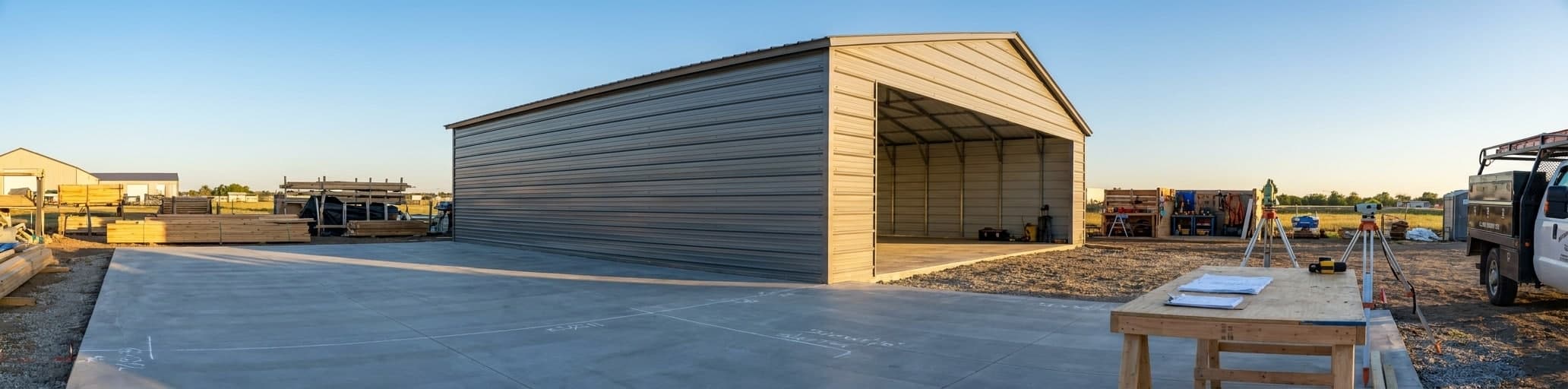

We help you navigate metal garage pricing, company vetting, and hidden costs that kit quotes routinely omit–so you can compare total project budgets instead of just materials. National buying power, transparent engineering, and local erection expertise separate providers who deliver on schedule from those who leave you managing surprises mid-project.
What Makes a Metal Garage Company the Best Choice for Your Needs
National providers lock in mill rates before price spikes hit, saving you $900-$2,000 on materials alone for a standard 30×40 building.
Single-Source Responsibility: Why Design, Engineering, and Installation Matter Together
National Buying Power vs. Local Mills: Real Cost Differences in 2026 Steel pricing in 2026 functions as a globally traded commodity, not a local supply-chain purchase — meaning your quote is shaped by worldwide supply, demand, and trade actions even when you're building in rural Oklahoma.[4] U.S. raw steel capability utilization was running in the mid-70% range in early 2026, a level tight enough that lead times were bumping up across sheet and plate.[4] When mills run tight, fabricators buying in smaller volumes face spot pricing — whatever the index says that week. National providers with consistent volume commitments can trigger a deposit-and-lock approach, securing mill rates before index spikes hit and holding the price through delivery.[4] A 30×40 steel building kit runs $18,000-$26,000 for materials alone,[5] so a 5-8% cost swing on that line item lands between $900 and $2,000 before you've poured a single cubic yard of concrete.
Freight adds a second gap that rarely appears in a kit-only quote. Long-haul steel packages are sensitive to shipping lane constraints, fuel surcharges, and driver availability — costs that can shift your delivered price even when mill pricing holds flat.[4] National providers shipping at scale carry negotiated freight rates that a local mill ordering sporadically simply cannot replicate. The U.S. Energy Information Administration tracks diesel prices weekly precisely because fuel moves fast and ripples through freight costs downstream.[4] Local mills typically pass those fluctuations directly to the buyer; high-volume national providers absorb them against committed tonnage.
Value engineering is where buying power becomes most visible on a finished quote. Tapered member designs and optimized bay spacing are the primary levers for reducing steel tonnage without sacrificing structural integrity, and national providers apply these across hundreds of builds per year.[4] Pre-engineered metal buildings already use roughly 30% less steel than conventional construction,[5] but only when engineering is matched to actual site loads rather than to whatever standard sections a local mill has sitting in inventory. A fabricator selling off stock has no structural incentive to shave tonnage — you pay for their inventory, not your engineering. Geographic variables sharpen the cost difference further: two projects with identical square footage but different zip codes can require materially different steel weights once wind speed, ground snow load, and seismic criteria are factored in.[4] The table below shows how those inputs shift by region, and why a national provider engineering to your actual loads — rather than a generic regional standard — keeps your budget where it belongs.
| Region | Typical wind (ASCE 7 ultimate gust) | Ground snow load | Primary cost driver |
|---|---|---|---|
| Texas inland (e.g., Tyler) | ~115-120 mph | ~10-20 psf | Frame depth, standard bracing |
| Texas Gulf Coast (e.g., Galveston) | ~140-160+ mph | Minimal | Uplift anchors, debris-region detailing, TDI compliance |
| Arkansas / northern Oklahoma | ~115 mph | 20-50 psf (location-dependent) | Purlin gauge, bridging, New Madrid seismic checks |
| Louisiana delta | ~115-130 mph inland | Minimal | Soil conditions; foundation can shift from slab to piles |
Understanding how a 30×40 prefab building is priced line by line makes it easier to spot exactly where national buying power shows up — and where a local mill's quote is quietly leaving risk on the table.[4]
Reputation Signals That Actually Predict Project Success
Not all reputation signals carry equal weight. A company's Better Business Bureau rating is one of the few public indicators that reflects both complaint volume and resolution quality — and it's worth checking before any other marketing claim.[6] An A+ BBB rating tells you that a company responds to disputes at a rate that satisfies an independent third party, which matters more than any award a vendor hands itself.[6] Pair that with verifiable customer references — not curated testimonials on a company's own website, but actual project contacts you can call — and you have a reasonable baseline for assessing whether a provider delivers on its promises.[8] Companies with deep project portfolios, like those with thousands of completed builds across commercial, agricultural, aviation, and industrial applications, carry an implicit burden of proof: that volume of work either earns sustained referrals or it doesn't.[7]
Licensing and insurance are non-negotiable signals, not formalities. A licensed builder has met the legal and technical requirements to operate in your jurisdiction, which directly affects whether your permit gets approved and your inspection passes.[8] Comprehensive liability insurance and workers' compensation protect you if something goes wrong on site — without them, that liability can land on you.[8] Beyond credentials, watch how a company communicates before you sign anything. Contractors who are slow to return calls, vague on scope, or evasive about lead times during the sales process don't improve once your deposit clears.[8] The companies worth hiring answer clearly, quote transparently with itemized line items rather than lump sums, and flag potential cost variables — site conditions, local wind and snow requirements, permit timelines — before you ask.[6] That kind of local prefab contractor vetting discipline is what separates providers who own the outcome from those who manage your expectations down after the fact.
Warranty terms are the last signal most buyers check and one of the most predictive. A provider confident in its materials and workmanship backs both with written coverage — manufacturer warranties on steel components and a separate workmanship warranty on installation.[8] Vague warranty language, short coverage windows, or warranties that exclude labor are signs a company expects problems it doesn't want to own.[6] Ask directly: what's covered, for how long, and who you call when something needs attention after completion. The answer tells you whether a company treats the job as finished when you sign or finished when the building performs as promised.
Metal Garage Pricing: What You Should Expect to Pay in 2026
Metal garages cost $11-$20 per square foot installed, roughly one-quarter the price of conventional stick-built construction at $50 per square foot.
How Much Should a Metal Garage Cost? Price Ranges by Size and ConfigurationMetal garages cost $6,999-$52,000+ delivered and installed, with the spread driven by size, roof style, and your state's engineering requirements.[9] On a per-square-foot basis, expect $11-$20 for a structure that includes delivery and professional installation — a meaningful contrast to conventional stick-built garages, which average $50 per square foot when combining labor and materials.[9][10] The table below captures the most common configurations buyers price out in 2026.
| Configuration | Footprint | Base installed price |
|---|---|---|
| Single-car | 12'x20' | From $4,190 |
| Single-car (extended) | 18'x40' | From $6,720-$9,225 |
| Two-car (minimum) | 20'x20' | From $5,700 |
| Two-car (comfortable) | 24'x24' | From $7,200-$9,786 |
| Workshop / multi-use | 30'x40' | From $15,401 |
| Commercial scale | 50'x60' | From $52,045 |
Two variables shift these base prices the most once size is locked in. Roof style is the first lever: regular-roof garages carry the lowest per-square-foot cost ($8.47-$10.39/sq ft), boxed-eave styles sit in the middle, and vertical roofs — required on buildings deeper than 35 feet — can push costs to $15.17/sq ft or higher.[11] Location is the second: states with stricter codes, like Florida (which mandates 26-gauge steel sheeting) and Pennsylvania (which requires additional bracing), carry noticeably higher base prices than lower-code states such as Alabama or West Virginia.[11] For conventional construction, those cost gaps widen further — professionally built one-car garages average $20,000, two-car garages run $14,500-$40,300, and three-car builds land between $28,200 and $57,100 before any add-ons.[10] If you're anchoring your budget around the most popular two-car footprint, the 24×24 metal building kit cost breakdown gives you a clean line-by-line baseline before you start pricing up.
30×40 Metal Building with Concrete Slab: Full Cost Breakdown
A 30×40 metal building delivers 1,200 sq ft of clear-span space, and most buyers land between $29,000 and $52,000 for a certified, enclosed shell before the slab enters the budget.[12] The concrete slab shifts that number significantly: a reinforced 4-inch pour runs $7,500-$12,000, while a 6-inch slab built for heavy vehicles or equipment lands between $8,500 and $13,500.[13][5] That puts a realistic all-in total for a 30×40 metal building with slab between $23,000 and $40,000 for a straightforward enclosed build, scaling to $52,000-$106,000 for a fully turnkey project with insulation, climate control, premium doors, and commercial-grade engineering.[13][5] For a grounded real-world reference: one Tennessee owner finished a 30×40 with 10-foot walls, two roll-up doors, a walk-in door, and spray foam insulation at $17,000 for the kit, $8,100 for the slab, and $2,000 for insulation — a total just under $27,500.[13] Your number will vary by region and load requirements, but that line-by-line split is a useful sanity check before you start collecting quotes. The table below shows where each dollar goes.
| Cost component | Typical range | Key driver |
|---|---|---|
| Building kit (framing + panels) | $14,000-$26,000 | Roof style, eave height, regional load engineering |
| Concrete slab (4"-6" reinforced) | $7,500-$13,500 | Intended use; equipment-grade work requires 6" minimum |
| Professional erection (labor) | $6,000-$12,000 | DIY saves this line item but needs a 3-4 person crew |
| Insulation | $1,500-$4,000 | Spray foam cuts energy costs 30-50% vs. uninsulated shell |
| Doors and windows | $500-$3,000+ | Thermal doors add cost; standard roll-up doors sit lower |
| Permits and engineering | Varies by county | Coastal and mountain jurisdictions almost always require sealed drawings |
The slab is the line item most buyers underplan. Slab thickness is driven by what you're putting on it, not just the square footage: a 4-inch pour handles standard passenger vehicles and light storage, but anything involving a truck lift, heavy farm equipment, or fork-truck traffic needs 6 inches with proper rebar and thickened edges.[5] Skimping on the pour is also the source of most post-project regrets — repairing or replacing a failed slab after the building is erected costs several times what the upgrade would have at pour time.[13] For a complete line-by-line breakdown specific to your site conditions and load requirements, the total project cost guide for a 30×40 steel building walks through every variable before you commit to a quote.
Hidden Costs Competitors Don't Mention: Permits, Site Prep, and Customization
Permit fees are the line item that disappears most often from competitor quotes — and the one that bites hardest when it surfaces late. Average permit costs run $550-$2,000, but in larger cities they can reach $7,500.[15] More damaging than the fee itself is what happens when you skip the permit entirely: heavy fines, forced redesigns to meet code, lender and insurer refusal to approve the property, and in some cases, a legal order to move or demolish the structure.[14] The property owner bears full responsibility for pulling the permit, not the erector — and coordinating plan-check requests between separate engineers and contractors is where unpermitted or under-managed projects stall.[14] When one company controls design, engineering, and erection under a single contract, that coordination problem disappears and the permit process moves in a straight line.
Site preparation is the second budget line competitors routinely exclude. Land clearing, grading, excavation, and drainage can add $2,000-$20,000 or more to your total, depending on site complexity and local labor rates.[14] Foundation work stacks on top of that: a reinforced concrete slab runs $10-$19 per square foot before you account for soil conditions that may require deeper footings or thickened edges.[14] Taken together, site prep and foundation work can represent 25-45% of your total project budget — a share that never appears in a kit-only quote.[15] Before you finalize any budget around a building package price, soil testing and a site-specific foundation estimate should already be in hand. The kit price reality for a 30×40 metal package breaks down exactly what the kit quote covers and what it leaves for you to discover later.
Customization costs are the third category that inflates final invoices well beyond the base quote. Roof style alone moves the needle: a vertical roof outperforms a boxed-eave design on drainage and leak resistance, but it also costs roughly 14% more.[15] Each window adds approximately $200, overhead doors run up to $800 per unit, and insulation — if you want the spray foam that cuts energy costs rather than basic fiberglass — runs $3-$7 per square foot versus $1-$3 for fiberglass.[15] High-load jurisdictions sharpen the cost further: projects in Florida or coastal Gulf zones carry a 15-25% structural premium over inland builds in lower-code states, driven by thicker steel requirements and certified wind-load engineering.[15] Freight is the final variable most kit sellers leave unaddressed — delivery costs shift with fuel prices, shipping lane constraints, and your distance from the manufacturing facility, and many quotes simply don't include them.[14] Getting an itemized, all-in quote — kit, freight, site prep, permits, and customization — before you commit is the only way to know what you're actually building toward.
Comparing Metal Garage Options: Decision Matrix for Your Project
Kit-only pricing typically represents just 40-60% of your actual project cost, so budget for foundation, labor, permits, and finishing before breaking ground.
Metal Garage Kits vs. Fully Installed Solutions: What's Included and What Costs ExtraThe kit price is where most buyers start — and where most budgets go wrong. A metal garage kit covers the structural skeleton: steel framing, wall panels, roof panels, fasteners, and trim, all pre-cut and delivered to your site.[16] That's the full scope of what the quote reflects.[16] Foundation work, erection labor, permits, insulation, electrical, and interior finishing all sit outside that number — and together those line items typically represent 40-60% of your total project cost.[16] Treating the kit price as a project budget is the single most common mistake in metal building procurement, and it's the reason so many buyers hit sticker shock mid-project when the ground hasn't even been broken yet.
A turnkey solution closes that gap by bundling the kit, a concrete foundation, all construction labor, and sometimes basic utilities under one contract — producing a move-in-ready building from a single invoice.[16] The per-square-foot difference between the two paths is direct: kit-only pricing runs $10-$30 per square foot for materials alone, while a fully installed steel building averages $24-$43 per square foot once foundation requirements, insulation, and delivery distance are factored in.[17][18] Prefabricated metal building kits typically fall in the $15-$25 per square foot range specifically, while fully installed builds land at the upper end of that installed spectrum depending on customization.[18] The table below shows exactly where each path begins and where the hidden line items surface.
| Line item | Kit only | Turnkey |
|---|---|---|
| Steel framing, panels, fasteners, trim | ✓ Included | ✓ Included |
| Delivery to site | ✓ Included | ✓ Included |
| Concrete foundation | ✗ Buyer sources separately | ✓ Included |
| Erection labor | ✗ Buyer sources separately | ✓ Included |
| Permit coordination | ✗ Buyer's responsibility | ✓ Managed by provider |
| Insulation | ✗ Extra | Optional add-on |
| Electrical and utilities | ✗ Extra | ✗ Extra (typically) |
| Interior finishing | ✗ Extra | ✗ Extra (typically) |
The kit route works when you have an experienced erection crew, a clear handle on local code requirements, and the capacity to manage subcontractors without losing schedule.[18] Strip away any one of those conditions and the apparent savings dissolve into coordination costs, rework, and permit delays that a turnkey contract would have absorbed.[16] For commercial, agricultural, or aviation projects where downtime costs money and compliance isn't optional, a fully installed solution gives you one contract, one point of accountability, and a provider whose incentive is to solve problems rather than deflect them. If you're still weighing steel garage kit features, costs, and installation options side by side, building that comparison around the complete cost picture — not just the kit line — is the only way to know which path actually fits your budget.
1-Car, 2-Car, 3-Car, and Extra-Large Garages: Size Recommendations with Real Dimensions
The most common sizing mistake is planning for your current vehicle instead of your actual use over the next decade. A 12×20 single-car garage technically fits most sedans, but it leaves no room to open doors comfortably, walk around the vehicle, or store anything — and buyers who start there often return to upgrade within a few years.[19] The table below gives you the minimum and recommended interior floor dimensions for each configuration before you commit to a footprint.
| Configuration | Minimum footprint | Recommended footprint | Primary use case |
|---|---|---|---|
| 1-car | 12×20 ft (240 sq ft) | 14×22 to 16×24 ft | Sedans, midsize SUVs, compact trucks |
| 2-car (standard) | 20×20 ft (400 sq ft) | 24×24 ft (576 sq ft) | Two full-size sedans with door clearance |
| 2-car (trucks/SUVs) | 24×24 ft | 24×30 ft (720 sq ft) | Full-size pickups, SUVs, minivans |
| 3-car | 30-32×20-22 ft | 36×24 ft (864 sq ft) | Three vehicles with 12-ft bays and rear storage buffer |
| 4-car / multi-use | 40×20 ft (800 sq ft) | 40×30 ft (1,200 sq ft) | Collectors, multi-vehicle households, equipment storage |
The 2-car configuration is the most popular and the most frequently undersized.[19] A 20×20 minimum fits two compact cars, but modern vehicles — even midsize sedans — are wider than earlier generations, leaving occupants climbing out sideways with no usable storage.[19] A 24×24 footprint is the practical sweet spot: roughly 2.5 feet of walking lane between parked vehicles and a rear buffer for storage behind the bumpers.[19] Households running full-size trucks or SUVs — which measure 6.5-7.0 feet wide and 17-22 feet long — need 24×30 feet to create a genuine 6-8 foot zone behind each vehicle for workbenches, a chest freezer, or tool storage.[19]
Three-car configurations follow the same logic at higher stakes. The technical minimum of 30-32×20 feet fits three sedans but leaves almost no bay clearance for door swings or rear access.[19] The industry recommendation is 36×24 feet, delivering 12 feet of width per bay — enough for a standard 9-foot door plus wall clearance — and a 24-foot depth that accommodates full-size trucks.[19] When two of three vehicles are large pickups, stretching to 40×24 feet gives each bay the 13+ feet that daily entry and exit actually demands.[19] Four-car and extra-large structures start at 40 feet wide; the 40×30 configuration adds a dedicated workshop corridor behind the parking bay without requiring internal support columns when built as a clear-span steel structure, which is why metal construction is the dominant choice at this scale.[19] Pair those footprints with the right door specs — a standard 9×7-foot single door for sedans, a 10-foot-wide opening for full-size trucks, and 12-14-foot-tall doors for RV storage — and ceiling height to match your intended use: 8-9 feet for standard residential parking, a minimum of 11-12 feet if you plan to install a car lift, and 14 feet if you want genuine lift comfort.[19] Getting those three dimensions right from the start is exactly what separates a garage you use confidently every day from one you're constantly working around. If you want to see how door placement, eave height, and clear-span framing interact across different footprints before you finalize yours, the steel garage building selection guide walks through each variable in detail.[20]
Custom Engineering Flexibility: When Standard Designs Fall Short
Standard catalog designs work for straightforward applications — basic residential parking, simple equipment storage, a generic workshop. The moment your project introduces a non-standard variable, that catalog design stops saving you money and starts creating problems you'll pay to fix later. Aviation hangars require clear-span widths and door heights no residential catalog addresses. Agricultural builds need ridge vents, lean-to extensions, or ventilation openings sized around specific livestock counts or equipment dimensions — not around what sold in volume last season. Commercial and industrial occupancies carry fire ratings, accessibility classifications, and occupancy-load criteria that a one-size option simply cannot satisfy.[22] Pre-engineered metal buildings solve this by designing structural members, bay spacing, eave height, and load paths around your specific application from the start — not by adapting the nearest standard model until it barely fits.[22] The result is a building engineered for what you're actually doing inside it, which keeps both the structure and your budget performing the way you planned.
Site conditions are where custom engineering earns its cost most visibly. Soil composition, topography, and drainage patterns feed directly into foundation design — a slab spec that works on a flat, sandy Texas lot will fail an expansive clay site in Tennessee or a sloped parcel anywhere with frost depth.[22] Local building codes stack another layer on top: each jurisdiction sets its own wind, snow, and seismic criteria, and a building stamped for inland Alabama requirements won't pass plan review in a Louisiana delta parish or a North Carolina coastal county.[22] Custom engineering accounts for all those variables before a single drawing goes to plan check, which means your permit moves in a straight line instead of circling back for structural redesign after the first rejection. Future scalability is the third reason standard designs fall short: a pre-engineered building designed for expansion from day one — with pre-punched endwall columns, load paths that accept additional bays, and roof framing that carries the anticipated future span — costs a fraction to extend later compared to modifying a standard box that was never designed to grow.[22] For operations that are actively planning phased expansion, steel frame farm building systems designed for future add-ons show how scalability gets engineered in at the start rather than value-engineered out and then retrofitted at a premium later.[22] The customization options available across architectural style, roofing materials, wall systems, and color mean the engineering flexibility extends to appearance as well — your building can match existing structures, meet corporate branding requirements, or carry coatings selected for your specific climate exposure.[22]
How to Vet a Metal Garage Company and Avoid Common Buyer Mistakes
Ask five specific questions about licensing, insurance, and payment structure before signing anything with a metal garage contractor.
Five Critical Questions to Ask Before Signing a Contract
Most buyers spend more time comparing kit prices than evaluating the company they're about to hand a deposit to. Five questions — asked before you sign anything — separate providers who can deliver from those who will cost you more than the building itself.
1. Are you licensed for this jurisdiction, and can you show documentation now?
Licensing requirements vary significantly by state and municipality, which means the burden of verification falls entirely on you.[25] A contractor who answers with specifics — registration numbers, municipal permits, standing with local code enforcement — is telling you something very different from one who answers vaguely.[25] Ask for documentation proactively. Any company worth hiring will have it ready before you ask, because they understand that transparency at this stage sets the tone for the entire project.[25]
2. What insurance do you carry, and will you name me as an additional insured?
You need two things confirmed in writing: general liability insurance at $1 million minimum per occurrence, and active workers' compensation coverage.[24] General liability protects you if something goes wrong on your property during construction; workers' comp protects you from financial liability if a worker is injured on your site.[25] Request certificates of insurance directly from the contractor's insurance agent — never accept contractor-provided documents, which can be altered or outdated.[24] Make certificate holder status a non-negotiable contract requirement before signing.[24]
3. How is the payment schedule structured, and what milestones trigger each draw?
Standard practice ties payments to verifiable progress: a deposit at signing, a draw when materials arrive on site, another at substantial completion, and a final payment after punch-list sign-off and certificate of occupancy.[25] Never pay more than 20% upfront regardless of what pressure or discount the contractor offers — large deposits enable contractors to fund other projects with your capital, and recovering that money if they fail to deliver becomes extremely difficult.[24] If a contractor requests 50% or more before breaking ground, treat that as a disqualifying red flag.[24]
4. What does your warranty cover, for how long, and who handles claims after completion?
Material warranties from reputable manufacturers cover 20-40 years on roof and wall panels against rust-through and fading, with structural steel framing carrying 50-plus-year coverage from AISC-certified producers.[24] The contractor's own workmanship warranty should cover installation defects for at least one to two years — leaks from improper panel installation, door misalignment, incorrect assembly — with a written commitment to respond to claims within 24-48 hours and complete repairs within five to ten business days.[24] Verbal warranty promises are unenforceable; insist on written terms in the contract specifying coverage duration, response time, claim procedures, and whether the warranty transfers to a future buyer if you sell the property.[24]
5. How do you handle change orders, and are pricing adjustments documented in writing before work proceeds?
Change orders arise on nearly every project — site conditions shift, code requirements surface after plan review, or you decide to add a door or window after signing.[25] What matters is whether modifications are documented in writing, priced transparently, and require your approval before anyone picks up a tool.[25] A contractor who is vague about change order procedures is a contractor who may present you with surprise invoices mid-project, when your leverage is lowest.[25] The right answer is a formal process: written scope description, cost impact, schedule effect, and mutual sign-off before execution — every time, without exception.[25] Pairing these five questions with a vetting framework for steel building contractors gives you a complete screen before any contract is on the table.
Red Flags: What Separates Reputable Companies from High-Risk Vendors
The bait-and-switch is the most financially damaging pattern buyers encounter, and it runs the same five-step playbook every time.[27] A headline price — typically advertised at 50-70% off — draws the call.[27] The salesperson confirms the deal is real and manufactures urgency: "three left at this price," "price goes up tomorrow," pushing you toward a non-refundable deposit of $500-$2,500 before you've seen a complete spec sheet.[27] Once the deposit clears, a "project coordinator" introduces change orders for everything the original contract omitted — doors, insulation, freight, anchor bolts, engineering certification — each item priced at 2-3x fair market value.[27] When the final math is tallied, blowout transactions average 8-15% more than a transparent, itemized quote for the same building configuration.[27] The entire scheme depends on locking in your commitment before you understand what you're actually buying; manufactured urgency is the mechanism, not a coincidence.
Digital footprint is a faster pre-deposit filter than most buyers use. A company with no verified Google Business Profile — confirmed contact details, project photos, and genuine reviews — lacks the public accountability layer reputable providers maintain as standard practice.[26] Review quality matters more than review count: vague, repetitive feedback without supporting project images or verifiable details signals manufactured social proof rather than real customer experience.[26] Pair a review audit with a direct BBB complaint search, specifically looking for the pattern of unresolved disputes rather than just the overall rating.[26] High-risk operators consistently produce a B-grade or lower BBB profile with multiple unresolved complaints centered on change-order disputes — a paper trail a bad actor can't clean up.[27]
Two operational signals complete the screen before any contract lands on the table. Delivery timelines that diverge significantly from industry norms without explanation deserve direct follow-up on sourcing and scheduling.[26] Lead times on steel packages are governed by mill production queues, fabrication schedules, and freight availability — a company that can't explain why its timeline beats the market is either overpromising or substituting materials to hit the window.[26] Post-sale project coordination is the second signal: a provider with no clear answer for who handles issues during permitting, erection, or after punch-list close is a provider whose accountability ends at the sale.[26] Checking those signals against a fully itemized metal building kit quote — one listing every component, freight cost, and engineering fee before you commit — is the fastest way to measure any competitor's transparency against what a reputable provider actually delivers.
Why Constant Communication and Local Erection Crews Make the Difference
Communication failures cost more than most buyers anticipate — not as a line item they can spot immediately, but as compounding delays that accumulate when a question sits unanswered while an erection crew stands idle on your site. Setting a fixed cadence from day one — weekly progress updates, written approvals for every scope change, a single named contact empowered to act rather than escalate — reduces ambiguity and keeps decision-making moving at erection speed rather than inbox speed.[28] The pattern shows up consistently across thousands of completed projects: buyers who reached their rep directly, got same-day answers, and saw field problems resolved before they became schedule issues reported tighter builds than those working through call centers or rotating contacts.[30] What separates the highest-rated providers from average competitors isn't price or even product quality — it's responsiveness after the deposit clears, when erectors are already on site and something doesn't fit.[30] One buyer running an 80x100x16 DIY build put it plainly: when parts were missing or something wasn't fitting, overnight shipments arrived, and the rep stayed engaged through five months of construction.[30] Another described a rep who communicated directly with plan checkers to resolve permit issues — not a hand-off, but direct intervention to keep the project moving.[30]
Local erection crews add a layer no amount of remote support fully replaces. A crew that works your county regularly already knows which inspectors want photos versus in-person walk-throughs, which concrete contractors understand anchor bolt tolerances, and how fast your permit office actually moves — knowledge that compresses the window between material delivery and first inspection in ways an out-of-state crew cannot replicate on their first project in your jurisdiction.[28] Specialized erectors also bring the right tools, measuring systems, and crews trained in bolting, anchoring, and panel integration — which speeds assembly, tightens fit-and-finish, and protects manufacturer warranties that require compliant installation to remain valid.[28] When permit drawings are signed and sealed by licensed professionals in your specific state, every piece pre-cut, pre-punched, and numbered to a building-specific erection guide, a knowledgeable local crew can execute without field improvisation.[29] That combination — engineered-for-your-jurisdiction drawings plus a crew that knows the jurisdiction — is what produces installations where bolts line up on the first attempt and red irons stand in days rather than weeks.[30] Understanding how those two variables interact from the moment your order is placed is exactly what the prefab building kits delivery timeline breaks down — engineering clock, fabrication queue, and crew scheduling all moving in sequence so nothing sits waiting on a decision that should have been made earlier.[29]
The combination of constant communication and locally experienced crews is what produces the outcomes buyers describe most consistently in verified project reviews: buildings delivered on schedule, components labeled and accounted for on the first shipment, problems resolved before they compound, and a rep who follows up weeks after completion without being asked.[30] That post-completion follow-through is the real signal. A provider confident in their work stays engaged after the final invoice because they know the building will perform — and they want you to see it perform.[30] One who disappears after delivery is communicating something about what they expect to happen next.[28]
- National providers lock in mill pricing before index spikes; local mills pass fuel and freight fluctuations directly to buyers.
- A 30×40 metal building kit runs $18,000-$26,000 for materials alone, but foundation, labor, and permits add 40-60% to your total budget.
- Kit-only pricing ($10-$30/sq ft) excludes foundation, erection labor, permits, and insulation–treating it as your project budget causes mid-project sticker shock.
- Verify licensing, insurance, and payment terms before signing; never pay more than 20% upfront regardless of discount pressure.
- Bait-and-switch schemes lock deposits before revealing omitted costs (doors, freight, engineering); manufactured urgency is the red flag.
- A 24×24 garage (576 sq ft) is the practical sweet spot for two vehicles with usable walking space and rear storage.
- Local erection crews familiar with your jurisdiction compress timelines by knowing inspector preferences and permit office speed.
- https://questarconstructionlp.com/professional-metal-building-supply-solutions-transform-cleveland-commercial-projects/
- https://forgebuildings.com/pre-engineered-metal-buildings-an-investment-alternative/
- https://www.gonzalesconstruction.com/services/design-build-delivery/
- https://www.tylerbuilding.com/post/2026-metal-building-cost-variables
- https://www.steelcobuildings.com/how-much-does-a-30×40-steel-building-cost-in-2026/
- https://sidebysidereviews.com/best-steel-building-companies-of-2025/
- https://www.bucksteel.com/
- https://lyndseyroofing.com/top-10-qualities-to-look-for-in-a-roofing-contractor/
- https://garagebuildings.com/blog/how-much-does-a-metal-garage-cost-in-2026
- https://www.angi.com/articles/how-much-does-it-cost-build-garage.htm
- https://alansfactoryoutlet.com/metal-garage-prices/?srsltid=AfmBOoqV2p5TfgNSqbWil4Y2lx7HDW3vdL1ZZI0mvLL1381aKaxGZ7RV
- https://www.engineeredmetalbuildings.com/blog/30×40-metal-building-prices/?srsltid=AfmBOooUGDNp0wOKUUpms89OotqOvpiBAnNIua-vSRE_uFiFUYSuvct1
- https://americanmetalgarages.com/30×40-metal-garage-cost-breakdown-what-you-get-and-how-it-works/
- https://pwssteelbuildings.com/the-hidden-costs-of-steel-buildings-what-you-need-to-know-before-your-purchase/
- https://ameribuilds.com/steel-building-costs-what-to-expect-2026/
- https://iconsteelbuildings.com/how-much-are-metal-buildings/
- https://www.buildingsguide.com/metal-building-prices/?srsltid=AfmBOoo6UQLRrkt44XCxLjfHiggsbdK-lMTf5DP9w-KhOV5XHLJjAFdd
- https://hintonbuildings.com/prefabricated-metal-buildings/?srsltid=AfmBOorZ_olnepUiTdvwwCKKVewlsapQb7cGOT6qnA_y_52-GfNO2Gph
- https://www.vikingsteelstructures.com/blog/standard-garage-size-dimension-diagrams?srsltid=AfmBOoq7aqbcJdA5GO9qhkXTv02_yKv2hQF_bIYBdoeVn8WIzsrt3GnP
- https://www.aametalbuildings.com/blog/custom-garage-buying-guide?srsltid=AfmBOopNsj_HbgPrlNg2IE0pmoNSGXstG2IffvSn_0s3QUtC2SW9E82u
- https://www.aametalbuildings.com/blog/custom-garage-buying-guide?srsltid=AfmBOoo8tKkuXPWBDxstzTITaCeJeTx2rOI2UEuDc2isBYmvH_K4ZYa_
- https://www.tylerbuilding.com/post/buyers-guide-pre-engineered-metal-building
- https://buildway.com/questions-to-ask-a-metal-building-supplier/
- https://www.metal-buildings.org/commercial-metal-building-contractor/
- https://texasmetalexperts.com/10-questions-to-ask-any-fort-worth-metal-building-contractor-before-you-sign/
- https://norfolkdailynews.com/online_features/press_releases/custom-structures-direct-outlines-8-warning-signs-of-metal-building-purchase-risks/article_d575f977-dd4d-5b15-97fc-daace7571ffb.html
- https://www.factorysteeloverstock.com/the-truth-about-blowout-sales/
- https://ibarraconstructionservices.com/10-proven-tips-for-choosing-trusted-metal-building-providers/
- https://armstrongsteel.com/blog/avoid-common-steel-issues-when-building-your-warehouse
- https://www.metalbuildingoutlet.com/reviews/