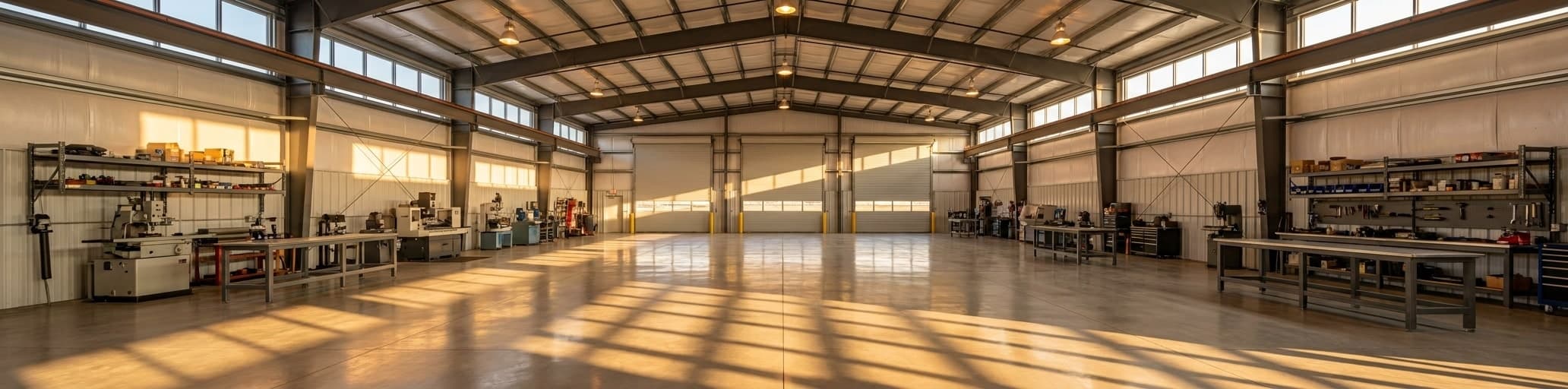

We help you understand how a 40×60 metal workshop delivers 2,400 square feet of unobstructed space while steel's superior strength, durability, and maintenance-free performance justify the investment over traditional construction. Smart layout planning and concurrent project phases compress your timeline to 8-16 weeks while locking in long-term operational efficiency.
Why a 40×60 Metal Workshop Delivers Maximum Space Without Excessive Cost
Steel's non-combustible construction and 50-plus-year lifespan eliminate interior columns while lowering insurance costs compared to traditional wood framing.
The Sweet Spot: Why This Footprint Works for Small-to-Medium Operations
Metal vs. Traditional Construction: Why Steel Wins for Workshops For a 40×60 workshop, the comparison between steel and wood framing resolves quickly once you look past the initial material quote.
Steel's strength-to-weight ratio lets the building span its full 2,400 square feet without a single interior column — wood trusses must be layered and joined at multiple points to achieve the same clear span, which escalates both material costs and labor significantly.[3] On maintenance, wood structures require repainting roughly every three years and are consistently vulnerable to rot, mold, and insect damage; their economic life runs only 15 to 20 years before siding, roofing, or structural members need replacement.[3] Pre-engineered steel, by contrast, is virtually maintenance-free and routinely delivers 50-plus years of service with no meaningful upkeep.[3] Construction speed adds another practical edge: factory-fabricated steel components arrive as a precision kit with no on-site cutting or welding, while wood framing demands custom measuring and fitting at every stage, adding labor hours and waste.[3] Fire behavior closes the financial argument — steel is non-combustible, which directly reduces insurance premiums over the building's life, a savings unavailable to wood-framed structures.[3] If you want to see what the 20-year ownership cost gap looks like in actual dollar terms, this steel barn cost vs. wood barn breakdown runs the math in detail.
What You Can Actually Fit in 2,400 Square Feet
The 40 ft clear span eliminates interior columns entirely, meaning you're working with a genuine 2,400 square feet of unobstructed floor rather than 2,400 minus the footprint of posts every 12 feet.[4] In practical terms, the footprint divides cleanly into four distinct operational zones: a front intake area for incoming vehicles or equipment, a primary work floor, a secondary workspace, and a rear staging or storage area — all running in sequence without sacrificing circulation space along either sidewall.[4] The enclosed volume reaches approximately 38,400 cubic feet at a 16-foot eave height, which is enough vertical clearance to run overhead lighting, mechanical systems, and elevated storage without those installations cutting into usable floor clearance.[4] Real-world use confirms the capacity: one documented 2,400-square-foot steel workshop houses a tablesaw with a 48-inch sliding table, multiple drill presses, a router table, a planer, a bandsaw, two separate dust collection systems, an air compressor, and 24 overhead fluorescent lights — with enough remaining floor area to design and fully assemble the interior structure of an 18-foot-high observatory dome inside the building itself.[5] What makes density like that achievable is disciplined layout planning: clustering machines by dust-collection need, building storage directly into machine bases to eliminate freestanding cabinets, and treating every sidewall as usable vertical real estate.[5]
Real-World 40×60 Workshop Layout Configurations (With Planning Grid)
Partition 600 square feet for offices and inventory while keeping 1,800 square feet of unobstructed production floor, separating customer traffic from active work areas.
Layout 1: Open Fabrication Floor with Separate Office and Storage
The most field-tested configuration for a professional shop or fabrication operation partitions a 15×40 section off one end of the building, yielding 600 square feet of enclosed office, administrative, or parts-storage space while leaving the remaining 1,800 square feet as completely unobstructed work floor.[7] The separation isn't cosmetic — it solves a real workflow problem.
Customer-facing functions, paperwork, and parts inventory stay contained in the enclosed zone while tools, equipment, and production activity occupy the main floor, reducing cross-traffic hazards and keeping the work area free of foot traffic unrelated to production.[7] Door placement determines how cleanly this layout performs: a standard entry door on the office end paired with one or two roll-up doors along the fabrication side keeps vehicle access and pedestrian movement on entirely separate paths.[6] The 1,800-square-foot main floor is large enough to accommodate multiple vehicle lifts, sequential heavy equipment, or a combination of active production space and equipment staging — and both sidewalls remain fully available for tool storage, overhead shelving, or benches that keep the center floor clear and usable.[7] For operations that expect customer visits alongside daily production, this configuration also satisfies most commercial zoning requirements that separate administrative space from manufacturing or service areas, so you're building compliance into the footprint from the start rather than retrofitting it later.[7]
Layout 2: Mixed-Use Workshop with Mezzanine for Administrative Space
A mezzanine solves the problem that Layout 1 can't: you want administrative square footage without surrendering any of the active production floor.
By engineering a structural steel mezzanine over a 20×20 or 20×30 section at one end of the building, you introduce a second level for offices, a break room, or parts storage while the full work floor below remains unobstructed.[9] The space directly beneath the mezzanine deck converts naturally into an enclosed mechanical room, tool crib, or secure storage zone, adding a third functional area without requiring a larger footprint.[9] Eave height is the critical planning variable: a 16-foot eave delivers roughly 8 feet of clearance on the mezzanine deck and 7 to 8 feet of usable headroom below the structural deck depth, which clears the minimum commercial occupancy threshold in most jurisdictions.[8] Finishing the building to a genuine mixed-use standard — production floor, mezzanine office level, and enclosed zone below — typically lands in the $65,000 to $90,000 range once interior walls, HVAC, flooring, and the mezzanine framing are included.[8] The cost difference versus a basic shell is almost entirely front-loaded: mezzanine steel and the additional eave height needed to carry it must be specified at the design stage, because retrofitting a mezzanine into a building originally designed at 14 feet costs significantly more than engineering for it from the outset.[9]
Layout 3: Equipment-Heavy Shop with Drive-Through Bay Access
The drive-through bay configuration is the right answer when heavy equipment anchors the floor plan — large vehicle lifts, press brakes, CNC machinery, or agricultural equipment that cannot be repositioned for every job. Two opposing roll-up doors, one on each 40-foot end wall, create a continuous traffic corridor down the full 60-foot depth of the building.
Vehicles and equipment enter one end and exit the other without reversing in a confined space, which eliminates the bottleneck that kills efficiency in single-door shops. Door count, opening size, and placement carry more budget impact than most buyers anticipate — they directly control workflow, vehicle movement, and daily operational convenience, and paying for the right access configuration once prevents layout friction that compounds across years of production.[10] With the drive-through corridor running the building's centerline, both 60-foot sidewalls remain fully available for fixed equipment bays: compressed air drops, electrical service panels, overhead lighting circuits, and tool storage all planned around stationary machines rather than around a generalized floor.
Large roll-up doors and multiple openings are among the highest individual cost drivers in any steel building project, so specifying oversized clearance doors on both end walls adds meaningfully to the base structure price.[10] For a shop running production-level volume, though, the operational return on a building that moves material and equipment without constant repositioning justifies that premium from the first week of use.
40×60 Metal Workshop Cost Breakdown: Foundation, Materials, and Installation
A 40×60 metal workshop kit costs $22,868 to $29,892 before freight and accessories, with insulation and doors each adding predictable percentages to your final budget.
Material Cost: What You're Actually Paying For in a Steel Structure
A 40×60 metal workshop kit covers five distinct component categories: primary rigid frames, secondary framing (purlins and girts), roof and wall panels, bolts, and fasteners.[11] At the 40×60 scale, that assembly runs roughly $7.50 per square foot for the steel kit alone — lower than the ~$9.60 per square foot benchmark for a 30×40 because economies of scale reduce per-foot material cost as the footprint grows.[11] Standard shop packages land between $22,868 and $29,892 before freight, foundation, or accessories.[11] Transportation is a real budget line that headline kit prices often omit — steel is heavy, freight costs are significant, and suppliers who can consolidate your delivery with other shipments can reduce that line item by 6 to 8 percent, which is worth asking about directly when comparing quotes.[11] Accessories compound quickly: windows and doors each add roughly 5 percent to total cost, and insulation runs $4,320 to $8,160 depending on wall dimensions, eave height, and target R-value.[11] The table below shows where material dollars actually go in a standard 40×60 kit:
| Component | Typical cost range | Key variable |
|---|---|---|
| Steel kit (base structure) | $22,868-$29,892 | Span, eave height, load requirements |
| Per-square-foot rate (kit only) | ~$7.50/sq ft | Scales down from ~$9.60 for 30×40 |
| Freight/transportation | Varies; 6-8% savings if consolidated | Shipment timing and supplier routing |
| Windows and doors | ~5% of total per category | Count, size, and opening type |
| Insulation | $4,320-$8,160 | Wall dimensions, height, material grade |
Two structural decisions move material tonnage more than any accessory line: clear span versus modular framing, and tapered versus straight columns.[12] Clear span frames — the configuration that eliminates interior columns across the full 40-foot width — require deeper rafters, larger haunches, and stiffer columns compared to modular designs that break the span with intermediate supports.[12] Tapered (built-up) members concentrate steel where stresses actually occur, reducing total weight against uniform straight sections that carry material serving no structural purpose; in a volatile 2026 market where steel is priced as a global commodity, unnecessary tonnage is unnecessary cost.[12] Mill capacity, freight lane constraints, and tariff exposure can all shift a quote between the day it's written and the day you sign — which is why most suppliers hold pricing valid for only 30 days and why locking material cost with a deposit immediately after scope approval is the standard hedge against market movement.[12]
Foundation and Site Preparation: The Hidden Budget Line Item
The foundation for a 40×60 metal workshop is the largest single cost line that most kit quotes omit entirely.
At 2,400 square feet, concrete alone runs $6 to $12 per square foot depending on location, site conditions, and current material pricing — putting the slab between $14,400 and $28,800 before any grading or prep work begins.[7] Site preparation adds a separate and highly variable layer on top: level ground with good drainage may need minimal work, while a sloped lot can require significant grading that pushes costs considerably higher.[7] The structural stakes of skipping proper prep are real — an unlevel installation causes the building to lean and creates leakage points at the base of the structure, converting what looked like a skippable budget line into a recurring maintenance liability.[7] Permit fees and local building code requirements compound the pre-construction budget further, varying enough by jurisdiction that buyers who treat site prep as a fixed number consistently encounter shortfalls once they price their actual parcel.[13] Soil type, drainage characteristics, slope, and utility access drive more cost variation than almost any other single factor in the project, which is why total installed costs for comparable builds in different markets can swing by tens of thousands of dollars based on site conditions alone.[14] For a concrete illustration of how local geology shifts foundation numbers, the Pittsburgh steel building site prep cost breakdown shows exactly how much soil type and drainage conditions can move the final figure.
Installation, Permits, and the Single-Source Advantage
Installation labor is a separate budget line from the kit, and total installed metal building construction costs range from $15 to $120 per square foot for most projects — a spread that reflects the gap between a bare shell and a fully finished facility with mechanical, electrical, and interior work included.[14] Most 40×60 workshops land in the middle of that range once erection, concrete anchor work, and utility rough-ins are added to the base kit price.[14] Shipping compounds the install budget whenever the site sits far from the manufacturer's facility, and transportation expenses can escalate significantly based on that distance — a variable that suppliers with regional distribution networks or consolidated freight lanes can reduce meaningfully.[15]
Permit requirements affect both timeline and structural design in ways that generic budgets don't capture. Local building codes and regulations can directly impact the design and construction process, potentially requiring engineering revisions if the original drawings don't satisfy a jurisdiction's load tables or occupancy classifications — and those revisions cost money and calendar time after the fact.[15] The coordination problem compounds when the steel supplier, engineer of record, and erection contractor are separate entities: each gap between accountability chains is a point where scope falls through and delays accumulate. Pre-engineered components manufactured off-site do compress erection time and reduce on-site labor costs compared to stick-built construction, but that speed only materializes when permit drawings, site prep, and erection are sequenced correctly from the outset.[15] A turnkey single-source design-build approach keeps permit documentation, engineering, fabrication, and installation under one roof — which means the drawings needed for permit submission are part of the building package from day one rather than a separate deliverable you have to coordinate across three vendors.
Getting Your 40×60 Metal Workshop Built: From Quote to Completion
Specify roof style, door configuration, and window layout together to ensure your 40×60 workshop functions optimally daily, then move through design-build in 8 to 16 weeks.
How to Specify the Right Roof Pitch, Doors, and Ventilation for Your Work
Roof style is the specification decision that most buyers treat as cosmetic but shouldn't.
A vertical roof panel orientation sheds water and debris actively, while a standard horizontal panel orientation allows moisture to pool along the seams over time — the vertical roof costs more upfront but delivers meaningfully better long-term performance in any climate with significant precipitation or snow.[7] Door configuration is equally consequential and directly tied to intended use: a 16-foot eave height paired with four roll-up doors maximizes flexibility for mixed-use operations where clearances vary by job, while two 12×12 roll-up doors paired with a 14-foot eave handles large equipment access with a more controlled entry footprint, and three 12×10 roll-up doors at a 12-foot eave suits operations in areas with height restrictions or where a lower-profile structure is required.[7] Ventilation in a metal workshop is primarily managed through window placement — 12 windows distributed across the building creates cross-ventilation that pulls heat and fumes across the floor rather than trapping them — and eave height amplifies that effect: taller eaves hold more air volume, so heat stratifies above the work zone instead of sitting at shoulder level.[7] Specify these three elements together rather than independently; the combination of roof style, door count and size, and window layout determines how the building actually functions on a daily basis, not just how it looks in a rendered drawing.
Timeline: Design Through Erection with a Design-Build Partner
A 40×60 metal workshop built through a pre-engineered design-build process runs from first concept to occupied structure in 8 to 16 weeks — faster than most buyers expect, but only when phases are sequenced correctly from the outset.[16] Design and engineering typically consume the first one to three weeks: footprint, eave height, door configuration, and interior features are locked in, then translated into stamped shop drawings that feed both permit submission and fabrication.[16] Projects that stall here almost always stall for the same reason — client decisions delayed past week one push every downstream phase back by the same margin.[16] Fabrication runs three to six weeks depending on customization level: a standard clear-span 40×60 kit lands closer to three to four weeks, while buildings with mezzanines, complex cladding, or non-standard door configurations budget up to six.[16] Delivery and site staging add roughly one week once fabrication is complete, assuming access roads and receiving logistics are pre-arranged.[16]
The schedule lever that separates well-run projects from slow ones is concurrency. Site preparation — clearing, grading, anchor bolt installation, and concrete work — should run in parallel with fabrication rather than waiting for steel to arrive.[16] A project that sequences site prep after kit delivery adds three to five idle weeks to a schedule that could have been running productively the entire time.[17] Permits carry the same urgency: submitting zoning and building permit applications while engineering is still finalizing shop drawings eliminates approval wait time from the critical path entirely — permits are often the hidden time thief that delays otherwise well-organized projects when treated as a post-design task.[16] With site prep and permit submissions running concurrently against fabrication, the erection phase itself — columns, frames, purlins, roof and wall panels, doors, and windows — takes one to three weeks for a standard 40×60 structure.[16] The full phase sequence and realistic time ranges are as follows:
| Phase | Typical duration | Key acceleration lever |
|---|---|---|
| Concept & design | 1-3 weeks | Lock in layout decisions at week one |
| Fabrication | 3-6 weeks | Standard configuration vs. high customization |
| Permit processing | Concurrent with fabrication | Submit immediately when drawings are started |
| Site prep & foundation | Concurrent with fabrication | Don't wait for steel delivery to begin |
| Delivery & staging | ~1 week | Pre-arrange access roads and receiving logistics |
| Erection & punch list | 1-3 weeks | Experienced crew, clean site, weather window |
| **Total** | **8-16 weeks** | Concurrency across all parallel phases |
What compresses a timeline from 16 weeks to 8 is not speed on any single phase — it's eliminating idle time between phases.[17] When the design team, fabrication facility, permit coordinator, and erection crew all report to a single source of accountability, drawings don't wait for handoffs, permit packages don't sit in a queue while a separate engineer finishes stamp reviews, and delivery logistics aren't coordinated around a contractor who wasn't part of the original schedule.[16] Fragmented project delivery — separate steel supplier, separate engineer of record, separate erector — introduces gaps at every handoff, and each gap is where days become weeks.[17] A single-source design-build structure keeps all five phases on one schedule, with one point of contact responsible for the sequence from the day design starts to the day the last panel is trimmed out.[16]
Next Steps: Working with National Steel Buildings on Your Project
Getting a quote starts with having four inputs ready: your site's parcel dimensions, intended use (shop, warehouse, agricultural, or mixed-use), door count and preferred configuration, and any local snow or wind load requirements your building department has already flagged.[18] Bringing those specifics to the first conversation collapses the back-and-forth that turns a 48-hour quote into a two-week delay — complete project information is the single biggest driver of estimating accuracy, and scope gaps at the outset cascade into revisions downstream.[18] Once you commit to a scope, 3D design and stamped engineering drawings are generated before fabrication begins, so the documents feeding permit submission and the documents feeding the fabrication line are the same set — no version drift, no re-engineering at the permit counter.[19] Steel pricing is commodity-driven, and quotes carry a validity window; locking material cost with a deposit immediately after scope approval is the standard protection against market movement between the day you accept a price and the day fabrication begins.[18] The entire process — quote, design, permit coordination, fabrication, delivery, and erection — runs under one contract and one point of contact, so schedule gaps between phases are managed internally rather than handed across vendor boundaries.[20] If your project is still in the comparison stage, the vetting guide for local prefab contractors covers exactly what to ask before committing to any supplier — scope coverage, pricing validity, and accountability structure included.
- Steel buildings deliver 50+ years of service with minimal maintenance versus wood structures requiring replacement every 15-20 years.
- A 40×60 metal workshop kit costs $7.50 per square foot ($22,868-$29,892), with foundation and site prep adding $14,400-$28,800+ depending on location.
- Clear span design eliminates interior columns, providing genuine 2,400 square feet of unobstructed workspace for equipment and production.
- Concurrent scheduling of site prep, permits, and fabrication compresses timelines from 16 weeks to 8 weeks by eliminating idle phases.
- Mezzanine configurations add office and storage space without sacrificing production floor, costing $65,000-$90,000 when engineered from initial design.
- Door placement and configuration directly control workflow efficiency; drive-through designs with opposing roll-up doors prevent vehicle bottlenecks.
- Single-source design-build contracts eliminate handoff delays between separate suppliers, engineers, and contractors across all project phases.
- https://hintonbuildings.com/metal-buildings-40×60/?srsltid=AfmBOor_7iCvBpaIV0jnsKtzZ6u9y-yBIsT5spgJkJE_blzWtZaQv7rz
- https://goldtierstructures.com/blogs/news/how-to-choose-a-metal-building-a-step-by-step-guide-nbsp?srsltid=AfmBOop2rGYUFUuLFVqMiW6x-_GgGuC82IpEWXXgGuiRzJ_T3tzUjquL
- https://norsteelbuildings.com/us/steel-building-basics/steel-vs-wood/
- https://towersteelbuildings.com/40x60x16-commercial-steel-workshop-kit/
- https://www.woodmagazine.com/woodworking-tips/techniques/outfitting-woodworking-shop/cabinet-maker-wood-shop
- https://qebuildings.com/2025/09/how-much-is-a-40×60-metal-building/?srsltid=AfmBOooMtzpqUGNLU-SrV4cZgCgYrwefAgA6kcNhRfy0gxFbDTFhl_pw
- https://metal-america.com/40×60-metal-building-guide/
- https://qebuildings.com/2025/09/how-much-is-a-40×60-metal-building/?srsltid=AfmBOoqbUA-KSKbWB1fEEuHy_KZlSFkZxJkmL6gfp1gGT8isqGif6u_F
- https://www.carportsadvisor.com/40×60-commercial-building?srsltid=AfmBOoqCio2hdnWfa6wMcilacqrWTym2X5eU7DmUfYX7ABJAsj9p-gIv
- https://www.northtexassheds.com/steel-building-cost-guide
- https://quonsethutkit.com/40×60-metal-building-cost-prices/
- https://www.tylerbuilding.com/post/2026-metal-building-cost-variables
- https://qebuildings.com/2025/09/how-much-is-a-40×60-metal-building/?srsltid=AfmBOoq0F6aRzsesz_fVq1kl6mI-fVCSL_LutOYDI1gM9iLf3QULW-hB
- https://swivl.tech/cost-guide/metal-building-construction
- https://www.metalcarports.com/blog/40×60-metal-building-cost/
- https://metalprobuildings.com/pre-engineered-steel-building-timeline/
- https://tapcobuilders.com/blog/how-long-does-it-take-to-build-a-metal-building/
- https://www.procore.com/library/construction-estimating
- https://www.greatlakespostframe.com/how-it-works.html
- https://www.northernconstruction.com/blog/what-are-the-stages-of-a-construction-project/