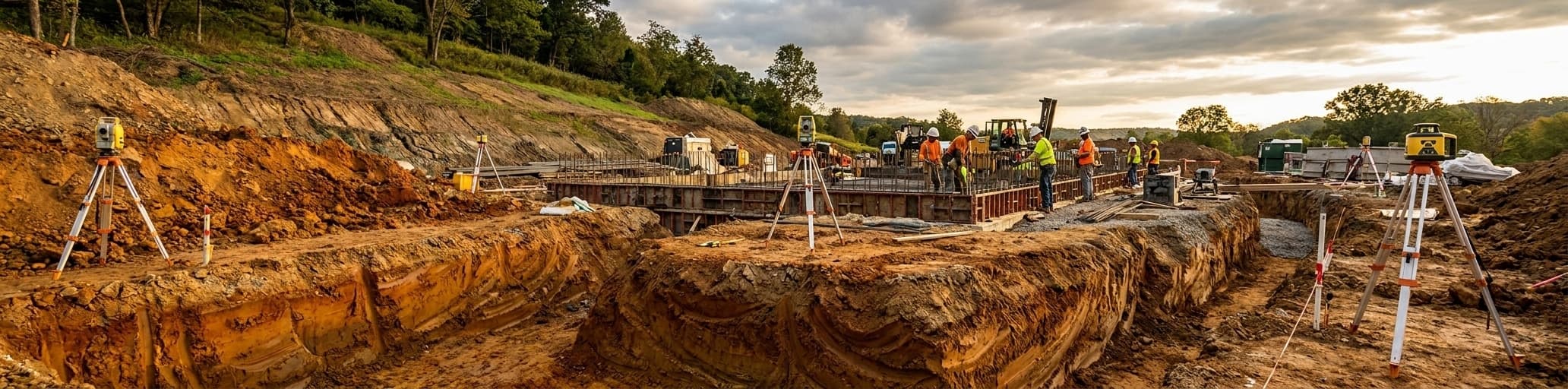

Pittsburgh's clay soils, frost cycles, and mining history create foundation costs that far exceed flat-site estimates, requiring geotechnical investigation before design locks in. We help you budget site prep accurately by coordinating structural engineering with local contractors who know Western PA soil conditions, keeping your project within reach from first shovel to final inspection.
Why Pittsburgh Site Prep Costs More Than You'd Expect
Pittsburgh's clay expansion, coal-mine subsidence, and frost heave cycles require contractors who understand local geology to keep your foundation costs realistic.
Regional soil challenges: clay, subsidence, and seasonal frost
Pittsburgh's geology stacks three distinct problems on top of each other, and each one adds cost before a single steel column goes up.
The region's clay-heavy soils are fine-grained and cohesive, but they expand and contract significantly as moisture levels change — a cycle that generates intense lateral pressure against foundation walls and can cause cracking or differential settlement if the foundation isn't engineered to handle it.[1] Below the surface in parts of Western PA, decades of underground coal extraction left voids that contribute to ground subsidence: a slow, uneven downward movement that shallow slab foundations aren't designed to resist, often requiring deep pile solutions or reinforced concrete systems to bridge unstable zones.[2] Then there's frost.
Pennsylvania's freeze-thaw cycles produce frost heave — water trapped in saturated soil expands as it freezes and physically lifts the foundation, then drops it unevenly when temperatures rebound.[1] The Pennsylvania Building Code responds to exactly these conditions, mandating frost protection for shallow foundations and requiring formal geotechnical investigation whenever expansive or questionable soils are identified on a site.[3] When you're vetting steel building contractors near me, the right question isn't just "have you built steel before?" — it's "do you know Pittsburgh clay, do you know how to check for subsidence risk, and do you know the local frost depth?" A contractor who can answer all three keeps your foundation budget where you planned it.
How Pittsburgh's topography affects foundation depth and drainage
Pittsburgh's steep hillsides and rolling terrain don't just affect how you build — they determine where you can build and what it will cost to get the ground ready.
Hillside lots carry thousands of pounds of lateral earth pressure against any foundation wall, and that load climbs sharply as water-saturated clay swells against the structure.[4] On sloped sites, creating a level building pad means cut-and-fill grading: you cut into the uphill side and fill on the downhill side, which introduces compacted fill soil with different load-bearing characteristics than undisturbed ground — often pushing foundation depth requirements higher than a flat-site project would demand.[4] Drainage is where Pittsburgh's topography compounds the cost most reliably.
Water running downhill toward a foundation accumulates and builds hydrostatic pressure, and on clay-heavy lots that pressure has nowhere to dissipate naturally.[4] Managing it requires a perforated drain pipe at the foundation base, clean gravel backfill, and filter fabric to keep clay from clogging the drainage path over time — none of which appear as line items in a basic steel building kit quote.[4] Pittsburgh's varied topography, freeze-thaw cycle, and clay soils interact in ways that make drainage engineering site-specific rather than standard, meaning your foundation cost on a sloped Western PA lot can diverge significantly from a flat-site estimate for the same building footprint.[4]
The hidden cost of skipping proper soil testing before steel erection
The real cost of skipping soil testing doesn't appear in your original budget — it surfaces months or years after erection, once differential settlement begins stressing the steel frame.[5] Unlike even settlement, where a building sinks uniformly, differential settlement means one section of the foundation drops faster than another, twisting the structure enough to crack walls, jam doors, and put lateral strain on the anchor bolt connections holding your columns in place.[5] Pittsburgh's clay soils add a chemical threat on top of the mechanical one: elevated sulfate content in certain Western PA soil profiles corrodes concrete foundations and steel reinforcements from within the foundation wall — damage that stays invisible until it's structurally significant.[5] When problems finally surface, the corrective measure is underpinning — stabilizing or deepening the foundation after construction — and that remediation bill dwarfs what a pre-construction geotechnical report would have cost.[5] The report isn't just a permit formality; it gives your structural engineer the bearing capacity values, soil chemistry data, and stratigraphy needed to specify the right concrete mix, anchor bolt embedment depth, and foundation type before steel goes up — decisions that are nearly impossible to reverse once erection is complete.[5] A geotechnical investigation run before design locks in is the one line item that protects every other line item in your Pittsburgh site prep budget.[5]
Complete Site Preparation Cost Breakdown for Pittsburgh Steel Buildings
Ongoing geotechnical inspection during construction catches compaction and foundation problems early, saving far more than the report's cost by preventing costly fixes after steel erection.
Soil testing and geotechnical reports: what they cost and why they're non-negotiable
A Pittsburgh geotechnical investigation isn't a single test — it's a coordinated sequence of work that includes subsurface investigation, geophysics, and special inspections of both shallow and deep foundations.[6] The subsurface investigation tells your structural engineer what's actually under your building pad: soil layering, bearing capacity, and moisture conditions. Geophysical methods go further, detecting voids or anomalies that standard soil borings can miss — critical on Western PA sites with any history of mining activity.[6] What many property owners don't realize is that a complete geotechnical scope also covers the construction phase: a qualified firm verifies that fill placement stays structurally stable and inspects reinforced concrete and structural steel connections as they're installed, not just before the project starts.[6] That ongoing inspection function is where the report earns its cost back.
Catching a compaction problem during backfill costs far less than underpinning a settled foundation after steel erection is complete. For a Pittsburgh steel building project, the geotechnical report is the document your structural engineer needs to specify concrete mix, anchor bolt embedment depth, and foundation type — none of which can be responsibly locked in without it.[6]
Foundation types and their price ranges: concrete slab, strip, and pile foundations
Choosing the wrong foundation type for a Pittsburgh site doesn't just add cost — it can mean rebuilding from the ground up after settlement begins. Three foundation systems are most common for steel buildings in Western PA, and each carries a distinct price range tied directly to the soil conditions described above.
A concrete slab is the most cost-effective starting point when your site offers flat, stable ground with adequate bearing capacity. Monolithic slabs run $6 to $14 per square foot for materials and labor combined, with labor alone accounting for roughly half that figure at $3 to $7 per square foot.[7] On Pittsburgh lots with confirmed bearing capacity and minimal frost risk at grade, a properly reinforced slab delivers a clean, low-maintenance floor and foundation in one pour. The trade-off is clear: slabs perform poorly in deep frost-line conditions and on sites where clay expansion puts upward pressure on the concrete from below.[7] If your geotechnical report flags those conditions — and on many Pittsburgh lots it will — a monolithic slab isn't the right tool. For a practical look at how slab thickness decisions affect your actual budget on a common footprint, the 30×40 concrete slab cost breakdown covers the variables that move the number most.
Strip foundations — also called stem wall or continuous footing systems — solve two problems that slabs can't: they work on sloped lots, and they allow different sections of the foundation perimeter to be built to different heights.[7] That makes them the default choice on Pittsburgh's hillside terrain, where cut-and-fill grading creates uneven pad elevations across the building footprint. Pricing runs $6 to $18 per square foot depending on wall height and reinforcement, with the upper end of that range reflecting the additional formwork and concrete volume required on sites with significant grade change.[7] The wider spread compared to slab pricing reflects how site-specific stem wall work actually is: a modest slope adds little cost, while a steep lot with saturated clay backfill pushes you toward the high end.
Pile foundations enter the picture when shallow solutions can't bridge the gap between your building load and a reliable bearing stratum — exactly the scenario on Pittsburgh sites with subsidence history or deep expansive clay profiles. Pier and pile systems typically run $8 to $15 per square foot, though deep-drilled caissons on sites with mining voids or very soft upper soils can push well beyond that range depending on depth and pile count.[7] The cost premium is real, but it buys you something neither slabs nor stem walls can provide: load transfer that bypasses the problematic upper soil layers entirely and seats the building load on competent material below. The table below summarizes the three systems side by side for quick reference:
| Foundation type | Typical cost per sq ft | Best Pittsburgh application |
|---|---|---|
| Concrete slab (monolithic) | $6-$14 | Flat lots with confirmed stable bearing capacity |
| Stem wall / strip footing | $6-$18 | Sloped or uneven terrain; grade-change sites |
| Pier / pile system | $8-$15+ | Subsidence risk zones; deep expansive clay profiles |
The numbers above are starting points, not fixed bids. Concrete thickness, rebar density, and excavation requirements all move the final figure, and Pittsburgh's soil variability means two adjacent lots can land in different tiers of the same range.[7] The geotechnical report your structural engineer uses to specify anchor bolt embedment and concrete mix design is also the document that tells you which row of that table applies to your site — which is why it belongs in the budget before foundation pricing does.
Drainage, grading, and utility relocation: budget-line items contractors often underestimate
Of all the line items that disappear from initial steel building quotes, grading and drainage are the most consistently missing — and the most reliably expensive when they surface mid-project. Site conditions are among the least predictable cost variables in any metal building budget, and a Pittsburgh lot that needs significant grading, has poor natural drainage, or requires land clearing will add real dollars that never appear in a base kit price.[8] Grading on a sloped Western PA site isn't a flat fee — it scales with how much material moves, what compaction testing reveals, and whether fill zones need engineered stabilization before concrete work begins.[9] The standard code expectation — a 2% slope away from the foundation perimeter — sounds simple but requires precise laser-grade work to achieve consistently across a full building footprint.[8]
Surface slope alone doesn't solve Pittsburgh's drainage problem. Water that sheds away from the slab still has to go somewhere, and on clay-heavy lots, it accumulates faster than it infiltrates. Managing it properly means layering solutions: surface grading handles sheet flow, while subsurface systems — perimeter drain tile, clean gravel backfill, and filter fabric — intercept groundwater before it builds hydrostatic pressure against the foundation.[8] Skipping subsurface drainage because it isn't in the original quote is a documented path to foundation moisture, slab cracking, and, critically, voided manufacturer warranties — most steel building suppliers explicitly require water to drain away from the structure as a condition of coverage.[8] Budget these items before you lock in your foundation spec, not after the slab is poured.
Utility relocation compounds the grading and drainage problem because it's the line item property owners most consistently treat as someone else's problem. Running electrical service, water, or gas to a new building pad requires trenching that intersects the same drainage plane you just engineered — poorly sequenced utility work can undercut compacted fill zones or compromise perforated drain runs. Electrical, plumbing, and HVAC connections are explicitly excluded from base metal building quotes, and together with site grading they often account for 30 to 60 percent of total project cost above the kit price.[9] Mapping utility routes before grading begins — not after — is the difference between a coordinated site prep sequence and an expensive redo.
Pittsburgh Foundation Costs by Building Size: Real Numbers for 30×40, 40×60, and 50×100 Steel Buildings
A 30×40 Pittsburgh foundation ranges from $7,200 to $21,600 depending on whether your lot is flat, sloped, or sits on expansive clay.
30×40 steel building: site prep and foundation cost estimate with variables
A 30×40 footprint gives you 1,200 sq ft to work with — enough for a two-bay workshop, farm equipment storage, or a light commercial shell. On a flat Pittsburgh lot with confirmed bearing capacity, a monolithic concrete slab runs $6 to $14 per square foot in materials and labor combined, putting a 30×40 slab between $7,200 and $16,800 before any site prep work begins.[7] Labor alone accounts for roughly half that figure at $3 to $7 per square foot, and concrete contractors typically price delivery separately at $60 or more per load.[7] Shift to a sloped Western PA lot and a stem wall foundation replaces the slab as the right tool: stem wall pricing runs $6 to $18 per square foot, which puts the same 1,200 sq ft perimeter between $7,200 and $21,600 depending on wall height and how much grade change the site carries.[7] When a geotechnical report flags subsidence risk or deep expansive clay, pier and pile systems enter the range at $8 to $15 per square foot — $9,600 to $18,000 for a 30×40 footprint, with deep-drilled caissons on mined ground pushing beyond that ceiling.[7] For full context on how the kit price and site costs combine into a single project number, the total project cost for a 30×40 steel building breaks down every line item. The table below shows how foundation type maps to Pittsburgh site conditions at the 30×40 scale:
| Foundation type | 30×40 cost range | Pittsburgh trigger condition |
|---|---|---|
| Monolithic concrete slab | $7,200 – $16,800 | Flat lot, confirmed stable bearing capacity |
| Stem wall / strip footing | $7,200 – $21,600 | Sloped terrain, cut-and-fill grading required |
| Pier / pile system | $9,600 – $18,000+ | Subsidence history, deep expansive clay profile |
Beyond the foundation itself, site conditions are among the least predictable cost variables in any metal building budget — a Pittsburgh lot that needs significant grading, poor natural drainage, or land clearing will add real dollars that never appear in a base kit price.[10] The installed turnkey range for a 30×40 steel building nationally lands between $29,000 and $52,000, and Pittsburgh's clay soils, frost depth, and topography push most projects toward the middle and upper portion of that spread rather than the floor.[10] Treating the foundation estimate and the site prep estimate as two separate line items — rather than a single combined figure — is what keeps your budget within reach when the geotechnical report comes back with site-specific conditions your original quote didn't anticipate.[7]
40×60 and 50×100 buildings: how foundation costs scale in Western PA soil conditions
Scaling from 1,200 sq ft to 2,400 or 5,000 sq ft doesn't just multiply your concrete volume — it multiplies every Pittsburgh soil risk across a much larger footprint. The per-square-foot rates stay the same, but the absolute dollar gap between foundation types grows fast enough to change which option is financially viable for your project. A 40×60 footprint (2,400 sq ft) on a flat Pittsburgh lot with confirmed bearing capacity puts a monolithic slab between $14,400 and $33,600 in materials and labor combined.[7] Move to a sloped lot requiring stem wall construction and that same 40×60 pad runs $14,400 to $43,200 — a spread wide enough that the upper end approaches twice the slab floor price.[7] When a geotechnical report identifies subsidence risk or deep expansive clay under a 40×60 site, pier and pile systems enter the picture at $8 to $15 per square foot, landing between $19,200 and $36,000 before deep-drilled caissons push the ceiling further.[7] At 50×100 (5,000 sq ft), the same per-foot rates produce numbers that demand a separate budget line entirely: a slab runs $30,000 to $70,000, a stem wall system runs $30,000 to $90,000, and pier or pile foundations start at $40,000 and climb well past $75,000 on sites with mining history or saturated clay profiles.[7] The soil and site conditions that affect cost are among the most variable factors in any metal building budget — and that variability hits harder as footprint grows because each additional square foot carries the same soil risk multiplied across a larger area.[11] For a 50×100 project headed toward warehouse or large commercial use, the industrial warehouse cost breakdown by size puts the foundation line item in context against the full project budget. The table below shows how foundation costs scale across the three most common systems at both footprint sizes:
| Foundation type | 40×60 cost range | 50×100 cost range |
|---|---|---|
| Monolithic concrete slab | $14,400 – $33,600 | $30,000 – $70,000 |
| Stem wall / strip footing | $14,400 – $43,200 | $30,000 – $90,000 |
| Pier / pile system | $19,200 – $36,000+ | $40,000 – $75,000+ |
What changes most at larger footprints isn't the rate per square foot — it's the number of anchor bolt positions, drainage perimeter length, and concrete volume that all scale with floor area, each amplifying the Pittsburgh soil premium.[7] A 50×100 building has more than four times the anchor bolt count of a 30×40, which means every inch of additional embedment depth your geotechnical report specifies adds cost across far more positions than a smaller building would require.[7] Larger footprints also create more surface area for hydrostatic pressure to build against the foundation perimeter on clay-heavy Western PA lots, pushing subsurface drainage requirements — and their cost — proportionally higher.[7] The foundation type your structural engineer specifies for a 40×60 or 50×100 project is determined by the same geotechnical data that governs a 30×40, but the financial consequence of choosing the wrong system scales directly with how many square feet you're building.[11]
Cost factors: how to adjust estimates for your specific lot conditions
Slope is the variable that moves your estimate most reliably. On hillside Pittsburgh lots, retaining walls aren't optional — they're structural, holding back thousands of pounds of lateral earth pressure that builds higher as clay-saturated soil swells against whatever holds it.[4] Wall height drives cost more than any other single factor: taller walls need thicker concrete, denser rebar, deeper footings below the frost line, and often engineering reports before permits are issued.[4] In most Pittsburgh-area municipalities, walls four feet or taller require stamped engineering drawings and building department approval before work can begin — a step that adds both time and cost to any sloped-lot project.[4] Budget these retaining elements as a separate line item from your foundation, not as an included cost, because a base steel building quote will never contain them.
Soil type and site access are the two variables most likely to push your actual invoice above the estimate. Clay, rock, and sandy soils each behave differently under load, and Pittsburgh's clay-heavy profiles expand when wet and contract when dry — a movement cycle that destroys weaker materials and demands engineered footings anchored below the freeze-thaw zone.[4] Access compounds the problem on steep Western PA lots: when trucks and equipment can't reach the pour location directly, concrete must be pumped, conveyed, or wheeled in by hand, and each option adds cost and scheduling complexity that won't appear in an initial quote.[4] Identifying access constraints during the site assessment — not after mobilization — keeps those surprises within budget.
Drainage infrastructure and finish specifications round out the cost factors worth adjusting before you lock in a number. A properly built drainage system behind any retaining wall or foundation perimeter on a Pittsburgh clay lot includes a perforated drain pipe at the footing base, clean gravel backfill, and filter fabric to prevent clay migration into the drainage path over time — none of which are visible once the project is finished, but all of which determine whether the system lasts two decades or eight.[4] On the finish side, stamped concrete, integral color, or exposed aggregate each add cost compared to plain concrete, and those choices are far easier to price accurately before work begins than to retrofit afterward.[4] Running through all five variables — slope and retaining wall height, soil type, site access, drainage scope, and finish spec — with your contractor before the estimate is written is what keeps the final invoice within reach of the original projection.
Why National Steel Buildings' Single-Source Approach Saves You on Site Prep Costs
Design-build coordination prevents costly anchor bolt mismatches by keeping your structural engineer and concrete team working from identical drawings instead of siloed contracts.
Coordinated engineering: how integrated design-build prevents costly foundation redesigns
The most expensive foundation problem on a Pittsburgh steel building project isn't the one your geotechnical report flags — it's the one that surfaces when your steel frame arrives and the anchor bolt pattern doesn't match the slab your concrete contractor poured two weeks earlier. That scenario is almost exclusively a product of fragmented delivery: one team designs the building, another pours the foundation, a third erects the steel, and every handoff between them is a gap where specification errors live undetected until steel hits concrete.
Design-build closes those gaps by running structural engineering and site preparation as a single coordinated scope. Design and construction phases overlap significantly in an integrated approach, allowing site work to begin before engineering is fully completed — compressing schedules by 10-20% compared to sequential delivery methods where each phase waits for the previous one to finish.[12] For a Pittsburgh project, that overlap is precisely what keeps anchor bolt embedment depths, concrete mix specifications, and frost-line foundation details locked together: the engineer specifying your column base plates and the team coordinating your concrete pour are working from the same drawing set, not passing documents between siloed contracts.[12] The parallel processing this enables — foundations poured while building components are being fabricated — is the core schedule and cost advantage that sequential design-bid-build delivery simply cannot replicate.[13] Industry data backs that cost advantage directly: design-build consistently produces measurably less cost growth than traditional design-bid-build, where scope gaps between a designer and a separate builder accumulate into change orders long after concrete has cured.[14] On a Western PA site where clay expansion, frost depth, and subsidence risk already push foundation engineering to its limits, a single-source construction team that owns both the building design and the site prep coordination removes the one variable that has nothing to do with soil conditions and everything to do with process: the costly redesign that happens when two separate contractors make two separate assumptions about the same anchor bolt.
Turnkey site prep partnerships: leveraging our network of vetted local contractors
Finding the right concrete contractor, excavation crew, and drainage specialist in Western PA on your own means starting three separate vetting processes — and none of those contractors have worked together before. That coordination gap is where Pittsburgh site prep budgets break down even when every individual trade is competent.
A pre-vetted local contractor network replaces cold calls with qualified relationships: crews who already know Pittsburgh's soil profiles, frost-depth requirements, and clay drainage behavior show up with answers rather than questions.[15] Local contractors bring something a national roster can't replicate — deep familiarity with the specific quirks of municipal code interpretation and permit offices that vary between Pittsburgh-area jurisdictions, knowledge that keeps inspections on schedule rather than triggering revision cycles that push your steel erection date back.[16] Trade partner selection is a preconstruction function, not a construction-phase scramble; identifying and qualifying site work subcontractors before ground breaks is what allows detailed budgeting and scheduling to surface risks as line items rather than surprises.[17] For guidance on what to ask before any subcontractor touches your lot, the local metal building contractors vetting guide covers the five questions that separate a capable Pittsburgh crew from one that will cost you a change order. The combination of pre-established contractor relationships and site-specific local knowledge is what keeps your turnkey site prep cost within budget from the first shovel to the final anchor bolt inspection.
Transparent communication from day one: the cost advantage of avoiding surprises mid-project
Poor communication causes one-third of all construction project failures, and only 31% of projects finish within 10% of their original budgets.[18] On a Pittsburgh site where clay soil, frost depth, and subsidence risk already press foundation costs toward the high end, that budget gap traces back almost entirely to information that existed before the project started but never made it into the original scope.[19] Design issues alone account for 56.5% of cost overruns and 40% of project delays industry-wide — and most of those changes would never have been necessary if the original scope had captured site conditions accurately from the start.[18] In Western PA, the equivalent failure mode is a contractor who knows Pittsburgh clay behaves a certain way under load, knows the frost line demands specific footing depths, and says nothing until the concrete is already poured.
Transparent communication has a specific financial structure — it isn't a soft promise. Every modification to a construction contract's scope, cost, or timeline requires a written change order signed by all parties before work proceeds; performing work without that document is one of the fastest paths to a disputed invoice and a project that finishes 28% over budget.[20] The discipline that keeps change orders short starts in preconstruction: thorough site assessment, clear scope definition, and upfront disclosure of the geotechnical findings, retaining wall requirements, drainage infrastructure scope, and utility routing conflicts price those variables into the original estimate rather than surfacing them as surprises after mobilization.[20] Proactively notifying you when any condition emerges that could affect cost — and presenting options with concrete numbers before work starts — is what separates a budget that holds from one that expands with every passing week.[19]
The payoff compounds as your footprint grows. On a 40×60 or 50×100 Pittsburgh project, a single undisclosed soil condition can add tens of thousands of dollars to the foundation line item, and 78% of commercial property owners in the United States regularly exceed their construction budgets because that kind of disclosure never happened at the estimate stage.[20] Weekly cost tracking against the original baseline, documented approval before any scope change, and a single point of contact who owns both the building design and the site prep coordination keep your project within budget from the first site assessment to the final anchor bolt inspection.[19]
- Pittsburgh's clay soils expand and contract with moisture, causing foundation cracking and differential settlement if not properly engineered.
- Coal mining voids beneath Western PA create ground subsidence requiring deep pile solutions instead of shallow slab foundations.
- Frost heave from freeze-thaw cycles lifts and drops foundations unevenly, mandating frost protection per Pennsylvania Building Code.
- Geotechnical investigation before design locks in costs far less than underpinning remediation after steel erection reveals foundation failure.
- Foundation costs scale dramatically with footprint size: a 50×100 building multiplies anchor bolt positions and drainage perimeter across 4x the area.
- Design-build delivery closes gaps between structural engineering and site prep, preventing costly anchor bolt mismatches between slab and steel frame.
- Fragmented contractor teams cause 78% of commercial projects to exceed budget; pre-vetted local crews eliminate coordination gaps on Pittsburgh clay lots.
- https://armstrongsteel.com/blog/how-weather-and-soil-conditions-affect-the-installation-of-metal-buildings
- https://www.rosehillbuilders.com/article/how-do-soil-types-impact-metal-building-installations
- https://up.codes/viewer/pennsylvania/ibc-2018/chapter/18/soils-and-foundations
- https://rmkconcrete.com/concrete-retaining-walls-for-sloped-yards-and-hillsides/
- https://ugceconsultants.com/cost-of-ignoring-soil-testing/
- https://www.hcea.com/project/the-bellwether-district-phase-i/
- https://estimators.us/foundation-cost-per-square-foot/
- https://metalprobuildings.com/drainage-grading-tips-for-steel-building-sites/
- https://www.steelstructuresamerica.com/metal-building-cost/
- https://www.engineeredmetalbuildings.com/blog/30×40-metal-building-prices/?srsltid=AfmBOopylssVGb-yG0yTlOPo2PJKiiAnET8Cnc0tTpsGbLsR81h7oO37
- https://www.vikingsteelstructures.com/100×100-metal-building?srsltid=AfmBOoodE8Mer8OR9q9vmbETDfK6S_MVMgMFtPxnZQRtYI6t4z4zsTP_
- https://www.plcconstruction.com/epc-vs-design-build-whats-right-for-industrial-projects/
- https://www.buildingsguide.com/build/pre-engineered-metal-building/?srsltid=AfmBOorG0rlbplBP6kiciUHalpjQbmyGx4EJXJbsIVsg97b7tTdGvzXQ
- https://dbia.org/
- https://westernsteel.com/why-working-with-a-local-steel-building-contractor-in-hawaii-makes-all-the-difference/
- https://www.rainwaterconstruction.com/construction-process-101-site-selection/
- https://www.keeleyconstruction.com/single-post/the-stages-of-construction-a-comprehensive-guide
- https://www.rhumbix.com/blog/change-orders-construction-definitive-guide
- https://cnba.us/2026/05/15/construction-cost-management-strategies-and-tools/
- https://www.sage.com/en-us/blog/construction-project-cost-overruns/