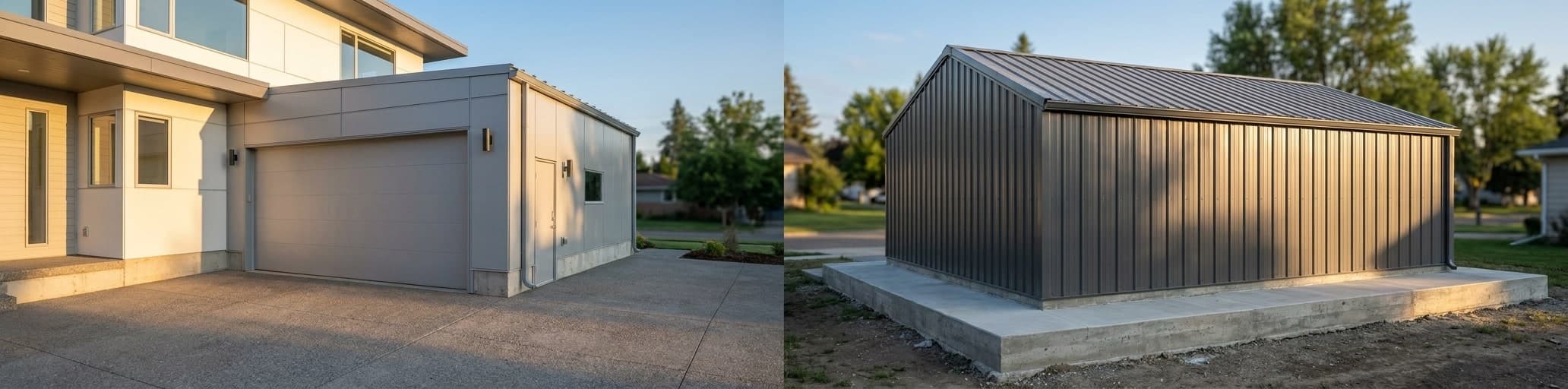

We help you navigate permit requirements, cost differences, and insurance implications when choosing between attached and detached steel garages. Understanding your location's specific codes, regional pricing, and coverage gaps ensures you budget accurately and protect your investment long-term.
Permit Complexity and Timeline: A State-by-State Reality
Your garage electrical, HVAC, and structural permits each require separate applications and inspections, with costs ranging from $50 to $500 per trade permit plus plan review fees.
Attached Garages Require Separate Electrical and HVAC Permits
The building permit for your attached garage is just the first approval — electrical and HVAC work each trigger standalone permit applications with their own inspection sequences, completely separate from the structural review.
Under the National Electrical Code, every garage needs at least one dedicated 20-amp circuit for receptacles and GFCI protection on all outlets, and the 2024 IRC now mandates a dedicated 240-volt circuit for EV charging in new attached garages as well.[9] Those requirements make an electrical permit mandatory regardless of whether the building itself required one — even a structurally exempt detached garage needs an electrical permit the moment you run a single outlet or light circuit.[9] Mechanical work follows the same logic: any HVAC equipment, whether a gas unit heater, a mini-split, or an extension of the home's existing forced-air system, requires a separate mechanical permit and its own inspection before the work can be covered or the space occupied.[10] In Indiana, adding circuits to a garage typically involves installing a subpanel, which triggers both the electrical permit and a dedicated inspection even when the structural permit path is straightforward.[9] Budget $50 to $500 for the electrical permit alone, plus plan review fees that typically run 25-65% of the permit fee itself.[9] For property owners planning a conditioned attached garage — where energy code compliance and insulation for metal buildings become part of the permit review — California even requires Title 24 energy calculations as part of the mechanical permit submission for any heated or cooled garage space.[9] Skipping any one of these trade permits exposes your project to stop-work orders, failed final inspections, and — in the worst case — insurance claim denials tied directly to uninspected electrical work.[9]
Detached Structures Face Fewer Code Overlaps (But Not Always Faster Approval)
Detached steel garages sidestep the three biggest code complications that slow attached builds: fire-separation wall assemblies, structural load-path review of the tie-in connection, and energy-code compliance for shared walls. Your permit application package is narrower — no engineer-stamped structural connection details, no gypsum board specifications, no forced-air extension documentation. What it doesn't eliminate is the permit requirement itself. California requires a building permit for any detached garage over 120 square feet, which covers virtually every standard garage size.[11] Virginia sets its threshold at 256 square feet for unheated structures without utilities, but that exemption disappears the moment you add a single outlet or a permanent footing.[10] Maryland's thresholds fragment further at the county level: Baltimore City and Baltimore County trigger permits at 120 square feet, Prince George's County at 150 square feet, Rockville at 150 square feet, and most Montgomery County jurisdictions at 200 square feet.[12] Even when a structure falls under the building permit threshold, a zoning permit is often still required — Annapolis mandates a zoning certificate for any accessory building regardless of size, and Anne Arundel County requires a zoning-only review for structures that don't hit the building permit threshold.[12]
The approval timeline for a detached garage tracks the local building department's workload, not your project's complexity. In smaller Virginia counties, a building permit can process in roughly two weeks; in a larger jurisdiction like Fairfax County, the same application can run a month or longer.[10] Site plan revisions, electrical trade permits, and proximity to environmental features extend that window further.[10] In Maryland, properties within 1,000 feet of the Chesapeake Bay face Critical Area review requirements that add approval layers regardless of structure type, and historic district rules in places like Ellicott City require separate approvals before standard permit processing begins.[12] California permit fees alone range from $200 to $500 on average — and can exceed $2,000 depending on scope — so the cost of navigating a multi-agency review in a complex jurisdiction adds up before a single panel goes up.[11] If you want a clear-eyed picture of what a detached metal garage actually delivers long-term before committing to a site plan, that context matters as much as the permit checklist. A detached build with a clean lot, straightforward setbacks, and no utilities can move quickly — but any one of those variables shifts the timeline in ways that are difficult to predict without knowing your specific jurisdiction's queue and submission preferences.
How National Steel Buildings Handles Permit Coordination for Both Types
The industry default puts permit responsibility squarely on the building owner — not the contractor.[14] In most jurisdictions, you're the one filing the application, coordinating with building officials, and tracking the engineering team's submission.[14] That's workable when you're dealing with a straightforward detached structure in a single jurisdiction, but attached garages layer in energy-code reviews, load-path documentation, and trade permit sequences that can stall a project for weeks if the submission package is incomplete.[15] What keeps projects moving is submitting clean plans on the first pass — clear drawings, paid fees, and an active line to the local building office.[14] The problem is most property owners don't know what "clean" looks like until they've already had a set rejected. Every NSB project ships with engineer-stamped plans and certification letters specifically because building departments expect that documentation before they'll approve fabrication.[15] Holding fabrication until stamped drawings are approved — what some manufacturers call a permit-hold order — protects you from receiving steel panels that don't match an amended site plan.[15] For attached garages, that matters even more: if a load-path detail gets revised during plan review, you don't want structural steel already cut to the wrong spec.
NSB's turnkey process coordinates that sequencing for you — permit submission, plan revisions, and fabrication release happen in the right order, within budget, without you managing each handoff. Detached structures under local thresholds — Kansas City, for example, exempts detached garages with a projected roof area under 200 square feet from building permits entirely — still need a zoning review and electrical permit the moment any wiring is planned, so the coordination requirement doesn't disappear just because the structural permit does.[13] One point of contact who already knows your AHJ's submission preferences compresses the approval timeline for both structure types, which is where NSB's nationwide project experience pays off more than any other single factor.
Total Cost Comparison: Attached vs. Detached Steel Garage (2026 Pricing)
Material and Labor Cost Breakdown by Configuration Type
The per-square-foot gap between attached and detached builds is well-documented, but the more useful question is which specific line items drive that gap. Steel kit pricing is identical regardless of configuration: commercial-grade building kits run $15 to $20 per square foot for the framing and panel package alone.[16] Turnkey installed pricing — kit plus concrete, delivery, and construction — averages $24 to $43 per square foot across both types.[16] The configuration split emerges in everything layered on top: exterior wall count, foundation scope, and utility run length all change when you move from attached to detached, pushing detached structures 10% to 20% higher than a comparable attached build.[17]
| Component | Attached steel garage | Detached steel garage |
|---|---|---|
| Steel kit only (supply) | $15-$20/sq ft | $15-$20/sq ft |
| Installed turnkey (avg) | $30-$55/sq ft | $40-$70/sq ft |
| 1-car full build | $18,000-$28,000 | $22,000-$38,000 |
| 2-car full build | $25,000-$50,000 | $30,000-$60,000 |
| Regional labor variance | +/-15-30% | +/-15-30% |
Regional labor rates and material costs shift your total by 15% to 30% regardless of configuration — urban and coastal markets consistently run higher, while rural builds often land closer to the floor of each range.[17] A detached structure on a distant or sloped site adds site-prep and utility-trench costs that can push it well past the $60,000 ceiling for a standard 2-car footprint, while a straightforward attached build on a prepped lot with an accessible panel can land near the lower bound.[18] For a size-specific cost breakdown that maps kit pricing to a common footprint, the 30×40 prefab building cost guide shows exactly how turnkey pricing stacks up against kit-only quotes at a footprint most 2-car and 3-car garage buyers land on. Pre-fabricated kit solutions start at $6,000 to $12,000 before labor, foundation, and finishing — a number that looks attractive until you add those line items back in, at which point the all-in turnkey comparison closes fast.[18]
Hidden Costs: Concrete Slab, Utilities, and Setback Requirements
The concrete slab is where most garage budgets come up short before a single panel is erected. A 4-inch pour handles light vehicle storage, but workshop use or heavy equipment storage demands 6 inches minimum — and that spec shift increases both material volume and labor on the pour.[19] Beyond thickness, perimeter footings are a separate line item most kit quotes omit: they must be at least 12 inches wide, 12 inches deep, and poured simultaneously with the slab to prevent settling.[19] Footing depth in frost-affected regions is typically set at 42 inches below grade — a requirement driven by local code, not the structure above it.[19] Add the standard spec of 4,000 psi concrete for any metal building foundation (an upgrade from typical residential-grade mixes), plus the 2-inch slab overhang beyond your building's frame dimensions needed for proper wall connection and drainage, and your concrete budget is meaningfully higher than the per-square-foot pour cost suggests.[19] For a detailed look at how slab thickness decisions interact with your specific footprint before committing to a foundation spec, the concrete thickness guide for 30×40 steel buildings shows exactly where those numbers land.
Setback requirements move from a zoning checkbox to a real cost driver the moment your preferred building location doesn't clear the minimums. In Kingsport, Tennessee, a detached garage must sit at least 5 feet behind the main house and 3 feet from both rear and side property lines — requirements that apply per structure, not site-wide.[20] Bartlett enforces the same 5-foot minimum between the garage and the dwelling, while Chattanooga allows placement as close as 3 feet to side or rear lines depending on the zoning district.[20] When a site doesn't clear those distances as positioned, your options are redesigning the footprint, relocating the slab, or filing for a variance — each adding cost, and the variance route adding weeks or months.[20] Properties in historic districts compound the delay further: Columbia, Tennessee requires a certificate of appropriateness before standard permit processing begins, and equivalent requirements exist across jurisdictions in every state.[20]
Utility permits are the hidden cost most owners don't price until they've committed to a site. Tennessee requires a standalone electrical permit any time you run wiring to a garage — a single outlet circuit is enough to trigger the requirement and its inspection fees.[20] Separate mechanical permits apply to any HVAC unit regardless of whether the structural permit was required at all.[20] The sequencing matters more than the fee itself: electrical and mechanical inspections happen after structural work is complete but before occupancy, so a missed permit doesn't surface until the final inspection — at which point remediation costs more than pulling the permit at the outset would have.[20]
Cost Estimator: See Your Local Pricing in Real Time
The national ranges in the table above are a starting point, not a final number — your zip code is what turns those ranges into an actual budget.
Your location determines which snow loads, wind speeds, and seismic conditions your structure must be engineered to meet, and those engineering requirements change the steel specification and fabrication cost before a single panel ships.[22] A garage built in Miami to hurricane wind standards carries a different material spec than the same footprint built in Montana to high-snow-load requirements, even if the footprint and configuration are identical.[22] On top of the engineering variables, regional labor rates shift your all-in cost by 15% to 30% compared to the national average — urban and coastal markets consistently land toward the top of every installed range, while rural builds in lower cost-of-living areas often land near the floor.[21] Pre-build fees like drafting and architectural review typically add 8% to 15% to the total project cost and vary by local firm rates, not national benchmarks.[21] Permits run $1,200 to $1,500 on average nationally, but fee schedules are set jurisdiction by jurisdiction, so a high-volume metro building department can push that figure higher.[23] The only way to get pricing that reflects your actual site, your local labor market, your AHJ's permit fees, and your structure's engineering requirements is to submit your zip code and footprint to a builder who engineers to your location's specific load conditions.
For a broader view of how steel frame construction costs stack up before you request a site-specific quote, that context grounds your expectations before the first number comes back.
Insurance, Resale, and Long-Term Value Implications
Adding a garage typically returns 60-85% of construction costs at resale, with attached garages commanding 10-15% higher value in convenience-focused markets.
How Attached Garages Affect Home Insurance and Property Value
Insurance classification is the first place the attached-versus-detached decision hits your wallet after construction. An attached garage is treated as part of the dwelling itself, so your insurer covers it under the dwelling section of your homeowners policy — the same coverage that protects the main structure.[24] That classification also means an attached garage raises your insured replacement value, which nudges your annual premium upward.[24] The risk calculus behind that adjustment is straightforward: fire, carbon monoxide, and structural damage in an attached garage can spread directly into the home, and insurers price that exposure accordingly.[24] Neither attachment type requires a separate policy — standard homeowners coverage handles both — but you do need to notify your insurer and update your declared home value any time you add or significantly modify a garage, regardless of configuration.[24]
On the property value side, the ROI case for any garage addition is strong across most U.S. markets. Garage additions return between 60% and 85% of construction cost at resale, depending on location, materials, and design.[25] In practical dollar terms, a functionally adequate garage in a typical market adds $5,000 to $25,000 to appraised value.[25] Regional demand sharpens that range considerably: in Chicago, where winters are severe and parking is limited, a garage addition can add a 38% premium to home value; in Los Angeles, where outdoor parking is common year-round, the same addition yields roughly a 3.2% premium.[25] Certified appraiser Angela Miller notes she gives as much value to a detached garage as an attached one in rural markets — and she assigns additional value for an unfinished but accessible second floor above the structure.[25]
Attached garages hold a specific advantage in convenience-driven markets where buyers prioritize direct interior access — the same factor that makes an attached build 10% to 15% less expensive to construct than a comparable detached structure.[25] Security is the primary trade-off: an attached garage with a compromised door or electronic opener gives an intruder direct access to the home's interior, a vulnerability that detached structures simply don't carry.[26] For steel frame structure buyers focused on long-term resale, the practical guidance is to match configuration to your market's buyer profile — urban and suburban markets with limited parking reward attached builds most, while rural and hobby-property markets value detached square footage nearly as highly, particularly when the space supports workshops, equipment storage, or a second-floor living area.[25]
Detached Steel Garages: Separate Policies and Lower Coverage Complexity
A detached steel garage is covered under Coverage B — Other Structures — of your standard homeowners policy, not the same component that protects your main dwelling.[27] Coverage B applies to the same named perils as the main house: fire, windstorm, hail, lightning, vandalism, and falling objects including snow and ice collapse.[28] What it does not cover is flood damage from any source, earthquake, gradual deterioration, or liability from business use on the premises — all excluded regardless of structure type.[28] The real limitation isn't the peril list; it's the default cap.
Coverage B is set at 10% of your dwelling coverage, and that cap is shared across every detached structure on your property combined.[28] A $300,000 dwelling policy gives you $30,000 total for your garage, shed, fence, and any other unattached structure — split however the adjuster determines.[27] A finished steel garage with built-in electrical, insulation, a workshop bench, and a mini-split can easily exceed that shared ceiling, leaving you with an uninsured gap you won't discover until you file a claim.[28] The fix is straightforward: request a Coverage B endorsement to raise the limit to reflect your garage's actual replacement cost — a modest annual premium increase that closes a gap a single total-loss claim would otherwise expose.[28] Also confirm whether your policy pays actual cash value or replacement cost value for Coverage B structures; ACV policies deduct depreciation, meaning a steel garage built a decade ago may pay out far less than what rebuilding it today actually costs.[28] If you operate a home-based business — a fabrication shop, a commercial studio with clients on site — standard Coverage B excludes that liability entirely, and a business owner's policy or home business endorsement becomes mandatory to restore it.[28]
Why National Steel Buildings's Turnkey Approach Simplifies the Entire Process
Most steel building buyers underestimate two factors that quietly blow their budget: hidden costs and the time required to coordinate every trade, permit, and inspection themselves.[29] That coordination gap is where attached and detached garage projects most commonly stall — a missed electrical permit here, a rejected plan set there, and suddenly your site is idle for weeks while fabricated steel panels sit in a warehouse waiting on an amended approval. The turnkey model collapses all of that into a single sequence with one accountable party managing each handoff.
The process starts with a project consultation to identify your site requirements, configuration goals, and load conditions, followed by conceptual design and a detailed quote before any commitment is made.[30] Once you approve the layout and contract, engineers produce stamped permit drawings calibrated to your project's complexity — the same documentation building departments require before they'll process an application.[30] From there, the pre-construction phase covers permit filing, site grading, and foundation preparation, a window that typically runs 4 to 8 weeks depending on your jurisdiction's review queue.[30] Materials are scheduled for delivery only after that groundwork clears, so you're never managing a steel delivery to a site that isn't ready to receive it.[30] For a precise look at how that delivery and fabrication sequence actually works from order confirmation forward, the prefab building kits delivery timeline lays out each phase with honest timelines. Installation follows once the slab is cured and the permit is in hand, running 1 to 3 months depending on footprint and site conditions, and closes with a walkthrough that confirms every element meets spec before the project is considered complete.[30] Every step, one contract, one point of contact — within budget, on schedule, without you managing the handoffs.
- Attached garages require electrical, mechanical, and structural permits with separate inspections; detached garages need fewer trade permits but still require building or zoning approval.
- Permit timelines vary dramatically by jurisdiction–from two weeks in small counties to months in complex areas with environmental or historic district reviews.
- Detached steel garages cost 10-20% more than attached builds due to extra exterior walls, full foundations, and longer utility runs, ranging $22,000-$60,000 for 2-car structures.
- Concrete slab specifications–thickness, footing depth, and frost-line requirements–are major hidden costs most kit quotes underestimate or omit entirely.
- Attached garages raise homeowners insurance premiums by increasing dwelling replacement value; detached garages fall under Coverage B with a shared 10% cap across all detached structures.
- Garage additions return 60-85% of construction cost at resale, but ROI varies by region: 38% premium in Chicago versus 3.2% in Los Angeles.
- Turnkey coordination eliminates permit delays and fabrication mismatches by sequencing engineering, permits, foundation work, and steel delivery as one managed process.
- https://www.howtolookatahouse.com/Blog/Entries/2020/7/what-is-the-difference-between-an-attached-and-detached-garage.html
- https://www.thebuildingcodeforum.com/forum/threads/definition-of-attached-vs-detached-garage.13760/
- https://www.finehomebuilding.com/2023/11/22/code-guidelines-for-garages
- https://trusscore.com/blog/garage-building-code-requirements-you-need-to-know.html
- https://permitsguide.com/garage/new-jersey
- https://dakotastorage.com/building-a-detached-garage-do-you-need-a-permit-find-out-here/
- https://precisiondoorla.com/blog/cost-comparison-attached-vs-detached-garage-construction/
- https://thegarage.guide/cost-guides/garage-addition-cost
- https://permitsguide.com/garage
- https://foleyconstruction.net/can-i-build-a-detached-garage-on-my-property/
- https://goldenstatebuildings.com/articles/garage-permits-in-california-the-complete-guide/?srsltid=AfmBOor6lgbHOrvryAgTIuDDseHNPki_ZqSXp8xXwFHaM4cksvkTvsat
- https://shedsunlimited.net/state-regulations/garage-permits-in-md/?srsltid=AfmBOor-ex14FQeU6jXVCylBLVqKLplD2_nAcJ8_ctxRwuUtsyrjHaCm
- https://www.kcmo.gov/city-hall/departments/city-planning-development/building-permit-exempt-work
- https://directmetalstructures.com/blog/real-reasons-you-need-a-permit-before-building-a-metal-garage/?srsltid=AfmBOorD7RATTppLh4zBlbUty58GtcJ4hVZ446DVlWwUOOAmGqu9Bnf1
- https://www.rhinobldg.com/blog/construction-permits-for-metal-buildings
- https://www.buildingsguide.com/metal-building-prices/?srsltid=AfmBOorrfaCgLB15CgrdSbcZYwQglUlUDF5Pn00diNG9C50KHj3LQUGM
- https://trusscore.com/blog/how-much-does-it-cost-to-build-a-garage.html
- https://estimators.us/cost-to-build-a-two-car-garage/
- https://prestigesteelstructures.com/metal-building-concrete-recommendation/?srsltid=AfmBOopjnc10eVEj_KG_CEabmNxamNW0PQWt3WhuKSKiaZTumNQslHfO
- https://shedsunlimited.net/state-regulations/garage-permits-in-tn/?srsltid=AfmBOoqwW3CLrmsJmvBactctpnE428XAIv3RpsBnS115oNbFL40bM6lp
- https://www.angi.com/articles/how-much-does-it-cost-build-garage.htm
- https://gensteel.com/price-your-building-online/
- https://primeestimation.com/how-much-does-it-cost-to-build-a-garage/
- https://clearsurance.com/blog/attached-garage-vs-detached-garage/
- https://www.homelight.com/blog/how-much-does-a-detached-garage-add-to-property-value/
- https://www.selective.com/about-selective/blog/personal-risk-preparedness/pros-and-cons-of-detached-vs-attached-garages
- https://www.policygenius.com/homeowners-insurance/does-home-insurance-cover-garages/
- https://www.moneygeek.com/insurance/homeowners/does-home-insurance-cover-detached-garages/
- https://buildway.com/steel-building-cost-breakdown-hidden-fees/
- https://www.steelcobuildings.com/steel-buildings/garages-workshops/