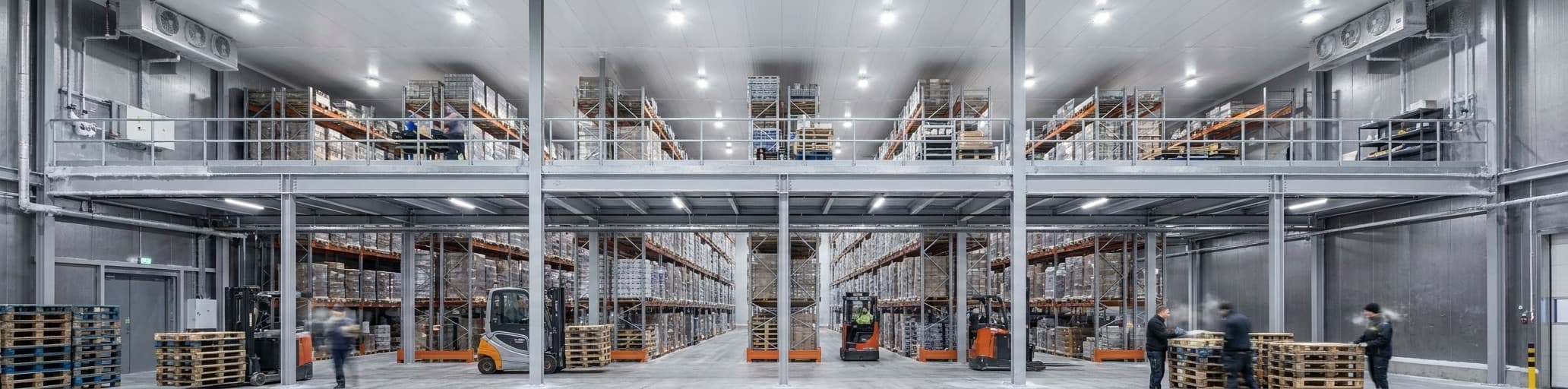

We help you compare mezzanines and building additions to determine which expansion path delivers faster ROI for your cold storage facility. Mezzanines win on speed and cost when your building has adequate clearance, while additions make sense only when you need unobstructed ground-level access and own the property long-term.
Why Mezzanines and Building Additions Matter for Cold Storage ROI
Mezzanines reach operational capacity faster and cost significantly less than building additions because they expand vertically within your existing structure, avoiding foundation and site work entirely.
The storage capacity crisis: Why existing warehouses need expansion
Mezzanines vs. additions: Which expands usable square footage faster A mezzanine adds floor area by working vertically inside your existing building envelope — no new foundation, no site work, no exterior construction.[5] That single structural reality is why mezzanine projects reach usable square footage faster than building additions in most scenarios. A well-planned mezzanine can effectively double your usable floor space while leaving your building footprint completely untouched.[4] The permit path is more involved than standard racking — building codes classify a mezzanine as a new floor level within an existing structure, which triggers full building permit requirements in virtually every U.S. jurisdiction.[5] Plan review typically runs 6 to 14 weeks, with California jurisdictions frequently pushing 8 to 12 weeks due to seismic design requirements.[5] A building addition carries all of those same permit obligations plus foundation engineering, site preparation, and exterior envelope work — each adding weeks or months before a single square foot becomes operational.
When your primary goal is getting usable cold storage capacity online quickly, expanding vertically inside your existing four walls wins on speed. You can explore industrial warehouse construction costs by size to see how addition costs scale before committing to either path.
How 2025 construction costs change the ROI math for each option
The cost gap between a mezzanine and a building addition has always existed, but 2025 and 2026 market conditions make it structurally wider — and that directly changes your payback math. Cold storage construction now runs $130 to $350 per square foot depending on temperature zone, two to three times the $78 to $85 per square foot benchmark for standard warehouse construction.[6] A building addition at the refrigerated or frozen end of that range absorbs every cost pressure hitting new construction right now: Section 232 steel and aluminum tariffs at 50% are embedded in structural framing and MEP rough-in, annual cost escalation runs 3 to 8%, and HVAC equipment lead times stretch 16 to 52 weeks — each factor pushing back the point at which new capacity generates positive cash flow.[7] Industrial construction costs held relatively stable year-over-year through early 2025 as a slower global construction pipeline softened competition for materials and services, but global trade uncertainty has since pushed suppliers to price in a structurally higher-cost operating environment.[8] A mezzanine sidesteps most of those new-construction cost drivers: no new exterior envelope to procure, no foundation scope, and a pre-engineered steel structure that avoids the full tariff and lead-time exposure of a ground-up addition.
If you're weighing the vertical option, two-story metal building configurations show how pre-engineered steel frames the floor-addition cost problem differently than site-built construction does. When you hold revenue per square foot constant and widen the cost denominator on only one path, the ROI advantage of vertical expansion compounds with every quarter the market stays pressured.
2025 Cold Storage Warehouse Construction Cost Per Square Foot: Direct Comparison
Cold storage mezzanines cost $85-$150 per square foot installed versus $20-$30 for dry storage, but choosing composite flooring over concrete can save $644,000 on a 90,000-square-foot project.
Cold storage mezzanine costs: $85-$150 per square foot installed
A standard dry-storage mezzanine runs $20-$30 per square foot for the structural steel alone — cold storage pushes that number to $85-$150 per square foot installed because the environment imposes costs that have nothing to do with framing. Cold storage demands insulated enclosures, high-performance vapor barriers, and specialized mechanical systems that drive per-square-foot costs far above standard warehouse mezzanine benchmarks.[9] Every floor penetration for refrigerant piping, every insulated panel section, and every vapor barrier transition point adds scope that a dry-storage mezzanine simply doesn't carry.
Flooring material selection is where you get the most immediate control over where in that range your project lands. A 90,000-square-foot mezzanine built with lightweight composite flooring panels came in at roughly $2.06 million all-in, compared to $2.71 million for an equivalent concrete deck — a $644,000 difference driven largely by the ability to reduce column diameter from 14 inches to 10 inches and trim foundation caisson costs by approximately $140,000 on the structural scope alone.[10] In a cold storage application, that weight reduction matters even more: lighter deck assemblies reduce point loads on an insulated floor system that is already engineered to resist moisture migration and thermal bridging.
For a comprehensive mezzanine installation scope — structural steel, insulated flooring, vapor barrier detailing, and refrigeration system tie-ins — budget figures in the $50-$120 per square foot range for the TI work, with cold storage-specific requirements pushing totals toward or past the top of that band depending on temperature zone.[11] The clearest way to control final cost is to finalize your flooring specification and column layout before structural engineering begins: changing column sizing after the foundation is designed is among the most expensive mid-project corrections in mezzanine construction.[10]
Building addition costs: $125-$200 per square foot (including foundation and envelope)
Cost Estimates: Mezzanine vs. addition for your facility size The per-square-foot ranges covered above translate very differently depending on how much square footage you're actually adding — and the cost gap compounds fast at scale. Cold storage construction benchmarks run $130-$350 per square foot for new addition work, while mezzanine installations in cold environments land in the $85-$150 per square foot range.[6] The table below applies those benchmarks across four common expansion footprints. The mezzanine column uses mid-range cold storage install costs. The addition columns split by temperature zone: refrigerated (35-50 degreesF) at $130-$210 per square foot and frozen (-10 to 32 degreesF) at $200-$285 per square foot. All figures exclude land acquisition, off-site utility upgrades, and tenant-specific process equipment — budget items that routinely push final costs past the published construction rate.[12]
| Expansion footprint | Mezzanine (cold storage) | Addition — refrigerated zone | Addition — frozen zone |
|---|---|---|---|
| 2,500 sq ft | $213K-$375K | $325K-$525K | $500K-$713K |
| 10,000 sq ft | $850K-$1.5M | $1.3M-$2.1M | $2.0M-$2.85M |
| 25,000 sq ft | $2.1M-$3.75M | $3.25M-$5.25M | $5.0M-$7.1M |
| 50,000 sq ft | $4.25M-$7.5M | $6.5M-$10.5M | $10M-$14.25M |
Small-scale expansions carry a disproportionately high per-square-foot burden because fixed costs — refrigeration equipment, controls, electrical service upgrades — don't shrink with floor area. A 1,200 square foot cold storage unit can run $300,000-$550,000 before land, implying $250-$460 per square foot at the small end of the size spectrum.[12] That dynamic makes the mezzanine advantage most actionable in the 10,000-25,000 square foot range, where structural savings are large enough to shift payback period by months but refrigeration scope hasn't yet hit the complexity ceiling of a major frozen addition. Frozen-zone additions also require engineered slab frost protection that refrigerated additions don't carry — a scope item that scales with lower target temperatures and widens the cost gap between vertical expansion and a new footprint at every size tier shown above.[12]
Five Hidden Cost Drivers That Favor One Option Over the Other
Mezzanines avoid the 25-35% refrigeration cost premium of building additions by leveraging your existing cooling system instead of engineering a new one from scratch.
Refrigeration system modifications: Why mezzanines cost less to cool
The refrigeration system is where the cost gap between a mezzanine and a building addition becomes most tangible in cold storage expansion. Cold storage refrigeration accounts for 25-35% of total initial construction costs — on a base rate of $150-$250 per square foot, that means $37-$87 per square foot of your build budget goes to mechanical cooling alone.[13] A building addition applies that full refrigeration cost to every new square foot: new evaporators, new compressor staging, new controls, and the fully insulated exterior envelope those systems are engineered to serve.[6] A mezzanine built within your existing conditioned space works differently.
Because a mezzanine is structurally independent from your walls and roof and requires no modifications to the building envelope itself, it doesn't create new exterior surface area for your refrigeration system to overcome.[14] You're modifying an existing refrigeration plant — adding evaporator capacity, adjusting controls, extending piping runs — rather than engineering and commissioning a new one from scratch. That distinction compounds over time because energy consumption runs 60-70% of total cold storage operating costs, and for a 100,000-square-foot facility annual energy bills commonly exceed $400,000-$600,000.[13] A new refrigeration plant adds permanently to that baseline; a modification to existing infrastructure doesn't carry the same long-run burden.
Scope discipline matters here too: systems oversized by contractors cycle inefficiently, while undersized systems run at continuous peak load — both scenarios generating energy waste that erodes ROI for decades after the addition opens.[13] Tying mezzanine square footage into existing refrigeration capacity avoids both failure modes and keeps you out of the full 25-35% mechanical cost bracket that a ground-up addition cannot escape.[13]
Foundation and site prep: The advantage of vertical expansion
A mezzanine's structural columns transfer point loads directly to your existing concrete slab — no new foundation engineering, no excavation, no site work.[15] That single structural fact eliminates the most time-consuming and cost-exposed line items in a building addition budget before the project even reaches design review.
Pre-engineered mezzanines channel loads from the platform level through structural steel columns into the concrete floor below, which means site preparation reduces to three steps: clear the floor, verify the slab can carry the new point loads, and confirm overhead clearance.[16] A building addition cannot borrow that shortcut — it needs its own foundation, its own slab, and in frozen storage applications, an engineered frost protection system that scales in cost with lower target temperatures.
Installation labor for a pre-engineered mezzanine runs $20-$60 per square foot, with engineering and permitting adding $5,000-$25,000 depending on complexity and jurisdiction — scope that replaces, not supplements, the foundation and site-work budget a building addition carries in full.[16] Freestanding mezzanine configurations extend the advantage further: because they are independent structures not connected to existing walls or columns, they impose zero modification obligations on your building envelope and can be dismantled and relocated if your operational footprint changes.[17] You get usable square footage without touching the ground.
Permit timelines and local code requirements: Speed-to-ROI breakdown
The distinction between planning permission and a building permit trips up more projects than any other permit misconception. Planning permission — which governs a building's external appearance and zoning use — is rarely required for a standard mezzanine installation.[18] The approval that's always required is a building permit, which scrutinizes structural engineering, fire safety, load capacity, and egress.[18] Conflating the two is how facilities end up with unpermitted structures that void insurance coverage and trigger mandatory demolition orders at the owner's expense.[18] A building addition carries that same mandatory building permit plus foundation engineering review, site-work approvals, and exterior envelope inspections — each a sequential gate that a mezzanine never touches.
Within the building permit process, IBC Section 505.2 is the single rule that most directly affects your timeline and total cost exposure. A mezzanine that complies with 505.2 is legally "considered a portion of the story below" — a classification that keeps your project in the simpler, faster permit lane.[18] Non-compliance flips that classification to a "new story," which cascades into far more complex regulations covering total building height, construction type, fire area, and overall area calculations — each adding review time and engineering scope.[18] The three compliance conditions are:
- The mezzanine floor area cannot exceed one-third of the floor area below
- Minimum clear heights of 7 feet must exist both above and below the deck, measured to the lowest obstruction
- The mezzanine must remain open to the room below, with limited exceptions for enclosed spaces under 10% of the mezzanine area
Hitting all three keeps your permit review on the standard path; missing any one pushes the entire project into a longer, more expensive review cycle that delays your first revenue-generating pallet position.[18]
The most common cause of permit delays isn't code complexity — it's incomplete submissions.[18] When a plan reviewer finds missing calculations or non-compliant designs, they issue rejection comments that restart the review clock entirely.[18] A pre-design consultation with the local code office, before engineering begins, is the highest-ROI step you can take: it surfaces local amendments, seismic requirements, and jurisdiction-specific interpretations before a single drawing is stamped.[18] If your timeline is the binding constraint on payback, one path worth evaluating is classifying the structure as a work platform rather than a mezzanine. Work platforms are treated as equipment rather than permanent building components, which means a simpler approval process and no fire area calculation obligations.[19] The operational trade-off is real: work platforms are engineered for equipment access rather than regular occupancy, and they depreciate over 7 years as equipment rather than 31 years as real property — a meaningful difference in how the capital outlay flows through your balance sheet.[19] For facilities where the space will see regular employee use or office functions, the mezzanine classification is mandatory regardless, and the permit investment is the cost of getting a legally compliant, insurable, permanent asset.[18]
Making the Right Choice: Decision Framework and National Steel Buildings Solutions
A mezzanine delivers 5-10 year payback when your facility has 20+ feet of clear height and can fill the new space from day one, outpacing traditional building additions.
When a mezzanine delivers faster payback (and when it doesn't)
Mezzanine payback outpaces a building addition when three conditions align: your facility has at least 20 feet of clear height, your operation needs additional floor area without relocating, and your workflow involves high-SKU picking or fulfillment where vertical separation actually improves throughput.[20] In those scenarios, a mezzanine can double or triple usable capacity within the same footprint, with a typical payback window of 5 to 10 years — a timeline a building addition can't match once you factor in land acquisition, foundation engineering, exterior envelope, and the carrying costs that stack up while construction runs.[21] The 30-year service life of a quality mezzanine stretches that ROI forward rather than resetting it, and modular configurations carry depreciation-based tax advantages that ground-up additions don't offer in the same form.[21]
The conditions that compress or erase mezzanine ROI are more structural than financial. Buildings with less than 20 feet of clear height are the most common disqualifier — code minimums for usable clearance above and below the deck leave little margin in facilities already short on vertical room.[20] Operations that depend on unobstructed ground-level forklift access across the full floor plate face workflow constraints that offset the productivity gain a mezzanine is designed to generate. Beyond physical fit, payback is directly tied to utilization: a mezzanine level that sits partially occupied doesn't return its investment faster than an underused addition would, which means the ROI case lives or dies on whether your operation can genuinely fill and use the new square footage from day one.[21]
When a building addition makes sense for long-term capacity
A building addition earns its $130-$350 per square foot price tag when three conditions converge: you own the property outright, your required capacity gain exceeds what your facility's vertical clearance can deliver, and your operation depends on unobstructed ground-level forklift access that mezzanine columns would compromise. A permanent structural addition cannot be relocated or reconfigured without additional construction, and if your business moves facilities, the investment stays with the building rather than following your operation — which means additions only make financial sense when the property itself is a long-term asset.[22] For owner-occupied cold storage facilities facing sustained volume growth that will push past a mezzanine's one-third floor-area limit, a ground-up addition is the only path to capacity at scale without operational trade-offs on the floor below.
The timeline commitment is real but sometimes the right call. A full addition runs 6 to 18 months from design through final inspection — permitting, foundation work, steel erection, HVAC, electrical, and exterior envelope — with the permit process alone consuming 2 to 4 months in most municipalities.[22] For operations that can plan ahead and absorb that runway, the result is permanent square footage with no vertical constraints, no column interference on the ground floor, and a refrigeration plant engineered from the start for the full expanded footprint. The most cost-effective path when you need both near-term relief and long-term scale: install a mezzanine now to handle immediate capacity gaps quickly, then build the addition as sustained demand justifies the capital outlay — the mezzanine can be dismantled and relocated into the expanded space once construction wraps.[22]
How National Steel Buildings designs hybrid solutions for maximum storage ROI
The strongest ROI case in cold storage expansion isn't a binary choice between a mezzanine and an addition — it's a sequenced hybrid that captures speed-to-revenue now and scale later. The design logic starts with a pre-engineered steel mezzanine engineered to your facility's specific clear height, slab load capacity, and refrigeration zone. A well-executed two-story modular mezzanine can add over 7,000 square feet of usable storage without a single change to the building's exterior footprint, while maintaining full operational continuity during installation.[23] That capacity gain is permanent and immediately revenue-generating — no foundation delay, no envelope construction, no months of carrying costs before a pallet position opens.[23]
The structural design choices made at the mezzanine stage are where hybrid solutions either compound ROI or erode it. Pre-engineered components fabricated off-site arrive job-ready, which compresses on-site installation time and limits temperature fluctuations in an active cold storage environment — a critical advantage when your refrigeration plant cannot be taken offline.[24] A phased implementation plan divides the install into zones, keeping the bulk of your floor operational while each section goes up.[24] For cold storage specifically, load ratings matter: a system engineered to 125 PSF handles the dynamic weight of pallet jacks, carts, and continuous foot traffic without structural qualification questions later.[23] Getting those parameters locked before fabrication begins is what separates a 14-to-22-week project completion from a schedule that drifts past the point where the mezzanine was supposed to be paying for itself.[24]
The workflow segregation a two-level system creates is where the ROI compounds beyond pure square footage. Ground-floor operations stay dedicated to high-throughput forklift activity; the mezzanine level handles order picking, slow-movers, or value-added functions that don't need pallet-in/pallet-out access.[24] That vertical separation has measurable outcomes: custom mezzanine racking layouts in cold storage environments have delivered 25-40% reductions in order picking time, and in documented distribution deployments, the combined effect of added capacity and workflow optimization has produced full project payback in under 16 months.[24] When you're ready to execute the addition phase — once sustained demand justifies the full $130-$350 per square foot commitment — the pre-engineered prefab warehouse frame that anchors the addition arrives with the same fabrication discipline: structural components engineered to your site's load and code requirements, delivered on a schedule built around your operation rather than around a general contractor's availability.
Building within budget and on schedule across both phases of a hybrid expansion means locking design decisions early — column layout, floor specification, refrigeration tie-in scope — before engineering is stamped and fabrication begins. That's where single-source accountability pays for itself. One point of contact owns the structural design, the material procurement, and the coordination with your refrigeration contractor, which means problems surface in the design phase rather than on-site. You get usable cold storage capacity faster, your expansion investment stays within budget, and the path to the addition phase is already mapped when your volume gets there.
- Mezzanines reach usable capacity 2-4x faster than building additions by expanding vertically within existing walls.
- Cold storage mezzanines cost $85-$150/sq ft vs. $130-$350/sq ft for additions, widening ROI advantage at every scale.
- Mezzanines avoid 25-35% of refrigeration costs by modifying existing systems rather than engineering new plants from scratch.
- IBC Section 505.2 compliance keeps permit review on fast track; non-compliance cascades into months of additional review.
- Hybrid approach–install mezzanine now for immediate relief, then build addition later–captures speed-to-revenue and long-term scale simultaneously.
- Workflow segregation on two-level systems delivers 25-40% picking-time reductions and full payback in under 16 months in documented deployments.
- https://www.mmcginvest.com/post/refrigerated-storage-industry-analysis-in-the-us-current-market-and-outlook
- https://www.aew.com/research/logistics-today
- https://mh-usa.com/blogs/industrial-mezzanine-vs-building-expansion-which-saves-you-more/?srsltid=AfmBOoqjFy8V-rznh-lnjdvICpxGJudIEzE2EyIAe1Cb5zFOswLNVjSw
- https://www.reynoldsbusinesssystems.com/storage-solutions/modular/mezzanines/
- https://www.hammerheadllc.com/articles/mezzanine-permit-requirements
- https://www.clarionconst.com/understanding-cold-storage-construction-costs-in-2025
- https://terrapincg.com/commercial-construction-costs
- https://www.cushmanwakefield.com/en/united-states/insights/industrial-construction-cost-guide
- https://www.foxblocks.com/blog/warehouse-cost-per-square-foot
- https://www.resindek.com/knowledge-hub/success-stories/sporting-goods-facility-saves-644000-using-resindek-vs-concrete/
- https://terrapincg.com/news/average-cost-to-build-3pl-logistics-warehouse-usa
- https://chinasteelbuildsales.com/cold-storage-warehouse-construction-cost/
- https://irpros.com/the-true-cost-of-cold-storage-beyond-the-bid-price/
- https://alliedmodular.com/mezzanine-office-design/
- https://actionliftinc.com/increase-capacity-with-a-mezzanine/
- https://lracking.com/prefabricated-mezzanine/
- https://www.budgetsavvydiva.com/2023/09/the-pros-and-cons-of-different-mezzanine-floors/
- https://structures.com.sg/mezzanine-permits-step-by-step-guide/
- https://alliedmodular.com/what-is-the-difference-between-a-work-platform-and-a-mezzanine/
- https://www.sourceequipment.com/feeds/blog/best-warehouse-storage-small-business
- https://www.speedrackwest.com/resources/learn-mezzanine-systems/mezzanine-systems-roi-and-long-term-value?srsltid=AfmBOopnmOzmUpuheUxOE1Hl2dSKsOQ15NRGNHKe3e40lNKEVVB6BMbA
- https://www.cogan.com/blog/mezzanine-vs-warehouse-expansion
- https://mh-usa.com/mezzanines/two-story-modular-mezzanine-for-flower-storage/?srsltid=AfmBOoq_xnA_xYlegjiO7P1wE2hXEKgzXKhQIFu0rsxHOlU_qbWBT4YZ
- https://geelyracks.com/zh/custom-mezzanine-racking-for-cold-storage/