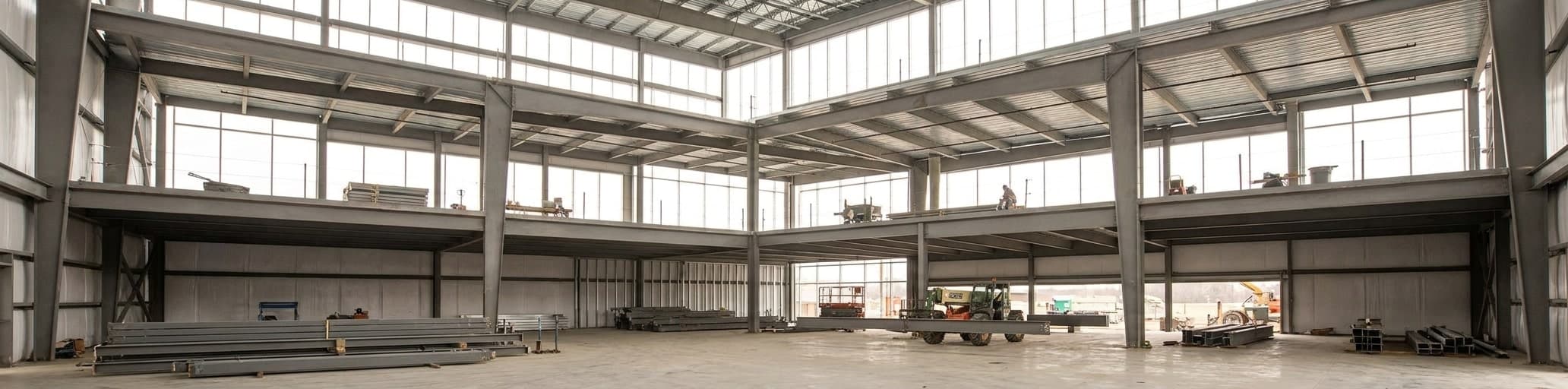

Pre-engineered two-story steel office buildings deliver customizable layouts with 25-40% less material than conventional frames, reducing foundation costs and construction timelines without sacrificing design flexibility. We help you integrate mechanical systems during design to avoid costly retrofits while maintaining budget control through single-source procurement and in-house erection.
Why Pre-Engineered Steel Is the Right Choice for Two-Story Office Buildings
Pre-engineered steel buildings use 25-40% less material than conventional frames by placing steel precisely where loads demand it, reducing your foundation costs and construction budget.
Superior strength-to-weight ratio reduces foundation costs by 15-20% compared to traditional construction
Pre-engineered steel buildings achieve their structural efficiency through tapered built-up sections — I-shaped members whose depth varies along the span to precisely match the bending moment demand at every point.[1] Rather than using uniform hot-rolled sections throughout regardless of where forces concentrate, PEB systems put steel only where the load requires it, eliminating over-designed members in low-stress zones and cutting unnecessary material consumption.[2] The numbers back this up across decades of peer-reviewed analysis: PEB systems consistently use 25-40% less steel than comparable conventional steel frames, with one study recording a 26.4% reduction in total steel weight under combined seismic and wind loading conditions.[1] Understanding how these structural steel components interact helps explain why that weight reduction matters so much for your budget.
Less steel overhead means a lighter building — and a lighter building transmits lower column reactions to the ground, which directly reduces the foundation size required under equivalent soil conditions.[1] Research by Iqbal and Shinde confirmed that lower support reactions in PEB structures allow for more affordable foundation designs, while Subashini and Valentina reached the same conclusion independently: reduced support reactions translate directly into economical foundation work.[1] Steel's high strength-to-weight ratio is the mechanism driving all of it — you carry the same structural loads with less material, less dead weight pressing into the soil, and a smaller concrete investment below grade.[3]
Speed to occupancy: Pre-engineered designs cut construction timelines from 6-9 months to 3-4 months
Design flexibility without custom engineering delays–National Steel Buildings delivers office layouts that work for your team The assumption that customization requires ground-up custom engineering is one of the most expensive misconceptions in commercial construction.
Pre-engineered two-story office building systems can be modified extensively — clear-span open floors, partitioned private suites, multi-level configurations, mezzanines, canopies, and custom exterior finishes — without triggering the blank-slate engineering process that inflates both cost and timeline.[8] Customizable pre-engineered systems typically cost 15-25% less than fully custom alternatives, and that cost advantage holds even when significant modifications are required, because proven engineering platforms allow efficient adaptation rather than complete re-engineering from scratch.[7] For office-specific applications, you can choose between open-concept collaborative upper floors, private office partitions, conference rooms, and mixed-use lower levels — all within the same pre-engineered framework — while also combining exterior materials like glass, brick, or wood with steel for a finished appearance that reflects your brand.[9] The practical payoff: your floor plan, mechanical rough-ins, and interior layout are locked in during manufacturing, so components arrive pre-cut and pre-punched for your exact configuration rather than requiring costly field modifications after delivery.[8]
Real-World Applications: How Two-Story Steel Office Buildings Solve Space Problems
Double your usable floor area on the land you already own by building vertically, freeing capital for operations instead of site acquisition.
Corporate headquarters and branch offices: Maximizing property value on limited footprints
For businesses operating in high-cost commercial corridors — suburban business parks, urban infill sites, or constrained branch office lots — land is the budget line that can't be negotiated.
A pre-engineered two-story office building solves this directly: it doubles your usable floor area without requiring a second parcel.[10] Multi-story steel construction creates efficient use of space precisely when a site's footprint is small, making it the go-to structural choice for companies that need professional headquarters presence on land that can't physically accommodate a single-story equivalent.[11] That math compounds quickly in markets where commercial construction for multi-story office space runs $150-$180 per square foot depending on location — because building vertically on a lot you already own costs far less than acquiring adjacent land at current commercial rates.[10] The customizable facade options available with pre-engineered systems mean your two-story headquarters can present a polished, brand-consistent exterior — glass curtainwall, architectural metal panels, brick veneer — while the interior configuration handles what corporate offices actually need: private executive suites on the upper floor, open collaborative space or reception below, and mechanical systems integrated during fabrication rather than retrofitted at extra cost.[12] Branch office operators get the same advantage at smaller scale: a pre-engineered two-story building on a compact leased or owned lot delivers the square footage of a full single-story build on a much larger parcel, freeing capital that would otherwise go toward site acquisition for operations, equipment, or staff instead.[11]
Medical and professional service offices: Meeting code compliance and patient/client flow needs
Medical and professional service offices carry a compliance burden that separates them from every other two-story office use — and failing to recognize that before breaking ground is an expensive mistake. The ADA elevator exemption, which allows buildings under three stories or under 3,000 square feet per story to forgo vertical accessibility, explicitly does not apply when the structure houses a professional office of a health care provider — defined as any location where a state-regulated professional provides services related to physical or mental health.[13] That single carve-out means the moment a physician, therapist, or psychologist occupies any floor of your pre-engineered two-story office building, a compliant elevator or accessible means of vertical travel is mandatory regardless of building size.[13] Identifying this requirement before design begins — not after the steel is ordered — is precisely where a single-source design-build approach pays off: elevator shaft rough-ins, structural reinforcement at the shaft location, and primary frame sizing for the additional dead load are resolved during fabrication rather than discovered as costly retrofits post-occupancy.
Beyond vertical access, the ADA requires licensed medical care facilities to provide at least one passenger loading zone at an accessible entrance, accessible parking calibrated to patient and visitor volume, and unobstructed 60-inch turning spaces within exam rooms and corridors where patients maneuver mobility aids.[13] Patient and client flow is not a design preference in a medical context — it is a structural compliance obligation. Research shows 73.8% of people with mobility disabilities encounter physical barriers in primary care settings, and ADA violations in a professional healthcare office carry fines ranging from $75,000 for a first offense to $150,000 for each subsequent violation.[14] The clinical requirement for minimum 32-inch clear door widths, accessible check-in counters designed for forward approach, and exam spaces with sufficient transfer clearance must be locked into the floor plan before a single panel arrives on site. Urgent care and outpatient clinic construction further requires healthcare-grade ventilation per ASHRAE 170, medical gas stub-outs, and radiation shielding where imaging equipment is installed — mechanical and structural provisions that integrate cleanly into a two-story metal building designed from the start for clinical occupancy rather than adapted from a generic commercial shell.[15]
Steel's clear-span capability directly resolves the corridor and exam room access problem that conventional framing routinely creates. Pre-engineered primary frames carry loads through the structural bays rather than interior bearing walls, leaving both floor plates free of columns that would otherwise force accessible routes into non-compliant widths or compress exam rooms below the turning space minimums the ADA requires.[13] Reception areas, consultation suites, accessible restrooms with properly positioned grab bars, and multi-room clinical layouts on both levels can be configured to match actual patient movement patterns — efficient intake on the ground floor, provider offices and procedure rooms above, with the elevator connecting them on an accessible route that runs interior and parallel to the general circulation path as ADA standards mandate.[13] You get the compliance documentation and the functional floor plan together, within budget, without managing separate architects, structural engineers, and contractors across two competing timelines.
Tech startups and creative studios: Open-plan upper floors with secure storage or operations below
Tech startups and creative studios share a spatial problem that a pre-engineered two-story office building resolves directly: they need open, uninterrupted floor plates for collaborative work while simultaneously requiring secure, climate-controlled space for servers, inventory, or operational equipment — two functions that can't coexist on the same open floor without compromising both.[16] A two-story steel configuration solves this by separating functions vertically rather than by partition.
The upper level delivers a column-free open plan that supports hot-desking, agile pods, and the rapid reconfiguration growing teams require as headcount shifts quarter to quarter.[17] Integrated electrical raceways built directly into wall panels mean data ports and power outlets move when workstations do — no demolition required — and acoustic wall options with STC ratings over 45 carve out meeting pods or focus zones without sacrificing the open character of the floor.[18] Below the creative floor, the ground level operates as a completely separate zone.
Steel's clear-span structural system eliminates interior load-bearing walls on both levels, so the lower floor can be configured as a server room, secure equipment depot, fabrication area, or fulfillment center depending on your business model — and it can be reconfigured later without touching the upper-floor structure.[16] For startups managing physical inventory alongside digital operations, or studios that need both a client-facing production floor and back-of-house storage, vertical separation is the only layout that keeps both functions efficient without one undermining the other.[17] On the financial side, pre-engineered steel office buildings in modular configurations are frequently classified by the IRS as tangible personal property rather than real property, qualifying for 7-year MACRS depreciation instead of the 39.5-year schedule applied to conventional construction — a distinction that produces approximately 32% in tax savings over the depreciation period and a net present value advantage that directly improves capital efficiency for early-stage companies watching every dollar.[18] Pair that with energy-efficient metal building design that lowers monthly utility overhead, and the two-story steel office delivers the cost structure a growth-stage startup actually needs: lower construction cost, faster occupancy, better tax treatment, and a floor plan that evolves without a full rebuild.
Pre-Engineered Two-Story Office Building Cost Breakdown and Budget Planning Tool
Eliminate middleman markups by working with a single-source provider who handles design, fabrication, delivery, and erection in-house, saving you 8-10% on total project costs.
What drives pricing: Foundation type, roof load requirements, interior finishes, and local code upgrades
National Steel Buildings cost advantage: Single-source procurement and in-house erection (ProTrades, LLC) eliminate middleman markups Every time a separate party touches your project — a design firm, a procurement agent, a general contractor, a steel fabricator, an erection crew — each one applies their own markup to the work they manage. Standard material markups in the construction industry commonly run 30-50% above wholesale cost, covering each firm's overhead, sourcing risk, and logistics management.[21] That markup is not padding; it reflects genuine operational cost for whoever is running the material procurement process.
But when four or five separate firms each apply that logic in sequence, the compounding effect is significant — and it lands entirely on your budget. Eliminating intermediary layers in the supply chain can save 3-5% on material costs alone, and effective single-source procurement has been shown to reduce overall project costs by 8-10% compared to fragmented multi-vendor approaches.[22] The mechanism is straightforward: a single-source provider buys materials once at contracted volume pricing, coordinates fabrication and delivery internally, and sends one erection crew to the site — meaning no markup is applied between the design phase and the steel arriving pre-cut and pre-punched for your exact configuration.
National Steel Buildings operates that model from design through erection. Fabrication, delivery, and on-site erection through ProTrades, LLC are kept under one roof, so the material cost you're quoted is the material cost you pay — not a retail price that two or three intermediaries have already marked up before it reaches your contract.[21] Prefabricated components built off-site in a controlled environment reduce on-site labor by 20-40% on structural elements compared to field fabrication from raw stock, and because erection crews are in-house rather than subcontracted, the labor markup that a general contractor would apply to a third-party crew disappears entirely from your invoice.[23] The result is a cost structure where your budget goes toward steel, engineering, and installation — not toward the overhead of managing a fragmented supply chain.
Cost estimator: Input your dimensions, location, and finishes to see real-world pricing–no surprise quotes later
A pre-engineered two-story steel office building shell — primary framing and wall panels only — runs $25-$40 per square foot, but that figure typically represents just 40-60% of your total project spend.[19] The complete installed cost, once site prep, foundation, mechanical rough-ins, and interior finishes are added, lands between $100 and $300 per square foot depending on location, load requirements, and finish program.[19] For comparison, conventional commercial office construction nationally ranges from $240 to $1,000 per square foot.[24] A fully finished pre-engineered steel package sits comfortably below the upper range of traditional builds for equivalent occupancy — a gap that widens further when single-source procurement removes the intermediary markups covered in the previous subsection.
Dimensions drive the baseline, but not in a straight line. Cost per square foot decreases as total area grows because manufacturing and materials scale more efficiently at larger volumes — rewarding buyers who size accurately from the start rather than adding square footage in a later phase.[19] Location introduces a separate cost layer that has nothing to do with freight. Local wind codes, ground snow load zones, and seismic criteria are zip-code-specific requirements that add steel weight and alter secondary framing specifications even when the footprint stays identical.[25] A structure in a high-wind coastal zone or a heavy-snow region requires heavier primary frames and stiffer bracing than the same footprint in a calm inland market, and that engineering delta shows up directly in material cost before a single finish decision is made.[25]
Finishes are where the spread between a functional office and a polished headquarters becomes most visible. The table below maps the three main cost layers across three finish levels for a representative 4,000 sq ft two-story configuration (2,000 sq ft per floor):
| Finish level | Shell only ($/sq ft) | Complete installed ($/sq ft) | Estimated total range |
|---|---|---|---|
| Basic — standard panels, open interior | $25-$30 | $100-$150 | $400,000-$600,000 |
| Mid-range — insulated panels, partitioned offices | $30-$35 | $150-$220 | $600,000-$880,000 |
| Premium — architectural facades, full fit-out | $35-$40 | $220-$300 | $880,000-$1,200,000 |
None of these ranges include permits, utility connections, landscaping, or paving — line items that first-time builders consistently underestimate.[19] Getting a fixed number rather than a ballpark requires specifying your exact footprint, your county's wind and snow load zone, and your complete interior program before requesting a quote.[25] That upfront specificity is the only mechanism that converts a wide cost range into a locked scope with no mid-project additions — which is precisely what a single-source design-build process is structured to deliver.[19]
Structural Considerations and Specifications for Two-Story Office Steel Buildings
Integrating MEP systems during the design phase costs a fraction of retrofitting them after construction, preventing the 5x to 50x cost multipliers that arise once concrete and steel are in place.
Foundation and load distribution: Why second-floor design starts with soil testing and proper pier spacing
HVAC, electrical, and code compliance: How National Steel Buildings integrates mechanical systems during the design phase to avoid costly retrofits MEP systems — mechanical, electrical, and plumbing — represent 40 to 60 percent of total construction cost on most commercial projects and 60 to 80 percent of long-term operating energy use, which means the moment you defer mechanical decisions to a later phase, you are deferring the majority of your project's cost risk into the most expensive window to resolve it.[33] The sequencing in a pre-engineered steel building is unforgiving: underground utilities, slab penetrations, and drain locations must be excavated and positioned before the concrete foundation is poured, conduit routes must be mapped before insulation or liner panels close the wall cavity, and fire suppression riser locations must coordinate with primary steel framing before erection begins.[32] A decision that costs $500 during the design phase can cost $5,000 after the slab cures and $25,000 once walls are up — and in a two-story configuration, those multipliers apply to both floor plates simultaneously.[32] On the electrical side, two-story commercial office builds routinely require 400-amp service rather than the standard 200-amp panel to handle HVAC equipment, lighting, and simultaneous high-draw loads across both levels, and panel capacity should be sized with a 10 to 30 percent margin beyond projected load so future tenant improvements or equipment additions don't trigger a service upgrade.[32] Conduit routing in a pre-engineered steel structure cannot follow wood-frame logic: electricians cannot notch steel columns or fish wire through girts, so every conduit run — whether exposed EMT or rigid metal conduit, both recognized by the NEC as equipment grounding conductors — must be mapped around the fixed structural skeleton during design, not after panels are installed.[32] For HVAC and ceiling integration specifically, pre-engineered ceiling systems resolve the coordination problem that fragments conventional builds: integrated solutions consolidate lighting fixtures, air diffusers, and sprinkler heads into compact linear zones as narrow as four inches, eliminating the cluttered penetrations that disrupt the ceiling plane and require multi-trade scheduling to patch.[31] Pre-engineered ceiling components run 30 to 50 percent faster to install than traditionally built on-site systems, generate less waste, and are already tested to meet IBC seismic requirements — which matters for upper-floor mechanical loads in any Seismic Design Category C or above classification.[31] Fire suppression is the compliance item that most frequently surfaces after the steel is ordered: when a sprinkler system is required based on building occupancy, square footage, or local jurisdiction, sprinkler heads, supply lines, and riser locations all must coordinate with primary steel framing — discovering this obligation after erection creates significant redesign work and cost.[32] Integrating all of these requirements — electrical service sizing, conduit routing, HVAC zone layouts, plumbing rough-ins, and fire suppression coordination — into the design documents before fabrication begins is precisely what a single-source design-build process is structured to accomplish, and the numbers support the model: design-build projects are delivered 33 percent faster than design-bid-build with 6 percent less cost growth, with the advantage most pronounced on MEP-intensive projects where field coordination conflicts are the largest driver of change orders.[33]
- Pre-engineered steel buildings use 25-40% less steel than conventional frames by tapering sections to match load demands, reducing foundation costs and dead weight.
- Customizable pre-engineered systems cost 15-25% less than fully custom alternatives while allowing extensive modifications without triggering complete re-engineering.
- Two-story steel construction doubles usable floor area on constrained sites, costing less than acquiring additional land in high-value commercial markets.
- Medical offices in two-story steel buildings require mandatory elevators and ADA compliance features that must be integrated during design, not retrofitted afterward.
- Mechanical, electrical, and plumbing systems represent 40-80% of project cost and must be designed before fabrication to avoid exponential retrofit costs later.
- Single-source procurement eliminating intermediary markups reduces overall project costs by 8-10% compared to fragmented multi-vendor approaches.
- Complete installed cost for pre-engineered two-story offices ranges $100-$300 per square foot, sitting below conventional commercial construction at $240-$1,000 per square foot.
- https://www.ijert.org/comparative-analysis-and-design-of-pre-engineered-buildings-and-conventional-steel-buildings-under-seismic-and-wind-loads-ijertv15is050128
- https://www.jswonemsme.com/blogs/blogs-articles/pre-engineered-steel-building-systems-vs-conventional-buildings?srsltid=AfmBOorfOE_0pN28NhhQl5elZEobfRPGn1Gp-fNEfBh7nG9lmKIJnqYg
- https://www.summitsteelbuildings.com/20-year-cost-comparison
- https://www.tylerbuilding.com/post/speed-to-market-how-pre-engineered-metal-buildings-cut-construction-time-by-30
- https://nordicsteel.construction/how-modern-steel-buildings-support-faster-commercial-project-completion/
- https://metalprobuildings.com/pre-engineered-steel-building-timeline/
- https://mbmisteelbuildings.com/blog/pre-engineered-vs-custom/
- https://bmbsteel.com.vn/en/how-to-customize-your-pre-engineered-steel-buildings
- https://norsteelbuildings.com/us/buildings/metal-office-buildings/
- https://evstudio.com/cost-per-square-foot-of-commercial-construction-by-region/
- https://www.summitsteelbuildings.com/what-size-metal-building-do-i-need
- https://reichconstructionllc.com/cost-of-a-100000-square-foot-prefab-steel-building/
- https://www.access-board.gov/ada/
- https://www.craftsmenind.com/blog/accessibility-design-in-medical-trailers
- https://terrapincg.com/urgent-care-walk-in-clinic-construction
- https://www.prefabex.com/our_galleries/prefabricated-office-plans
- https://www.karmod.com/en/blog/reasons-for-the-popularity-of-container-offices-in-the-startup-world/
- https://microflexspace.com/modular-office-space/
- https://builtmammoth.com/how-much-does-a-steel-building-cost/
- https://www.tylerbuilding.com/post/2026-metal-building-cost-variables
- https://truittandwhite.com/contractor-markup-on-materials
- https://www.procuredesk.com/construction-project-procurement/
- https://projul.com/blog/how-to-reduce-construction-costs/
- https://www.clarisdesignbuild.com/2024-update-commercial-construction-cost-per-square-foot-in-the-us/
- https://iconsteelbuildings.com/how-much-are-steel-buildings/
- https://iconsteelbuildings.com/steel-building-foundation-requirements/
- https://up.codes/viewer/new_york_city/nyc-building-code-2022/chapter/18/soils-and-foundations
- https://www.nachi.org/structural-design-foundations-home-inspector.htm
- https://www.iqsdirectory.com/articles/mezzanine.html
- https://mammoth.build/metal-buildings/residential/
- https://continuingeducation.bnpmedia.com/courses/armstrong-ceiling-and-wall-solutions/understanding-codecompliant-integrated-ceiling-solutions/2/
- https://metalprobuildings.com/metal-building-utilities/
- https://terrapincg.com/mep-engineering