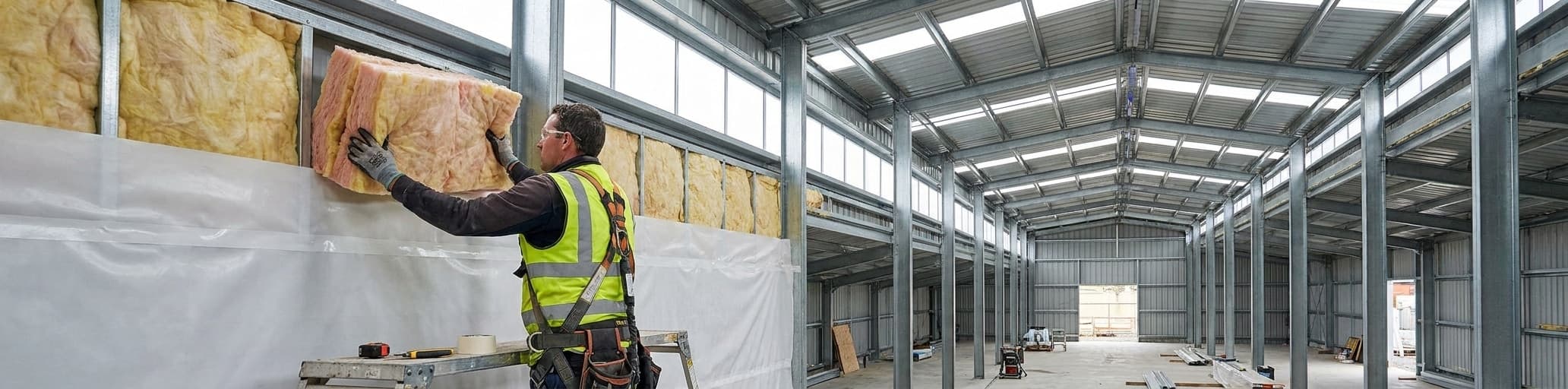

Steel and metal building insulation are functionally identical terms describing the same products and performance standards, so terminology differences won't affect your specification. What matters is insulation type, R-value matched to your climate zone, and installation quality–three variables that determine actual thermal performance regardless of labeling.
The Short Answer: Steel and Metal Building Insulation Are Functionally Identical
Steel and metal building insulation are functionally identical products with the same R-values and installation requirements, regardless of which term appears in your specs.
Why the terminology overlap creates confusion in the industry
The root cause is a technical distinction the industry quietly ignores.
Steel is an alloy of iron and carbon–not a pure element–so it isn't a metal in the strict chemical sense, even though it looks and behaves like one.[1] Construction professionals know this, yet routinely call steel-framed structures "metal buildings" anyway, because the distinction rarely affects a build decision.[1] That habit runs throughout the sector: the same structure gets called a pole barn, a post-frame building, or a metal barn depending on where the contractor learned the trade, with neither party technically wrong.[3] Even the line between "pre-engineered" and "prefabricated" trips up experienced buyers–two terms that sound interchangeable but describe meaningfully different systems.[2] When the industry uses labels this loosely at the structural level, insulation specs follow the same pattern.
"Steel building insulation" and "metal building insulation" appear in manufacturer catalogs, code documents, and contractor quotes as interchangeable phrases for identical products, R-values, and installation requirements–creating search confusion for buyers who wonder whether they're missing something by landing on one term instead of the other.
How National Steel Buildings uses both terms interchangeably in design specs
In practice, design documents and spec sheets for any pre-engineered structure routinely mix the two labels without flagging a switch. A single source page might open with "steel building insulation" in one section heading and "metal building insulation" three paragraphs later–referring to the same product, the same R-value requirement, and the same installation sequence.[4] The technical explanation is straightforward: steel is the material inside the primary frame, but the complete structure–cladding, purlins, girts, roof panels, and insulation–includes components that go beyond steel alone, which is why the broader label "metal building" became the industry-standard term.[5] Calling a finished structure a "steel building" is common and universally understood, but it technically describes only part of the system.[5] National Steel Buildings carries that same dual-label convention through every phase of a project.
Structural drawings reference metal building insulation specs; procurement orders may specify steel building insulation products; the erection crew uses whichever term the manufacturer printed on the roll. None of those label differences change the material, the R-value target, the vapor barrier requirement, or the installation method.
What they do signal is that when you see either phrase in a quote or a spec packet, you're looking at identical scope–so you can evaluate the actual numbers without worrying that a terminology mismatch means something is missing from the package.
What actually matters: insulation type, R-value, and installation method–not the building material name
Three variables determine how well a building performs thermally–regardless of whether the spec sheet says "steel" or "metal": insulation type, R-value target, and installation quality.[6] The industry organizes insulation into three primary categories: fiberglass batts and rolls (the most cost-effective and most common choice), continuous rigid foam board systems, and insulated metal panels that integrate the structural skin and insulation core into a single prefabricated assembly.[6] R-value–the thermal resistance rating measuring how well a material slows heat flow–runs from R-8 to R-30 in metal building applications, but ASHRAE 90.1 evaluates performance at the assembly level rather than the material level, which means your local climate zone sets a minimum U-factor for the complete wall or roof assembly, not just the insulation product alone.[6][8] Installation quality is where rated R-value either holds or collapses: compressed insulation loses its full rated thermal resistance, and air leaking through gaps around purlins and girts can negate even a correctly specified system.[7] Vapor retarder selection adds another layer–perm ratings run from 0.02 to 0.9, and the right rating depends on the building's end-use and humidity conditions, not on what the framing is called.[6] Strip away the label debate, and those three decisions–material type, R-value matched to your climate zone, and installation discipline–are where energy performance is built or lost.
What Insulation Is Best for a Steel Building: Types and Performance Comparison
Fiberglass delivers competitive thermal resistance at the lowest cost, though pairing it with continuous insulation eliminates thermal bridging and keeps your assembly U-factor code-compliant.
Fiberglass batts and rolls: affordability meets thermal resistance in agricultural and commercial applications
Fiberglass is the most widely used insulation material in metal buildings, primarily because it delivers competitive thermal resistance at the lowest cost across all available options.[6] Sold as batts, rolls, or factory-laminated blankets, fiberglass provides R2.9-R3.8 per inch of thickness–enough to satisfy most climate zone requirements without expensive assemblies.[10] In agricultural applications such as barns and storage buildings (structures often classified as semi-heated spaces in commercial energy codes), single-layer laminated fiberglass handles freeze protection at minimal upfront cost: a vapor retarder is bonded directly to one fiberglass layer, installed between purlins and exterior roof panels in a single pass.[6] Commercial projects with full conditioning requirements demand more, which is where High-R fiberglass systems step in.
Two configurations dominate the market: Banded Liner Systems run two unfaced fiberglass layers beneath a low-permeance fabric vapor retarder that spans the full purlin underside (creating a clean interior ceiling surface), while Long Tab Banded Systems layer one laminated and one unfaced layer with purlins left exposed for easier HVAC and electrical trade access.[6] The one performance limitation to plan around is thermal bridging–fiberglass doesn't wrap steel purlins or girts, creating heat-loss pathways that reduce real-world assembly performance below the labeled R-value.[9] Pairing fiberglass with a continuous insulation layer closes those pathways and keeps the full assembly U-factor within code compliance, which is why reviewing the complete steel building insulation spec–not just the product R-value–matters as much as choosing the right roll for your footprint.
Mineral wool and rigid foam: superior fire rating and moisture control for industrial and high-humidity environments
Mineral wool and rigid foam serve different but complementary roles in demanding environments where fiberglass alone falls short.
Mineral wool–composed primarily of basalt rock–is specified in fire-rated wall assemblies because it holds its structure under heat rather than melting or losing integrity, making it the preferred choice for industrial facilities, manufacturing plants, and aviation hangars where fire code compliance drives material selection.[11] Its R-value runs R3.0-R3.3 per inch, slightly outperforming fiberglass per inch of thickness, but the more consequential advantage in high-humidity environments is durability: properly installed mineral wool can last the lifetime of the building, whereas fiberglass batts can absorb moisture and compress over time–compressing insulation degrades its rated thermal resistance directly.[11] Rigid foam board, most commonly polyisocyanurate (polyiso), fills a different gap entirely: at R6.2 per inch, polyiso delivers up to twice the thermal resistance of most other insulating materials at equal thickness, and because it installs as a continuous layer over the building envelope rather than between framing members, it eliminates the thermal bridging pathways left open at every steel purlin and girt.[12][9] For cold-storage facilities and industrial buildings where consistent interior temperatures protect operations or product integrity, rigid foam's unbroken coverage across wall and roof assemblies removes the heat-loss shortcuts cavity-fill systems cannot prevent.[9] Pairing mineral wool in fire-rated cavity positions with rigid foam as continuous exterior insulation produces assemblies that satisfy both fire codes and energy code U-factor targets–a single coordinated spec rather than two competing priorities.[11][9]
Spray foam and insulated metal panels: continuous coverage that eliminates thermal bridging and air leaks
Closed-cell spray foam works differently from every other insulation category: it expands on contact and fills the gaps, cracks, and cavities around purlins and girts that fiberglass and mineral wool leave open.[15] Closed-cell is the correct choice for metal buildings–not open-cell–because it doesn't absorb water the way open-cell foam does, a critical distinction given steel's vulnerability to condensation when warm interior air contacts cooler panel surfaces.[13][15] When applied correctly, closed-cell foam adheres directly to the building envelope, cuts air infiltration at every penetration point, and delivers a higher R-value per inch than fiberglass.[13] Two specification limits define where spray foam stops being the right answer: applying it directly to the back of exposed-fastener panels can trap moisture against the metal and void panel warranties, so best practice routes it onto separate sheathing instead; and because closed-cell foam restricts thermal movement, it shouldn't serve as the primary insulation layer under standing seam roofs where panels must expand and contract freely.[15]
Insulated metal panels (IMPs) solve the assembly problem from a different angle–by eliminating multi-layer construction entirely. Each panel bonds two corrosion-resistant steel facings around a continuous polyurethane or polyisocyanurate foam core in a factory-controlled pour, producing a finished assembly with no gaps, no compression zones, and no purlin penetrations breaking the thermal envelope.[14][15] Exterior finish, insulation, and interior finish arrive as a single prefabricated unit, which removes the installation variables–misaligned vapor barriers, compressed batts, unsealed seams–that degrade field-assembled systems over time.[14][15] The trade-offs are real: IMPs carry the highest installed cost of any metal building insulation option, and panel size and weight require heavy machinery during erection.[15] For refrigerated warehouses, aviation hangars, and fully conditioned manufacturing facilities where thermal consistency protects operations or product integrity, however, that single-layer assembly eliminates the condensation and bridging risks that even well-executed multi-layer systems can only partially control.[13][15]
Steel Building Insulation R-Value and Cost: What You Actually Pay for 30×50 and 40×60 Footprints
Your climate zone determines minimum R-value requirements, with northern regions requiring R-21 walls and R-49 ceilings versus moderate zones needing only R-13 and R-30.
How R-value requirements vary by climate zone and building use (with 2026 cost ranges for common sizes)
Climate zone sets your minimum R-value targets before a single roll of insulation is priced–and the spread is substantial. In moderate climate zones, code-minimum assemblies call for roughly R-13 in walls and R-30 in ceilings, while northern regions with severe winters push those thresholds to R-21 walls and R-49 ceilings.[16] Midwest projects fall in the middle, where R-19 fiberglass batts in walls and R-38 blown insulation overhead represent a cost-effective baseline that satisfies most state energy codes.[17] Building use shifts the calculus just as sharply as geography: a detached personal workshop or agricultural storage building rarely triggers mandatory energy-code compliance at all, leaving the insulation decision as a straight cost-benefit comparison between heating costs and material investment; commercial structures and any garage attached to a residence must meet full energy-code requirements, including documented R-values for every assembly plane and both air and vapor barriers throughout.[17] The table below maps climate-zone requirements to 2026 installed cost ranges for two common footprints.
| Climate zone | Wall R-value (min) | Ceiling R-value (min) | Use type driving compliance |
|---|---|---|---|
| Moderate (Zones 1-3) | R-13 | R-30 | Commercial / attached residential |
| Mixed (Zones 4-5, Midwest) | R-19 | R-38 | Commercial / attached residential |
| Cold / Very cold (Zones 6-8) | R-21 | R-49 | Commercial / attached residential |
| All zones | Varies by owner preference | Varies by owner preference | Detached personal / agricultural use |
On the cost side, a 30×40 structure runs approximately $4,000 to insulate to code, while a 40×60 building lands between $3,000 and $8,000 depending on wall height, material choice, and the insulation depth required by local climate conditions.[17][18] One consistent pattern across both footprints: larger projects produce a lower installed cost per square foot as material orders and crew efficiency scale up, so the per-square-foot premium for a fully conditioned 40×60 is lower than what you pay on a smaller footprint reaching the same R-value target.[17]
Budget-friendly insulation strategies without sacrificing thermal performance or code compliance
The most actionable budget framework puts performance-critical spending first: insulation systems, moisture management, and HVAC quality deserve priority over interior finishes, lighting fixtures, and cabinet hardware–all items you can upgrade after move-in without touching the thermal envelope.[16] For the insulation layer itself, the cost-effective entry point is blown-in or batt insulation in wall cavities with a continuous interior air barrier, a well-insulated ceiling with baffles at the eaves, and sealed rim details that close the gaps fiberglass alone leaves open.[19] A tight building is far more efficient to heat and cool than a leaky one regardless of what insulation product fills the cavities–a point that holds whether you're in a cold northern climate or a mixed-humidity zone.[19] Where the budget allows one targeted upgrade, thermal breaks at door frames and window openings deliver disproportionate return: those junctions shed heat regardless of how well the field insulation performs.[19] Closed-cell spray foam applied selectively at those penetration points–rather than across the full envelope–adds both R-value and structural stiffness at a fraction of whole-building spray foam cost.[19] The long-term case for investing at or above code minimum is straightforward: advanced insulation systems reduce utility costs regardless of climate zone, converting upfront material spend into measurable operating expense reduction across the building's full service life.[16]
Why single-source design-build procurement saves 15-25% on material and labor versus sourcing separately
Sourcing insulation separately from your steel building package introduces the same coordination gap that drives cost overruns across all construction procurement: designers and builders work in isolation, each team making assumptions about what the other will deliver.[21] Design-and-build procurement eliminates that gap by placing design and construction under a single contract, which provides a maximum price commitment early, removes disputes between separate design and procurement teams, and compresses the timeline by overlapping design, procurement, and installation phases simultaneously.[21] The cost impact of that integration is measurable.
On a $50 million project, traditional procurement methods produce change orders averaging 10% of project cost; a coordinated design-build approach reduces that figure to roughly 3%, a direct saving of $3.5 million on that scale alone — and the same proportional math applies to a $200,000 insulation-and-envelope package.[20] Material procurement compounds the savings further: contractors who consolidate purchasing across a full building package can negotiate bulk discounts and cash-payment terms that typical single-trade buyers cannot access, and knocking 10% off an $80,000 material order puts $8,000 back into the project budget without touching specification quality.[22] Prefabricated insulation assemblies — specified and ordered as part of the complete building package rather than sourced after erection — cut on-site labor by 20-40% on the components involved, because work completed in a controlled factory environment arrives ready to install rather than requiring field measurement, cutting, and fitting.[22] When all of those levers pull in the same direction — coordinated design, consolidated procurement, reduced change orders, and prefabricated assemblies — the 15-25% savings range over separate sourcing reflects documented project outcomes, not marketing math.
The advantages of a turnkey single-source approach extend beyond the insulation line item: a single contract owner carries accountability for every assembly plane, which means specification gaps between the structural package and the thermal envelope never fall into the no-man's-land between separate trades.[20][21]
Installation Matters More Than Material Name: How National Steel Buildings Ensures Proper Insulation Coverage
Vapor retarder placement and field seam precision directly determine whether your insulation system performs as specified or gradually fails from condensation and thermal loss.
Vapor barriers, sealing, and purlin clips: the hidden details that prevent condensation and performance loss
Where the vapor retarder sits relative to the purlins determines whether your steel building insulation system actually performs as specified–or slowly fails from the inside out.
In a liner system, the vapor retarder is installed as a single continuous piece below the bottom flange of every roof purlin, held in place with steel straps fastened to the lower purlin flange.[24] That placement matters because it physically isolates the purlins from the conditioned interior space, eliminating the cold surface that warm interior air would otherwise contact.[24] Filled cavity assemblies take a different approach: each fiberglass roll arrives with a vapor retarder laminated directly to it, which means every joint between rolls requires a field seam applied during installation.[24] The problem with field seams is precision–tabs must extend far enough to travel up the full vertical depth of the purlin web, across the web-to-flange transition, and seal horizontally over the top purlin flange on both sides.[24] A 60-inch purlin spacing with an 8-inch-deep purlin requires at least 88 inches of vapor retarder width per bay to achieve a properly sealed cavity; tabs pulled too tight create gaps along the purlin web, and those gaps are exactly where interior air circulates around the framing member and hits the exposed fastener tip or clip–the precise location where condensation forms first.[24] Sealing strategy extends beyond the vapor retarder itself: every seam where two pieces of facing overlap must receive patch tape, every wall penetration needs facing extended 2 to 3 inches past the rough opening and secured with staples, and the roof-to-wall transition requires overlapping coverage of at least 3 inches to produce the continuous, unbroken envelope that keeps rated performance intact.[23] At standing seam roof assemblies, thermal blocks–available in 3/8-, 5/8-, and 1-inch thicknesses–install between the roof panel and the clip to interrupt the metal-to-metal contact that would otherwise conduct heat directly through the structural connection point, bypassing the insulation layer entirely.[15] Air barriers address the remaining failure mode: uncontrolled air leakage through gaps at girts, purlins, and framing penetrations raises energy consumption directly, because every cubic foot of conditioned air that escapes carries heat or cooling with it regardless of what the insulation's labeled R-value reads on paper.[15] Strip away all the specification language, and the functional requirement is simple–cover every purlin and girt with a continuously sealed vapor retarder, tape every seam, and block every metal-to-metal contact point, because the thermal performance claims for any assembly assume that no conditioned air reaches the cold structural members inside the building envelope.[24]
Professional installation versus DIY: where cutting corners costs you in energy bills and structural damage
How National Steel Buildings's in-house erection division (ProTrades, LLC) guarantees consistent, code-compliant installation from day one The standard delivery model for pre-engineered steel buildings ships a fabricated package to the project site for erection and installation by an independent erector or general contractor.[26] That handoff is where specification intent and field execution diverge most reliably: the design team sets R-value targets and vapor retarder placement requirements, but the contractor on site carries full responsibility for the proper field installation of all materials related to energy usage and code compliance.[26] When the erection crew has no direct connection to the design documents–working from a separate contract, reading drawings they didn't commission, and accountable to a different organization–details get interpreted rather than followed. Compressed batts, skipped seams, and misplaced vapor retarders all read as "insulated" on a punch list but fail at inspection or perform below spec for the building's full service life.
ProTrades, LLC closes that gap by keeping the erection function inside the same organization that designed and procured the building package. The installation crew reads the same spec sheets the design team wrote, works from the same manufacturer drawings that governed fabrication, and carries accountability to the same client through every phase.
That structure reflects the documented principle that single-source construction is more streamlined and more cost-efficient than conventional multiparty construction–and the logic applies with equal force to insulation installation specifically, where the gap between trades is exactly where performance is lost.[26] As energy codes continue to demand higher insulation values, the crew installing the system needs to understand code requirements, not just roll out material.[27] Installer certification matters in concrete, documentable terms: for spray foam systems specifically, the installer must provide certification detailing the foam type, R-value, thickness, and density of all installed foam to demonstrate energy code compliance–documentation that must exist before the inspector arrives, not assembled afterward.[28] An in-house erection division that treats those certification and documentation steps as standard workflow–rather than leaving them to a subcontractor to compile under time pressure at closeout–closes the last accountability gap between what the spec sheet promises, what the code inspector signs off on, and what your building actually delivers on day one and every year after.
- Steel and metal building insulation are functionally identical products despite terminology differences in industry documentation and specifications.
- Thermal performance depends on three variables: insulation type, R-value matched to climate zone, and installation quality–not on material naming conventions.
- Fiberglass is the most cost-effective option, but thermal bridging at purlins reduces real-world performance unless paired with continuous insulation layers.
- Proper vapor retarder placement below roof purlins and sealed field seams are critical to prevent condensation and maintain rated R-value performance.
- Design-build procurement with single-source erection reduces change orders and installation costs by 15-25% compared to separate sourcing and subcontractor models.
- Closed-cell spray foam should fill gaps around purlins selectively rather than cover entire envelopes, and never directly contact exposed-fastener panels.
- Insulated metal panels eliminate multi-layer installation variables but carry highest costs, making them cost-effective only for temperature-critical facilities.
- https://mststeel.com/industry-news-blog/metal-vs-steel-difference/
- https://metalprobuildings.com/what-is-the-difference-between-pre-engineered-and-prefabricated-metal-buildings/
- https://milmarbuildings.com/learning-hub/metal-barn-pole-building-post-frame-barn-etc.-do-these-all-mean-the-same-thing
- https://norsteelbuildings.com/steel-building-basics/metal-building-system-guide/
- https://pinnacleinfotech.com/pre-engineered-metal-building-structure-features/
- https://therm-all.com/a-guide-to-metal-building-insulation/
- https://www.energy.gov/energysaver/insulation
- https://greengirt.com/articles/understanding-insulation-r-value-in-commercial-buildings/
- https://www.rmax.com/blog/metal-building-insulation
- https://norsteelbuildings.com/steel-building-insulation/metal-building-insulation/
- https://norsteelbuildings.com/us/steel-building-insulation/metal-building-insulation/
- https://www.energy.gov/energysaver/types-insulation
- https://www.greenvilleonline.com/press-release/story/115494/mineral-wool-vs-spray-foam-for-metal-buildings-new-comparison-highlights-condensation-and-performance-differences/
- https://info.greenspanprofiles.com/blog/why-you-should-choose-insulated-metal-panels-imps-over-other-options
- https://www.texassteel.com/building-blog/metal-building-insulation-guide
- https://metalbuildingshop.com/metal-building-homes/
- https://waltersbuildings.com/cost-to-insulate-a-pole-barn/
- https://quonsethutkit.com/40×60-metal-building-cost-prices/
- https://bowerdesignandconstruction.com/pole-barns-wisconsin-cost-permits-design-2025/
- https://archdesk.com/blog/progressive-design-build
- https://www.netsuite.com/portal/resource/articles/erp/types-of-construction-procurement.shtml
- https://projul.com/blog/how-to-reduce-construction-costs/
- https://www.insulationoverstock.com/guides/metal-building-installation/
- https://thermaldesign.com/techinfo/newsMain/location_location_location/
- https://durapedia.com/comparisons/
- https://continuingeducation.bnpmedia.com/courses/metal-building-manufacturers-association/using-metal-building-systems-to-meet-and-exceed-the-energy-code/
- https://ssstructures.net/metal-building-services/
- https://incosteelbuildings.com/spray-foam-insulation/