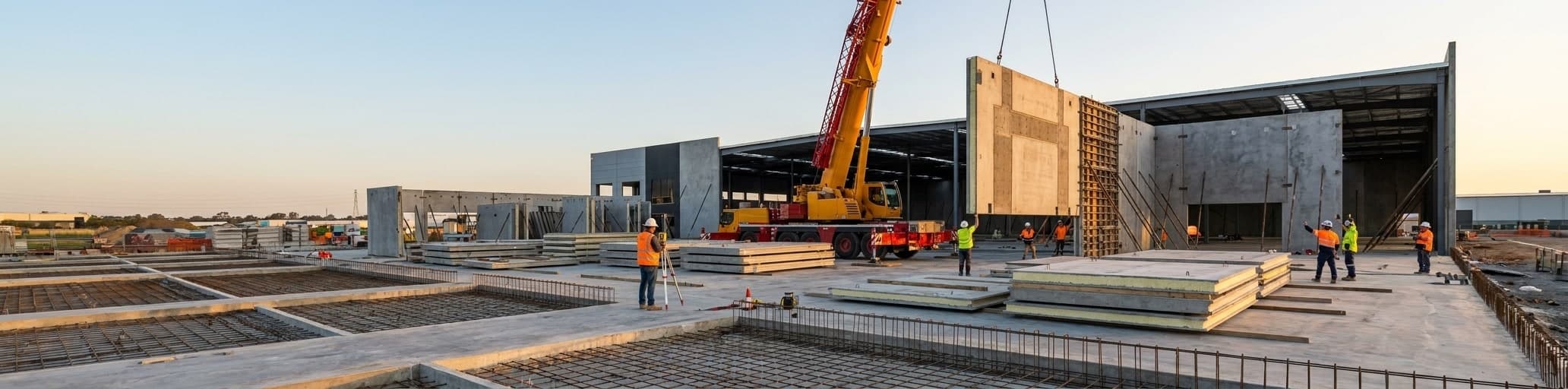

We help you understand 2026 tilt-up warehouse costs across project sizes, from $115-$185/SF for industrial shells, with regional variations of 25-50%. Steel buildings deliver lower first costs and dramatically reduced 20-year maintenance expenses, making them the smarter choice for most warehouse owners.
What Tilt-Up Warehouse Construction Costs in 2026: Direct Pricing Breakdown
Tilt-up warehouse construction runs $115-$185 per square foot for industrial shells in 2026, with panel specifications and project scale determining your final cost baseline.
Current average tilt-up warehouse cost per square foot (2026 market rates)
Tilt-up warehouse construction cost per square foot in 2026 runs $115-$185/SF for industrial shells and $145-$235/SF for distribution and light manufacturing facilities on a complete build–covering the tilt-up envelope, conventional steel roof, and slab-on-grade.[1] The spread within that range is driven primarily by panel specification: standard 6-7 inch reinforced panels cost $14-$22/SF of wall area, sandwich insulated panels run $20-$28/SF, and architectural panels with reveal detailing or specialty finishes reach $24-$32/SF.[1] When scoped to just the wall enclosure system rather than the full shell, tilt-up panels typically add $25-$40/SF to a project's cost basis, with premiums applied for thicker panels, added insulation layers, or complex reinforcement patterns.[2] Industrial construction costs held broadly stable year-over-year through early 2025, though global trade uncertainty has begun pushing material prices modestly upward as suppliers prepare for a higher-cost environment.[3] For a complete warehouse building cost per square foot baseline, tilt-up sits at the higher end of structural system choices–particularly for projects under 80,000 SF, where panel repetition hasn't yet scaled enough to offset the inherent concrete and crane mobilization costs.[1]
How tilt-up pricing compares to concrete and steel alternatives
Pre-engineered metal buildings (PEMBs) cost $14-$30/SF for a shell-only package and $55-$175/SF as a fully completed dry warehouse–a meaningful gap below tilt-up's $115-$185/SF floor for an equivalent industrial shell.[4] Masonry flips the economics at small scale: for projects under 6,000 SF, avoiding the crane mobilization required for tilt-up panels can make CMU block the cheaper choice, but for large-footprint warehouses above 24-foot clear heights, tilt-up pulls ahead because wall thickness increases only incrementally with height while masonry requires progressively larger block sizes.[5] Steel's cost advantage widens further when you factor in regional labor availability–tilt-up dominates markets like Houston precisely because specialized crews are abundant there, but in thinner trade markets the mobilization premium can erode any panel-repetition savings.[5]
| Structural system | Shell-only $/SF | Complete build $/SF | Typical sweet spot |
|---|---|---|---|
| PEMB steel | $14-$30 | $55-$175 | Any size; scales down efficiently |
| Tilt-up concrete | $25-$40 (wall system only) | $115-$185+ | 80,000 SF+ with available crane crews |
| CMU masonry | Higher per SF for large runs | Above tilt-up at scale | Under 6,000 SF or low-clearance |
Regional pricing shifts the comparison further. National benchmarks adjust 25-50% based on location: the Southeast runs 10-20% below national average, Texas 5-15% below, the Northeast 30-50% above, and the West Coast 20-40% above.[4] A tilt-up warehouse priced at $140/SF in Dallas could run $195/SF or more in Boston–while a steel alternative at $90/SF in Dallas scales to roughly $125/SF in Boston, preserving a structural cost gap that compounds across large footprints. For projects where tilt-up crane availability is limited or where the building footprint falls below the threshold where panel repetition yields savings, steel warehouse alternatives consistently deliver a lower initial cost basis without sacrificing durability.[4]
Why National Steel Buildings's steel approach delivers better long-term value
The initial cost gap between steel and tilt-up widens significantly once ongoing ownership expenses enter the equation.
Pre-engineered metal frames run $10-$20/SF for the structural system versus $25-$40/SF for tilt-up wall enclosures alone, and that structural savings compounds over time because tilt-up panels require periodic joint resealing and insulation upgrades to maintain code-required R-values–costs that simply don't appear on a steel building's maintenance schedule.[6] Pre-engineered steel frames can also save up to 30% on structural budgets while shortening construction schedules, so you're not just paying less per square foot–you're occupying the building sooner and starting to generate revenue faster.[7] For projects under 80,000 SF, PEMB steel consistently delivers a lower cost basis than tilt-up, where panel repetition hasn't scaled enough to offset concrete and crane mobilization costs.[1] National Steel Buildings's single-source design-build model layers an additional advantage on top: one point of accountability from fabrication through erection eliminates the coordination gaps between structural, envelope, and roofing trades that routinely trigger change orders on tilt-up projects managed across multiple contractors.
When you factor in lower first cost, faster delivery, and a maintenance profile that stays flat over 20-plus years, the long-term value case for steel is straightforward–and it's strongest precisely where most warehouse owners are building, in the 10,000-75,000 SF range where tilt-up's scale economics never fully materialize.[1]
Five Cost Drivers That Determine Your Final Tilt-Up Warehouse Price
Concrete and rebar costs rose 5-10% in mid-2026, with panel pricing ranging from $14-$32 per SF depending on your specification tier.
Material and concrete panel costs: what changed in 2026
Concrete and rebar remain the dominant cost line in any tilt-up budget, and both moved upward in 2026.[8] Higher fuel costs pushed cement prices above prior-year levels, while steel reinforcement pricing fluctuated with global supply-demand shifts.[8] At the panel level, the 2026 cost stack breaks into three tiers: standard 6-7 inch reinforced solid panels run $14-$22 per SF of wall area, sandwich (insulated) panels with rigid foam cores land at $20-$28 per SF, and architectural panels with reveals, formliners, or specialty finishes reach $24-$32 per SF.[1] Industrial construction costs held broadly stable through early 2025, but global trade uncertainty has since pushed material prices modestly higher as suppliers build margin cushion into forward quotes.[1] The practical effect: owners pricing tilt-up projects in mid-2026 are seeing panel budgets run 5-10% above estimates from 12 months prior, particularly in markets where ready-mix suppliers are managing cement input cost volatility.[8] Thicker panels required for seismic zones or buildings above 40-foot clear heights compound the increase–8-10 inch panels carry heavier reinforcement schedules and more embed plates, adding both material weight and crane cycle time to the erection cost.[1]
Labor, site prep, and regional labor rate variations by market
The crane and erection package is tilt-up's most concentrated labor cost. A standard 200-panel project requires a 90-180 ton mobile crane, rigging crew, surveyor, and brace installers running continuously for 2-4 weeks–and that mobilization cost spreads across fewer panels on smaller footprints, directly inflating per-SF price.[1] Before any of that begins, site preparation consumes budget: grading, compaction, and drainage for a standard slab-on-grade run $6-$12/SF, and in frost-sensitive northern markets, frost-protected shallow foundations or heated slabs push the foundation line 5-10% higher.[6] Labor supply is what separates Sunbelt markets from the rest of the country.
Roughly 60% of U.S. tilt-up volume concentrates in Sunbelt markets precisely because specialized crews are plentiful there, keeping erection costs competitive through crew availability.[1] In thinner trade markets, the opposite applies: crew scarcity widens bid spreads, and timing your project around regional construction workload can produce measurable pricing improvement.[7] RSMeans regional cost indices put numbers on the full effect–material and labor multipliers swing total project cost by 10-25% across U.S. regions, meaning an identical tilt-up spec costs materially more in the Northeast or Pacific Northwest than in Texas or the Southeast.[6] Cold weather compounds the labor premium further. Pour windows for tilt-up panels effectively close in Mountain West and Northeast markets from December through February without significant heating and protection costs, adding 4-8 weeks of schedule exposure that a pre-engineered steel frame–with no concrete curing dependency–avoids entirely.[1]
Project size, complexity, and how panel count affects your per-square-foot rate
Panel count is the mechanical reason tilt-up's per-SF rate drops as footprint grows. Crane mobilization on a standard 200-panel project runs 2-4 weeks regardless of building size–that fixed cost spreads across every panel poured, so fewer panels means a higher mobilization burden per square foot.[1] At 50,000 SF with 80-100 panels, the crane and rigging crew eats proportionally more per panel than at 200,000 SF with 300-plus panels, because building size is the single biggest lever on per-SF cost: fixed expenses like sitework, utilities, project management, and soft costs spread more efficiently across larger floor plates.[9] Below 30,000 SF, masonry typically beats tilt-up on first cost; below 80,000 SF, pre-engineered metal buildings win on the same measure–tilt-up's scale economics simply don't materialize until panel repetition is high enough to compress crane cost.[1] Complexity multiplies that threshold further.
Irregular panel geometry, seismic reinforcement schedules, and clear heights above 40 feet all require 8-10 inch panels with heavier embed plates and longer crane cycle times–none of which scale linearly with footprint.[1] A 410,000 SF e-commerce distribution center in central Texas illustrates what the right scale looks like: 168 panels averaging 28 feet tall, erection at 14-18 lifts per day, full envelope closed in 12 working days, and a delivered shell cost of $138/SF–competitive precisely because the panel count was high enough to drive repetition efficiency.[1] For a side-by-side view of how warehouse size shifts total cost in 2026, the industrial warehouse cost breakdown by size covers the full range from small bays to large-format distribution facilities. Below the 80,000 SF threshold, that repetition benefit never fully appears, and per-SF rates stay elevated regardless of how straightforward the panel design is.[1]
Real-World Tilt-Up Warehouse Cost Examples: 10,000 to 100,000 Sq Ft Projects
Small tilt-up warehouses under 25,000 sq ft cost roughly twice as much per square foot as metal buildings because fixed expenses like crane mobilization don't scale down proportionally.
Small warehouse (10,000-25,000 sq ft): typical budget and cost per sq ft
A 10,000-25,000 sq ft tilt-up warehouse is where the method's economics work hardest against you.
In Texas markets, that size range runs $80-$150/SF for a standard shell with basic interiors and MEP systems, climbing to $140-$230/SF for Class A specifications with higher-grade finishes and distribution-center-grade mechanical systems.[10] National cost data puts 10,000-20,000 SF tilt-up projects at roughly $140/SF on average–the highest per-square-foot tier across all warehouse sizes–because fixed expenses like site mobilization, utility connections, permit fees, and crane mobilization don't scale down proportionally when the footprint shrinks.[9] Spread a 90-180-ton crane mobilization across 80 panels instead of 300, and that fixed cost inflates every square foot of wall.[2] The budget structure compounds the exposure: hard costs consume 65-75% of the total project budget, soft costs (architecture, engineering, permits, financing) add another 10-20%, and a 7-10% contingency reserve is standard given material price volatility and the geotechnical risk that a smaller site budget can't easily absorb.[10] A pre-engineered metal building shell at the same 10,000-25,000 SF scale routinely delivers at $55-$90/SF–roughly half the tilt-up cost basis–because steel eliminates the crane cycle, the concrete pour window, and the panel repetition threshold that tilt-up needs to become competitive.[9] For owners who want a full picture of how those cost gaps compound across different footprint sizes, the warehouse construction cost guide breaks down the full range from small bays to large-format facilities.
Mid-size warehouse (50,000 sq ft): detailed cost breakdown with regional variations
A 50,000 sq ft warehouse sits at the threshold where tilt-up construction begins to show its first real cost efficiencies–but also where the full weight of its fixed-cost structure is most visible. A 50,000 SF warehouse built to moderate specification costs between $4 million and $7 million in total project budget, which translates to a national average range of $80-$150 per square foot for general industrial construction before tilt-up premiums are applied.[11] Tilt-up's structural system cost lands above that range, pushing the delivered shell toward the higher end for projects where panel repetition hasn't yet reached the 200-plus panel threshold that drives maximum repetition efficiency.[3] Within that total budget, the cost stack breaks roughly as follows: site preparation and grading consume an additional 10-20% of total project cost on top of the structural scope; labor runs 20-30% of the complete build; utilities and MEP systems add $10-$30 per square foot; and design, architecture, and engineering fees add another 5-10%.[11] Permits, inspections, and compliance close out the soft cost stack at 3-5% of project value–a line that often surprises first-time warehouse owners building in markets with active code enforcement.[11]
Regional labor and material costs are the single largest variable in a 50,000 SF tilt-up budget. Industrial construction costs held broadly stable through early 2025, but global trade uncertainty has since pressured suppliers to build margin into forward quotes, creating upward price movement across multiple input categories.[3] Cushman & Wakefield's Industrial Construction Cost Guide, which tracks 46 markets across the Americas, consistently shows the widest spread between the most expensive and most affordable construction markets concentrated in coastal versus interior U.S. locations–a spread that directly affects what any given 50,000 SF tilt-up project pencils out to in an owner's specific geography.[3] The table below maps estimated all-in construction costs for a 50,000 SF tilt-up warehouse shell against a comparable pre-engineered metal building across five U.S. regions, using published national benchmarks adjusted for documented regional labor and material premiums.
| Region | Tilt-up $/SF (est.) | Tilt-up total (50K SF) | PEMB steel $/SF (est.) | PEMB total (50K SF) |
|---|---|---|---|---|
| Southeast | $120-$145 | $6.0M-$7.25M | $65-$90 | $3.25M-$4.5M |
| Texas / South Central | $125-$155 | $6.25M-$7.75M | $70-$95 | $3.5M-$4.75M |
| Midwest | $135-$165 | $6.75M-$8.25M | $75-$105 | $3.75M-$5.25M |
| Northeast | $160-$210 | $8.0M-$10.5M | $95-$130 | $4.75M-$6.5M |
| West Coast | $155-$200 | $7.75M-$10.0M | $90-$125 | $4.5M-$6.25M |
For owners comparing these totals, the regional construction cost data from warehouse cost per square foot by region adds further granularity on how market-specific labor rates shift total budgets across the Northeast, Midwest, South, and West. At 50,000 SF, tilt-up's cost gap relative to steel is widest in the Northeast and on the West Coast–markets where specialized tilt-up crews are least concentrated and where crane mobilization premiums are highest–while that gap narrows (though never closes) in Texas and the Southeast, where crew availability keeps erection costs competitive.[3] Even at its most competitive, tilt-up at 50,000 SF still carries a first-cost premium of $2-$4 million over a comparable pre-engineered steel shell, a gap that compounds further once 20-year maintenance expenses enter the comparison.[11]
Large warehouse (100,000+ sq ft): economies of scale and how pricing shifts
At 100,000 SF and above, tilt-up construction finally operates in its designed cost range. For a 100,000+ SF shell in Texas markets, tilt-wall concrete runs $65-$110/SF — a substantial drop from the $140-$230/SF seen at the 10,000-25,000 SF range — because the fixed crane mobilization cost spreads across a panel count large enough to generate genuine repetition savings.[9] A real-world benchmark from the Houston market confirms the pattern: a 243,031 SF industrial facility delivered at approximately $62-$68/SF for shell and core systems at that scale, reflecting the cost compression that only emerges when panel volume passes the 200-unit threshold.[9] Cushman & Wakefield's industrial cost data supports that benchmark from a different angle, showing large-format industrial projects averaging $77/SF nationally — a figure consistent with efficient tilt-up economies on projects where fixed pre-construction, mobilization, and slab costs absorb across hundreds of thousands of square feet.[12]
The mechanism behind the drop is structural, not incidental. Fixed expenses — sitework, utilities, project management, soft costs — spread more efficiently across larger floor plates, and a crane-and-rigging package that costs disproportionately per panel at 80 panels costs a fraction per panel at 300.[9] The 410,000 SF e-commerce distribution center in central Texas is the clearest illustration: 168 panels averaging 28 feet tall, full envelope closed in 12 working days, delivered at $138/SF all-in including foundations, slab, structural roof, and basic MEP rough-in — and priced 8% under the GC's initial estimate because three local concrete suppliers competed aggressively for the panel volume.[1] At that scale in a Sunbelt market with deep tilt-up labor infrastructure, tilt-up becomes the cost-discipline choice rather than the premium one.[1] Pre-engineered metal buildings remain competitive for owners prioritizing faster occupancy or lower first cost at any scale, but the per-SF gap narrows meaningfully above 100,000 SF in markets where specialized crews are plentiful enough to keep erection costs predictable. For owners evaluating whether to expand an existing facility versus build new at large scale, the warehouse addition cost per square foot guide breaks down how incremental square footage shifts the cost structure across both structural systems.
When Tilt-Up Makes Sense–and When Steel Buildings Deliver Better Economics
Tilt-up construction compresses your building schedule by 30-50% while delivering 50-plus years of durability with minimal maintenance costs.
Tilt-up advantages: speed, durability, and low maintenance appeal
Tilt-up's staying power in commercial construction comes down to three concrete advantages: speed, longevity, and a maintenance profile that stays flat for decades.
On the speed side, an experienced erection crew can lift up to 40 panels in a single day, and a 60,000 SF structure can be fully enclosed in roughly four weeks–compressing the overall construction schedule by 30-50% compared to traditional cast-in-place or masonry methods.[13] That schedule compression matters because it moves your occupancy date forward and cuts the financing carry cost that accumulates while a building sits unfinished.
Durability is equally compelling: tilt-up buildings routinely last 50-plus years with minimal upkeep, and the panels' concrete mass delivers thermal performance that exceeds what thinner wall systems achieve in 24-hour temperature cycles.[13] Tilt-up structures also create tighter building envelopes than many alternatives, reducing air infiltration and improving energy performance without additional cladding layers.[13] On the labor side, tilt-up needs fewer workers than traditional concrete methods because it skips interior framing entirely, and those reduced labor hours translate directly into lower operating costs over the building's life.[13] For owners weighing long-run energy costs alongside construction speed, energy-efficient metal buildings offer an alternative path to envelope performance–one that doesn't require the panel volume thresholds tilt-up needs to reach its cost floor.
Hidden tilt-up costs: future repairs, foundation settling, and long-term ownership expenses
Subgrade failure is the leading cause of industrial facility depreciation–and tilt-up structures carry concentrated exposure to it.[12] Concrete panels impose sustained loads on a slab-on-grade foundation that must perform without interruption for decades, but clay soils prevalent across Tennessee, Alabama, and the Carolinas expand and contract with moisture changes, creating differential settlement risks that crack slabs and buckle pavements years after the certificate of occupancy is issued.[12] That settlement doesn't announce itself at ribbon-cutting.
It surfaces 3-7 years in as joint failures, dock leveler pit damage, and surface spalls that require progressively expensive intervention.
Sawcut joints in tilt-up floor systems deteriorate under forklift traffic and must be repaired with semi-rigid epoxy or polyurea fillers on a recurring basis to prevent product damage, vehicle wear, and safety hazards–a maintenance line that has no equivalent on a pre-engineered steel building's ownership schedule.[12] High water tables in coastal areas add another layer of foundation risk, and inadequate geotechnical investigation during pre-construction–consistently cited as one of the most common and costly mistakes in industrial facility construction–can add months to the schedule and hundreds of thousands of dollars to the budget when foundation problems emerge post-occupancy.[12] Operating expenses compound the picture further: long-term ownership of a tilt-up facility carries ongoing costs for property management, utilities, and maintenance that accumulate year over year, and a seemingly inconsequential product selection made to reduce initial construction costs can have outsized impact on site performance and safety downstream, resulting in closures and repairs that dwarf the original savings.[12][14]
Why National Steel Buildings's turnkey steel solutions often cost less over 20+ years
The per-square-foot price on bid day is a poor proxy for what a warehouse actually costs you. Over a 20-year hold, annual maintenance on a pre-engineered steel building runs roughly 1% of initial cost–approximately $1,500-$2,500 per year for a 10,000 SF structure–while concrete construction demands 2-4% annually, translating to $7,000-$20,000 per year on the same footprint.[16] That gap exists because concrete joint sealants deteriorate every 5-8 years, slabs crack under forklift loads, and rebar corrodes in coastal or de-icing-salt environments–repair cycles with no equivalent on a steel maintenance schedule.[15] Steel buildings also deliver 10-20% annual energy savings over traditional construction through tighter thermal envelopes and reduced air infiltration, compounding the ownership advantage year over year.[16] Factored across two decades, a 10,000 SF steel facility carries total costs of roughly $350,000 versus $670,000-$1.1 million for comparable traditional construction–a gap that scales directly with building size.[16] For owners in the 10,000-75,000 SF range where tilt-up's panel-repetition economies never fully materialize, that compounding figure is the number that matters most. The table below applies published maintenance benchmarks to a 50,000 SF warehouse to show what the 20-year ownership picture actually looks like across structural systems.
| Structural system | Initial cost (50K SF) | Est. annual maintenance | 20-yr maintenance total | 20-yr total cost of ownership |
|---|---|---|---|---|
| PEMB steel | $4.0M-$4.5M | ~1% of initial | ~$800K-$900K | ~$4.8M-$5.4M |
| Tilt-up concrete | $6.0M-$7.25M | ~2-4% of initial | ~$2.4M-$5.8M | ~$8.4M-$13.0M |
| CMU masonry | $5.5M-$7.0M | ~2-4% of initial | ~$2.2M-$5.6M | ~$7.7M-$12.6M |
Sources: initial cost benchmarks from 2026 market data; [1] maintenance rate benchmarks from 20-year steel vs. traditional comparison.[16]
The structural cost savings are only half the equation. Pre-engineered steel frames also earn better insurance terms in many occupancy classes because their ductile behavior under seismic loads and predictable structural detailing reduce underwriter risk–a premium differential that adds up over decades of policy renewals.[15] For owners evaluating how steel frame structures compare on fire ratings and insurance savings, the compounding effect of lower premiums alongside lower maintenance makes the long-term value case even stronger. National Steel Buildings's single-source design-build model layers a final advantage on top of all of it: one point of accountability from fabrication through erection eliminates the coordination gaps between structural, envelope, and roofing trades that routinely generate change orders on tilt-up projects split across multiple contractors. You get a faster delivery schedule, a flatter maintenance profile, and a partner who is still on the phone when a question surfaces in year twelve–within budget, every step of the way.[1]
- Tilt-up warehouse construction costs $115-$185/SF for industrial shells in 2026, with panel type driving 40% of variation in pricing.
- Projects under 80,000 SF see tilt-up costs 2-3x higher than pre-engineered metal buildings due to fixed crane mobilization expenses.
- Regional labor availability concentrates 60% of U.S. tilt-up volume in Sunbelt markets, where specialized crews keep erection costs 25-50% lower than Northeast or West Coast.
- Over 20 years, tilt-up ownership costs $8.4M-$13M for a 50,000 SF warehouse versus $4.8M-$5.4M for steel due to concrete joint deterioration and slab maintenance.
- Tilt-up becomes cost-competitive only above 100,000 SF where panel repetition exceeds 200 units and fixed expenses spread efficiently across larger footprints.
- Subgrade failure and joint deterioration in clay soils create recurring maintenance costs starting 3-7 years post-occupancy on tilt-up structures.
- Material costs rose 5-10% in mid-2026 due to cement price volatility and global trade uncertainty affecting concrete panel budgets.
- https://terrapincg.com/news/tilt-up-concrete-construction-cost-per-square-foot-2026
- https://www.foxblocks.com/blog/warehouse-cost-per-square-foot
- https://www.cushmanwakefield.com/en/united-states/insights/industrial-construction-cost-guide
- https://terrapincg.com/commercial-construction-costs
- https://www.maxxbuilders.com/concrete-tilt-up-vs-masonry-buildings-comparison/
- https://www.foxblocks.com/blog/cost-to-build-a-5000-sq-ft-warehouse
- https://anchoredconstructiontn.com/warehouse-construction-cost/
- https://universeestimating.com/tilt-up-concrete-building-construction-cost/
- https://www.maxxbuilders.com/cost-per-square-foot-build-warehouse-texas/
- https://blog.eb3construction.com/construction/texas/tilt-wall-warehouse-cost-per-square-foot-dfw/
- https://vidtech.com/blog/what-does-it-cost-to-build-an-industrial-warehouse/
- https://wrightconstructioninc.com/post/industrial-facility-construction-guide/
- https://constructtwo.com/design-and-construction/tilt-up-construction-vs-traditional-construction-real-cost-time-benefits/
- https://www.maxxbuilders.com/what-does-it-cost-to-build-an-industrial-warehouse/
- https://colonyconstruction.com/steel-vs-concrete-industrial-building-cost-usa/
- https://www.summitsteelbuildings.com/20-year-cost-comparison