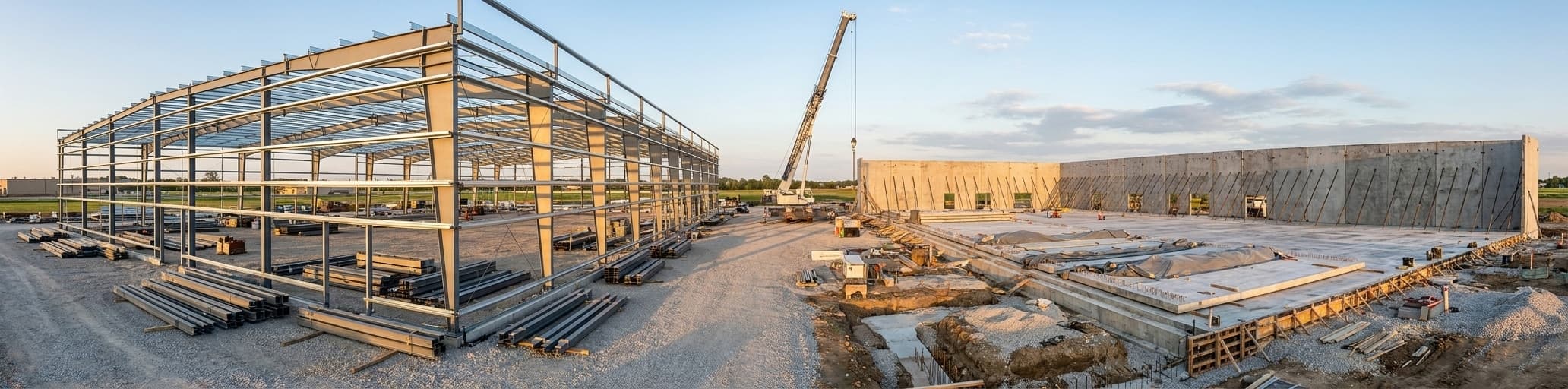

We help you compare steel and tilt-up concrete warehouse additions by footprint, region, and timeline so you can lock in the right construction method before costs escalate. Steel typically wins below 80,000 square feet, while tilt-up becomes competitive at larger scales in year-round pour climates.
National Average Warehouse Addition Cost Per Square Foot in 2026
Steel warehouse additions in 2026 cost $85-$150 per square foot installed, with the difference reflecting real scope variations like eave height, floor load capacity, and regional labor rates.
Steel warehouse additions: $85-$150 per square foot installed
Steel warehouse additions in 2026 run $85-$150 per square foot installed, a range that reflects real differences in scope rather than vague estimating. The lower end applies to straightforward pre-engineered metal building additions with standard wall heights, basic overhead doors, and minimal interior work.
The upper end accounts for taller eave heights, heavier floor loads requiring thicker slabs, insulation systems, and markets where labor costs sit above the national average. To put those numbers in context: dry warehouses as a category span $55-$175 per square foot in current commercial benchmarks, and the $85-$150 installed range for a steel addition sits squarely in the middle of that band once foundation, erection labor, and basic MEP rough-in are factored in.[2] One critical distinction buyers often miss is that a pre-engineered metal building shell alone–the structural steel, panels, and hardware–costs only $25-$40 per square foot.[1] Everything beyond the shell, including site prep, concrete slab, erection labor, permits, and finishes, closes the gap to the installed figure.
On a typical warehouse addition project, erection labor alone runs 30-50 percent of the steel package cost, and that number varies significantly by region and crew availability.[3] Two additional forces are pushing 2026 installed costs toward the higher end of the range: Section 232 steel and aluminum tariffs currently set at 50 percent are embedded in every structural component, and annual construction cost escalation is running 3-8 percent.[2] Regional spread adds another layer–Southeast markets can land 10-20 percent below the national benchmark, while Northeast and West Coast projects often exceed it by 30-50 percent.[2] For a more detailed look at how building size affects total warehouse construction cost, the industrial warehouse cost breakdown by size 2026 provides useful context on how per-square-foot pricing shifts as footprint grows.
Tilt-up concrete additions: $120-$200 per square foot installed
Tilt-up concrete additions run $120-$200 per square foot installed in 2026, a premium over steel that reflects the system's material intensity and site coordination requirements. Full shell costs break down by occupancy type: industrial additions land at $115-$185 per square foot, while distribution and light manufacturing projects climb to $145-$235 per square foot.[4] Panel pricing accounts for only a portion of those figures — standard 6-7 inch reinforced panels run $14-$22 per square foot of wall area, insulated sandwich panels run $20-$28, and architectural finishes push to $24-$32.[4] Current tilt-up cost guides corroborate that range, showing warehouse shells at $25-$40 per square foot for panel-only scope before crane, erection labor, slab, and MEP rough-in are added.[5] For an addition project, structural coordination with an existing building's framing and foundations adds cost that new-build benchmarks don't capture — which is why installed figures sit at the high end of published ranges.
The schedule profile of tilt-up is unlike any other system in commercial construction. Foundation and slab preparation takes 4-8 weeks before the first panel can be cast, and each panel requires 7-14 days of cure time before crane operations begin.[4] The slow start is offset by a fast finish: once erection begins, crews can lift 12-24 panels per day, closing a full envelope in a matter of weeks.[4] That trade-off works in Sunbelt markets — roughly 60 percent of national tilt-up volume is built there — where concrete pour windows stay open year-round.[4] In Mountain West and Northeast markets, cold weather effectively shuts down panel pours from December through February without expensive heating and protection measures, adding 4-8 weeks of schedule exposure that a warehouse addition cost per square foot analysis for 2026 confirms steel additions rarely face.
Scale determines whether tilt-up's cost structure actually delivers value. The economics improve as panel count rises — mobilizing a 90-180 ton crane for 168 panels costs far less per panel than mobilizing for 40.[4] A real-world data point: a 410,000 square foot e-commerce distribution center in central Texas delivered a complete tilt-up shell at $138 per square foot, covering foundations, slab, wall panels, a conventional steel joist and metal-deck roof, and basic MEP rough-in.[4] Three local concrete suppliers competed aggressively for that panel volume, pushing the final cost 8 percent below the general contractor's opening estimate.[4] Below 80,000 square feet, that pricing discipline rarely materializes — the Tilt-Up Concrete Association's data and field benchmarking across 38 states both show pre-engineered metal buildings consistently undercutting tilt-up at smaller footprints, where panel repetition can't compress per-square-foot crane and erection costs.[4]
Why construction method drives total project cost
Construction method is the single biggest lever on your per-square-foot cost–more than location, more than dock count, and more than interior finish level. The building shell alone accounts for roughly 65 percent of total industrial construction cost, with site work at 23 percent and office tenant improvements at 13 percent.[7] That weighting means structural and enclosure decisions made in the first week of planning set the trajectory for the entire budget. Steel and tilt-up concrete carry fundamentally different material mixes, and that difference amplifies cost volatility: structural steel and concrete/precast combined make up more than half of all shell costs, and each material responds to supply chain disruptions independently.[7] When steel prices soften, tilt-up costs don't follow–and vice versa. Locking into one system early means your contingency budget is exposed to the volatility of that system's specific commodities, not the market broadly.
Beyond raw material pricing, each method carries hidden cost multipliers that only surface during execution. Pre-engineered metal building systems can reduce structural costs by up to 30 percent compared to other methods while compressing the construction timeline–a schedule advantage that directly reduces financing carry costs, which compound at tens of thousands of dollars per month on most commercial projects.[6] Tilt-up, by contrast, concentrates cost risk in the concrete pour and cure window: any weather delay or labor disruption during panel casting pushes the entire erection sequence, and crane mobilization costs don't refund.[5] Method-driven schedule risk is why contingency budgets for tilt-up projects typically require 7-10 percent of hard costs, a reserve most lenders now mandate regardless of market conditions.[6] The construction method you select doesn't just determine what your building is made of–it determines how much financial exposure you carry from permit approval through certificate of occupancy.
Steel Warehouse Additions: Cost Breakdown and Hidden Advantages
Lock in your steel building package price during favorable procurement windows to capitalize on tapered member design that reduces frame weight by 15-30% compared to conventional steel.
Material and fabrication costs for pre-engineered steel structures
The building package — meaning the primary rigid frame, secondary framing (purlins and girts), roof and wall panels, trim, and all structural fasteners — is the fabrication core of any pre-engineered steel warehouse addition.
Standard PEMB packages from established manufacturers run $14-$22 per square foot for base configurations in 2026, while enhanced specifications including higher wind or snow loads, wider clear spans, or crane-ready framing push package pricing to $35-$55 per square foot.[8] PEMB materials alone, excluding erection, run $17-$20 per square foot according to current market benchmarks, with the broader clear-span kit range landing at $15-$30 per square foot once tariff-driven cost factors are built in.[10] Steel market conditions move the needle on every quote: U.S. hot-rolled steel coil traded around $970 per ton in early 2026, down sharply from the 2021 peak above $2,000 per ton but still well above pre-tariff baselines.[8] Section 232 tariffs on imported steel maintain upward pricing pressure even as domestic supply stabilizes, which is why locking in a building package price during a favorable procurement window is one of the most effective cost management strategies available for a warehouse addition cost per square foot project in 2026.[8] Fabrication efficiency partially offsets material costs: PEMB tapered member design concentrates steel where structural loads are highest and removes it where loads are lowest, reducing total frame steel weight by 15-30% compared to a conventional hot-rolled structural steel frame for an equivalent clear span and load capacity.[8] For a 20,000-square-foot addition, materials typically run $7-$11 per square foot before erection and foundation work are added, with accessories such as insulation systems, specialty doors, and mezzanines adding another 15-20% to total package cost.[9][10]
On-site erection and labor: why single-source turnkey solutions save time and money
The hidden cost of splitting design, fabrication, and erection across separate contracts rarely appears in any line item–it accumulates in change orders, crew idle time, and the liability gap between what was engineered and what arrives on-site.[6] When the structural steel supplier and the erection contractor operate under separate agreements, any discrepancy between fabricated components and engineering drawings becomes a field problem that neither party owns; resolving it requires a change order that both bills and delays.[6] Single-source turnkey delivery closes that gap by placing design intent, manufactured components, and field installation under one contract with one point of accountability–a structure that removes the finger-pointing dynamic that derails tightly scheduled addition projects.[6] Prefabricated steel components arrive pre-cut and pre-punched to a specific assembly sequence, cutting on-site labor hours and eliminating the coordination overhead that inflates cost when multiple subcontractors share the same critical path.[11] Design-build delivery compounds the advantage by running material procurement in parallel with design work, which is often the single scheduling move that prevents cost spikes when steel prices shift between quote and delivery.[11] Owners who engage a single-source contractor during preconstruction–rather than pricing materials after design is finalized–also capture procurement savings through established manufacturer relationships, with integrated buying networks delivering 15-35 percent reductions on envelope and structural materials compared to spot-market purchasing.[6] For owners who do evaluate erection contractors independently, vetting your 40×80 building erection crew before signing walks through the qualification criteria and red flags that apply equally to warehouse addition scopes of any footprint size.
Long-term ROI: maintenance, durability, and expansion flexibility with steel
Maintenance cost is where the 20-year ROI comparison between steel and tilt-up concrete separates most clearly. Steel warehouse additions require annual maintenance spending of roughly 1% of initial cost — approximately $1,500-$2,500 per year on a 10,000-square-foot facility — while concrete buildings run 2-4% annually, translating to $7,000-$20,000 per year on an equivalent footprint.[14] That gap compounds: a 10,000-square-foot steel facility projects to roughly $350,000 in total 20-year expenditures including all operating costs, while comparable concrete construction runs $670,000-$1.1 million over the same window.[14] Energy performance adds another line of annual savings, with steel buildings capturing $2,000-$5,000 per year through insulated metal panel systems, versus $1,000-$2,500 for traditional construction.[14] Durability underpins every one of those maintenance figures.
A properly engineered steel structure can exceed 100 years of service life, driven by dimensional stability that resists moisture cycling without warping or cracking, resistance to termites that cause more than $5 billion in annual structural damage nationwide, and non-combustibility that slows fire spread and protects occupants.[13] Concrete carries a different long-term vulnerability: rebar corrosion expands steel volume inside panels and slabs, generating tensile stress that cracks and delaminates concrete surfaces — a progressive failure mode that requires expensive structural remediation as buildings age.[13] Expansion flexibility closes the ROI case. Steel's modular framing accepts additions, crane upgrades, mezzanine insertions, and increased floor loads without structural redesign, and its adaptability to changing owner requirements extends useful building life well beyond the original design intent.[13] A properly engineered prefabricated steel warehouse delivers better lifecycle economics precisely because operational flexibility produces real financial returns that exceed any initial structural premium.[12] Resale value reflects this: steel structures are projected to increase in value by 20-30% over a 20-year hold period, a figure concrete additions rarely match given the cost and complexity of any future reconfiguration.[14]
Tilt-Up Concrete Additions: Cost Structure and Trade-Offs
Tilt-up additions cost $14-$32 per square foot depending on panel complexity, but the casting bed requirement and 7-14 day cure cycles create the real budget and schedule leverage points.
Concrete material, formwork, and curing timeline expenses
Tilt-up concrete cost decomposes into three distinct budget lines: the panels themselves, the structural slab that doubles as the casting bed, and crane and erection labor.[4] Panel pricing in 2026 varies directly with specification complexity — standard 6-7 inch reinforced panels run $14-$22 per square foot of wall area, sandwich insulated panels with R-12 to R-30 foam cores run $20-$28 per square foot, and architectural panels with reveals, formliners, or exposed aggregate push to $24-$32 per square foot, a 25-50 percent premium over plain panels.[4] The casting bed arrangement is a cost lever most owners miss entirely.
Tilt-up panels are cast horizontally on the building's own slab, which serves as the forming surface and eliminates separate formwork costs when the slab can bear the casting load.[4] On an addition project, the existing adjacent slab often cannot serve that function — requiring a premium-thickness or high-smoothness casting bed as a distinct scope item that adds materially to the concrete budget without adding a single square foot of new wall area.[4] Curing timelines generate the construction calendar's most consequential constraint: each panel requires 7-14 days of in-place curing before crane operations can begin, and foundation and slab preparation takes 4-8 weeks before the first panel can be cast.[4] That front-loaded sequencing — slow start, then a fast finish once erection begins at 12-24 panels per day — is manageable in Sunbelt markets where pour windows stay open year-round, but creates real schedule exposure in Mountain West and Northeast projects where concrete pour windows effectively close from December through February without expensive heating and weather-protection measures.[4] Ready-mix concrete lead times are not typically a national supply constraint, but tilt-up erection labor capacity can run tight in markets experiencing high warehouse construction volume — a scarcity that does not affect steel addition projects where fabricated components ship on a manufacturer-controlled schedule.[4]
Site preparation and foundation requirements for tilt-up projects
The foundation and slab scope for a tilt-up addition costs more and takes longer than most buyers anticipate–because the slab serves a dual role that no other construction system requires. Workers pour a concrete foundation that functions simultaneously as the permanent building floor and the horizontal casting surface for wall panels, with a chemical bondbreaker applied to the slab surface to prevent panels from permanently bonding to it.[15] Foundation and slab preparation takes 4-8 weeks before the first panel can even be cast, a front-loaded schedule that steel additions simply don't carry.[4] On an addition project, a complication surfaces immediately: the existing adjacent slab typically cannot serve as the casting bed, because it wasn't poured to the smoothness or bearing capacity tilt-up casting demands, making a purpose-built casting bed a separate, billable scope item that adds materially to the concrete budget without contributing a single square foot of new wall area.[4]
Site logistics impose a second layer of requirements that drive cost before any panel leaves the ground. The building perimeter needs a flat, open staging area and clear access paths wide enough for a 90-180 ton mobile crane–the minimum equipment class for panel erection.[4] Crane positioning determines both equipment selection and site preparation scope; inadequate staging forces either a larger crane configuration or temporary grading that wouldn't otherwise be needed, both of which add cost.[15] Typical warehouse slabs run 4-6 inches at $5-$7 per square foot, but tilt-up casting loads and post-construction forklift operations routinely push specifications toward the upper end of that range, and heavy storage above 40,000 pounds adds roughly $0.75 per square foot for each additional 2 inches of slab thickness.[16] For addition projects where the existing building's foundation footprint or active utility lines restrict crane staging access, understanding the regulatory sequencing that governs when site work can legally begin is critical–the warehouse addition permits state-by-state approval roadmap outlines jurisdiction-specific timelines that directly affect whether the 4-8 week slab preparation window fits within your overall project schedule.
Limitations on future modifications and expansion potential
The structural physics that make tilt-up concrete durable are the same forces that make modifying it expensive. Once panels are erected and roof framing is connected, each panel becomes a load-bearing element in an interconnected system — altering one component requires re-engineering the adjacent panels as well.[17] Adding a door or window opening means specialized concrete cutting, structural header installation, and patchwork finishing that compromises the seamless exterior the system was built to deliver.[17] That repair complexity isn't incidental: if a concrete panel is damaged or needs alteration, the size and load-bearing capacity of each unit demands careful re-engineering before any field work can begin.[18] A panel that weighs tens of thousands of pounds cannot be repositioned without crane mobilization and a full structural re-analysis — which means even minor envelope changes carry major mobilization costs.
Expansion at the building perimeter compounds the problem further. A tilt-up addition requires the same casting bed preparation, 7-14 day cure cycle, and crane sequencing as the original project.[18] That minimum setup cost applies regardless of how many square feet you are adding, which means a 10,000-square-foot future expansion carries nearly the same fixed mobilization overhead as the original build — panels can theoretically be engineered as removable or modifiable, but the practical economics rarely justify it for addition scopes that don't reach the panel-repetition threshold where crane and crew costs start compressing.[18] Tilt-up structures also involve thicker concrete walls and additional support columns that limit flexibility for remodels or complex floor plan changes — the very rigidity that supports large clear spans also constrains how the interior can be reconfigured as operational needs shift.[18] For owners evaluating whether a ground-level addition or an internal square footage strategy makes more financial sense before committing to a tilt-up perimeter expansion, the mezzanine vs. building addition storage ROI comparison breaks down the cost trade-offs in detail.
Steel construction sidesteps every one of those constraints by design. Framed openings can be located almost anywhere in the structure, interior layouts can be reconfigured without triggering a structural redesign, and perimeter expansions are straightforward because the modular primary frame was engineered with future additions as an assumed condition rather than an afterthought.[17] Many steel warehouse owners plan and document future addition anchor points during the original design phase — a cost-free preconstruction step that eliminates the re-engineering fees tilt-up owners pay just to determine whether an expansion is structurally feasible.[17] For projects where business growth is not fully predictable at the time of construction, that inherent adaptability is a real financial advantage: the building envelope can evolve as operational needs change without requiring the crane mobilization, structural analysis, and demolition patchwork that make tilt-up modification budgets difficult to control.[17]
Steel vs. Tilt-Up: Cost Comparison and Decision Framework
Your building size determines which system wins on cost: steel below 80,000 square feet, tilt-up above 200,000 square feet in competitive markets.
Cost estimates: estimate your warehouse addition by size, location, and method
Building size is the first variable that determines which system actually delivers cost value — and the threshold is more specific than most buyers anticipate. Below 80,000 square feet, pre-engineered metal buildings consistently undercut tilt-up on a per-square-foot basis because panel repetition hasn't reached the volume needed to compress crane and erection overhead.[4] Above 80,000 square feet, tilt-up's panel repetition starts closing that gap, and on projects approaching 400,000 square feet in Sunbelt markets, tilt-up can become the more cost-disciplined choice — a 410,000-square-foot Texas distribution center delivered a complete tilt-up shell at $138 per square foot, 8 percent below the general contractor's opening estimate, because three local concrete suppliers competed aggressively for the panel volume.[4] The table below shows installed cost ranges for warehouse additions in 2026 by footprint and construction method, covering total hard costs including structure, slab, basic MEP rough-in, and erection labor — excluding soft costs, interior fit-out, and specialty systems.
| Addition size | Steel (PEMB) installed | Tilt-up installed | Key constraint |
|---|---|---|---|
| Under 30,000 SF | $85-$120/SF | Not cost-effective | Crane mobilization costs don't compress at low panel counts |
| 30,000-80,000 SF | $90-$140/SF | $120-$185/SF | Steel typically wins; tilt-up viable for high-bay industrial only |
| 80,000-200,000 SF | $100-$150/SF | $120-$185/SF | Systems competitive; site conditions and schedule drive selection |
| 200,000+ SF | $110-$150/SF | $115-$185/SF | Tilt-up reaches cost parity in high-volume Sunbelt markets |
Regional multipliers compound every figure in that table. High-cost markets — primarily New York City, the San Francisco Bay Area, and Seattle — add 25-45 percent to national benchmarks for both systems.[20] Moderate-cost markets including Chicago, Boston, and Denver add 5-15 percent, while at-benchmark markets in Phoenix, Dallas, and Atlanta fall within five percent of national averages.[20] Rural Southeast and Midwest locations without significant union density typically run 5-15 percent below national benchmarks, making them the most cost-effective environments for either system.[20] For a detailed breakdown of how those regional multipliers shift warehouse construction costs specifically by geography, the warehouse cost per square foot by region for the Northeast, Midwest, South, and West in 2026 provides current market-calibrated data. Applied to a concrete example: a 50,000-square-foot steel warehouse addition priced at $100 per square foot in an average national market runs approximately $125-$145 per square foot in the Northeast or Pacific Northwest, and approximately $85-$95 per square foot in the rural Southeast — a swing of $1.5 million to $3 million on the same footprint.[19][20] Construction cost inflation running at 3-5 percent annually in 2026 means any estimate older than six months should be adjusted upward before being used for budget planning, and tariff-driven pressure on structural steel makes locking in a building package price during a favorable procurement window one of the most actionable cost management steps available for either system.[4][20]
Comparison table: timeline, maintenance, customization, and total cost of ownership
The variables that separate steel from tilt-up concrete don't all live in the initial quote — they surface across timeline, weather exposure, flexibility, and the maintenance budget you'll carry for the next two decades. The table below maps each category against real 2026 benchmarks so you can read the total cost of ownership at a glance rather than reconstructing it from separate line items.
| Category | Steel (PEMB) addition | Tilt-up concrete addition |
|---|---|---|
| Shell first cost | $85-$150/SF installed | $120-$200/SF installed |
| Optimal size range | Under 80,000 SF | 80,000 SF and above |
| Erection speed | ~33% faster than competing methods; 6-10 weeks schedule acceleration possible | 4-8 weeks slab prep + 7-14 days cure per panel before first lift |
| Weather sensitivity | Erectable in hot or cold conditions; no pour window | Concrete pours close Dec-Feb in Mountain West and Northeast without costly heating measures |
| Customization | High: framed openings anywhere, clear-span column-free layouts, easily remodeled | Limited: more support columns required; any alteration needs structural re-engineering |
| Annual maintenance | ~1% of initial cost | 2-4% of initial cost |
| Service life | 100+ years with proper engineering | 100-year service life |
| Future expansion | Modular framing designed for additions; low remobilization cost | Same crane mobilization, cure cycle, and casting-bed prep required as original build |
| Recyclability | 100% recyclable; LEED credits available | Lower recyclability; no inherent LEED advantage |
| Value retention | Depreciates slower than concrete over time | Complex future reconfiguration reduces resale value |
A few rows in that table carry outsized financial weight. The maintenance gap — 1% versus 2-4% of initial cost annually — compounds into a six-figure divergence over a 20-year hold on most warehouse footprints.[6] Erection speed is a second compounding variable: pre-engineered metal building systems can reduce structural costs by up to 30% compared to other methods, and the 6-10 week schedule compression they deliver cuts financing carry costs that accumulate at tens of thousands of dollars per month on most commercial projects.[6] The customization row matters most when your operational footprint isn't fixed — steel's column-free clear spans and modifiable framing accept future door openings, mezzanines, and bay extensions without a structural re-engineering fee, while concrete's support-column density limits how interior layouts can shift as business needs change.[21] On service life, both systems are rated for 100-year performance, but the path to that milestone looks different: steel resists the rebar-corrosion cycle that progressively cracks and delaminates concrete panels over time, and steel structures depreciate slower in value than concrete ones, which is a material consideration if a sale or refinance is in scope within the ownership horizon.[4][21]
When to choose steel and when tilt-up makes sense for your project
The decision reduces to four variables: footprint, timeline pressure, site access, and how fixed your operational model is.
Choose steel when your addition falls under 80,000 square feet, when your schedule cannot absorb a 4-8 week slab preparation window, when soil conditions on your site make heavy foundations expensive, or when you anticipate future changes to door placements, bay configurations, or interior layouts.[17] Steel is also the natural fit when the building will see limited public traffic and security needs center on perimeter access control rather than wall penetration resistance.[22] Tilt-up earns its cost premium when your addition exceeds 80,000 square feet in a Sunbelt market with a concrete pour window that stays open year-round, when local fire codes mandate concrete wall assemblies, when high-traffic public access creates a durability argument for concrete's impact resistance, or when temperature control through thermal mass is a core operational requirement.[23] One scenario that sidesteps a binary choice entirely is mixed-system construction: many warehouse owners now use tilt-up panels for office and high-visibility perimeter walls while running pre-engineered steel framing through storage bays, capturing concrete's fire resistance and aesthetic where it matters most without paying tilt-up's modification penalty across the full footprint.[23] If none of those conditions apply cleanly, the default for most addition projects is steel — faster delivery, lower installed cost at typical addition footprints, and a framing system engineered to accommodate whatever your operation requires next.[17]
- Steel warehouse additions cost $85-$150/SF installed in 2026, while tilt-up concrete runs $120-$200/SF, with steel winning on projects under 80,000 square feet.
- Erection labor comprises 30-50% of steel package costs and varies significantly by region, while tilt-up requires 4-8 weeks slab prep plus 7-14 days cure time per panel before lifting can begin.
- Steel maintenance costs roughly 1% annually versus 2-4% for concrete, creating a six-figure difference in total 20-year ownership costs on typical warehouse footprints.
- Steel structures accept future modifications like door openings and mezzanines without structural redesign, while tilt-up alterations require expensive re-engineering and crane remobilization.
- Section 232 steel tariffs at 50% and construction cost inflation of 3-8% annually in 2026 make locking in building package prices during favorable procurement windows critical for cost management.
- Regional cost variations swing projects by $1.5-3 million on identical footprints, with high-cost markets adding 25-45% to national benchmarks and rural Southeast running 5-15% below.
- https://builtmammoth.com/how-much-does-a-steel-building-cost/
- https://terrapincg.com/commercial-construction-costs
- https://www.steelstructuresamerica.com/metal-building-cost/
- https://terrapincg.com/news/tilt-up-concrete-construction-cost-per-square-foot-2026
- https://www.foxblocks.com/blog/warehouse-cost-per-square-foot
- https://redstagfulfillment.com/cost-to-build-a-warehouse/
- https://www.cbre.com/insights/reports/warehouse-and-distribution-construction-cost-trends-2023-2024
- https://terrapincg.com/news/pre-engineered-metal-building-cost-per-square-foot-usa
- https://www.alliedbuildings.com/20000-square-feet-warehouse/
- https://www.coherentmarketinsights.com/market-insight/metal-building-system-market-5459
- https://www.foxblocks.com/blog/cost-to-build-a-5000-sq-ft-warehouse
- https://www.ibeehivesteelstructures.com/blog/prefabricated-steel-warehouse-cost/
- https://www.alliedbuildings.com/metal-building-life-expectancy/
- https://www.summitsteelbuildings.com/20-year-cost-comparison
- https://constructtwo.com/design-and-construction/tilt-up-construction-vs-traditional-construction-real-cost-time-benefits/
- https://anchoredconstructiontn.com/warehouse-construction-cost/
- https://mbmisteelbuildings.com/blog/commercial-steel-buildings-vs-tilt-up-construction/
- https://www.solutionsgc.com/the-power-of-tilt-up-construction-a-faster-cost-efficient-building-method/
- https://revizto.com/resources/blog/average-commercial-construction-costs
- https://www.meltplan.com/blogs/construction-cost-per-square-foot-2026-us-benchmarks-by-building-type
- https://www.alliedbuildings.com/pre-engineered-steel-vs-tilt-up/
- https://www.tiltwall.ca/news/pre-engineered-steel-buildings-vs-tilt-up-construction/
- https://mbcmusa.com/choosing-between-tilt-up-and-pre-engineered-warehouses/