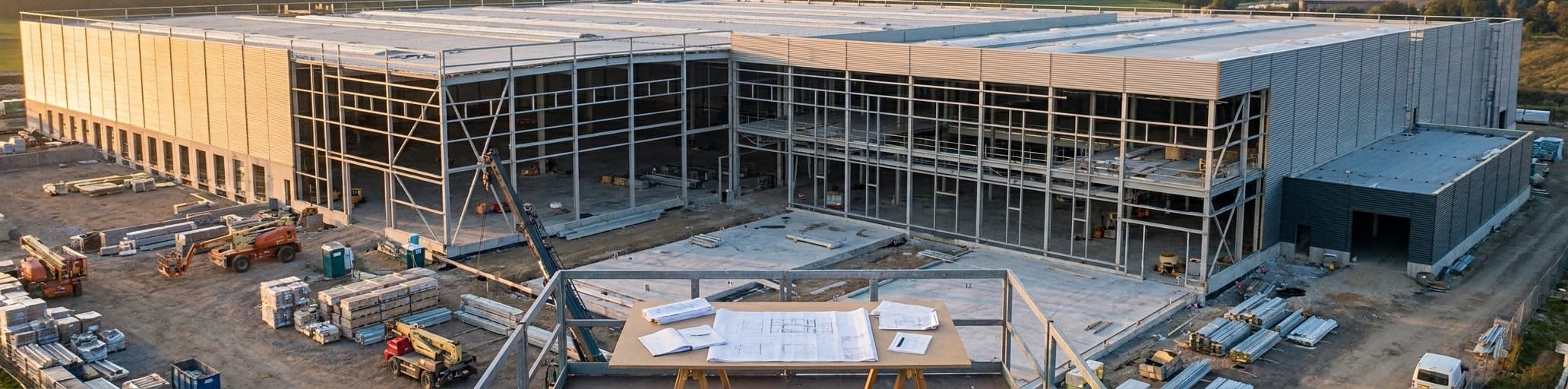

We help you understand how warehouse construction costs break down by region, complexity tier, and material choice–so you can budget accurately before your first contractor quote arrives. Steel's predictable pricing, faster erection schedule, and 30-year durability advantage compound into real savings that transform how you should evaluate total cost of ownership.
National Average Warehouse Construction Cost in 2026: What You're Looking at
Warehouse construction costs break predictably by complexity tier, with MEP systems and dock equipment accounting for most of the $45-to-$175 spread.
Why warehouse costs range from $20 to $200 per square foot (and what drives the gap)
2026 cost benchmarks by warehouse complexity: basic shell vs. turnkey operations Complexity tier is the most reliable lens for reading warehouse quotes — and the spread between tiers is predictable once you know what drives each step up. A bare pre-engineered metal building shell — primary frame, slab, basic envelope — runs $45-$75 per square foot.[4] A standard dry-storage warehouse with dock doors, fire suppression, and lighting lands in the $60-$130 per square foot range, which aligns with the Cushman & Wakefield national benchmark for general warehouse construction.[4] A full turnkey operational build — HVAC, offices, complete electrical, dock equipment — runs approximately $110 per square foot for mid-size facilities, with larger or more complex builds pushing $130-$175 per square foot.[4] Two line items explain most of the gap between tiers: mechanical, electrical, and plumbing systems add $15-$35 per square foot, and dock doors, overhead equipment, and finishes claim another 10-15 percent of total project cost on top of structure.[4]
| Complexity tier | What's included | 2026 cost per sq ft |
|---|---|---|
| PEMB shell only | Primary frame, slab, basic envelope | $45-$75 |
| Standard dry warehouse | Shell + dock doors, lighting, fire suppression, reinforced slab | $60-$130 |
| Turnkey operational build | All above + MEP systems, HVAC, office build-out, full electrical, dock equipment | $100-$175+ |
Moving outside the standard dry-warehouse band in either direction carries a clear cost logic. Below $60 per square foot, you're typically accepting a shell that needs future retrofits for dock operations, fire code compliance, or adequate lighting — expenses that surface later at higher installed cost than if spec'd upfront. Above $130 per square foot, you're paying for operational upgrades: cold chain systems, high-bay racking infrastructure, or heavy-power distribution. Cold storage warehouse construction alone starts at $130 per square foot and climbs to $350-plus depending on temperature zone.[1] Regardless of tier, soft costs — architectural and engineering fees, permitting, insurance, project management — add another 15-30 percent on top of every hard-cost number above.[1]
How material sourcing and national buying power affect your final per-square-foot price
Steel prices fluctuate daily, which means the gap between your budget estimate and your final invoice can widen quickly if you price materials after design lock.[5] Construction input costs rose at a 12.6% annualized rate in the first two months of 2026 alone — driven by surges in oil, copper, lumber, and steel — making timing and sourcing strategy as consequential as any specification decision.[6] The procurement move that consistently protects your budget is engaging a builder during preconstruction rather than after design completion: owners who wait routinely face 15 to 25 percent redesign penalties when late-stage value engineering forces specification changes.[1] Builders with direct manufacturer relationships — covering structural steel, insulated metal panels, and mechanical equipment — typically deliver 15 to 35 percent material savings compared to spot-market purchasing.[1] Bulk steel procurement compounds those savings further: precision-cut prefabricated components minimize waste, and volume buying lowers the base material cost before a single truck leaves the mill.[5] Fuel costs add one more variable — transportation from mill to job site shifts with diesel prices, and a builder with multiple manufacturing sources can route materials from the nearest facility to reduce that exposure.[5] When you're comparing warehouse building cost per square foot across bids, sourcing strategy and buying power explain a significant share of why two structurally identical buildings can carry quotes $20 to $40 per square foot apart.
Regional Breakdown: Northeast, Midwest, South & West Warehouse Costs
Northeast warehouse construction costs 30 to 50 percent above national benchmarks due to labor shortages, constrained land supply, and layered code compliance requirements.
Northeast warehouse costs: labor premiums, code compliance, and land scarcity ($90-$180 psf)
The Northeast is the most expensive region in the U.S. for warehouse construction, consistently running 30 to 50 percent above national benchmarks.[1] Applied to the standard dry-storage range of $55-$175 per square foot, that premium pushes effective Northeast costs into the $90-$180 psf band — and three compounding forces drive the gap. Labor tops the list: trade contractor rates in metro markets like Boston, New York, and Philadelphia reflect both union wage structures and a persistent skilled-worker shortage that has tightened further through 2026.[1] Land is the second pressure point. New Jersey, as a representative Northeast market, carries steep land prices driven directly by proximity to New York City and a constrained land supply — site acquisition alone costs more here than nearly anywhere else in the country.[8] Code compliance closes the loop: dense urban jurisdictions in the Northeast enforce layered zoning, fire suppression, and structural requirements, and extended permitting timelines translate into real financing carry costs that inflate your total development budget beyond what the hard-cost number alone suggests.[8] Location factors like these account for 30 to 40 percent of a project's final cost, which is why two structurally identical warehouses can carry budgets $40 to $60 per square foot apart depending solely on where you build.[8] Cushman & Wakefield's industrial construction data consistently flags Northeast U.S. metros among the most expensive warehouse construction markets in the Americas.[7] If you're planning a warehouse build or addition in the Northeast, budget soft costs at the upper end of the 15-30 percent range and price site work and permitting as first-order line items, not afterthoughts.
| Cost factor | National baseline | Northeast impact |
|---|---|---|
| Standard dry warehouse | $55-$175 psf | $90-$180 psf (30-50% premium) |
| Regional cost adjustment | Baseline | +30-50% above national average |
| Soft costs (A&E, permits, carry) | 15-25% of hard cost | Upper band: 25-30% of hard cost |
| Location as share of total cost | Varies | 30-40% of final project cost |
Midwest warehouse construction: affordable labor and competitive pricing ($60-$120 psf)
The Midwest delivers the most cost-effective warehouse construction environment in the country — and two structural advantages explain most of the gap. Lower trade labor rates and stronger access to domestic structural materials compress hard costs in ways that show up directly on your per-square-foot number.[10] Where Northeast projects absorb union wage premiums and land scarcity markups, Midwest markets draw from a deeper skilled labor pool and benefit from proximity to domestic steel supply chains, keeping commercial construction costs in cities like Chicago well below coastal equivalents.[10] That combination puts standard dry-storage warehouse construction — dock doors, fire suppression, reinforced slab, lighting — in the $60-$120 per square foot range for most Midwest markets. Columbus, Ohio anchors the value case: often called the "Crossroads of America," Columbus offers one-day delivery reach to a large share of the U.S. population, with warehouse lease rates of $5.50-$7.00 per square foot confirming the market's cost competitiveness for distribution-focused operators.[9] Cushman & Wakefield's industrial construction data consistently flags Midwest markets among the most affordable in the Americas, with a slower global construction pipeline through early 2025 keeping material pricing particularly stable in inland markets insulated from coastal demand pressure.[7] For developers running prefab warehouse projects in Ohio, Indiana, Illinois, or Missouri, that 20-35 percent hard-cost advantage over Northeast benchmarks is real money — and it compounds across larger footprints where the per-square-foot savings multiply against a bigger base.
| Cost factor | National baseline | Midwest impact |
|---|---|---|
| Standard dry warehouse | $55-$175 psf | $60-$120 psf |
| Regional cost driver | Baseline | Lower labor rates + material availability |
| Representative market | N/A | Columbus, OH ("Crossroads of America") |
| Soft costs (A&E, permits, carry) | 15-25% of hard cost | Lower band: 15-20% of hard cost |
| vs. Northeast hard costs | Baseline | 20-35% below Northeast benchmarks |
South and West regional variations: sprawl advantages, climate factors, and growth demand ($70-$150 psf)
Material costs: steel's predictable pricing vs. lumber and concrete volatility in 2026 The 2026 material pricing environment has fractured into distinct tracks — and which track your primary structural material follows determines how much contingency you actually need in your warehouse budget. Overall construction input prices have risen approximately 2.8% in aggregate, but that headline figure conceals sharp divergence by category.[12] Steel and aluminum saw gains of 20-30% year over year in 2025, driven primarily by Section 232 tariffs reaching as high as 50% on imported products.[13] Those tariff levels are now embedded in domestic pricing — which makes the exposure known, quantifiable, and manageable through procurement strategy rather than a variable that surfaces mid-project.[13] Contractors who lock in supply agreements months in advance and leverage bulk purchasing can stabilize structural steel costs before groundbreaking; larger firms with direct manufacturer relationships are already doing exactly that.[13]
What gives steel a planning advantage over lumber and concrete isn't its price level — it's price structure. Steel moves primarily with identifiable policy inputs: Section 232 rates, domestic mill output, and origin freight. Lumber, by contrast, is seeing tariffs and housing demand reintroduce volatility after a period of relative calm — mill slowdowns and trade duties can trigger localized price spikes quickly, and those swings are harder to hedge because they track residential demand cycles that don't align with commercial project timelines.[14] Concrete inputs face separate pressure: energy-intensive production makes them directly sensitive to fuel price movements, and geopolitical disruptions to oil markets can push concrete input costs upward faster than redesign or material substitution is practical.[12] In a market where pricing cycles have shortened and contractors are seeing more frequent estimate updates than in prior years, building your warehouse on a material with identifiable cost drivers reduces the replanning burden substantially.[14]
For developers comparing steel frame versus wood frame construction, the material cost argument runs deeper than today's quoted price. A 12-week construction schedule with lumber sourced at bid carries real repricing risk if housing demand surges before you break ground; a pre-engineered steel package with pricing locked at contract execution eliminates that exposure.[13] Average material cost increases of approximately 5% year over year across all categories understate actual variance if your budget lands on the wrong side of a lumber or concrete input swing.[13] In 2026, material choice and procurement timing are risk management decisions first — cost optimization second.
Labor efficiency and erection speed: how steel reduces per-square-foot timeline costs
Timeline cost is one of the most consistently underestimated line items in any warehouse budget. Every week a building stays under erection is a week of financing carry, deferred operations, and delayed revenue — expenses that accumulate at a fixed rate regardless of what's causing the hold. Pre-engineered steel's scheduling advantage is structural: components arrive precision-cut and ready for bolt-up assembly, which eliminates the field fabrication, curing cycles, and trade-sequencing dependencies that extend concrete tilt-up and wood-frame timelines.[15] Building shell erection accounts for roughly 65% of total warehouse construction cost, so compressing the shell phase has a larger per-square-foot budget impact than optimizing almost any other schedule variable.[16] An installed, turnkey steel warehouse — kit, slab, delivery, and construction included — runs $24 to $43 per square foot, a figure that already reflects bolt-together assembly efficiency rather than field-intensive labor hours.[15] When you price an equivalent operational footprint in concrete or wood-frame construction and layer in extended trade sequencing, longer subcontractor windows, and higher on-site skilled-labor hours, that installed cost comparison shifts further in steel's favor.
Labor represents a material share of total steel building cost,[17] but prefabrication restructures where that labor happens. Factory-floor fabrication under controlled conditions replaces unpredictable field conditions — reducing rework, weather delays, and crew idle time that inflate per-square-foot labor expense on traditional builds. The schedule difference compounds across phases: a steel frame that moves from slab cure to weathertight shell in weeks rather than months gives you earlier MEP rough-in access, reduces trade crew congestion, and compresses the path to a certificate of occupancy. For any project where revenue starts on opening day, your real per-square-foot cost calculation has to include the carrying cost of every week added to the schedule — and on that measure, steel's erection speed routinely offsets any kit-price premium. If you want to understand how prefab building kit delivery timelines translate into actual schedule compression from order to weathertight shell, the sequencing works in your favor from the moment engineering begins.
Long-term durability and maintenance: calculating true cost per square foot over 30+ years
Per-square-foot pricing at groundbreaking tells you roughly 20-30% of what you'll actually spend on a warehouse over its life — the rest accumulates through maintenance, energy bills, and eventual structural repairs.[20] That math fundamentally changes how you should evaluate steel against traditional construction. Annual maintenance for metal buildings runs $0.25-$0.45 per square foot, compared to $1.10-$1.80 per square foot for wood-frame equivalents — a difference that compounds into $1.42 million in savings over 30 years on a 50,000 square foot warehouse.[20] Steel's inorganic composition is what drives that gap: no rot, no termite damage, no warping, and no recurring paint cycles.[18] The construction industry loses roughly $1.2 billion annually repairing pest and moisture damage in traditional structures — none of which appears in a wood-frame quote but all of which lands in your operating budget.[20]
The durability advantage has a direct insurance dimension too. Metal buildings carry Class A fire ratings and weather-resistant surface coatings that retain 98% reflectivity after 15 years in coastal climates, compared to 54% degradation in asphalt shingle alternatives.[20] Insurers price that performance difference directly: commercial metal buildings typically draw 12-15% lower premiums than equivalent wood-frame structures, with fire-resistant design reducing insurance costs by 18-25% according to NFPA data.[20] For owners evaluating energy-efficient metal buildings, insulated metal panels add another layer to the TCO equation — steel buildings save $2,000-$5,000 per year in energy costs versus $1,000-$2,500 for traditional construction, a gap that grows as utility rates escalate.[19]
The 30-year numbers make the investment case concrete. Steel requires just 1-1.5% of initial construction value in annual maintenance versus 2.5-4% for wood structures — and that 60-70% cost differential stems from metal's resistance to the three drivers that inflate traditional maintenance budgets: moisture-related deterioration, pest damage, and repainting cycles.[20] A 10,000 square foot steel warehouse runs approximately $350,000 in total 20-year costs including all operating expenses; comparable wood construction lands between $670,000 and $1.1 million over the same period.[19] Resale captures the remaining advantage: metal buildings hold 17-23% more value at resale after 25 years compared to wood-frame equivalents, and galvanized steel improvements return approximately $4.20 for every dollar invested in durability upgrades.[20]
| Cost category | Steel warehouse | Wood-frame warehouse |
|---|---|---|
| Annual maintenance (per sq ft) | $0.25-$0.45 | $1.10-$1.80 |
| Annual maintenance (% of initial cost) | 1-1.5% | 2.5-4% |
| Energy savings vs. baseline (annual) | $2,000-$5,000 | $1,000-$2,500 |
| Insurance premium reduction | 12-25% lower | Baseline |
| Expected service life | 40-60 years | 25-45 years |
| 20-year total cost (10,000 sq ft) | ~$350,000 | $670,000-$1.1M |
| 30-year maintenance savings (50,000 sq ft) | $1.42M below wood | Baseline |
| Resale value premium after 25 years | +17-23% vs. wood | Baseline |
Two specification decisions determine where your steel warehouse lands within those ranges. First, coating grade: standard G-90 galvanized steel lasts three times longer than basic coatings in corrosion testing, while 26-gauge steel with aluminized/zinc alloy finishes delivers five times greater salt spray resistance — the difference between repainting every 8-10 years and repainting once every 20-25 years.[20] Second, galvanization technique: proper galvanization eliminates 73% of unplanned repair costs and keeps decade-long maintenance budgets 38% below commercial averages.[20] Specifying both upfront adds a modest amount to initial hard cost and eliminates a predictable sequence of unbudgeted expenses that surface throughout a 30-year ownership cycle.
Calculate Your Warehouse Cost: Pricing Guide by Size, Region & Specifications
Soft costs–permits, engineering fees, and financing–add 10-25% to every hard-cost number, so accounting for them upfront prevents the mid-project budget shortfalls that trip up most developers.
Quick cost estimator: plug in square footage, region, and building type for 2026 baseline
The calculation itself is simple: square footage multiplied by the per-square-foot baseline for your building type gives you a hard-cost starting point, then you layer in regional adjustment and soft costs.[21] What trips up most developers isn't the formula — it's using the wrong baseline for their building type or missing the soft-cost add-on entirely. Soft costs — permits, architectural and engineering fees, utility connections, insurance, and financing carry — add 10-25% on top of every hard-cost number, and leaving them out of your initial budget is the single most common cause of mid-project shortfalls.[22] A practical approach: calculate hard costs first, multiply by your soft-cost percentage based on project complexity, then apply the regional index to the combined total.[22] Location-specific construction indices shift your final number by as much as +/-20% from national averages — which means two warehouses with identical specs built in different regions can carry materially different budgets before a single trade rate or code variable enters the picture.[11]
The table below gives you the 2026 hard-cost baseline ranges organized by building size and type. These are construction-only figures — land, soft costs, and contingency are separate line items.
| Building size | Basic shell total cost | Standard dry warehouse total | Turnkey operational total |
|---|---|---|---|
| 10,000 sq ft | $140,000-$220,000 | $600,000-$1.3M | $1.0M-$1.75M |
| 20,000 sq ft | $280,000-$440,000 | $1.2M-$2.6M | $2.0M-$3.5M |
| 100,000 sq ft | $2.0M-$3.5M (PEMB) | $6.0M-$13.0M | $10.0M-$17.5M+ |
Basic shell figures for 10,000 and 20,000 square foot footprints use a $14-$22 per square foot hard-cost foundation;[21] the 100,000 square foot range reflects $20-$60 per square foot for a basic pre-engineered metal building through tilt-up construction at that scale.[11] Standard dry and turnkey columns apply the $60-$130 and $100-$175 per square foot complexity tiers established earlier in this guide, scaled against each footprint. To apply a regional adjustment, multiply your hard-cost total by the appropriate factor: Midwest and most Southern markets run at or below national baseline (0.85-1.00x); Northeast metro markets and California coastal markets carry a 1.30-1.50x premium over that same baseline.[11] Add your soft-cost percentage last — 15-20% for straightforward Midwest builds, 25-30% for Northeast or California projects where permitting timelines and compliance requirements compress your contingency buffer.[21] For warehouse builds in Texas specifically, industrial and warehouse construction runs $130-$250 per square foot depending on use case and finish level, with secondary Texas markets like San Antonio coming in below Austin and Dallas-Fort Worth on both labor and land.[22] That regional spread inside a single state illustrates exactly why the +/-20% location index matters: apply it before you finalize any budget, not after your first contractor quote arrives.
How to read your estimate: what's included in per-square-foot pricing and what isn't
Every per-square-foot figure you see in a warehouse quote covers hard costs only — the physical components that end up in the structure.[23] Exactly which hard costs depends on the complexity tier used to generate the number. A shell-only PEMB figure covers primary framing, slab, and basic envelope. A standard dry-warehouse figure adds dock doors, fire suppression, lighting, and a reinforced slab. A turnkey figure layers in full MEP systems, HVAC, office build-out, and dock equipment.[1] The problem most developers run into isn't misreading the per-square-foot rate — it's assuming everything else is covered when it isn't. Hard costs represent 60-70% of total project cost, which means 30-40% of what you'll actually spend never appears in the construction number.[23]
What a standard per-square-foot warehouse estimate excludes:
- Land acquisition (excluded from every published benchmark)[1]
- Architectural and engineering fees, which run 5-12% of hard cost on commercial projects[1]
- Permitting, which ranges from under $1,000 on simple builds to $500,000-plus for large commercial developments in high-cost cities[23]
- Insurance and legal fees tied to the development process[23]
- Financing carry — the cost of capital sitting idle while the building is under construction[1]
- Project management and owner representative fees[23]
- Post-construction costs: commissioning, punch list labor, MEP balancing, and site work deferred during construction, which typically run 2-5% of hard costs[23]
Those excluded categories collectively add 15-30% on top of every hard-cost figure — and on complex projects like cold storage or heavily code-restricted Northeast builds, the AIA and ACEC benchmarks show soft costs routinely exceeding 30%.[1] Understanding this split also requires distinguishing between three terms that get used interchangeably but mean different things: an estimate predicts costs, a bid is a contractor's fixed-price offer, and a budget is the approved spending limit that governs the project.[23] The per-square-foot benchmarks in this guide are estimates — useful for sizing scope and stress-testing feasibility, but not a substitute for a contractor bid against your specific site, jurisdiction, and building program.[23] Projects that conflate the two pay for it: only 47.9% of construction projects are completed within budget, with the average overrun sitting at 65%, and the projects that stay on track almost always share one common factor — full hard-cost and soft-cost visibility from the start.[23]
| Cost category | Typically in per-sq-ft estimate | Typically excluded |
|---|---|---|
| Structural framing, slab, envelope | Yes | — |
| Dock doors, lighting, fire suppression | Yes (standard dry warehouse tier and above) | Excluded from shell-only figures |
| MEP systems, HVAC, electrical | Yes (turnkey tier only) | Excluded from shell and standard figures |
| Land acquisition | — | Always excluded |
| A&E fees (5-12% of hard cost) | — | Always excluded |
| Permitting and regulatory compliance | — | Always excluded |
| Financing carry and insurance | — | Always excluded |
| Post-construction commissioning (2-5% of hard cost) | — | Almost always excluded |
The practical move: once you have a hard-cost estimate for your footprint and complexity tier, add your soft-cost percentage on top before you take any number to a lender or ownership group. For straightforward Midwest builds, 15-20% is defensible. For Northeast or California projects where permitting timelines are extended and compliance layers compound, budget 25-30% — and treat post-construction costs as a separate, non-negotiable line item rather than something to absorb from contingency.[1] If you want a detailed look at how industrial warehouse construction costs break down by size, that analysis covers how fixed costs amortize across footprint scale and where the per-square-foot number shifts most sharply.
Next steps: working with National Steel Buildings for transparent, single-source budgeting
The data throughout this guide points to one consistent finding: warehouse projects go over budget not because of the building itself, but because of fragmented accountability across multiple vendors, each owning a slice of scope with no one responsible for the full number. Only 47.9% of construction projects finish within budget, and the average overrun sits at 65% — a gap that traces directly to incomplete scope definition, disconnected procurement, and soft costs treated as afterthoughts rather than first-order line items.[24] The fix isn't a bigger contingency. It's a procurement model where design, fabrication, engineering, and delivery live under one contract with one accountable party who owns the complete budget from day one. Labor alone accounts for roughly 50% of total warehouse construction cost on complex projects, and when labor is sourced separately from the structural package, schedule slippage and change orders multiply — each one adding to a number that was already understated at signing.[24]
Pre-engineered steel changes that dynamic structurally. Prefabrication moves fabrication work into a controlled factory environment, reducing field labor hours, eliminating rework from fit issues, and compressing the erection schedule in ways that directly shrink your financing carry cost.[25] A single-source supplier handles structural engineering, steel fabrication, and delivery coordination as one integrated package — which means the quote you receive at contract execution maps to an actual scope, not a placeholder.[25] Material costs for steel structures run $12-$19 per square foot for a standard warehouse footprint, with labor in the $5-$10 per square foot range depending on complexity and regional wage rates — numbers that hold when procurement and fabrication are controlled by one party rather than bid piecemeal across multiple subs.[26] That's the difference between a budget that tracks through construction and one that drifts.
National Steel Buildings operates as that single-source partner — nationwide buying power, in-house engineering, and direct manufacturer relationships that lock in structural steel pricing before ground breaks rather than after design is complete. Every project starts with a complete line-item estimate covering hard costs, soft cost guidance by region, and site-specific variables before you commit capital. You get one point of contact from design through delivery, which means no scope gaps between your structural package and your construction timeline, and no surprises when the invoice arrives. If you're ready to turn the regional benchmarks in this guide into an actual budget number for your site, reach out to the team at National Steel Buildings — we're with you every step of the way, from first estimate to certificate of occupancy.
- Northeast warehouse construction costs 30-50% above national average due to union labor, land scarcity, and code compliance.
- Midwest offers 20-35% hard-cost savings over Northeast through lower labor rates and direct access to domestic steel supply chains.
- Steel structures require only 1-1.5% annual maintenance versus 2.5-4% for wood, saving $1.42M over 30 years on 50,000 sq ft buildings.
- Soft costs (permits, engineering, financing carry) add 15-30% on top of hard costs and are the primary cause of budget overruns.
- Pre-engineered steel with single-source procurement eliminates scope gaps and schedule slippage that plague traditional multi-vendor construction models.
- Material choice and procurement timing are risk management decisions–steel's identifiable cost drivers beat lumber and concrete volatility in 2026.
- https://terrapincg.com/commercial-construction-costs
- https://www.foxblocks.com/blog/warehouse-cost-per-square-foot
- https://www.maxxbuilders.com/what-does-it-cost-to-build-an-industrial-warehouse/
- https://www.foxblocks.com/blog/cost-to-build-a-5000-sq-ft-warehouse
- https://www.alliedbuildings.com/30000-square-feet-warehouse/
- https://www.constructiondive.com/news/staggering-construction-prices-february-2026/815257/
- https://www.cushmanwakefield.com/en/united-states/insights/industrial-construction-cost-guide
- http://www.247pro.com/blog/your-state-by-state-guide-to-construction-costs-and-calculations-in-the-us
- https://www.brownintegratedlogistics.com/blog/us-average-warehouse-cost-per-square-foot
- https://www.clarisdesignbuild.com/2025-update-commercial-construction-cost-per-square-foot-in-the-us/
- https://redstagfulfillment.com/cost-to-build-a-warehouse/
- https://www.wsinc.com/blog/construction-supply-chain-disruptions-2026/
- https://construction-today.com/news/8-ways-rising-material-costs-are-changing-construction-in-2026/
- https://www.inflowinventory.com/blog/construction-material-cost/
- https://www.buildingsguide.com/metal-building-prices/?srsltid=AfmBOorsQvdKtp-dthByJJeJWyyqal4X8M6apwqs0HOLDfnb5z-9GLPc
- https://www.cbre.com/insights/reports/warehouse-and-distribution-construction-cost-trends-2023-2024
- https://americansteelinc.com/blog/steel-building-costs-prices-guide/
- https://www.alliedbuildings.com/commercial-steel-building-vs-traditional-construction-costs/
- https://www.summitsteelbuildings.com/20-year-cost-comparison
- https://www.jysteelstructure.com/blog/low-upkeep-costs-of-metal-buildings-saving-money-over-time
- https://www.autodesk.com/blogs/construction/commercial-construction-cost-per-square-foot/
- https://jdj-consulting.com/construction-cost-per-square-foot-in-texas-the-2026-guide/
- https://constructionleadpro.com/construction-project-budget/
- https://www.ism.ws/logistics/how-much-does-it-cost-to-build-a-warehouse/
- https://sunwardsteel.com/how-much-does-it-cost-to-build-a-warehouse/
- https://www.foxblocks.com/blog/cost-to-build-a-30000-warehouse