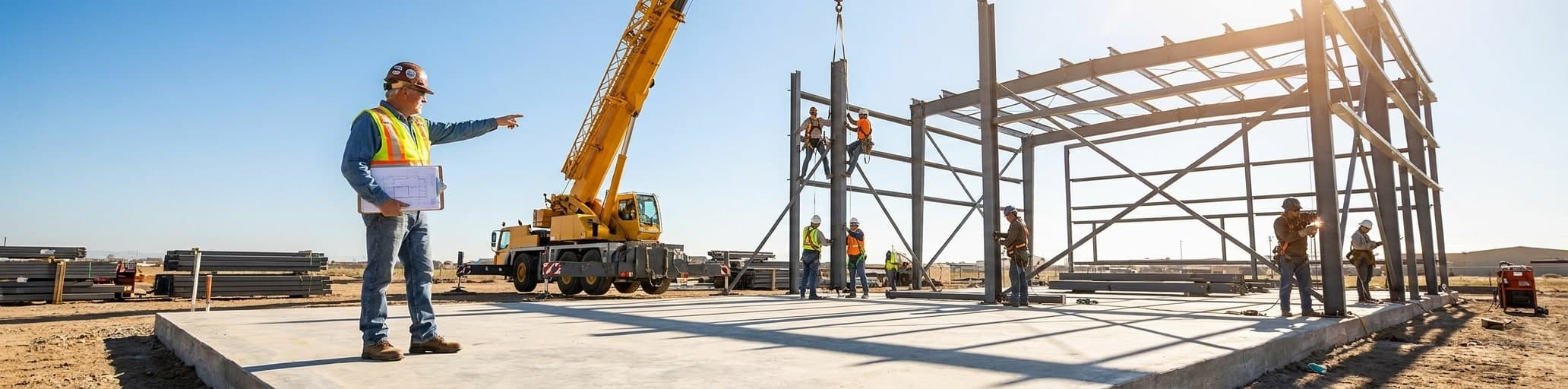

We help you understand how experienced metal building crews work and why crew expertise matters more than finding the cheapest installer. Single-source installers provide accountability across every phase, protecting your budget and ensuring your building performs for decades.
Why Crew Expertise Matters More Than Finding the Cheapest Installer
Cheap installation quotes hide real costs–misaligned frames, warranty gaps, and permit rejections–that experienced crews price upfront in a single contract.
The Hidden Costs of Inexperienced Metal Building Crews
The lowest quote you find when searching for metal building installers near me usually signals three things: thin-gauge steel, an undersized crew, and a contractor who stops answering calls once the final panel goes up. [1] Most buyers also underestimate what inexperienced crews add to total project cost through delays and rework — misaligned primary frames, panel gaps that void weather-tightness warranties, and permit rejections from crews unfamiliar with local snow-load or wind-zone requirements. [2] One property owner evaluating a 40×45 shop framed the decision clearly: a $17,000 kit with advice to "find your own crew" looked attractive on paper, but their instinct said it would cost extra in headaches as well as money. [3] That instinct holds up.
When you separate the kit purchase from installation, you absorb hidden line items — site-specific engineered drawings, proper foundation sequencing, insulation scheduling — that experienced local prefab contractors price into a single number from day one.
A cheap labor quote rarely accounts for any of it, and the shortfall lands on your budget after the crew is already gone. [1]
How Single-Source Accountability Prevents Costly Delays and Rework
When you split the kit purchase from installation and coordinate multiple trades yourself, accountability dissolves fast. Each subcontractor focuses only on their scope — the concrete crew doesn't care that the frame erectors are waiting on-site, and the electrician won't adjust his schedule because panels arrived late. When something goes wrong, everyone points at the trade that just left.
Industry data backs this up: owner-managed commercial projects exceed original budgets by 30-40% and timelines by 60-90% compared to professionally managed builds. [4] A single-source installer changes that math entirely. One contract, one phone number, one company that owns every phase from foundation to final inspection — so if the slab reads out of level on day one, your installer catches it before the frame ships, not after the crew has already driven three hours to your site and loaded everything back onto trucks. That accountability doesn't stop at the handoff, either.
Local installers who serve the same communities year after year have a direct stake in the quality of their work — their referrals, their reputation, and their next job all depend on it. [5] Two years in, when a panel seam needs attention or a door frame needs adjustment, you call the same team that installed it — people who know your site, your specs, and what was done. That continuity is what keeps a building performing for decades instead of costing you money every season.
Metal Building Installation Crew Roles and Responsibilities
A site foreman and project manager working as one command chain eliminate delays by catching problems like misaligned bolts before they cascade into costly rework.
Site Foreman and Project Manager: Your Single Point of Contact
On a metal building install, two roles determine whether your project runs clean or bleeds money in delays: the site foreman and the project manager.
The site foreman is your ground-level authority — the person who opens the site each morning, assigns tasks to erection crews, and receives and inspects every material delivery before anything gets unloaded or stored. [7] When two crews need the same space at the same time, the foreman resolves it on the spot instead of waiting for a call chain to work itself out. [6] They're also the direct communication link between what's actually happening on your slab and what the project manager needs to know — catching a misaligned anchor bolt pattern or a panel damaged in transit before those problems cascade into rework. [7] The project manager operates across both the site and the office: managing your budget, sequencing permits, negotiating with suppliers, and making sure every trade has materials and access to keep moving each day. [6] Together, these two roles collapse what would otherwise be a tangle of phone calls and finger-pointing into a single chain of command — one number to call, one team that owns the outcome, and one clear line of accountability from foundation pour to final inspection.
Structural Steel Erectors, Bolters, and Welders: Core Installation Roles
Three specialized trades handle the physical assembly of your metal building frame, and knowing what each one does helps you confirm any installer you're evaluating has the right mix of people on-site. Structural steel erectors — also called ironworkers — are responsible for lifting and placing the primary steel beams, girders, and columns that form your building's skeleton, using cranes and forklifts to move components into exact position before any connection is made. [9] Once a piece is in place, bolters make the structural connections.
Bolting is the primary method for joining steel on-site: it's fast, it's inspectable, and it's adjustable if a member needs to shift before everything is torqued down. [8] Site welders handle what bolting alone can't — fusing joints that carry higher stress loads or require a permanent, rigid bond between members. [8] All three trades work at height in conditions that shift daily, which is why crew safety protocols aren't just a formality on a well-run site — they're what keeps the schedule intact and your structure sound from the first column to the last panel. The structural steel components overview breaks down exactly what gets fabricated and why each piece matters on-site.
The Five-Phase Metal Building Erection Timeline and What Happens at Each Stage
Your building's steel frame rises in days 4-8, with the first bay precisely positioned and braced before remaining frames follow at accelerated pace.
Phase 2: Column and Frame Assembly (Days 4-8)
Days 4 through 8 are where your building goes from a cured slab to a standing steel frame. The crew starts by staging every primary framing component near its final position — a process called "shaking out" — so the lifting sequence runs clean and no one wastes time locating the right piece on a crowded site. [10] Rigging crews then attach heavy-duty slings and shackles to each column, the crane operator hoists it into position, and the base plate drops onto the anchor bolts projecting from your foundation.
The first bay — two frames plus their connecting purlins and girts — has to be perfectly plumb and square before anything else gets bolted; a fraction of an inch off here compounds into a measurable structural problem by the time the crew reaches the far end of the building. [10] Once that initial bay is stabilized with temporary bracing, the remaining frames follow faster. Standard pre-engineered systems typically complete primary and secondary framing within one to two weeks for structures in the 5,000-15,000 sq. ft. range, with factory pre-punched components eliminating most on-site cutting or modification that otherwise drain days from the schedule. [11] After the primary frames are standing, the crew installs secondary framing — C- or Z-shaped girts running horizontally along the walls and purlins spanning across the roof — starting at the eave strut where wall meets roofline, then working up toward the ridge and down the walls simultaneously.
Every spacing is pulled directly from the engineered erection drawings, set to the wind, snow, and seismic load requirements for your specific location; an experienced crew uses calibrated torque wrenches throughout, because over-driven bolts warp the steel and create weak points just as surely as under-driven ones do. [10] The phase closes with diagonal and rod bracing installed across the frame bays, locking the entire structure against racking, twisting, or swaying under load — the step that converts a collection of bolted steel members into a rigid skeleton ready to accept wall and roof panels. The guide to coordinating slab pour and steel erection for a 20×40 footprint walks through how the transition from foundation pour to erection phase gets sequenced to avoid costly crew standdowns. [10]
Metal Building Installation Costs: What You'll Actually Pay and Why
Larger buildings spread fixed costs across more square footage, dropping your per-square-foot labor rate from $7-8 down to $5-6 as crews work more efficiently.
How Building Size, Complexity, and Site Conditions Drive Crew Duration and Cost
Building size is the most straightforward cost lever in any installation quote. Per-square-foot erection labor drops as your footprint grows — a 1,200 sq. ft. structure typically runs $7-8 per sq. ft. to install, while a 3,000 sq. ft. building can drop to $5-6 per sq. ft. as fixed mobilization costs spread across more floor area. [12] That dynamic shows up in real completed project data: a 30×40 builds out at roughly $70,000 at the median all-in, a 40×60 around $120,000, and a 50×100 near $235,000 — with the per-square-foot rate improving at each step up in size. [14] The crew doesn't necessarily grow as the building gets larger; they simply work more efficiently once the erection sequence is established on-site, which is why larger commercial warehouses, aviation hangars, and agricultural storage buildings often have better cost-per-square-foot economics than a small residential garage. The 30×40 prefab building cost calculator provides a detailed cost breakdown for a common mid-size footprint.Complexity is where size alone stops predicting your crew's time on-site — or your bill.
Standard prefabricated kits for single-span structures install at $4-7 per sq. ft. in labor. Add a mezzanine, curved roof panels, or multiple interior partitions and that number climbs to $8-10 per sq. ft., because each deviation from a standard frame requires additional engineering coordination and often heavier lifting equipment. [13] A 4,000 sq. ft. complex commercial building can carry $280,000 in labor compared to roughly $200,000 for a standard warehouse at the same footprint — a 40% premium driven entirely by design complexity. [13] Every additional overhead door, specialty opening, or mechanical penetration compounds this: each one adds crew hours, and in high snow-load or high-wind regions, the engineering required to meet local code can add $5,000-$20,000 to a mid-size project before the first column goes up. [14]Site conditions are the least predictable variable and the one most likely to erode a budget that looked solid in the proposal. Flat, accessible land with stable soil costs you nothing extra — the crane has room to work, deliveries stage cleanly, and the schedule holds.
Anything else adds measurable friction: narrow site access forces smaller equipment and slower lifts, raising erection costs by 5-10%; slopes or rocky ground require leveling work that runs $13,000-$65,000 depending on severity; and remote locations add 5-10% in logistics costs for material delivery and crew accommodation. [13] Clay-heavy soils that expand and contract with moisture require deeper footings, poor drainage demands additional base prep, and permit jurisdictions that mandate multiple inspection hold-points all extend crew time on-site. [12] Experienced installers assess your site before pricing the job — not after the contract is signed — because that sequence is what keeps your project within budget instead of bleeding cost in the final weeks.
- Cheap installation quotes often hide costs in delays, rework, and permit rejections that exceed initial savings by thousands of dollars.
- Owner-managed projects exceed budgets by 30-40% and timelines by 60-90% compared to professionally managed builds with single-source accountability.
- Site foreman and project manager roles create one chain of command that prevents cost-bleeding finger-pointing between multiple trades.
- Installation labor ranges from $7-8 per square foot for small structures to $4-5 per square foot for larger buildings due to improved efficiency.
- Design complexity like mezzanines or curved roofs increases labor costs by 40% and adds $5,000-$20,000 in engineering for high-wind or snow-load regions.
- Site conditions including narrow access, slopes, and poor drainage can add $13,000-$65,000 in unexpected preparation costs before erection begins.
- https://metal-america.com/the-hard-truth-about-steel-building-cost/
- https://buildway.com/steel-building-kit-upgrade-installation-diy-vs-pro/
- https://www.garagejournal.com/forum/threads/steel-building-is-hiring-my-own-crew-worth-it.514809/
- https://metal-america.com/turnkey-commercial-steel-building-construction-in-texas-and-oklahoma/
- https://www.rnkbuildings.com/why-hiring-local-metal-building-contractors-saves-time-money-and-headaches
- https://www.procore.com/library/construction-foreman
- https://www.nectoselection.com/blog/site-foreman-job-description
- https://www.southeasternconst.com/2022/02/16/responsibilities-of-structural-steel-companies-and-steel-erectors/
- https://esub.com/blog/what-does-a-steel-erector-do
- https://harrisconstructorsinc.com/metal-building-erection/
- https://metalbuildermagazine.com/faster-builds-fewer-delays-understanding-metal-building-erection-timelines/
- https://metalstructuresales.com/steel-building-installation-cost/
- https://chinasteelbuildsales.com/labor-cost-for-erecting-a-metal-building/
- https://www.steelstructuresamerica.com/metal-building-cost/