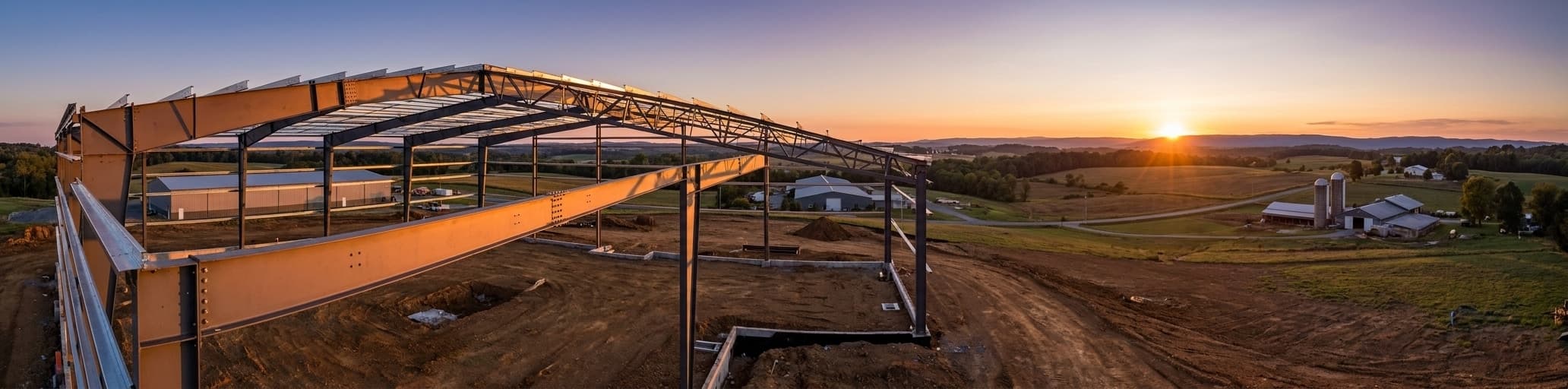

We help Harrisburg property owners understand steel building costs, permits, and timelines to make confident construction decisions. Steel structures deliver 20-30% cost savings upfront while eliminating long-term maintenance cycles that traditional construction cannot avoid.
Why Harrisburg property owners choose steel buildings for commercial and industrial projects
Steel buildings cost 20-30% less upfront than traditional construction and eliminate costly wood-frame repairs over 20 years.
Harrisburg's climate and code requirements: what steel delivers
Total Cost of Ownership: Steel vs. Traditional Construction in Harrisburg The upfront numbers favor steel decisively.
Traditional stick-built commercial construction runs $150-$250 per square foot on average, while a completed steel building in the same market lands between $50 and $145 per square foot depending on finish level and site conditions — a 20-30% cost advantage before long-term factors enter the equation.[5] Budgeting accurately means understanding where the spend actually lives: the fabricated steel kit accounts for roughly 30% of total project cost, with interior finishing alone representing approximately 55%, and the concrete slab foundation adding another $4-$8 per square foot.[6] Labor for steel erection runs $5-$10 per square foot, which is substantially lower than conventional framing because pre-engineered components arrive pre-cut and bolt together with smaller crews in less time.[6] Where steel extends its advantage is in the years after occupancy.
Steel frames don't warp, crack, rot, or attract termites, eliminating the repair and treatment cycles that accumulate real cost in wood-frame buildings over a 20-year horizon.[6] Properly engineered steel structures also carry fire-resistance ratings and can withstand winds up to 140 mph, characteristics that directly reduce commercial insurance premiums on an annual basis.[6] Plan for a 15-20% contingency reserve regardless of how clean your initial quote looks — it covers permit adjustments, site-specific soil findings, and scope changes without destabilizing your baseline budget.[6]
Steel Building Types Available for Harrisburg Businesses, Farms, and Religious Organizations
Steel buildings deliver faster occupancy than conventional framing while per-square-foot costs drop significantly as your building footprint scales.
Commercial Warehouses and Retail Structures for Harrisburg's Growing Business District
Central Pennsylvania's logistics and distribution sector is in an active expansion phase, and the pressure is reaching Harrisburg directly. Regional evidence is hard to ignore: a 5.5 million-square-foot Class A industrial park recently broke ground in southern Berks County — just over an hour from Harrisburg — with developers citing that 36% of the U.S. population sits within a one-day truck drive of the site.[7] That same geography applies to Harrisburg, which sits at the crossroads of I-81 and I-83, making the metro area a natural target for warehouse, distribution, and last-mile retail development.
Pre-engineered steel buildings harrisburg pa operators are choosing for commercial use deliver exactly the features driving regional demand: flexible column spacing that allows open floor plans from 30 to 300 feet, adjustable eave heights that accommodate racking systems and dock doors, and clear-span interiors that need no interior columns to interrupt workflow or pallet movement. Phase 1 of the Berks development alone is projected to create 450 jobs and generate roughly $2 billion in regional economic activity upon full build-out — a signal that industrial tenants and owner-operators across Central PA are committing capital now, not waiting.[7] For Harrisburg business owners looking to build rather than lease, steel construction delivers faster occupancy than conventional framing, and the industrial warehouse cost breakdown by size shows clearly how per-square-foot costs drop as building footprints scale — a meaningful advantage when you're sizing a warehouse to match five years of growth rather than today's inventory.
Agricultural Steel Barns and Equipment Storage for Dauphin County Farms
Dauphin County farms need storage that keeps up with the scale of modern agricultural operations — tractors, combines, hay inventory, and livestock housing all demand clear, unobstructed interior space without the column interruptions that fragment a working floor plan.
Pennsylvania's Uniform Construction Code offers a meaningful advantage here: the UCC explicitly provides an agricultural exemption for buildings used solely to store farm implements, livestock, or hay, which means a purpose-built equipment barn on your Dauphin County property may bypass the full commercial permit review track, reducing your soft costs and shortening your approval timeline before a single bolt is set.[9] The pole barn options common to the Central PA market — and well-represented by contractors serving Dauphin County — offer equipment storage, horse stalls, and hay barns in wood post-frame construction, which competes on initial price but carries cumulative maintenance costs in the form of post rot, settling, and periodic repainting that wood-frame structures cannot avoid over a 20-to-30-year operating horizon.[8] Steel clear-span frames sidestep those maintenance cycles entirely: no posts to rot, no wood to treat, no repainting schedules.
For Dauphin County farms storing large equipment — wide-turning combines, hay balers, large-deck mowers — the clear span matters practically, not just theoretically, because interior columns placed for structural reasons in pole-frame designs directly reduce how you can position and maneuver machinery inside the building. Steel frame farm building systems that accept future add-ons seamlessly are also purpose-designed for agricultural expansion: when your operation adds acreage or equipment lines, new bays attach to the existing structure without demolition, which keeps your storage capacity growing in line with your business rather than forcing a ground-up rebuild every time your needs change.[10]
Aviation Hangars and Industrial Facilities for Harrisburg-Area Operations
The Harrisburg region's aviation history makes the structural demands of hangar construction concrete rather than theoretical. Penn-Harris Airport, which operated southeast of downtown Harrisburg, ran five metal hangars — the largest measuring 60 feet by 40 feet.[11] Across the region, operators consistently ran into the same engineering constraint: door clearance. At Lewisburg Airport, the second hangar was built 60 feet square with an 18-foot ceiling and fitted with special overhead doors whose support posts moved on rollers specifically to allow aircraft with 40-foot wingspans and taller tail sections to pass in and out without obstruction.[11] That wingspan-clearance-and-eave-height problem doesn't disappear in modern hangar design — it defines it. Pre-engineered steel clear-span frames resolve it directly, because the entire interior width stays open without intermediate columns breaking up the floor plan or limiting door placement. Taylor Field, west of Harrisburg, operated a 125-foot by 55-foot wood and metal hangar as its largest structure,[11] a footprint that illustrates how even early regional aviation demanded wide, unobstructed bays that conventional post-frame construction struggled to deliver cost-effectively.
What happened to several former Harrisburg-area airfields after aviation use ended is equally instructive for industrial facility planning. The former Crumling Airfield runway was eventually covered by industrial buildings,[11] and Millard Airport transitioned into a storage area for construction equipment and logistics.[11] That shift from aviation to industrial isn't accidental — the structural overlap between the two uses is substantial. Both require clear-span interiors, high eave clearances, wide-opening doors, and slab floors capable of carrying heavy equipment loads. For Dauphin County operators building new hangars at private airstrips or converting former aviation sites into manufacturing and distribution space, steel clear-span structures deliver all of those specifications in a single pre-engineered package: engineered to Pennsylvania's snow load and wind requirements, fabricated off-site to reduce on-site labor time, and erected faster than wood-frame or concrete tilt-up alternatives.
Harrisburg Steel Building Pricing, Permits, and Timeline: What to Expect
Ask your builder directly what the price includes and excludes, since labor alone comprises 40-60% of total project cost and often appears separately from materials.
Transparent Pricing Model: How National Steel Buildings Quotes and Delivers Value
Getting an accurate steel building quote in Harrisburg starts with understanding what any building quote actually covers–and what it defers to a future line item.
Labor alone makes up 40-60% of total project cost depending on build complexity, yet many quotes present only materials at the top of the page.[13] Optional line items–concrete slabs, overhead doors, windows, insulation, and delivery fees–are routinely priced separately, which means two proposals at similar headline figures can represent substantially different scopes of work.[13] The gap between those scopes is where budgets break down after fabrication begins.
A credible detailed proposal specifies transparent pricing, a project timeline, and warranty options tied specifically to your building and site conditions–not a catalog estimate that expands once engineering uncovers site-specific requirements.[12] Before signing any quote, ask your builder directly what the price includes and what it excludes; confirm whether engineered plans, permit drawings, and Dauphin County-specific snow load calculations are bundled into the scope or billed separately.[13] When comparing steel buildings harrisburg pa quotes side by side, the most useful filter is whether each proposal accounts for your actual site–soil classification, flood zone designation, wind exposure category–or whether it's a generic starting number that will climb with change orders once construction documents go to the city's Bureau of Codes Enforcement.
Dauphin County Permit Requirements and Inspection Timeline for Steel Structures
Harrisburg's Bureau of Codes Enforcement administers the International Building Code and enforces it alongside Pennsylvania Department of Labor & Industry requirements — state regulations take precedence whenever they are stricter than local provisions.[14] For a commercial steel structure, the permit fee is $100 plus $10 per $1,000 of estimated construction cost, split into two payments: half covers plan review and is due at application submission (nonrefundable), and the remaining half covers inspections and is due at permit issuance.[14] That split has a direct cash-flow implication — half your permit cost is a day-one expense, not a milestone cost tied to construction start. If work begins before a permit is filed, an administrative fee equal to the full permit cost is assessed on top of the standard fee, so there is no financial incentive to break ground early.[14] For steel building projects spanning adjacent Dauphin County municipalities, the process shifts: Swatara Township, which borders Harrisburg to the east, routes all plan reviews and construction inspections through Approved Code Services, Inc., an exclusive third-party agency under contract with the township.[15] Confirming which jurisdiction's office governs your parcel before submitting drawings prevents resubmission delays — a common schedule killer on Central PA commercial projects. The PA steel building permits county timeline and checklist breaks down the county-by-county approval sequence in detail, which is worth reviewing before your engineer finalizes permit drawings.
The table below maps the standard Harrisburg commercial permit sequence for a steel structure, from application through occupancy:
| Stage | What happens | Fee due |
|---|---|---|
| Application submission | Plans filed; plan review begins | $100 application fee + $5 per $1,000 of estimated cost (nonrefundable) |
| Plan review | Bureau reviews structural drawings, IBC compliance, floodplain status | None additional |
| Permit issuance | Permit released; inspections scheduled | $5 per $1,000 of estimated cost |
| Construction inspections | Footing, framing, rough-in, final | Covered by inspection fee paid at issuance |
| Certificate of occupancy | Final inspection passed; building released for use | None additional |
Floodplain location adds a mandatory pre-permit step: before any permit is issued for a site within Harrisburg's designated flood hazard zones, the City Engineer must approve a stormwater management plan, and no building permit is released without that final engineering sign-off.[14] For steel structures in those zones, the code also requires structural anchoring against flotation and lateral movement, lowest floor elevations at least two feet above the one-hundred-year flood height for nonresidential buildings, and a certified engineer or architect document confirming adequate flood damage precautions are incorporated into the design.[14] Pre-engineered steel bolted frames and sealed panel assemblies satisfy the anchoring requirement directly — the bolted connections that hold a steel frame together also serve as the structural anchor points the floodplain ordinance requires.[14] Pennsylvania's UCC framework also requires that any permit application statewide include construction documents sufficient to verify code compliance — engineered drawings, load calculations, and site-specific data — rather than generic catalog specifications.[14] For Harrisburg specifically, that means your Dauphin County snow load calculations, wind exposure category, and soil classification must appear in the permit package, not as future add-ons after the Bureau begins its review.
Design-to-Completion Timeline: From Concept to Occupancy in Harrisburg
A real Harrisburg steel-frame construction sequence — the Penn State Harrisburg Educational Activities Building — shows how phasing decisions directly control schedule.
That project ran from February 4, 2013 through May 30, 2014, covering a 55,057-square-foot steel-framed structure at $19.4 million under a CM at Risk/Guaranteed Maximum Price delivery method.[16] The sequence the project team used is instructive: foundation work began in the south wing, then shifted to the north wing, so slab-on-grade pours and steel frame erection could follow each wing in turn rather than waiting on the entire footprint to cure before steel went up.[16] Metal decking and elevated concrete slabs were installed floor by floor from the roof down, and MEP rough-in work overlapped with finishes on each completed floor while other floors were still being framed above — a concurrent approach the project record notes "accelerates the construction work and makes it more efficient."[16] The project team also built Harrisburg's climate directly into the schedule from the outset, specifically to avoid weather-driven delays rather than absorbing them reactively.[16] For pre-engineered steel buildings, the same logic applies with one structural advantage: primary framing components arrive pre-cut and pre-drilled, compressing the steel erection phase relative to field-fabricated structural steel.
The sequencing discipline demonstrated at PSU Harrisburg — overlapping phases, concurrent wing activity, weather-aware scheduling — is the same framework a single-source contractor applies to a commercial warehouse, agricultural barn, or aviation hangar in Dauphin County today.
How to Choose the Right Steel Building Partner for Your Harrisburg Project
Verify your Harrisburg contractor's HIC registration directly against Pennsylvania's Attorney General registry before signing any contract to confirm active status and legal standing.
Contractor Vetting Essentials: Red Flags and Green Lights for Harrisburg Builders
Pennsylvania's contractor licensing framework creates a specific trap for Harrisburg steel building buyers. There is no single "Pennsylvania contractor license" — the state runs a two-tier system where the Office of Attorney General manages a statewide Home Improvement Contractor (HIC) registration focused on consumer fraud prevention, while local municipalities enforce competency and safety through their own separate licensing requirements.[18] A contractor holding a valid PAHIC number is registered for consumer protection purposes only — that registration does not verify structural competency or authorize the contractor to pull commercial building permits through Harrisburg's Bureau of Codes Enforcement.[18] Before you sign anything, verify the contractor's registration number directly against the Pennsylvania Attorney General's public registry, which displays the registered business name, active status, and expiration date — a number that doesn't match the business name or shows as expired is an immediate stop signal.[17]
Five red flags that appear on the contract or proposal before a single steel panel ships:
- No HIC registration number on the written estimate or contract[17]
- Deposit demands exceeding one-third of the total contract price — Pennsylvania law caps upfront deposits at that threshold, and any contractor pushing for 50% or more in cash should not receive it[17]
- Verbal or ballpark pricing with no written, itemized scope — a legitimate proposal names materials, quantities, labor rates, permit fees, and warranty terms in writing[17]
- High-pressure tactics demanding same-day signatures or claiming prices expire by end of day[17]
- Offers to skip the permit "to save you money" — skipping Harrisburg's Bureau of Codes Enforcement review risks fines, voids warranties, and surfaces as an unresolved code violation during any future sale or refinance[17]
Green lights — signals that a contractor is structured to deliver your steel building within budget and on schedule — look different from the red flags but are equally specific. A credible steel building contractor produces a written proposal that itemizes the steel kit, erection labor, concrete scope, permit fees, and engineered drawing costs as separate line items rather than a single lump sum.[17] Payment milestones tied to construction progress — not front-loaded before fabrication begins — reflect a contractor confident in their delivery, not one dependent on your deposit to fund their operations.[17] Single-source accountability matters here: Pennsylvania's regulatory environment distinguishes between the state-level consumer protection registration and the municipal-level competency licensing that commercial steel erection in Harrisburg actually requires, and a contractor who cannot explain which credentials cover which portion of your project is not structured to navigate both layers on your behalf.[18]
Communication and Problem-Solving: Why Local Responsiveness Matters
Communication breakdown is the direct cause of rework, cost overruns, and missed schedules in commercial construction — not material shortages or bad weather.[19] With multiple stakeholders involved in a Harrisburg steel building project — structural engineers, permit officials, erection crews, and site contractors — misaligned expectations compound quickly when no single party owns the information chain.[19] Appointing a single point of contact on both the contractor and client sides prevents the assumption cycles that generate costly field corrections; when one team member can answer a question about Dauphin County snow load specs or floodplain anchoring requirements in real time, the project keeps moving rather than stalling at an unanswered request for information.[20] Waste, excessive cost, and schedule delays result directly from poor coordination among specialists — a structural organizational problem, not a personnel one.[21] For steel buildings harrisburg pa projects specifically, local responsiveness closes the gap between what the Bureau of Codes Enforcement requires today and what the fabrication shop ships next week: a contractor who knows the permit reviewer, has managed a Dauphin County floodplain approval before, and can reach the right office on the first call is not simply a communication convenience — that institutional knowledge functions as a direct budget protection mechanism.
Understanding why a Pennsylvania-based steel builder differs from national-only sourcing becomes especially relevant once your project enters permit review, where local code familiarity determines how many revision cycles stand between your drawings and an approved permit.[21]
Next Steps: Getting a Custom Quote and Site Assessment from National Steel Buildings
A custom quote starts with a site assessment — and the assessment is where the real work begins, not the paperwork.
Before any fabrication scope is priced, a thorough site inspection examines the property's physical, environmental, and regulatory conditions: natural slope, soil composition, drainage patterns, and flood zone designation all feed directly into your structural specifications and foundation design.[22] Soil testing — typically costing $500-$1,000 — establishes bearing capacity and drainage characteristics that determine which foundation type your Harrisburg site requires, and skipping that step means your quote is built on assumptions that change orders will later correct.[23] The inspection itself typically takes a few days to a few weeks depending on property size and site complexity, so factoring that window into your project calendar before you expect a final number is the difference between a realistic schedule and a frustrating one.[22] Once site data is in hand, a complete quote can be assembled with confidence: kit costs, site preparation (typically 10-15% of total project budget), erection labor, permit fees, and any Dauphin County-specific engineering requirements — all as separate line items, not a single figure that expands post-fabrication.[23] Good drainage and grading documentation also matters beyond budgeting: manufacturers can — and do — decline warranty claims when poor site prep causes settling or moisture damage, so a site-prep record confirming proper compaction, pad elevation, and slope away from the foundation is part of protecting the building's coverage from day one.[24] Call 1-800-763-9631 or visit nationalsteelbuildingscorp.com to schedule your site assessment and receive a fully itemized quote — within budget, with every step covered from the first soil test through final occupancy.
- Steel buildings cost 20-30% less than traditional construction, ranging from $50-$145 per square foot versus $150-$250 for stick-built structures.
- Steel frames eliminate long-term maintenance costs from wood rot, termite damage, and weather degradation over a 20-30 year lifespan.
- Harrisburg's permit process requires site-specific data including snow load calculations, soil classification, and flood zone designation before permit approval.
- Pennsylvania's contractor licensing requires both state HIC registration and local municipal competency licensing; HIC registration alone does not authorize commercial permit work.
- Legitimate quotes must itemize steel kit, labor, concrete, permits, and engineering as separate line items with payment milestones tied to construction progress, not front-loaded deposits.
- Floodplain locations in Harrisburg require pre-permit city engineer approval of stormwater management plans and structural anchoring specifications before any building permit is issued.
- Site assessments costing $500-$1,000 for soil testing are essential to establish bearing capacity and prevent costly change orders based on inaccurate foundation assumptions.
- https://www.pa.gov/agencies/dli/programs-services/labor-management-relations/bureau-of-occupational-and-industrial-safety/uniform-construction-code-home/ucc-municipal-code-change-ordinances
- https://ecode360.com/13780116
- https://albuilders.net/design-build/
- https://ncsturgeon.com/how-our-design-build-process-saves-time-and-adds-building-value/
- https://www.ydr.com/press-release/story/8731/americans-turning-to-metal-buildings-for-affordable-living/
- https://masonsteelcorp.com/how-to-build-your-dream-home-using-steel-building-kits-a-beginners-guide/
- https://news.constructconnect.com/ground-broken-at-massive-southern-berks-industrial-park-in-pennsylvania
- https://www.fettervillesales.com/barn-builders-in-harrisburg
- https://www.newhollandsupply.com/blog/uncategorized/barndominium-regulations-in-pa
- https://www.lancasterpolebuildings.com/pole-barns-and-buildings/lebanon-county-pa/
- https://www.airfields-freeman.com/PA/Airfields_PA_Harrisburg.htm
- https://schultzcommercialroofing.com/harrisburg-commercial-roof-repair
- https://summertownmetals.com/pole-barn/pole-barn-cost-guide/
- https://www.permitflow.com/state/pennsylvania
- https://swataratwp.com/codes-permits/
- https://www.engr.psu.edu/ae/thesis/portfolios/2013/mna118/buildingstatistics.html
- https://www.adilayroofing.com/blog/roofing-estimate-red-flags-philadelphia
- https://billdr.ai/blog/how-to-become-a-general-contractor-in-pennsylvania
- https://smartpm.com/blog/construction-company-risks
- https://tbicontracting.com/the-clients-role-during-construction/
- https://www.cmu.edu/cee/projects/PMbook/01_The_Owners%27_Perspective.html
- https://www.gramsconstruction.com/what-to-expect-during-a-metal-building-site-inspection-a-step-by-step-guide
- https://chinasteelbuildsales.com/how-to-build-a-steel-building/
- https://metalprobuildings.com/drainage-grading-tips-for-steel-building-sites/