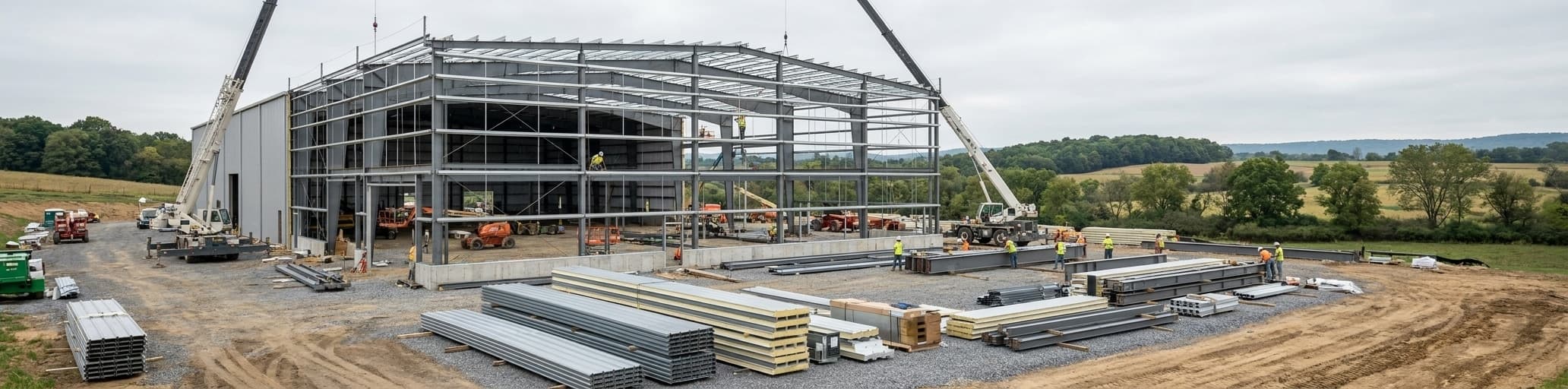

We help you navigate Pennsylvania's county-specific snow loads, permitting requirements, and engineering standards so your steel building passes inspection and stays on budget. A single-source turnkey contract eliminates the vendor handoffs and coordination gaps that routinely push timelines off track and costs up.
Find the Right Pennsylvania Steel Builder: Quick Local Search Tips
Choose a Pennsylvania steel builder with decades of local experience backed by nationwide fabrication resources to navigate snow loads, county permits, and keep your project on budget and timeline.
Leverage NSB's Nationwide Reach with a Pennsylvania Focus
When you search for steel building contractors near me in Pennsylvania, the biggest risk is choosing a builder with local knowledge but no production scale — or national reach with no grasp of Pennsylvania's variable snow load zones and county-level permitting requirements.[3] Builders who have operated across the state for decades understand how structural requirements shift from the higher snow load regions to lower-elevation counties, and they engineer around those variables before a single permit is filed.[3] That local expertise becomes significantly more valuable when backed by nationwide fabrication resources: bulk material procurement keeps your project within budget even when regional steel prices move, and a single-source contract means design, fabrication, and erection all move under one roof without the vendor handoffs that create costly delays.[1] Eliminating separate contractor coordination cuts the communication breakdowns that routinely push timelines off track — your building goes up faster, and you open for business sooner.[2] If you're evaluating options, the NSB contractor vetting guide walks through the specific questions that separate capable builders from ones that cost you time mid-project.
How to Verify Credentials and Local Code Expertise
Pennsylvania's Uniform Construction Code (UCC) applies statewide but is enforced at the municipal level — meaning your contractor's code knowledge must be specific to your county and township, not just the state.[4] Most municipalities require permits for accessory structures over 200 sq ft, and every permitted build requires wet-stamped drawings from a Pennsylvania-licensed professional engineer.[4] The first question to ask any contractor is simple: can you produce PE-stamped drawings with the engineer's active Pennsylvania license number? Ask for it before the conversation goes any further. Verify that the engineer is stamped to the ASCE 7-22/IBC standard and rated for your region's specific wind and snow load values — a builder working from a generic state average instead of your municipality's actual requirements is building you a compliance problem, not a building.[4]
Snow load is where credential gaps cost the most. The Poconos, Allegheny Plateau, and Laurel Highlands routinely see 50-60+ psf ground snow loads, while Erie's lake-effect belt demands additional engineering consideration beyond standard thresholds — and a builder who engineers to a 30 psf minimum in a 90 psf zone creates structural liability.[4] Confirm that the engineering drawings are calibrated to your municipality's specific snow load requirement, not a regional default. On the wind side, look for documented ratings of at least 150 mph under ASCE 7-22/IBC compliance — that's the benchmark that signals the builder is working to current code, not an outdated standard.[4] Understanding how these structural steel components interact with local load requirements is what separates a compliant build from a costly inspection failure.
Some Pennsylvania municipalities have opted out of direct UCC enforcement and contracted with third-party inspection agencies certified by the Pennsylvania Department of Labor and Industry.[5] That doesn't eliminate the need for engineered drawings — it changes who administers the approval process.[5] Cross-reference the PA Department of Labor and Industry's certified third-party agency list to confirm which enforcement path applies to your township, then verify your builder has navigated both routes before.[5] Pennsylvania's IBC Chapter 22 also governs steel identification, connection standards, and corrosion protection requirements that apply regardless of which enforcement path your municipality uses.[6] A builder unfamiliar with these provisions will hit inspection delays that push your timeline and budget off track — exactly the kind of problem that credential verification prevents before it starts.[6]
Why "steel building contractors near me" Leads Directly to NSB's Turnkey Solution
When that search lands you on a turnkey provider, the value is immediate and concrete.
A turnkey solution means one team handles every phase — design, engineering, fabrication, and erection — under a single contract, which cuts out the scheduling gaps and cost overruns that come from managing separate vendors.[7] The design/build model, where one contractor serves as your single point of contact from concept to completion, is a deliberate departure from the traditional approach of hiring separate firms for each phase — and that separation is where projects go sideways.[8] Compliance, permitting, PE-stamped drawings, and on-site construction all stay under one roof, so you don't inherit a subcontractor's mistake two-thirds of the way through your build.[7] The turnkey process from dirt to door means a faster build, tighter budget, and a single phone number when you have a question — which is exactly what "near me" should mean, regardless of where the fabrication facility sits.
Cost Clarity: Pennsylvania Steel Building Pricing Made Transparent
Pennsylvania steel buildings typically run $24-$43 per square foot installed, but snow load zones and custom features can push costs higher before site work begins.
Breakdown of Typical Project Costs (Design, Fabrication, Erection)
The steel shell — primary framing, roofing, and siding — is where your budget starts, not where it ends. A standard pre-engineered metal building package runs $25-$40 per square foot for the kit alone, covering structural steel and cladding but nothing below grade.[11] Rigid-frame commercial buildings move that range to $35-$55/sq ft, and fully finished structures with custom interiors or complex layouts push $60-$100+ per square foot.[10] In Pennsylvania, higher snow load zones push framing specs heavier, which nudges per-square-foot cost toward the top of those bands before you've touched a shovel — that's a variable a generic national quote won't capture.
Foundation and concrete land at $8-$12/sq ft as a separate line item, and professional erection adds $10-$20/sq ft on top of that.[10] Stack those phases together and a turnkey installed price — kit, slab, delivery, and erection — runs $24-$43/sq ft for standard builds.[9] That's where most Pennsylvania agricultural, commercial, and industrial projects land when footprint dimensions are conventional and site conditions are manageable. A line-by-line breakdown of a 30×40 steel building cost shows exactly how design, fabrication, and erection stack for one of the most common footprint sizes.
Three variables consistently push projects above that installed range: clear-span framing with no interior columns (required for hangars, wide-bay warehouses, and arenas), high-R insulation mandated by Pennsylvania energy codes for conditioned spaces, and specialty exterior finishes or custom door and window configurations.[10] Three things keep projects within it: sticking to standard dimensions, flexible delivery scheduling that lets your builder lock in lower freight rates, and a single-source contract that removes the markup layers and scheduling gaps that come from managing design, fabrication, and erection as separate vendor relationships.[11]
Answering Common Cost Questions – 30×40, 20×20, 40×60, 2000 sq ft
The four size questions buyers ask most often have concrete answers.
A 30×40 (1,200 sq ft) kit runs approximately $24,000, using commercial-grade I-beam steel at $15-$20 per square foot.[12] A 20×20 (400 sq ft) falls at the lower end of that same kit range — the right footprint for personal workshops, equipment shelters, or small garages.[12] A 40×60 kit lands around $43,200 for 2,400 sq ft of clear-span space, a footprint that handles commercial shops, warehouses, and prefab aviation hangars with equal ease.[12] A 2,000 sq ft build sits between those two larger footprints and prices within the same kit band proportionally.[12] Installed turnkey cost — kit, concrete slab, delivery, and erection combined — runs $24-$43 per sq ft across all standard footprints, putting the all-in number for a 30×40 between $29,000 and $52,000, and a 40×60 between $58,000 and $104,000.[12] For conditioned spaces requiring insulation, windows, and custom door configurations, the fully finished range moves to $30-$50 per sq ft — a figure that applies at any footprint, from a 400 sq ft 20×20 up to a 2,000 sq ft finished commercial bay.[13]
NSB's Pennsylvania Cost Calculator (Unique Interactive Tool)
Generic online estimators give you a national average and call it a quote. NSB's Pennsylvania Cost Calculator works differently: you input your footprint, intended use, and county, and the tool maps those inputs against current commercial-grade steel pricing to return a phased cost range that accounts for Pennsylvania's snow load variables before you ever speak to a contractor. Standard kit pricing runs $15-$20 per square foot for the steel package, with installed turnkey costs — kit, concrete slab, delivery, and erection combined — landing at $24-$43 per square foot across standard footprints.[14] The calculator applies those benchmarks to your actual dimensions rather than rounding to a national midpoint, which is where most estimators quietly lose accuracy on Pennsylvania projects. For a 30×40 prefab building cost, the output breaks down each cost phase so you can see exactly where your budget is going before you commit to anything.
What the calculator outputs isn't a single blended number — it's a line-by-line range by phase. Concrete foundation cost runs $4-$8 per square foot as a separate line, professional installation adds $3,000-$10,000+ depending on footprint and complexity, and permit and site preparation fees layer on top of that.[14] Size-specific benchmarks inform each estimate: a 30×40 business shop kit lands at $18,000-$28,000, a 40×60 commercial shop at $30,000-$45,000+, and larger footprints scale proportionally.[14] Commercial construction costs in the Eastern US also vary significantly by location, with factors like climate and local jurisdiction requirements driving meaningful differences from state to state — which is exactly why a Pennsylvania-specific input matters more than a regional average.[15] You walk away from the calculator with a realistic planning number, not a figure that surprises you at contract signing.
Performance Benefits of Choosing NSB for Pennsylvania Projects
Steel structures engineered for your Pennsylvania location prevent the frost heave, freeze-thaw damage, and snow load failures that generic specifications miss.
Durability Against Pennsylvania Weather and Code Requirements
Pennsylvania's weather doesn't stay in one lane — Erie's lake-effect belt, the Poconos, and the Allegheny Plateau carry snow loads that routinely exceed what generic national specs account for, while the southeast adds humid summers and storm exposure that accelerates material degradation in wood and light-gauge structures.[16] IBC Chapter 16, enforced through Pennsylvania's UCC, governs every structural variable your building must handle: ground snow loads under Section 1608, wind exposure categories under Section 1609, and load combinations under Section 1605 all require site-specific engineering calibrated to your location — a state average leaves structural gaps that show up at inspection or, worse, under load.[17] Rigid-frame structural steel addresses these demands directly: steel doesn't rot, warp under freeze-thaw cycling, or lose load capacity after years of Pennsylvania winters the way wood framing does, and a properly engineered rigid frame carries heavy snow without the cumulative fatigue that compromises other materials over time.[16] Pennsylvania's frost line also ranges from 36 inches in the south to 48+ inches in the north, so foundation footings must be designed to that exact depth to prevent frost heave — a county-specific detail that only appears in drawings engineered for your site, not pulled from a regional default.[16] For agricultural and commercial operators comparing materials against Pennsylvania's four-season climate, the steel barn vs. wood barn durability comparison makes the structural case concrete before you commit to a material.
Single‑Source Turnkey Process Saves Time and Reduces Risk
The risk math is concrete: projects coordinated across separate design, procurement, and construction vendors experience 20-50% cost overruns at significantly higher rates than those delivered under a single-contract model, while properly structured single-source delivery achieves on-time completion rates above 90%.[19] Under a turnkey arrangement, your contractor absorbs 80-90% of cost and schedule risk — when steel prices shift mid-project or an inspection requires rework, that exposure stays with your builder, not your contingency budget.[19] Fewer communication lines between a smaller set of suppliers removes the coordination gaps where timelines actually slip: every question has one destination, every schedule conflict has one owner, and every permit hurdle gets resolved by the same team that's already building your structure.[18] Fast-tracking — overlapping design and construction phases rather than running them sequentially — compresses timelines by 10-25% compared to the traditional hand-off model, a direct advantage when your warehouse, hangar, or agricultural facility needs to be operational on a fixed date.[19] For Pennsylvania builds specifically, where county-level permitting and snow-load engineering must be locked before a single footing is poured, that coordination advantage compounds: one team already calibrated to your municipality's requirements doesn't restart the compliance clock every time a subcontractor change introduces a new variable.[18] Understanding how prefab kit delivery timelines sequence from engineering through fabrication shows exactly where delays enter a project — and why they disappear under a single-source model.
Custom Engineering Options Tailored to Agricultural, Commercial, or Aviation Needs
The engineering requirements for a Pennsylvania poultry barn, a crane-equipped manufacturing bay, and an aircraft hangar have almost nothing in common — and a builder who treats all three from the same standard kit catalog will underdeliver on at least one of them.
Pennsylvania's agricultural sector produces everything from dairy and poultry to fruit crops and Christmas trees, meaning farm buildings must be engineered around specific clear-span widths, ventilation loads, and interior configurations that vary by operation.[21] Steel agricultural structures can be engineered to handle up to 350 lb snow load capacity while preserving the unobstructed interior space that lets livestock, equipment, and stored product move freely without column interruptions.[21] Commercial and industrial builds introduce a different set of demands: manufacturing facilities that require overhead bridge cranes need structures engineered for high load-bearing capacity, clear-span framing, tall vertical clearance, and internal bracing reinforcements that aren't standard on off-the-shelf packages.[21] Custom engineering also covers the full range between those poles — from soundproofed enclosures for generator installations to warehouses with integrated crane systems and mezzanine levels, all built on the same rigid-frame platform.[20] Aviation adds another layer: airplane hangars appear as a distinct building type precisely because door opening dimensions, eave heights, and floor provisions must be spec'd to aircraft requirements, not adapted from a commercial template.[20] For owners who need a metal airplane hangar alongside an equipment storage bay and a conditioned office wing, a builder equipped to deliver all three under one engineering team keeps your project on a single timeline and within budget — instead of splitting accountability across vendors who each own only part of the problem.[22]
Decision Checklist: Confirming NSB Is the Best Fit for Your Pennsylvania Build
Verify your builder uses pre-engineered I-beam steel, 26-gauge panels, fixed-price contracts, and can document crew safety records and financial stability before signing.
Printable "Pennsylvania Steel Builder Vetting Checklist" (Unique NSB Resource)
Before any Pennsylvania steel builder makes your shortlist, run them through this checklist — it's designed to surface the gaps that don't show up in a sales call but cost you time and money mid-project.
Start with the building system itself: confirm the builder uses pre-engineered commercial-grade I-beam steel, not arch (Quonset-style), web truss, weld-up, or light-gauge cold-formed systems — the latter four require significantly more on-site labor and introduce structural tolerances that pre-engineered systems eliminate at the factory.[24] Ask for the panel gauge in writing; 26-gauge PBR panels are the commercial standard, and any builder quoting 28- or 29-gauge wall and roof panels is cutting a corner that affects weatherproofing and long-term durability.[24] On the safety side, request the crew's Experience Modification Rate (EMR) — a number below 1.0 signals a better-than-average safety record, and anything above 1.0 is a concrete red flag about how the crew operates on-site.[23] Next, press on the contract structure: for a standard pre-engineered footprint, a fixed-price contract is the industry norm, and a builder pushing a cost-plus arrangement on a straightforward kit is transferring budget risk to you without justification.[23] Verify financial stability — a contractor who can't provide proof of financial health may not complete your project — and ask specifically how subcontractors are vetted, who holds the project manager role, and what their documented experience with that role looks like.[25] The warranty question has two parts: what the workmanship warranty covers (leaks, panel alignment, fastener integrity) and for how long — a builder who hedges on either answer is telling you something important before the first bolt is tightened.[23] Finally, ask for references from projects similar to yours in scope and use type, cross-reference their BBB rating, and confirm the communication protocol: how updates are delivered, who owns a change order, and what the process is if an inspection requires rework.[24][25] Owners building agricultural facilities can also reference the full-service agricultural building contractor checklist for use-specific vetting criteria that stack directly on top of this general framework.
Comparing NSB's Value vs. Generic Local Contractors
Next Steps – From Quote Request to Groundbreaking with ProTrades Moving from a quote request to breaking ground follows a repeatable six-phase sequence that removes the uncertainty most owners dread. You submit your site details, footprint, intended use, and county–information that locks your engineering variables before anyone picks up a shovel.
From there, the design phase produces PE-stamped drawings calibrated to your municipality's specific snow and wind load requirements, which feed directly into permit submission without the vendor handoffs that restart compliance timelines. Structured scheduling at this stage matters more than most owners expect: when every task is mapped with a defined baseline–including which activities must finish before others can start and which can run in parallel–projects achieve a 30% higher on-time completion rate than those managed without a formal schedule.[29] Risk analysis at the planning stage goes further, identifying which county-level approval steps or material lead times carry the highest probability of delay and quantifying their potential cost and schedule impact before they become real problems.[29] Once permits clear, fabrication runs against a fixed delivery window tied directly to your site readiness–steel arrives when your foundation is ready, not before or after.
The final mile from delivery to groundbreaking moves through NSB's ProTrades network, which coordinates erection crews, material staging, and inspection scheduling under the same single-source contract that governed every prior phase–no new vendors, no restarted compliance clock, no finger-pointing when a revision comes back from the inspector. You get the same team that engineered your building showing up to put it up, within budget and on schedule, every step of the way.
- Pennsylvania's variable snow loads (30-90+ psf) and county-level permitting require site-specific PE-stamped engineering, not state averages.
- Turnkey single-source contracts eliminate vendor handoffs, reducing cost overruns by 20-50% and achieving 90%+ on-time completion rates.
- Pre-engineered commercial-grade I-beam steel outperforms wood and light-gauge systems under Pennsylvania's freeze-thaw cycles and frost-line variations.
- Fixed-price contracts on standard footprints transfer budget risk to the builder; cost-plus arrangements on straightforward kits signal unnecessary risk transfer to you.
- Verify contractor credentials: PE-stamped drawings with active license, ASCE 7-22/IBC compliance, 150+ mph wind rating, and documented safety records (EMR below 1.0).
- Custom engineering for agricultural, commercial, and aviation builds prevents underdelivery; one team handling all three keeps accountability unified and timelines compressed.
- https://cdmg.com/metal-building/falls-pa
- https://pressadvantage.com/story/41729-pennsylvania-metal-building-company-cdmg-is-a-global-leader-in-pre-engineered-metal-buildings-industr
- https://simpsonsteel.com/pennsylvania-steel-buildings/
- https://keensbuildings.com/metal-buildings-pennsylvania/?srsltid=AfmBOootJRG3Coc0Yp0gQ0aSb1O300d1e-AqxSpHs6pXKCAIBQ9pNo6w
- https://www.pa.gov/agencies/dli/programs-services/labor-management-relations/bureau-of-occupational-and-industrial-safety/tpa-buildings
- https://up.codes/viewer/pennsylvania/ibc-2018/chapter/22/steel
- https://redironbuildings.net/turnkey-red-iron-buildings/
- https://www.acibuildings.com/what-we-do/design-build/
- https://www.buildingsguide.com/metal-building-prices/?srsltid=AfmBOoromfWEsbIb-vquMZDgltBUWGDeOd2X_hLj0JgvBXXzXh9wqIf9
- https://titansteelstructures.com/price-guides/the-2026-steel-building-price-guide-what-to-expect-this-year/
- https://builtmammoth.com/how-much-does-a-steel-building-cost/
- https://www.buildingsguide.com/metal-building-prices/?srsltid=AfmBOoohEbOu1w1vJTuI6aGkPHfIXi9EOTAGORFEHl8645oyBLXqqKYb
- https://www.metal-buildings.org/
- https://www.buildingsguide.com/metal-building-prices/?srsltid=AfmBOook4DtzlHXp-IAzgdTvihY1E-ps8NSHJNnXhggtSdV0uju8pA_j
- https://www.autodesk.com/blogs/construction/commercial-construction-cost-per-square-foot/
- https://iconsteelbuildings.com/pennsylvania-steel-buildings/
- https://up.codes/viewer/pennsylvania/ibc-2018/chapter/16/structural-design
- https://www.summitsteelbuildings.com/the-general-contractor-role-in-steel-building-projects
- https://www.plcconstruction.com/epc-vs-design-build-whats-right-for-industrial-projects/
- https://ironbuiltbuildings.com/steel-buildings-pennsylvania-2/
- https://titansteelstructures.com/coverage-areas/metal-buildings-pennsylvania/
- https://stevensec.com/pre-engineered-metal-building-company/allentown-pa
- https://iconsteelbuildings.com/steel-building-installers/
- https://www.rhinobldg.com/blog/vetting-a-metal-building-company
- https://www.jbsteelconstruction.com/blog/what-to-look-for-when-hiring-a-metal-building-contractor
- https://westernsteel.com/how-to-choose-steel-building-contractors-in-your-area/
- https://www.buildingsguide.com/build/advantages-of-pre-engineered-steel-buildings/?srsltid=AfmBOopVBdP8OplulFmTvppYCPDfYp4DuhtQlixLldbLksRaLa-ISBAw
- https://www.hcsteelstructure.com/pros-cons-prefabricated-steel-buildings-vs-traditional-construction/
- https://cost4estimating.com/primavera-scheduling-services/